Disclosure: We may earn a commission when you buy through links on this page, at no extra cost to you. We buy nothing, sell nothing and accept no payment for coverage — commissions never decide what we recommend. How we make money.

Outdoor accessories can make a walker or rollator easier to use in rain, dust, low light, and cold weather, but they should never interfere with brakes, hand grips, wheels, or folding parts. Start with the problem you want to solve: keeping the frame dry, making yourself visible from farther away, protecting your hands, or securing personal items without changing how the mobility aid handles.
Walkers and rollators call for slightly different accessory choices. A standard or two-wheel walker has fewer moving parts, while a rollator has hand brakes, brake cables, wheels, and often a seat that must stay clear and easy to operate.
Walkers vs. rollators outdoors: the accessory needs are different
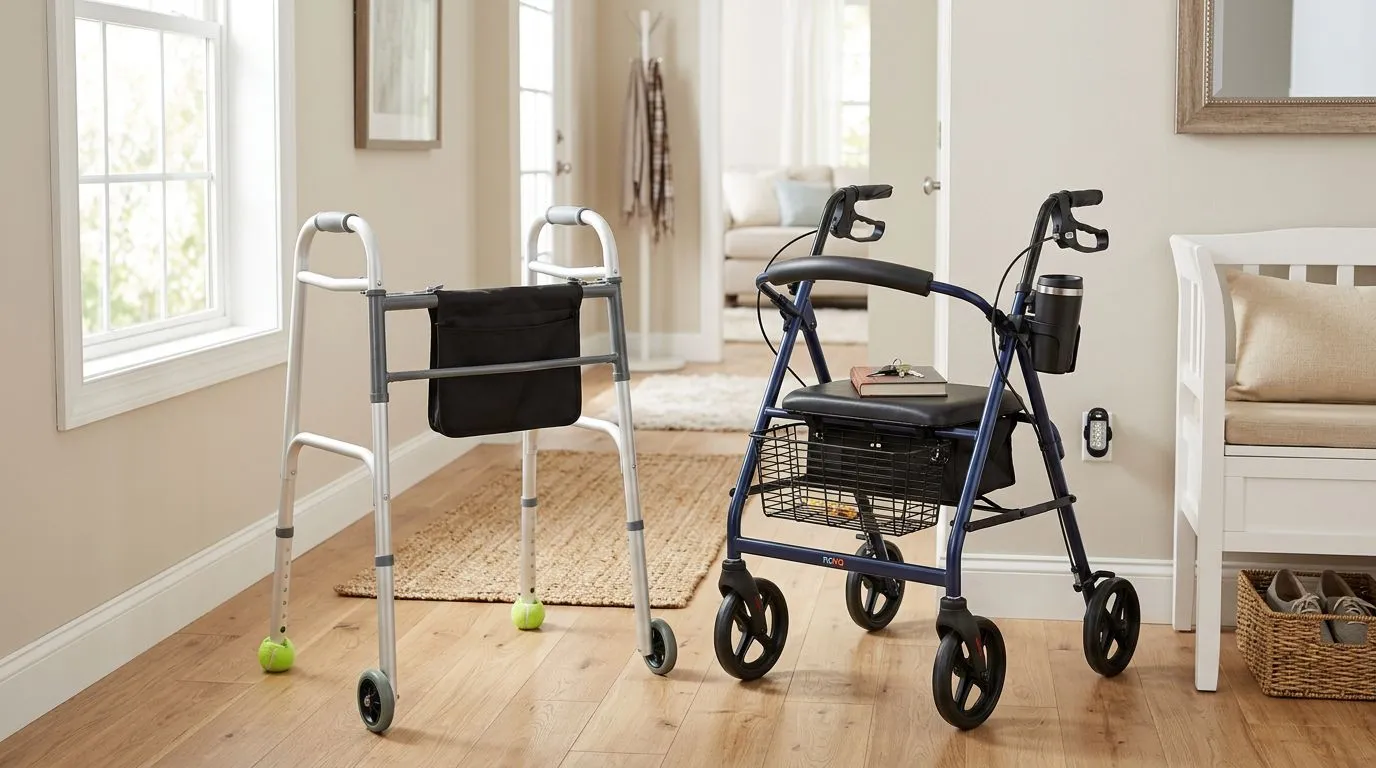
A walker and a rollator may look similar at first glance, but their outdoor accessory needs are not the same. A standard walker usually has 4 legs and no wheels. A two-wheel walker has 2 front wheels and 2 rear glide tips or legs. A rollator has 3 or 4 wheels, hand brakes, and usually a built-in seat and storage pouch or basket.
That difference matters when you add covers, lights, reflectors, or gloves. On a no-wheel walker, the main concerns are grip, frame protection, and keeping rubber tips dry and stable. On a rollator, you also need to protect brake function, avoid snagging cables, keep the seat usable, and make sure any added item does not swing into the wheels.
| Mobility aid type | Common outdoor concerns | Accessories that often help |
|---|---|---|
| Standard walker, no wheels | Wet rubber tips, slick hand grips, lifting effort | Grip covers, weather-resistant hand protection, reflective tape |
| Two-wheel walker | Front-wheel splash, rear tip traction, curb transitions | Small frame cover, front reflectors, non-slip gloves |
| 3-wheel rollator | Narrow turning space, front visibility, brake access | Compact lights, reflective strips, fitted handle gloves |
| 4-wheel rollator | Seat getting wet, brake cables, storage bag exposure | Seat cover, rain cover, front and rear lights, glove-friendly brakes |
| Upright or stand-up rollator | Tall frame visibility, forearm pad exposure, larger folded size | Tall-frame reflective tape, pad covers, bright front lighting |
| Bariatric rollator | Wider frame, heavier build, larger seat and wheels | Wider covers, high-output reflectors, sturdy attachment straps |
If you are deciding between a walker and a rollator for outdoor use, accessories should not make the decision by themselves. Choose the mobility aid that fits your balance, strength, and medical guidance first. Then add weather and visibility accessories that support safe use.
Rain, dust, and storage covers for frames, seats, and bags
Weather covers address 3 common problems: rain on the frame, dust during storage, and wet seats or storage pouches on rollators. A cover can be as simple as a small water-resistant seat cover or as large as a full-length storage cover that slips over the entire folded walker or rollator.
For walkers, a frame cover is usually most useful when the device is stored on a porch, in a garage, or in the trunk of a car. Standard walkers often fold to a relatively slim profile, sometimes under 8 inches thick when folded, so a basic dust cover may be enough. Two-wheel walkers may need a little more room at the front because the wheels protrude beyond the frame.
Rollators need more targeted protection. A wet rollator seat can be uncomfortable and slippery, while a soaked under-seat pouch may damage personal items. A seat cover or pouch cover can be practical for short errands, but it should not block access to the brake handles or prevent the seat from locking into position if your rollator uses a locking seat design.
Water-resistant vs. waterproof
Water-resistant fabric can handle light rain or splashes for a short time, such as a 10-minute walk from a parking lot to a clinic. Waterproof or highly water-repellent covers are better for longer exposure, outdoor storage, or frequent rainy conditions. Even then, seams, zippers, and drawcord openings can let moisture in.
Look for covers that fit snugly without needing to be tied around brake cables, folding joints, or wheel forks. Loose fabric can flap in wind, touch a wheel, or catch on a door threshold. If a cover hangs below the seat or basket, check that it stays at least 2 inches above the wheels during normal walking.
Where covers help most
- Seat protection: useful for 4-wheel rollators used outdoors, especially after rain.
- Storage pouch protection: practical when carrying a phone, wallet, mail, or medication list.
- Full-frame storage: a good option for a folded walker or rollator kept in a garage, entryway, or vehicle.
- Handle protection: useful in cold or wet weather, but only if grip and brake control remain secure.
Avoid using large plastic bags as improvised covers while walking. They can tear, slide, collect water, or create a tripping hazard if they hang near the wheels or tips.
Visibility aids: lights, reflectors, and high-contrast markings
Low visibility is not only a nighttime issue. Cloudy afternoons, shaded sidewalks, parking lots, and early winter evenings can make a walker or rollator harder for drivers, cyclists, and other pedestrians to notice. Many safety organizations use 500 feet as a common visibility benchmark for reflective or illuminated gear, but real-world visibility depends on weather, angle, battery strength, and where the accessory is placed.
For a walker, the best visibility points are often the front crossbar, side legs, and outer edges of the frame. For a rollator, use both front and rear visibility aids because the device may be seen from multiple angles in a parking lot or crosswalk. A white light at the front and a red light or red reflector at the rear follow the same basic direction cues used on bicycles and vehicles.
| Visibility accessory | Best use | Walker considerations | Rollator considerations |
|---|---|---|---|
| Clip-on light | Dusk, night, indoor hallways, parking lots | Attach to front crossbar or side frame | Keep away from brake cables and folding hinges |
| Reflective tape | Passive visibility when light shines on it | Works well on straight frame sections | Place on front, sides, and rear if space allows |
| High-contrast bands | Daytime visibility and easier device identification | Helpful on silver or dark frames | Useful around storage areas and handles |
| Wheel reflectors | Side visibility when crossing paths or lots | Only applies to wheeled walkers | Works best on larger 8-inch or 10-inch wheels |
Placement matters. A light mounted too low may be hidden by a curb or car bumper. A light mounted too high on a rollator handle can glare into your eyes or distract from brake control. When possible, place forward-facing lights between knee and waist height, then add side reflectors lower on the frame.
Check batteries on a schedule. If you walk outdoors 3 times a week, a weekly battery check is simple and realistic. Rechargeable lights should be charged before they are fully dead because a dim light may create a false sense of visibility.
Gloves and hand protection for cold, wet, or sore hands
Hands do a lot of work on walkers and rollators. They guide the frame, bear some weight, grip handles, and, on rollators, operate the brakes. When temperatures drop below about 50 degrees Fahrenheit, cold fingers can become slower and less precise, especially for people with arthritis, reduced circulation, or hand weakness.
For standard walkers and two-wheel walkers, gloves should improve grip without adding too much bulk. Thick mittens may feel warm, but they can make it harder to hold the handle securely. A glove with a textured palm can help on smooth plastic or foam grips, especially in rain.
For rollators, brake control comes first. You should be able to wrap your fingers around the hand grip and squeeze the brake lever fully while wearing gloves. Before taking a rollator outside, test both brakes indoors at least 5 times with the gloves on. The lever should move smoothly, and your fingers should not slide off the brake handle.
Good glove features for walker and rollator users
- Non-slip palm: rubberized or textured material helps maintain contact with the grip.
- Low-bulk fingers: easier for rollator brake levers and walker hand placement.
- Warm but flexible fabric: better than stiff winter gloves that limit finger bend.
- Secure wrist closure: helps keep rain and cold air out without dangling straps.
- Easy on and off: important if hand strength is limited.
Some users also add padded grip covers to reduce pressure on the palms. That can help, but it changes the handle diameter. If a grip cover makes the handle more than about 1 inch larger around, it may reduce control for smaller hands. Test indoors first.
Brake, grip, and wheel safety after adding accessories
Any accessory can create a safety issue if it changes how the walker or rollator functions. A cover that looks harmless can interfere with a folding latch. A light strap can rub a brake cable. A storage cover can hang near a wheel. Take 60 seconds to check the device after every new accessory is installed.
Rollators need special attention because hand brakes are central to safe use. Most rollator brakes are cable-operated loop brakes. The brake lever should squeeze easily, stop the wheels when engaged, and lock securely for sitting if the rollator has a parking brake function. Do not attach pouches, lights, or decorative items to the brake cable unless the accessory is specifically designed to mount there without pulling on it.
Walkers have fewer mechanical parts, but their tips and glides matter. Wet rubber tips can slip on smooth tile or painted concrete. If you use a standard walker outside and then come indoors, wipe the tips before walking across a slick floor. Replace worn tips when the tread pattern is smooth or uneven.
A simple 6-point safety check
- Confirm both hands can reach the grips without stretching.
- On rollators, squeeze each brake lever 3 times and lock the parking brakes once.
- Make sure covers, straps, and cords stay at least 2 inches from wheels.
- Check that folding buttons, latches, or crossbars still move freely.
- Look for loose reflective tape edges that could peel or snag.
- Walk 10 to 15 steps indoors before using the device outside.
If an accessory changes your posture, balance, or braking, remove it. Comfort and convenience matter only when the basic mobility aid still works as intended.
How to choose and measure accessories before buying
Measuring first prevents most fit problems. Many walkers are about 17 to 20 inches wide inside the handles, while rollators are often wider overall, commonly around 23 to 30 inches depending on frame type and weight capacity. Bariatric rollators may be wider and may need larger covers or longer attachment straps.
Use a soft tape measure and write down the numbers before shopping for generic accessories. Measure the device as you actually use it, not only when folded. If you use a bag, cane holder, oxygen holder, or tray, include those items in your clearance check.
Key measurements to take
- Overall width: measure the widest point from outside edge to outside edge.
- Handle height: measure from the floor to the top of the grip.
- Seat size: for rollators, measure width and depth of the seat.
- Wheel diameter: common rollator wheel sizes include 6, 8, and 10 inches.
- Folded size: important for full covers and car storage.
- Grip circumference: useful when adding padded covers or winter hand protection.
| Problem | Accessory to consider | Measurement to check | Safety note |
|---|---|---|---|
| Rain on seat or pouch | Seat cover or pouch cover | Seat width and depth | Must not block seat latch or brake cables |
| Dust during storage | Full-frame cover | Overall height, width, and folded depth | Remove before walking unless designed for active use |
| Low-light walking | Lights and reflectors | Tube diameter and mounting space | Avoid glare and loose straps |
| Cold or wet hands | Gloves or grip covers | Grip size and brake reach | Test braking or grip control indoors |
| Dirty wheels or tips | Wipe-down cloth or storage mat | Wheel size or tip width | Clean before entering slick indoor floors |
Weight capacity is another clue. A walker or rollator rated for 300 pounds may have different frame dimensions than one rated for 400 pounds or more. Do not assume a universal cover will fit every frame, especially upright and bariatric rollators.
Who these accessories are best for in everyday situations
Outdoor accessories are most useful for people who use a walker or rollator beyond short indoor trips. If you walk to a mailbox 5 days a week, cross a parking lot for appointments, wait outside for transportation, or store your mobility aid near an exterior door, weather and visibility accessories can solve real problems.
For occasional outdoor use, start small. A reflective strip set and a pair of grippy gloves may be enough. For daily rollator users, a more complete setup may include a seat cover, pouch cover, front light, rear reflector, and glove system that still allows full brake control.
| User situation | Best accessory focus | Why it helps |
|---|---|---|
| Short daytime walks on dry sidewalks | Reflective tape and comfortable gloves | Simple visibility and better grip without bulk |
| Early morning or evening errands | Front light, rear reflector, side markings | Improves visibility from multiple directions |
| Frequent rain exposure | Water-resistant seat, pouch, or frame cover | Keeps contact points and belongings drier |
| Cold-weather rollator use | Flexible insulated gloves | Protects hands while preserving brake control |
| Garage or porch storage | Full dust and weather cover | Reduces dust, moisture, and debris on the frame |
| Upright or bariatric rollator use | Wider, taller visibility and cover options | Better fit for larger frames and higher handles |
These accessories are not a substitute for choosing the right mobility aid. A person who needs maximum stability may do better with a standard walker than a rollator, even if the rollator has better lighting options. A person who needs a seat for rest breaks may need a properly fitted 4-wheel rollator rather than a folding walker with add-ons.
Care, cleaning, and replacement timing
Accessories work best when they are clean, dry, and secure. After rain, remove wet covers when you get home and let them dry fully, ideally within 24 hours, before storing them in a pouch or closet. Trapped moisture can lead to odor, mildew, or corrosion on metal parts over time.
Reflective surfaces lose effectiveness when covered by dust or road grime. Wipe reflectors and lights at least once a month, or more often if you walk near wet streets, gravel, or salted winter sidewalks. Check tape edges for peeling and replace strips that no longer stay flat against the frame.
Gloves need attention too. If the palm becomes smooth, cracked, or slippery, it no longer provides the same control. For rollator users, worn glove palms can affect braking because the hand may slide during a firm squeeze. Keep a backup pair if you depend on gloves for daily outdoor trips.
Finally, recheck every accessory after folding and unfolding the mobility aid. Folding walkers and rollators move at hinges and crossbars, and repeated motion can loosen straps or shift covers. A 30-second check before leaving home is easier than fixing a loose light in a parking lot.
Bottom line: solve the outdoor problem without changing safe use
The best walker or rollator accessories solve a specific outdoor problem while preserving safe, familiar operation. Covers should protect without dragging. Lights and reflectors should improve visibility without creating glare or loose straps. Gloves should keep hands warm while allowing a secure grip and, for rollators, full brake control.
Start with the essentials: measure your frame, choose accessories that fit your walker or rollator type, and test everything indoors for at least 10 to 15 steps. If the accessory makes the mobility aid harder to steer, lift, brake, fold, or sit on, it is not the right fit.
FAQ
Frequently asked questions
Can I use the same rain cover for a walker and a rollator? +
Sometimes, but fit matters. A standard walker may need only a simple frame or storage cover, while a rollator often needs clearance for the seat, wheels, hand brakes, and brake cables. Measure the overall width, height, folded size, and seat area before choosing a cover.
Where should I put lights on a walker or rollator? +
Place a white light toward the front where it can be seen without shining into your eyes. On a rollator, keep lights and straps away from brake cables, folding joints, and wheels. Rear reflectors or red lights can also help others see you from behind.
Are gloves safe to wear with rollator brakes? +
Gloves can be safe if they are flexible and not too bulky. Test them indoors by squeezing and locking both brakes several times. If your fingers slip, cannot fully reach the brake levers, or feel clumsy, choose thinner gloves with better grip.
Do reflectors work in daylight? +
Reflectors are most effective when light shines on them, such as from headlights or bike lights. For daytime visibility, high-contrast tape, bright bands, or colored frame markers may be more noticeable, especially in parking lots or shaded sidewalks.
Can accessories affect walker or rollator safety? +
Yes. Covers, straps, lights, and bags can become hazards if they block brakes, rub cables, interfere with folding, or hang near wheels or walker tips. After adding any accessory, do a short indoor test walk and check that all parts move normally.
Keep reading
Related guides

Walker Covers, Lights, and Reflective Accessories: Protect Your Walker and Improve Visibility
14 min read
Walker and Rollator Accessories Guide: Bags, Trays, Cup Holders, Lights, and Comfort Add-Ons
14 min read
Mobility Walker Accessories and Replacement Parts: Bags, Baskets, Glides, Grips, and Brakes
16 min read