Disclosure: We may earn a commission when you buy through links on this page, at no extra cost to you. We buy nothing, sell nothing and accept no payment for coverage — commissions never decide what we recommend. How we make money.
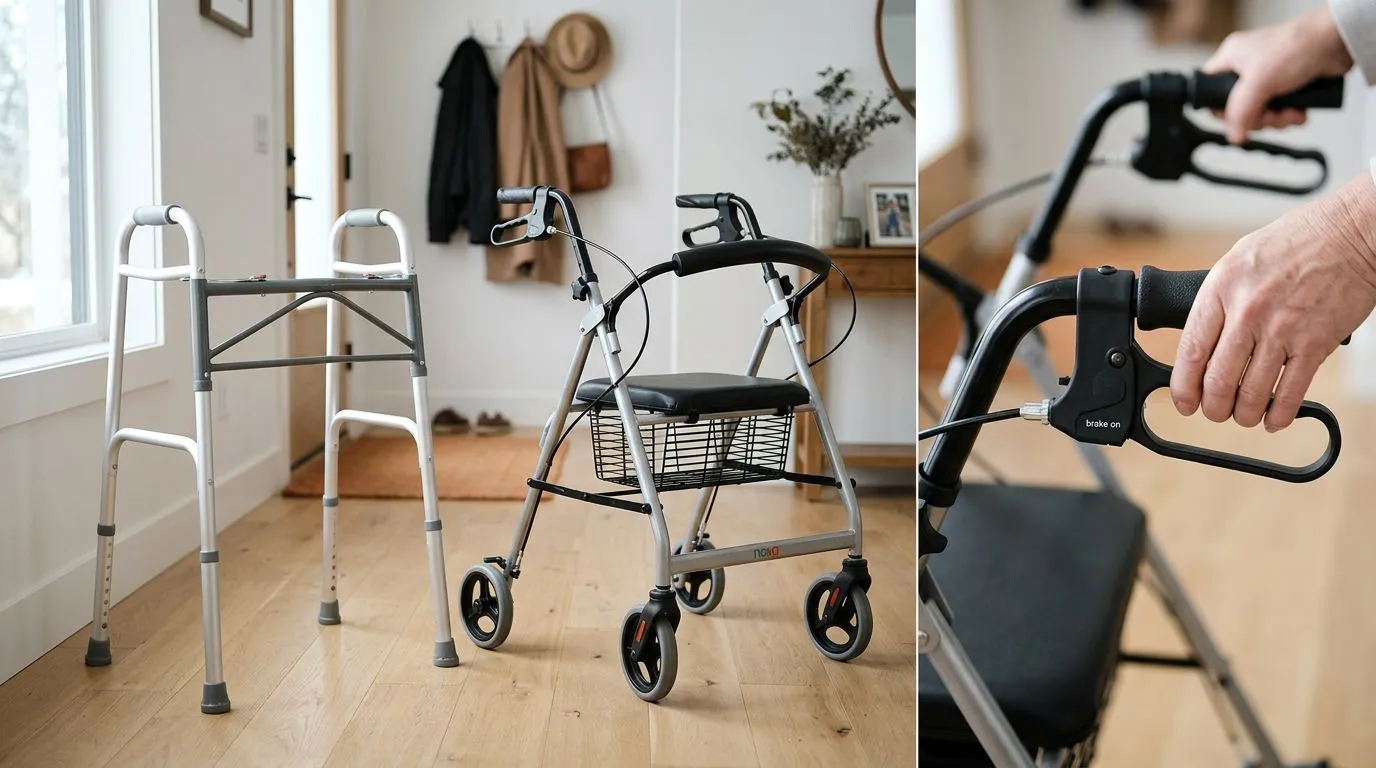
Hand brakes are the most common braking system on rollators because they let users slow down, stop, and lock the wheels before sitting. Push-down brakes may help some people with limited finger strength, while no-brake designs are usually found on standard walkers and two-wheel walkers that rely on rubber tips and friction instead of rolling speed.
The right choice depends on the device, because walkers and rollators are not the same. A walker is usually a frame with no seat and either 0 or 2 front wheels; a rollator is a wheeled walker, commonly with 3 or 4 wheels, hand-controlled brakes, and often a built-in seat.
The 3 braking setups: hand brakes, push-down brakes, and no brakes
Most shoppers are comparing 3 brake setups: hand brakes, push-down brakes, and no brakes. The first 2 are mainly rollator options. The third is common on standard walkers and some two-wheel walkers, where the back legs have rubber tips or glide caps that create resistance.
This distinction matters because a 4-wheel rollator can keep moving if the brakes are not used, especially on a ramp, driveway, or smooth indoor floor. A standard no-wheel walker moves only when the user lifts it and places it forward, so it does not need the same type of wheel brake.
| Brake setup | Common device type | How it works | Best fit |
|---|---|---|---|
| Hand brakes | 3-wheel and 4-wheel rollators, upright rollators, many bariatric rollators | User squeezes levers to slow, then pushes or flips to lock | People with enough grip and hand coordination to control 2 levers |
| Push-down brakes | Some 4-wheel rollators | User presses downward on the handles to engage braking pads or mechanisms | People who struggle to squeeze levers but can safely apply downward pressure |
| No brakes | Standard walkers, folding walkers, many two-wheel walkers | Rubber tips, rear legs, or frame contact resist movement | People who need maximum stability and move at a slower step-by-step pace |
A simple rule helps: if the device has 4 rolling wheels and a seat, brakes are a core safety feature, not a luxury. If the device is a standard walker frame with 0 wheels, having no hand brake is normal.
Hand brakes on rollators: common on 3-wheel and 4-wheel designs
Hand brakes, sometimes called loop-lock brakes, are standard on most rollators with 3 or 4 wheels. The user squeezes the brake levers to slow the wheels while walking. To park the rollator or sit on the seat, the user locks the brakes according to the device instructions, often by pushing the levers down until they click.
This setup feels familiar to many people because it works somewhat like bicycle brakes, although rollator brakes are designed for walking speeds, not cycling speeds. When adjusted correctly, it offers good control on indoor floors, sidewalks, clinic hallways, and parking lots.
Who hand brakes are best for
- Users who can close each hand around a lever and release it reliably.
- People who walk at a moderate pace and need the ability to slow down gradually.
- Rollator users who plan to sit on the built-in seat and need a parking lock.
- People using a 3-wheel rollator who need steering control in tighter spaces.
- Users who can remember a 2-step routine: lock brakes before sitting, unlock before walking.
Hand brakes do require hand strength and coordination. A practical at-home check is whether the person can squeeze a lever-like handle, hold that squeeze for 3 to 5 seconds, and repeat it several times without pain, numbness, or delayed release. This is not a medical test, but it is a useful screening question before trying a rollator.
Hand brakes also have more parts than a standard walker: levers, cables, springs, brake pads, and adjustment points. That is not a problem for many users, but it does make maintenance important. Loose cables, worn pads, or brakes that do not lock firmly should be fixed before the rollator is used for walking or sitting.
Push-down brakes: less finger squeeze, more downward pressure
Push-down brakes engage when the user presses downward on the rollator handles. Instead of squeezing 2 hand levers, the user applies body weight or arm pressure into the frame. This can help someone with arthritis, reduced finger strength, or limited dexterity, provided they can safely control the downward motion.
The tradeoff is the control style. Hand brakes can be feathered, meaning the user can apply light or firm braking while the rollator is still moving. Push-down brakes may feel more like an on-off resistance system, depending on the design. Some users like that simplicity; others find it harder to slow smoothly on a slope.
Who push-down brakes are best for
- People who cannot comfortably squeeze 2 brake levers.
- Users with painful fingers but enough arm strength to press down through the handles.
- People who walk mostly indoors or on level outdoor surfaces.
- Users who can keep both hands on the handles while stopping.
Push-down brakes are not automatically safer for every person with weak hands. If the user is very light, has poor upper-body control, or tends to lean heavily and unpredictably on the frame, the brakes may feel awkward. A person who relies on the rollator for major weight support may also need a clinical fit check, because rollators are meant for balance and mobility support, not full body-weight bearing in the same way some walkers are used.
Maintenance is still part of ownership. Push-down systems may have fewer cable adjustments than hand brakes, but brake pads, rear wheels, springs, and contact points can still wear. Test the brakes on a flat surface before each outing and check them more carefully at least once a month.
No brakes: normal for 0-wheel and 2-wheel walkers, risky for rollators
No brakes can be perfectly appropriate on a standard walker. A no-wheel walker has 4 legs with rubber tips, and the user moves it by lifting or partially lifting the frame, setting it down, and stepping into it. Because it does not roll freely, a hand brake would not usually add value.
Two-wheel walkers work differently. They typically have 2 front wheels and 2 rear legs with rubber tips or glide caps. The front wheels help the walker move forward without a full lift, while the rear contact points add friction. Many folding walkers in the United States use this 2-wheel layout, often with 5-inch front wheels.
No-brake walkers are often best for people who need a very stable frame, walk slowly, and do not need a built-in seat. They can be a better match than a rollator when balance is poor, when the user has trouble managing levers, or when a clinician has recommended a step-by-step gait pattern.
The caution is clear: a 3-wheel or 4-wheel rollator without a reliable braking system is not the same as a no-brake walker. A rollator rolls continuously. If it also has a seat, the brakes must hold the frame still before the user sits or stands. Without dependable brakes, sitting can become unsafe.
Brake type comparison: 7 features that affect daily use
The best brake type is the one the user can operate correctly 10 times out of 10, including when tired, distracted, or standing near a curb. The table below compares everyday features rather than brands or model names.
| Feature | Hand brakes | Push-down brakes | No brakes on walkers |
|---|---|---|---|
| Primary device | Rollators with 3 or 4 wheels | Some 4-wheel rollators | Standard and two-wheel walkers |
| Hand strength needed | Moderate grip and finger control | Less finger squeeze, more arm pressure | Minimal brake-specific hand strength |
| Ability to slow while moving | Good when adjusted properly | Varies by design and user control | Walker speed is controlled by lifting, placing, and friction |
| Parking before sitting | Brake lock is typically required | Brake engagement is required before sitting if a seat is present | Usually no seat, so not applicable |
| Maintenance | Cables, levers, pads, wheel contact | Pads, springs, rear braking contact | Rubber tips, frame bolts, wheels if present |
| Best terrain | Indoor floors, sidewalks, level outdoor routes | Mostly level indoor and outdoor surfaces | Indoor floors and short, controlled routes |
| Main risk | Weak grip or unlocked brakes before sitting | Not enough downward pressure or poor modulation | Lifting difficulty, worn tips, or catching on thresholds |
For many users, hand brakes provide the most versatile rollator control. For others, especially those with hand pain, push-down brakes may be worth trying in person. For someone who needs the frame to stay planted and move only in short steps, a standard walker may be the safer category.
Who each option is best for: 5 common user profiles
Real life is not just a feature list. Two people of the same age and height may need different brake systems because one has strong hands and the other has painful thumbs, or because one walks outdoors daily while the other moves mostly from bedroom to kitchen.
1. The user with good grip who wants a seat
A 4-wheel rollator with hand brakes is often the most practical option for someone who can squeeze, lock, and release both levers. The seat is useful for rest breaks, but it should only be used after the brakes are fully locked and the rollator is on a level surface.
2. The user with arthritis or weak fingers
Push-down brakes may reduce the need for finger squeezing. Still, the person should test whether pressing down feels controlled and comfortable. If hand pain also affects steering or holding the handles, a mobility professional may need to evaluate the broader fit.
3. The user with poor balance or very slow gait
A standard walker or two-wheel walker may be a better match than a rollator. With 4 legs or 2 rear tips in contact with the floor, the device encourages a slower pattern and may feel more stable during each step.
4. The user who walks outdoors on sidewalks
Hand brakes are usually the most adaptable rollator brake type for outdoor walking, especially when the route includes curb cuts, slight slopes, or uneven pavement. Larger wheels, often in the 8-inch to 10-inch range, may also help outdoors, though wheel size does not replace safe braking.
5. The larger-bodied user needing a higher weight capacity
Bariatric walkers and bariatric rollators commonly have reinforced frames and higher listed weight capacities, often above the 250 to 300 lb range seen on many standard mobility aids. Brake choice still matters: the brakes must hold the device steady under the user according to the product rating and instructions.
How to choose and measure: 6 checks before deciding
A brake system should be chosen with the whole walker or rollator fit in mind. Handle height, width, wheel size, weight capacity, and the user environment all affect how safe the brakes feel in daily use.
- Check handle height. With the user standing tall in supportive shoes, handles are commonly set near the wrist crease when arms hang relaxed. Many users will have a slight elbow bend of about 15 to 20 degrees while holding the grips.
- Test brake reach. On a rollator, the fingers should reach the levers without stretching or shifting the palm off the grip. The user should be able to squeeze, lock, and release the brakes several times in a row.
- Match the device to the job. A standard walker is usually better for maximum stability. A 3-wheel rollator may turn more easily in tight spaces. A 4-wheel rollator offers a seat and broader outdoor usefulness for many people.
- Consider doorway and hallway width. Many interior doorways are around 28 to 32 inches wide. Measure the narrowest doorway, bathroom path, and bedroom route before choosing a wider rollator or bariatric frame.
- Review weight capacity. Standard walkers and rollators often list capacities around 250 to 300 lb, while bariatric versions may be rated higher. The user, clothing, and items carried in a basket or pouch should stay within the stated rating.
- Try the real terrain. Smooth kitchen floors, carpet edges, ramps, sidewalks, and gravel feel very different. If possible, test braking on the surfaces the user crosses every week, not just in a showroom or clinic hallway.
Do not ignore the seat height on rollators. Common seat heights are often in the high teens to low 20s in inches, but the right height depends on leg length and standing ability. A seat that is too low can make standing harder, even if the brakes are excellent.
Safety and maintenance: a 30-day routine that prevents surprises
Brakes should feel boringly reliable. A quick daily check and a more careful 30-day inspection can catch many problems before they affect walking safety.
- Before each use: squeeze or engage the brakes and confirm the wheels stop on a flat surface.
- Before sitting: lock both brakes, place the rollator on level ground, turn carefully, and reach back only if stable.
- Every week: look for loose handles, wobbling wheels, worn rubber tips, or debris wrapped around axles.
- Every 30 days: inspect brake cables, brake pads, springs, wheel contact points, and folding joints.
- After a fall, hard bump, or curb impact: stop using the device until the frame and brakes are checked.
For standard walkers, maintenance focuses less on brakes and more on the contact points. Rubber tips can wear unevenly, crack, or lose grip. If a walker tip is smooth, torn, or no longer sits flat on the floor, replace it promptly. On two-wheel walkers, check that both front wheels roll freely and that the rear tips or glides are even.
For rollators, brake adjustment is critical. If the brake lever touches the handle before the wheel stops, if one side brakes harder than the other, or if the parking lock slips when the user sits, the rollator needs adjustment or repair. When in doubt, ask a qualified mobility equipment provider, physical therapist, occupational therapist, or medical professional to review the fit and brake function.
FAQ: 5 questions about walker and rollator brakes
Do all walkers have brakes?
No. Standard walkers and many two-wheel walkers do not have hand brakes because they rely on rubber tips, rear legs, and controlled placement. Rollators, especially 3-wheel and 4-wheel designs, usually need brakes because they roll freely.
Are hand brakes or push-down brakes safer?
Neither is automatically safer. Hand brakes are more common and allow better control while moving, but they require grip strength. Push-down brakes may help users with limited finger strength, but they require controlled downward pressure.
Can I use a rollator if I cannot squeeze the brakes?
Not safely unless another brake style works for you and is properly fitted. If you cannot operate the brakes every time, consider a push-down brake rollator, a standard walker, or a clinical evaluation before using a rollator independently.
Should I lock rollator brakes before sitting?
Yes. Lock both brakes before sitting on a rollator seat, and sit only on a level, stable surface. A rollator should not be used like a wheelchair or pushed while someone is seated.
How often should rollator brakes be checked?
Do a quick brake test before each use and a more complete inspection about every 30 days. Check sooner after a fall, a curb impact, or any change in braking feel.
FAQ
Frequently asked questions
Are hand brakes better than push-down brakes? +
Hand brakes are more common and usually offer better control while walking, but they require grip strength. Push-down brakes may help users with painful or weak fingers if they can apply downward pressure safely.
Who should consider a no-brake walker? +
A no-brake standard walker or two-wheel walker may suit someone who needs maximum stability, walks slowly, and does not need a built-in seat. It is different from a rollator, which should have reliable brakes.
Can a rollator be used if the brakes do not lock? +
No. A rollator with brakes that do not lock should be adjusted or repaired before use, especially if the user plans to sit on the seat.
How often should walker or rollator brakes be maintained? +
Test rollator brakes before each use and inspect cables, pads, wheels, and locks about every 30 days. For standard walkers, regularly check rubber tips, frame joints, and wheels if present.
Keep reading
Related guides

Rollator Brake Safety Checklist: How to Stop, Lock, Test, and Avoid Brake-Related Falls
11 min read
Rollator Seat Safety: How to Sit, Stand, and Lock the Brakes the Right Way
13 min read
When a Rollator May Not Be the Safest Choice: Balance, Fall Risk, and Caregiver Considerations
11 min read