Disclosure: We may earn a commission when you buy through links on this page, at no extra cost to you. We buy nothing, sell nothing and accept no payment for coverage — commissions never decide what we recommend. How we make money.
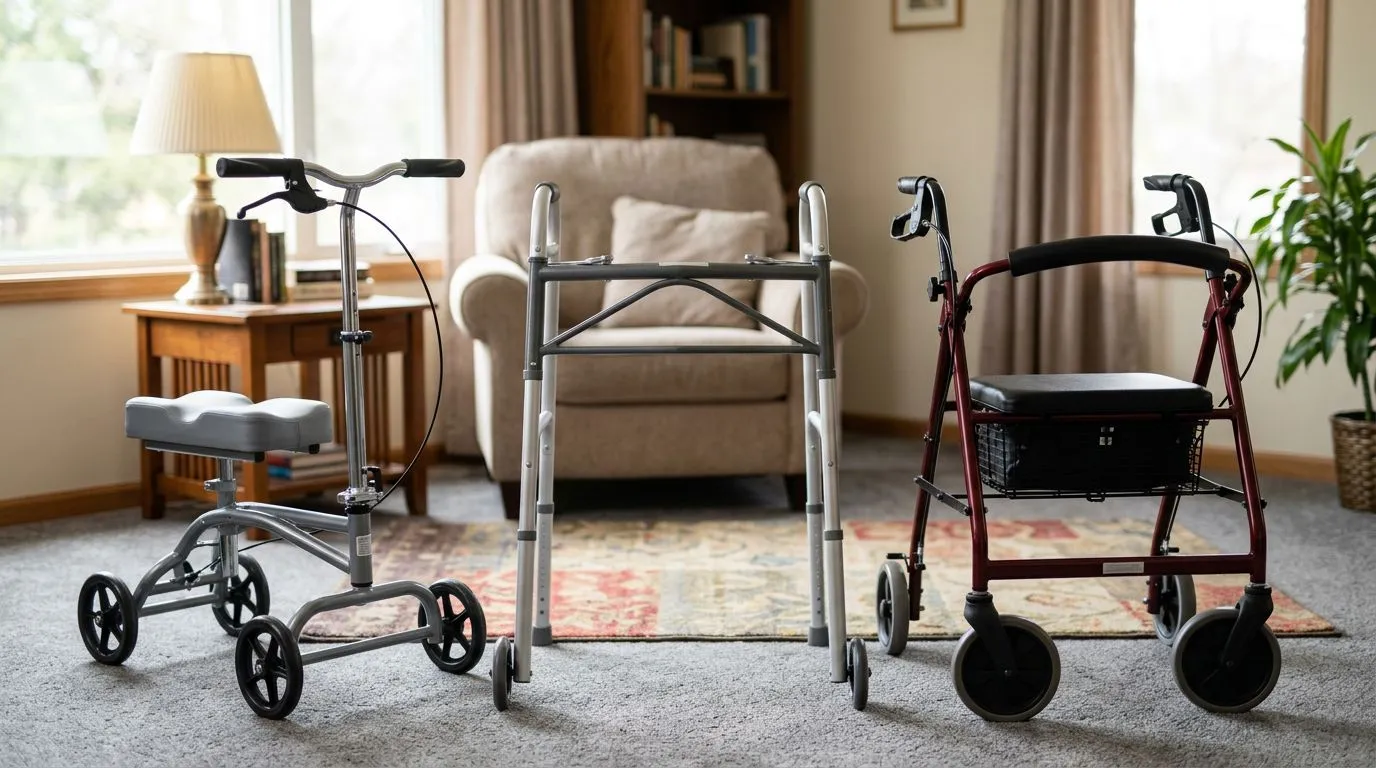
A knee walker is usually best for short-term foot or ankle recovery when one leg must stay non-weight-bearing. A standard walker is better when you need maximum stability for standing, transfers, or slow walking. A rollator is usually best for longer-term mobility when you can walk but need support, a seat, and hand brakes.
The right choice depends on your medical restrictions, balance, arm strength, home layout, and how long you expect to use the device. If your clinician has told you to avoid putting weight on one foot for 6 to 12 weeks, your needs are different from someone managing arthritis, low endurance, or balance changes over many months or years.
Key difference: 1 injured leg versus 2-sided walking support
The easiest way to compare these aids is to ask what problem you need to solve. A knee walker supports one lower leg on a padded platform while you propel yourself with the other foot. A standard walker supports you with a stable frame, usually with either no wheels or 2 front wheels. A rollator is a wheeled walker, most often with 3 or 4 wheels, hand brakes, and a built-in seat on many 4-wheel designs.
A knee walker is not a general balance device. It is made for a specific situation: one foot or ankle cannot safely take weight, but the opposite leg, hips, hands, and balance are strong enough to steer and stop. Many people consider one after surgery, a fracture, or a severe sprain when crutches feel too tiring.
A standard walker is the most stable of the three because it creates a wide, rigid base of support. A no-wheel walker must be lifted and placed with each step, which slows the user down but gives excellent control. A 2-wheel walker rolls forward more easily while still offering more stability than most rollators.
A rollator is built for movement, not maximum bracing. The wheels reduce effort, the brakes help control speed, and the seat provides a place to rest during longer outings. That convenience has a tradeoff: a rollator can move away from you if the brakes are not used correctly, so it is usually not the best choice for someone who needs to lean heavily for support.
Quick comparison of 3 mobility aid choices
Most adult walkers and rollators support users in common weight ranges around 250 to 300 lb, while heavy-duty or bariatric versions may support 400 lb or more. Knee walkers also have stated weight limits, and those limits matter because the device must handle body weight while turning, braking, and rolling over small floor changes.
| Mobility aid | Best fit | Typical strengths | Main cautions |
|---|---|---|---|
| Knee walker | Foot or ankle recovery when one leg is non-weight-bearing | Faster than crutches for many indoor routes; keeps injured foot elevated; useful for 6 to 12 week recoveries | Requires good balance, one strong leg, safe steering, and a fairly open home layout |
| Standard walker, no wheels | Maximum stability, transfers, very slow walking | Stable 4-point contact; simple frame; often folds for transport | Must be lifted each step; can be tiring for weak arms or shoulders |
| 2-wheel walker | Stability with easier forward movement | Front wheels reduce lifting; rear legs add control; common after hospital or rehab discharge | Less maneuverable than a rollator; no built-in seat |
| 3-wheel rollator | Narrow spaces and light support for active users | Tighter turning; often lighter and slimmer than 4-wheel rollators | Usually no seat; less stable than 4-wheel designs |
| 4-wheel rollator | Longer walks, errands, and rest breaks | Seat, hand brakes, basket or pouch, smooth rolling | Not meant for heavy leaning; brakes must be used every time you sit |
| Upright or stand-up rollator | People who tolerate a more upright posture and need forearm support | Forearm pads or higher handles may reduce forward bending for some users | Usually larger; fit and brake reach are critical |
| Bariatric rollator or walker | Higher weight capacity or need for wider frame | Reinforced frame; wider seat or stance; capacities may be 400 lb or higher | Heavier, wider, and harder to maneuver in tight rooms |
Who a knee walker is best for during 6 to 12 weeks of recovery
A knee walker is best for a person recovering from a lower-leg injury who has been instructed to keep weight off the foot or ankle. Common examples include some ankle surgeries, foot fractures, Achilles tendon procedures, or severe sprains. The device lets the injured side rest on a knee platform while the uninjured leg does the pushing.
It can be a good fit if you can stand on one leg for short periods, steer with both hands, and operate hand brakes. You also need enough hip and knee comfort to rest the injured leg bent on the pad. If kneeling is painful, or if you have a knee replacement, significant knee arthritis, or poor balance, a knee walker may not feel safe.
Home layout matters. A knee walker works best on firm, fairly level surfaces with turning room. Tight bathrooms, thick rugs, cluttered hallways, and steps can make it difficult. Many knee walkers are not intended for stairs, and even a single 6-inch step at an entryway can become a major obstacle.
People often compare knee walkers with crutches, but the better comparison here is purpose. A knee walker is mainly for one-sided injury recovery. It is not designed to manage long-term full-body balance problems, dizziness, weakness on both sides, or progressive conditions that require ongoing walking support.
Who a standard walker is best for when stability matters most
A standard walker is best for someone who needs a very steady base, especially during transfers, standing from a chair, or short indoor walks of 10 to 50 feet. It is commonly used after illness, surgery, a fall, or a hospital stay when the priority is controlled movement rather than speed.
A no-wheel standard walker is the slowest but most stable option. The user lifts the frame, places it a short distance ahead, then steps into it. Because all 4 legs contact the floor, it is less likely to roll unexpectedly. This can be reassuring for people who need to put firm pressure through their hands.
A folding walker is a practical version of the same idea. Many standard walkers fold by pushing a button or lever so they can fit in a car trunk, beside a bed, or against a wall. Folding does not automatically mean flimsy; the key is that the frame locks securely when open.
A 2-wheel walker may be a better choice when lifting a no-wheel walker is too tiring. The front wheels glide while the back legs provide friction and control. This design can help people with limited endurance, mild arm weakness, or a walking pattern that benefits from smoother forward movement.
Standard walkers usually do not have seats. That matters. If the person needs frequent rest breaks during a 5-minute walk to the mailbox or through a store, a rollator may be more practical, assuming balance and brake use are safe.
Who a rollator is best for during long-term walking support
A rollator is best for someone who can walk but needs support for balance, endurance, posture, or confidence over longer distances, such as 100 to 500 feet at a time. It is a strong option for community use because the wheels roll continuously, and the built-in seat on many models provides a rest point.
Four-wheel rollators are the most familiar style. They typically have hand brakes, a padded or sling-style seat, a backrest, and a storage pouch or basket. They are useful for people who fatigue during errands, want to pause safely, or need a place to sit while waiting.
Three-wheel rollators are narrower and often turn more easily in apartments, kitchens, and small stores. They can fit active users who need light support and maneuverability. The tradeoff is that many 3-wheel rollators do not include a seat and may feel less stable than a 4-wheel frame.
Upright rollators, sometimes called stand-up rollators, place the support higher and may include forearm platforms. They are designed to encourage a more upright position compared with leaning down on low handles. Fit is especially important because handles or forearm pads that are 1 to 2 inches too high can cause shoulder strain, while low supports can lead to hunching.
Bariatric rollators and heavy-duty walkers are built for higher weight capacity and may have wider seats and reinforced frames. The added strength often means more width and weight. Before choosing one, measure the narrowest doorway, bathroom path, and car storage space because a wider frame can improve comfort but reduce access.
How to choose and measure: 5 checks before buying or borrowing
Fit affects safety. A walker or rollator that is even 2 inches too tall or too short can change posture, reduce control, and increase strain through the wrists, shoulders, or back. Use these checks before buying, borrowing, or renting any mobility aid.
1. Confirm your weight-bearing rule
If your clinician says non-weight-bearing, a knee walker may fit the recovery plan if you meet the balance and home-safety requirements. If you are partial weight-bearing, weight-bearing as tolerated, or using support for general balance, a standard walker or 2-wheel walker may be more appropriate. A rollator is usually for people who are allowed to walk and are not relying on the device to fully unload one leg.
2. Measure handle height at the wrist crease
Stand in your usual shoes with arms relaxed at your sides. The handgrips should line up close to the crease of your wrist. When holding the grips, your elbows should bend slightly, often around 15 to 20 degrees. This applies to standard walkers, 2-wheel walkers, and most rollators.
3. Check knee platform height for a knee walker
For a knee walker, the injured leg should rest comfortably on the pad without hiking the hip or leaning sideways. Your standing leg should feel stable, and your shoulders should stay level. If the pad is too low, you may bend awkwardly; if it is too high, you may feel tipped to one side.
4. Measure doorways and turning areas
Many interior doorways in US homes are about 28 to 32 inches wide, and bathroom doors may be narrower in older homes. Compare that with the outside width of the device. A rollator with large wheels or a bariatric frame may feel great in a hallway but be frustrating at a small bathroom door.
5. Test brakes, folding, and lifting weight
Rollators and knee walkers depend on brakes. You should be able to squeeze the brakes while walking and lock them before sitting or stopping. Also check the device weight if you will lift it into a car; a difference of 5 to 10 lb can matter when your balance or shoulder strength is limited.
Home and outdoor use: match the device to 3 real routes
Before deciding, picture the 3 routes you use most: bedroom to bathroom, living room to kitchen, and front door to car. A mobility aid that works beautifully in a wide clinic hallway may be awkward around a laundry basket, a 30-inch doorway, or a raised threshold.
For bedroom-to-bathroom trips, a standard walker or 2-wheel walker is often easier to control in tight spaces than a knee walker or full-size rollator. If nighttime bathroom trips are common, stability and predictable placement matter more than speed. Remove throw rugs, cords, and low clutter before using any device.
For kitchen tasks, the choice depends on standing balance and hand use. A standard walker offers support but does not carry items well. A rollator may include a pouch or basket, but it should not be used as a moving shopping cart while leaning heavily into it. A knee walker can leave the injured foot protected, yet turning near counters and appliances takes practice.
For outdoor routes, wheel size matters. Small wheels can catch on cracks, gravel, grass edges, or uneven sidewalks. Rollators often handle longer outdoor walks better than standard walkers because they roll continuously, but they still require controlled speed on slopes. Knee walkers can be difficult on rough pavement and should be used cautiously near ramps or curb cuts.
Stairs are a special case. None of these devices should be treated as a simple stair solution without training. If you have steps at home, ask a physical therapist or clinician to teach the safest method for your specific injury, strength, and layout.
Safety tradeoffs: stability, speed, brakes, and seats
A standard walker may slow walking to 1 step at a time, but that slow pace can be exactly what makes it safer for someone with poor balance. A rollator may help a person walk farther, yet it can roll away if used like a fixed support. A knee walker may feel efficient during recovery, but a sharp turn or sudden stop can challenge balance.
With rollators, brakes are not optional. The brakes should be easy to reach, easy to squeeze, and simple to lock. Before sitting on a rollator seat, lock both brakes, turn carefully, back up until you feel the seat behind your legs, and sit with control. A rollator seat is for resting, not for being pushed like a wheelchair unless the device is specifically designed and labeled for transport use.
With standard walkers, the common mistake is placing the frame too far ahead. Keep the walker close enough that you can step into it without leaning forward. On a 2-wheel walker, move slowly enough that the rear legs stay in contact with the floor when needed for control.
With knee walkers, speed is the common risk. It is easy to push faster than you can stop, especially on smooth floors. Practice starting, stopping, turning, and backing up in a clear area for at least 10 to 15 minutes before using it in busy rooms.
Any new fall, dizziness, sudden weakness, numbness, or increasing pain is a reason to pause and contact a healthcare professional. Mobility aids can support independence, but they do not replace medical guidance or therapy when your condition is changing.
Short-term recovery versus long-term use over 3 months or more
If your need is short-term and injury-specific, a knee walker may make sense for a defined period such as 6, 8, or 12 weeks. Once your clinician allows progressive weight-bearing, you may transition to a boot, cane, walker, or no device depending on strength, pain, and balance.
If your need is broader and expected to last more than 3 months, think beyond the first week. A standard walker may be ideal after surgery or during a period of weakness, but long-term users often value easier rolling, a seat, and storage. That is where a rollator may fit, provided it offers enough control.
Some people use more than one device. A 2-wheel walker may be safest for early morning bathroom trips, while a 4-wheel rollator may be better for supervised hallway walks or outdoor errands. During foot or ankle recovery, a knee walker may work on the main floor while another plan is needed for stairs.
The goal is not to choose the most advanced device. The goal is to choose the device that matches your safest walking pattern today, then adjust as your recovery or long-term needs change.
Decision guide: which mobility aid fits your situation?
Use this guide as a practical starting point, then confirm with your clinician, physical therapist, or occupational therapist. A 10-minute professional fitting can prevent weeks of frustration with the wrong height, wheel style, or brake setup.
| Your situation | Most likely fit | Why |
|---|---|---|
| Foot or ankle surgery with non-weight-bearing instructions | Knee walker, if balance and home layout allow | Supports the injured side without stepping on it |
| Very unsteady when standing or transferring | Standard no-wheel walker | Provides the most fixed, stable base |
| Need stability but cannot lift a walker repeatedly | 2-wheel walker | Rolls forward while rear legs help control movement |
| Can walk but needs rest every few minutes | 4-wheel rollator | Seat and brakes support paced walking and rest breaks |
| Small apartment with narrow turns | 3-wheel rollator or compact folding walker | Narrower frames can maneuver better in tight spaces |
| Need higher weight capacity or wider support | Bariatric walker or bariatric rollator | Reinforced frames and wider dimensions may improve fit |
| Forward-flexed posture with adequate brake control | Upright rollator evaluation | Higher forearm support may encourage a more upright position |
When in doubt, choose stability over speed. A device that feels slightly slower but predictable is often safer than one that feels fast but difficult to control.
FAQs: 5 common questions before choosing
Is a knee walker safer than a rollator?
Not automatically. A knee walker can be very useful for non-weight-bearing foot or ankle recovery, but it requires steering, braking, and balancing on one leg. A rollator is better for people who can walk on both legs but need support and rest breaks.
Can I use a rollator instead of a standard walker after surgery?
Sometimes, but only if your surgeon, clinician, or therapist says it matches your weight-bearing status and balance. If you need firm support or tend to lean heavily, a standard walker or 2-wheel walker may be safer than a rollator.
What is the biggest difference between a walker and a rollator?
A standard walker is a stable frame that may have no wheels or 2 front wheels. A rollator is a wheeled walker, usually with 3 or 4 wheels, hand brakes, and often a seat. Walkers prioritize stability; rollators prioritize easier movement and rest breaks.
Do knee walkers work in small homes?
They can, but tight bathrooms, narrow halls, rugs, and sharp turns make them harder to use. Measure your narrowest doorway, often around 28 to 32 inches, and test turning space before relying on a knee walker indoors.
Should I choose a 3-wheel or 4-wheel rollator?
A 3-wheel rollator is usually more maneuverable in tight spaces, but many do not have a seat. A 4-wheel rollator is often more stable and better for resting during longer walks, though it may be wider and heavier.
FAQ
Frequently asked questions
What is the difference between a walker and a rollator? +
A standard walker is a stable frame with no wheels or 2 front wheels. A rollator is a wheeled walker, usually with 3 or 4 wheels, hand brakes, and often a built-in seat. Walkers prioritize stability; rollators prioritize easier movement and rest breaks.
Do knee walkers work well in small homes? +
They can, but tight bathrooms, narrow hallways, rugs, and sharp turns can make them difficult. Measure doorways and turning areas before relying on one, especially in older homes where some interior doors may be around 28 to 32 inches wide.
Keep reading
Related guides
Mobility Walker With Seat vs Standard Walker: Which One Is Right for You?
14 min read
No-Wheel Walker vs Two-Wheel Walker vs Rollator: How Wheels Change Stability, Effort, and Control
13 min read
How to Walk With a Walker After Hip or Knee Surgery
14 min read