Disclosure: We may earn a commission when you buy through links on this page, at no extra cost to you. We buy nothing, sell nothing and accept no payment for coverage — commissions never decide what we recommend. How we make money.
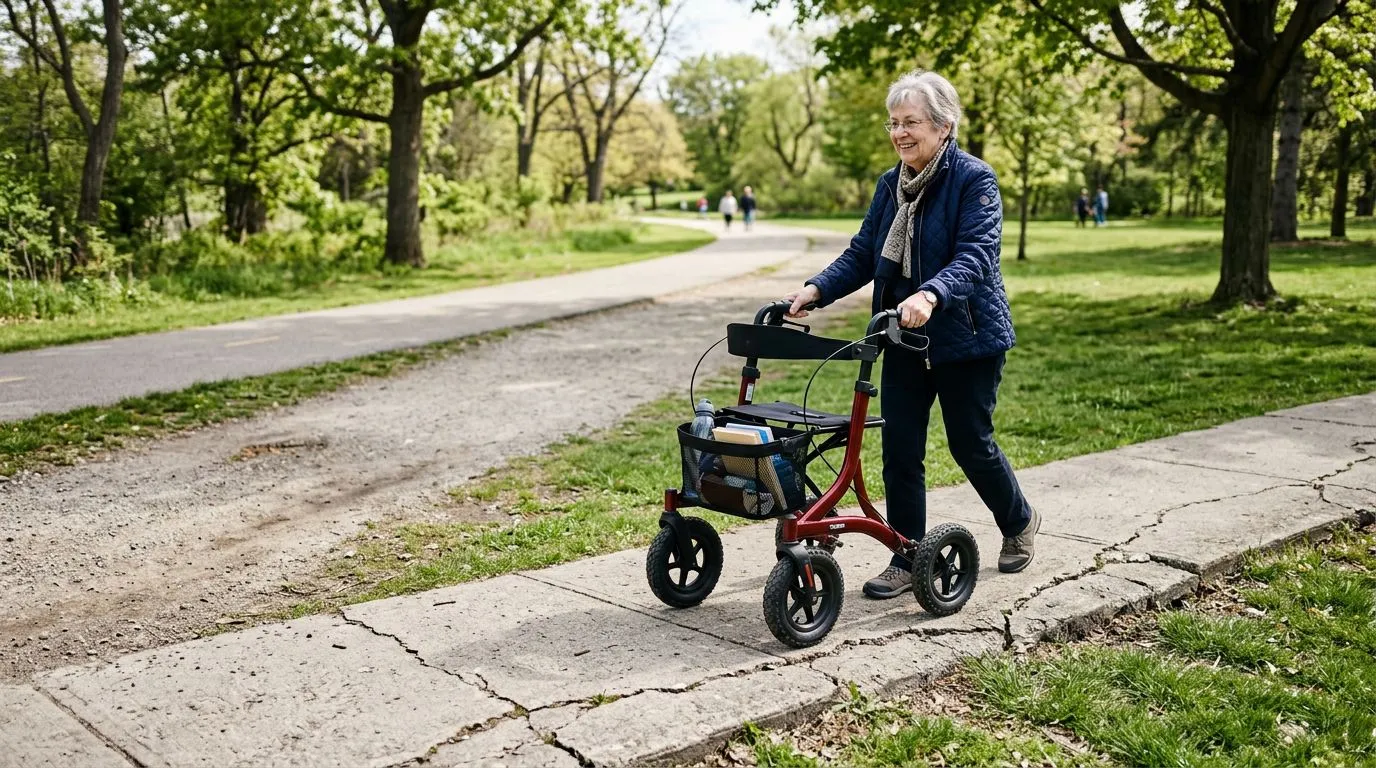
An all-terrain rollator walker is best for people who need a wheeled mobility aid outdoors on surfaces such as cracked sidewalks, packed gravel, short grass, curb cuts, and uneven paths. Choose one by focusing on wheel size, tire style, brake control, frame stability, seat height, handle fit, and weight capacity—not looks alone.
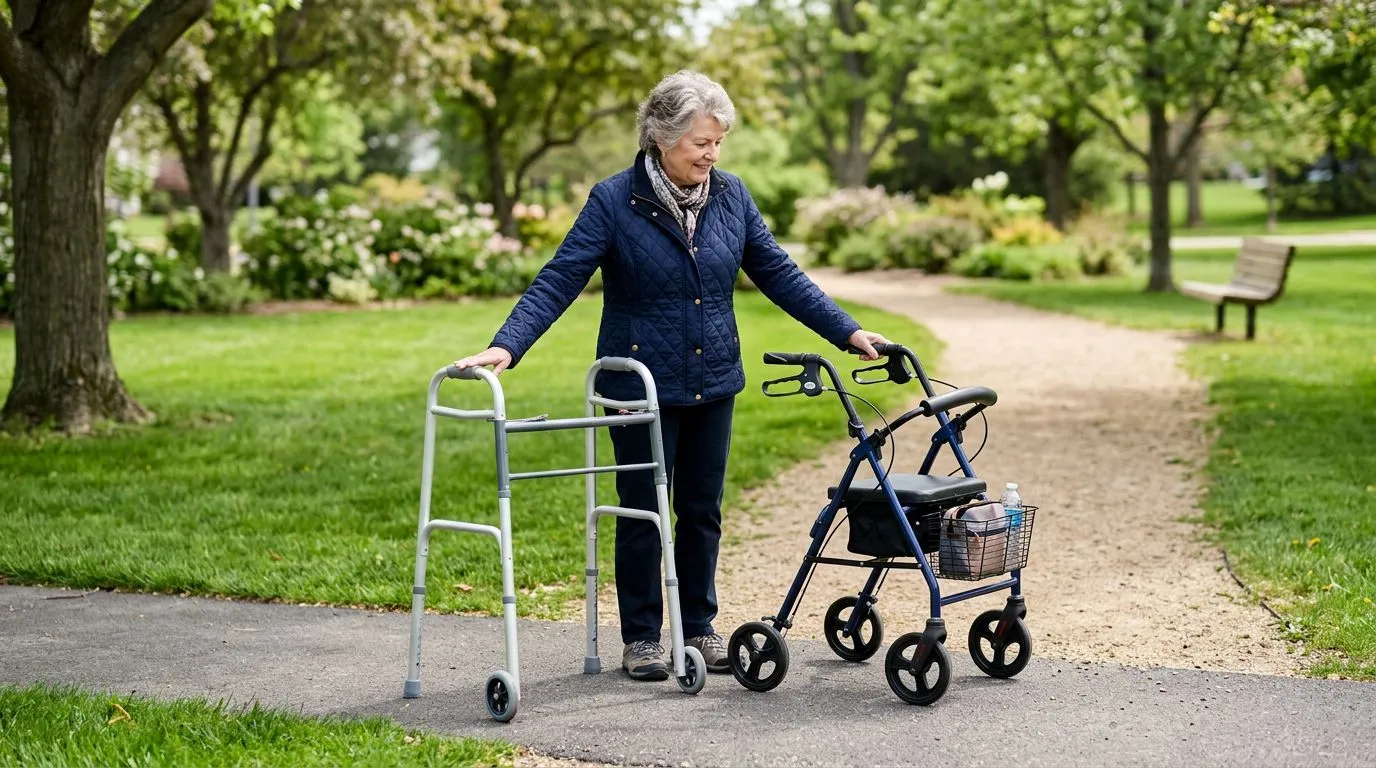
On rougher ground, a rollator is not the same as a standard walker. A standard walker or two-wheel walker can be steadier for very slow, step-by-step support, while a rollator has 3 or 4 wheels, hand brakes, and usually a seat for resting. The right choice depends on your balance, walking speed, terrain, and whether you need somewhere to sit during longer outdoor trips.
What makes an all-terrain rollator different: 8- to 12-inch wheels matter
Most indoor rollators are made for smooth floors, tight hallways, and short paved walks. All-terrain rollator walkers are built for outdoor use, where small cracks, gravel, grass, and uneven transitions can stop a small wheel suddenly. The most obvious difference is wheel size: many outdoor-focused rollators use wheels around 8 inches, 10 inches, or sometimes 12 inches in diameter.
Larger wheels do not make a rollator “off-road” in the same way a bicycle or wheelchair might be, but they can roll over small surface changes more easily. A 10-inch front wheel, for example, is generally less likely to catch on a raised sidewalk edge than a 6-inch wheel. Tire width matters too. A wider tire can feel more stable on packed gravel or short grass because it spreads contact over more surface area.
The frame is another difference. Outdoor rollators often have a wider stance, stronger cross-bracing, and a heavier build than compact indoor rollators. That can improve stability, but it also adds weight when lifting the rollator into a car. Many standard rollators weigh roughly 15 to 25 pounds, while heavier-duty or bariatric rollators can weigh more.
Brakes are essential outdoors. On a flat kitchen floor, a brake issue may be annoying. On a sloped driveway or trail approach, weak brake control can be unsafe. Look for hand brakes you can squeeze comfortably and parking brakes that lock securely before you sit.
Rollator walker vs standard walker: 4 key differences for outdoor use
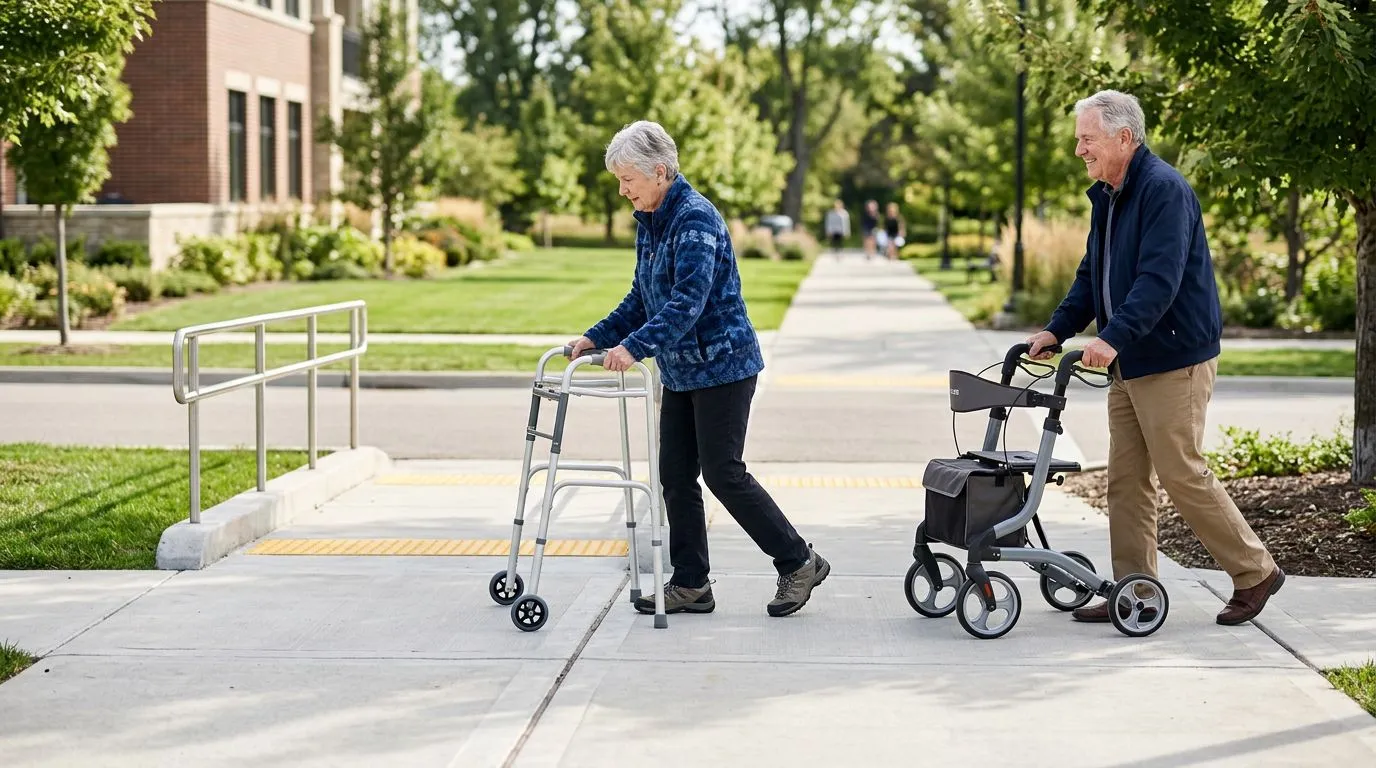
The word “walker” is often used broadly, but the differences matter. A standard walker has no wheels and is lifted forward with each step. A two-wheel walker has front wheels and rear glides or tips. A rollator has 3 or 4 wheels, hand brakes, and usually a built-in seat. All three can support mobility, but they behave very differently outdoors.
| Mobility aid type | Best outdoor fit | Important limits |
|---|---|---|
| Standard walker, no wheels | Short, slow distances on mostly level surfaces when maximum step-by-step control is needed | Must be lifted repeatedly; not practical for gravel, grass, or longer walks |
| Two-wheel walker | Short sidewalk trips, entrances, and transitions where some rolling help is useful | Rear legs can drag or catch on rough ground; no built-in seat |
| 3-wheel rollator | Narrow paths, doorways, and maneuvering around outdoor tables or tight spaces | Usually no full seat; can feel less stable than a 4-wheel rollator |
| 4-wheel rollator | Sidewalks, parks, errands, and outdoor walking where rest breaks are needed | Requires good brake use and enough balance to control a moving frame |
If you put significant body weight through your arms with every step, ask a physical therapist or clinician before switching from a walker to a rollator. A rollator moves continuously, so it takes control. It should not roll ahead faster than you can walk.
For many outdoor users, the decision comes down to this: choose a walker when you need slower, more controlled support; choose a rollator when you can walk with a rolling aid, need hand brakes, and benefit from a seat during trips of 5, 10, or 20 minutes.
Who it’s best for: 5 outdoor situations that favor an all-terrain rollator
An all-terrain rollator is most useful for people who can walk but need added support, pacing, and a safe place to rest outdoors. It is not right for every surface, and it is not a substitute for professional fall-risk guidance, but in the right setting it can make daily movement easier.
- Cracked or uneven sidewalks: Larger wheels can handle small gaps and raised seams better than small indoor wheels.
- Packed gravel paths: A stable 4-wheel frame with wider tires may roll better over firm gravel than a narrow-wheel rollator.
- Short, dry grass: Big wheels help, especially when the ground is firm. Wet grass or soft soil is much harder.
- Outdoor errands: A seat can help if you need a 2- to 5-minute rest while waiting for a ride, standing in line, or walking through a park.
- Longer paved routes: If you walk several blocks, hand brakes and a seat can make pacing more manageable.
A 4-wheel all-terrain rollator is usually the better choice for people who want a seat. A 3-wheel rollator can work well for maneuverability, but most 3-wheel designs do not offer the same seated rest option. Upright or stand-up rollators may help some users maintain a more vertical posture, but they are taller, larger, and not automatically more stable on rough ground.
It is also important to know when an all-terrain rollator is not enough. Loose sand, deep gravel, muddy trails, steep slopes, snow, ice, and roots can challenge even large wheels. If a surface forces you to lean hard, twist suddenly, or pull the rollator sideways, it may not be a safe walking route.
Wheel and tire choices: 6, 8, 10, and 12 inches compared
Wheel size is one of the most practical specs to compare. The difference between a 6-inch wheel and a 10-inch wheel is easy to feel outdoors. Smaller wheels turn tightly indoors, while larger wheels tend to track better over rough pavement and outdoor transitions.
| Wheel size | Best use | Outdoor note |
|---|---|---|
| 6 inches | Indoor floors and very smooth pavement | More likely to catch on cracks, gravel, or uneven seams |
| 8 inches | Mixed indoor and outdoor use | A common all-around size for sidewalks and curb cuts |
| 10 inches | Outdoor walking, rough sidewalks, packed paths | Better rollover than 6- or 8-inch wheels, but often adds bulk |
| 12 inches | More demanding outdoor surfaces | Can handle rougher ground, but may be heavier and wider |
Tire material matters as well. Solid tires are low maintenance because they do not go flat. Pneumatic, or air-filled, tires may provide more cushioning on rough ground, but they can lose air or puncture. Some rollators use softer solid tires to add comfort without needing inflation.
Front wheel design also affects handling. Swiveling front wheels are easier to turn around patio furniture or store aisles. Fixed or more controlled front wheels may feel steadier on longer straight paths. If you walk on both sidewalks and indoor floors, look for a balance: wheels large enough for outdoor use, but not so large that the rollator becomes awkward in your hallway or bathroom doorway.
Brakes, slopes, and control: test the first 10 feet before you trust it
Outdoor rollator safety depends heavily on the brakes. Most rollators use loop-style hand brakes that slow the wheels when squeezed and lock when pushed down or engaged. Before using any rollator outside, test the brakes on a flat surface for at least 10 feet, then check the parking brake before sitting.
Brake handles should fit your hands without strain. If you have arthritis, reduced grip strength, or numbness, a brake that feels fine in a store for 30 seconds may feel tiring after a longer walk. You should be able to slow the rollator without clenching hard or bending your wrists at an uncomfortable angle.
Slopes require extra caution. Even a slight downhill can make a rollator move faster than expected. When walking down a driveway or ramp, keep the rollator close, use light brake pressure, and avoid letting it roll an arm’s length ahead. Going uphill can also be difficult because you may push down and forward at the same time.
Parking brakes are not optional. Lock both brakes before sitting, standing, reaching into a storage bag, or pausing on a path. A rollator seat is meant for resting, not for being pushed while seated unless the device is specifically designed and approved for that use.
Seat, handle height, and frame fit: measure within 1 inch
Fit is just as important as wheel size. A rollator that is too low can make you stoop. One that is too high can raise your shoulders and reduce control. For many users, the handles should line up near the crease of the wrist when standing upright in walking shoes, with arms relaxed at the sides. Even 1 inch can change posture and comfort.
To measure handle height, stand on a level floor wearing the shoes you use outdoors. Let your arms hang naturally. Measure from the floor to the wrist crease. Then compare that number with the rollator’s adjustable handle range. If the range does not include your measurement, keep looking.
Seat height matters if you plan to rest often. Common rollator seat heights are often around 20 to 24 inches, though designs vary. A seat should allow you to sit down with control and stand back up without sinking too low. If you use a higher chair at home because low seats are hard, do not ignore seat height on the rollator.
Also compare seat width and frame width. Outdoor rollators may have wider frames for stability, but a wider frame can be harder to use through a 30- to 32-inch doorway, narrow garden gate, or crowded café entrance. If you need the rollator both indoors and outdoors, measure the narrowest doorway you use every day.
Weight capacity and bariatric rollators: start with the stated lb rating
Every rollator has a stated weight capacity, often listed in pounds. Standard rollators commonly support around 250 to 300 pounds, while bariatric rollators may be rated for higher capacities such as 350, 400, or more pounds depending on the design. Always follow the manufacturer’s stated limit for the specific device.
A bariatric all-terrain rollator is not only about the weight rating. It may also have a wider seat, reinforced frame, stronger wheels, and a broader base. Those features can improve comfort and durability for some users, but they add size and weight. A heavier frame may be harder to lift into a vehicle or carry up 2 porch steps.
Do not choose a rollator right at the edge of its limit if you regularly carry groceries, a bag, or an oxygen cylinder in the storage area. Added cargo counts toward real-world load, even if the listed capacity focuses on user weight. Check both the user weight capacity and any separate basket or bag limit.
If you are unsure about the right size, ask a clinician, mobility specialist, or durable medical equipment professional to check fit and walking pattern. The goal is not just a stronger frame. The goal is a rollator you can control comfortably on the surfaces you actually use.
How to choose for sidewalks, gravel, grass, and rough ground: a 7-step checklist
Choosing an all-terrain rollator is easier when you begin with your real routes. Think about the 3 places you go most often: the sidewalk outside your home, the parking lot at your doctor’s office, the park path, the mailbox, or the route from your door to the car. Match the rollator to those surfaces first.
- List your surfaces. Smooth sidewalk, cracked pavement, packed gravel, grass, ramps, and curb cuts all place different demands on wheels and brakes.
- Choose wheel size. For outdoor use, consider 8-inch wheels as a practical minimum, with 10-inch or 12-inch wheels for rougher paths.
- Check brake comfort. Squeeze the brakes repeatedly for 1 minute if possible. Your hands should not ache or slip.
- Measure handle height. Use your wrist crease measurement in outdoor shoes and confirm the adjustment range.
- Test the seat. Sit only with both brakes locked. Make sure your feet touch the ground and you can stand up safely.
- Measure storage and transport needs. Check folded size if you plan to place it in a trunk, back seat, closet, or apartment entry.
- Confirm weight capacity. Include your body weight plus typical carried items, and do not exceed listed limits.
If possible, try the rollator outdoors or on a surface that resembles your daily route. A rollator that feels smooth on a showroom floor may feel different on a sloped sidewalk with expansion joints every few feet.
3-wheel, 4-wheel, upright, and folding designs: feature comparison
All-terrain rollators come in several designs. A 4-wheel rollator is the most common choice for outdoor walking because it combines a frame, brakes, and a seat. A 3-wheel rollator can be easier to steer in tight spaces, but it typically gives up the full seat and some stability. Upright rollators support the forearms or a taller hand position, which may appeal to people who dislike bending forward.
| Design | Strengths | Trade-offs |
|---|---|---|
| 3-wheel rollator | Tight turning, lighter feel, easier around narrow spaces | Usually no standard seat; less stable for some users |
| 4-wheel rollator | Seat, storage, steady outdoor use, common 8- to 10-inch wheels | Can be wider and heavier than a basic walker |
| Upright rollator | Encourages a taller posture for some users, forearm support on some designs | Larger frame, different steering feel, may be harder to transport |
| Bariatric rollator | Higher lb capacity, wider seat, reinforced frame | Heavier, wider, and may not fit tight indoor spaces |
| Folding rollator | Easier storage and vehicle transport | Folded size still varies; outdoor wheels can add bulk |
Folding style is worth checking in person. Some rollators fold side-to-side, while others fold front-to-back. A rollator that folds quickly can still be difficult if it weighs 25 pounds and must be lifted into a high SUV. If you travel often, practice folding, lifting, and unfolding before relying on it for appointments.
Common buying mistakes: avoid these 6 outdoor rollator problems
The first mistake is buying by wheel size alone. Large wheels help, but they cannot make a poorly fitted rollator safe. Handle height, brake reach, frame width, and total weight matter just as much.
- Choosing wheels too small for the route: A 6-inch wheel may be fine indoors but frustrating on rough sidewalks.
- Ignoring brake strength: Outdoor use requires dependable slowing and parking brakes, especially near ramps.
- Buying too wide: A stable outdoor frame is helpful until it will not fit through your bathroom door or apartment entry.
- Overlooking lift weight: If you cannot lift the folded rollator into a car, it may not work for errands.
- Sitting without locking brakes: Always lock both brakes before using the seat, even for a short rest.
- Using it on unsafe terrain: Loose gravel, wet grass, snow, ice, and steep trails can exceed what a rollator is designed to handle.
A practical rule: match the rollator to your hardest regular surface, not your easiest one. If you walk across 30 feet of gravel every day to reach the mailbox, that gravel matters more than the smooth floor inside your kitchen.
FAQ: 5 questions about all-terrain rollator walkers
Can an all-terrain rollator go on grass?
Yes, but only on the right kind of grass. Short, dry, firm grass is much easier than wet, soft, uneven, or sloped grass. Larger 10- or 12-inch wheels may help, but they do not remove the risk of sinking, slipping, or tipping.
Is a rollator better than a walker for gravel?
For packed gravel, an all-terrain rollator with larger wheels can be easier to move than a standard walker because you do not have to lift it every step. For loose or deep gravel, neither may be ideal. A standard walker can catch, and a rollator can roll unpredictably.
What wheel size is best for rough sidewalks?
For rough sidewalks, many users do better with at least 8-inch wheels, while 10-inch wheels often provide better rollover on cracks and seams. The best size also depends on brake control, frame width, and whether you need to use the rollator indoors.
Can I sit on a rollator seat outdoors?
Yes, if the rollator has a seat and both parking brakes are fully locked on a level, stable surface. Do not sit on a slope, soft ground, or uneven surface. The rollator should not be used as a transport chair unless it is specifically designed for that purpose.
Are upright rollators good for all-terrain use?
Some upright rollators can work outdoors, especially on sidewalks and firm paths, but the design is taller and may feel different to steer. Check wheel size, brake reach, frame stability, and folded weight before choosing one for rough ground.
Keep reading
Related guides
All-Terrain Walkers and Rollators: What Works for Sidewalks, Grass, Gravel, and Uneven Ground
12 min read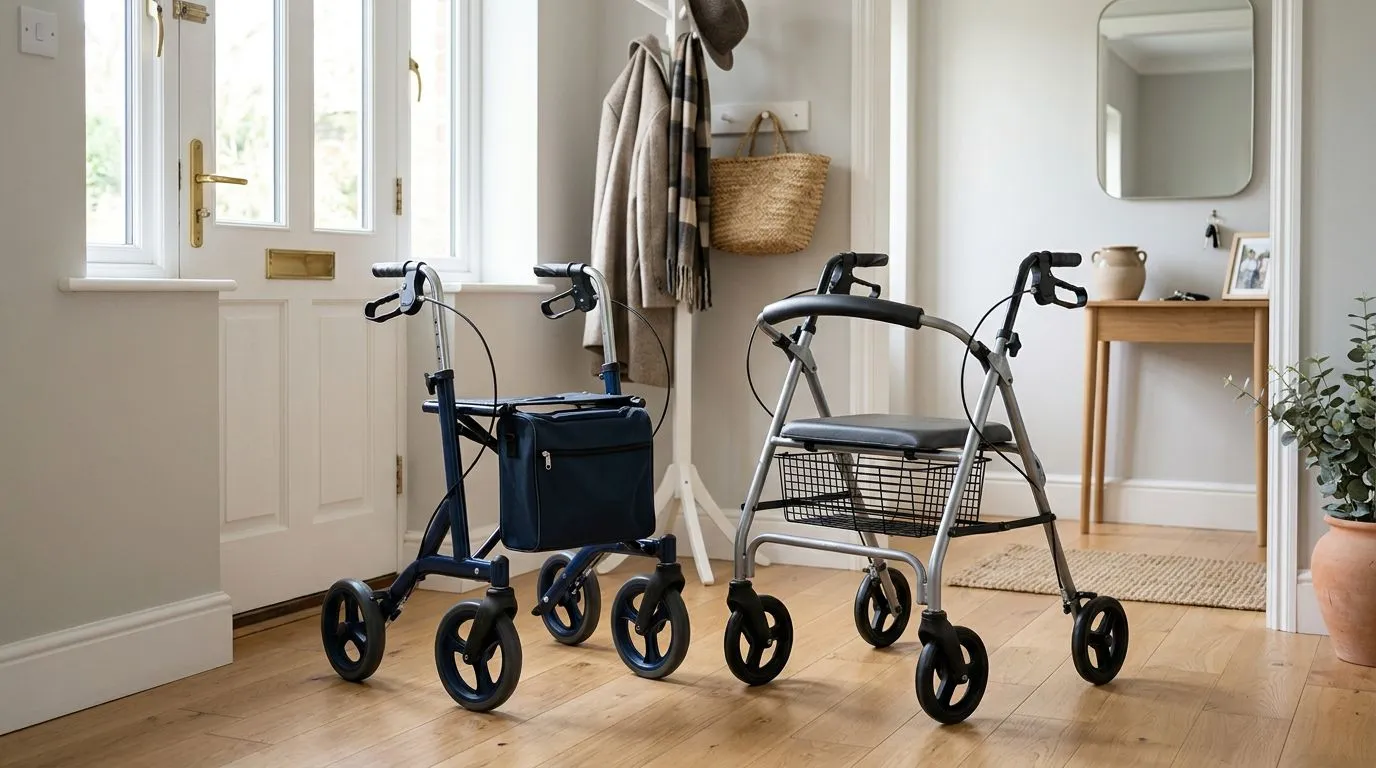
3-Wheel vs 4-Wheel Rollator Walkers: Which Design Fits Your Needs?
11 min read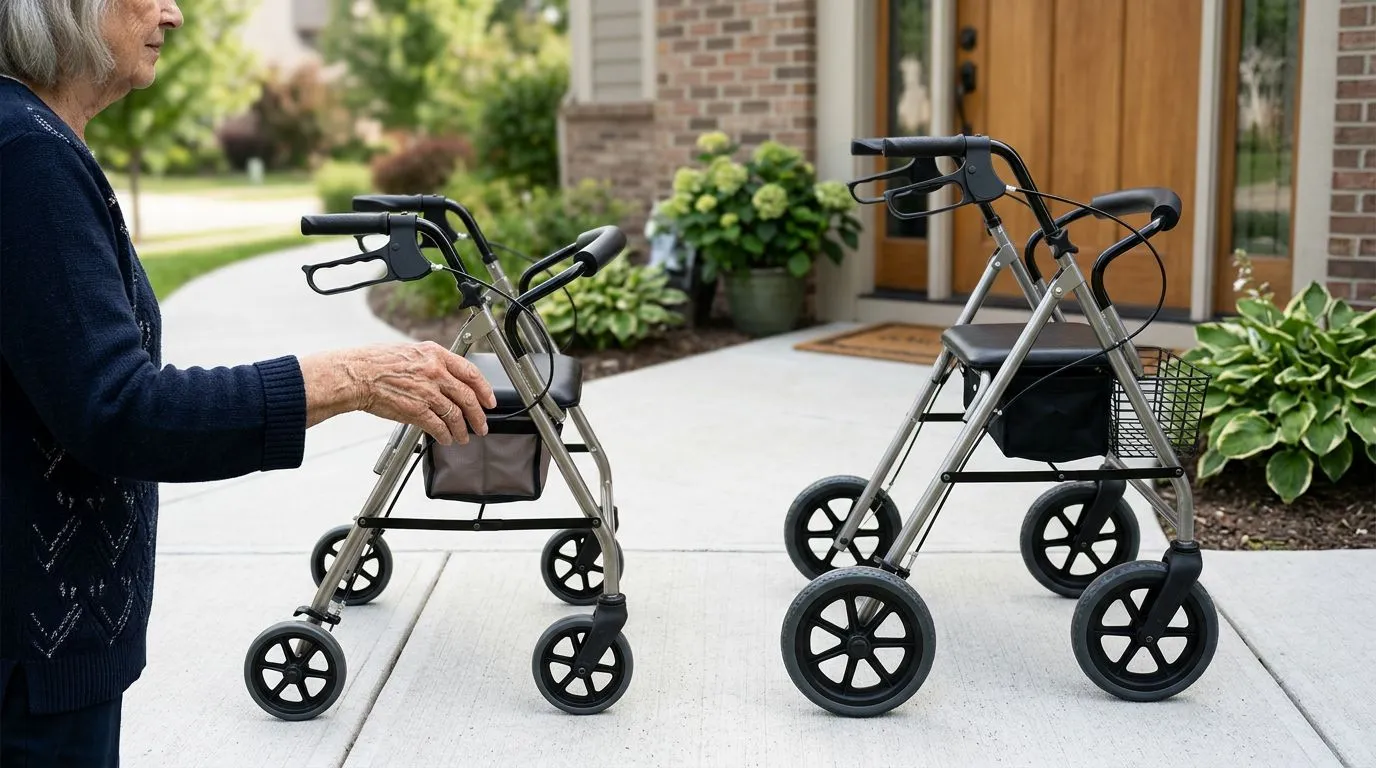
Large-Wheel vs Small-Wheel Rollators: How Wheel Size Affects Fit, Stride, and Stability
12 min read