Disclosure: We may earn a commission when you buy through links on this page, at no extra cost to you. We buy nothing, sell nothing and accept no payment for coverage — commissions never decide what we recommend. How we make money.
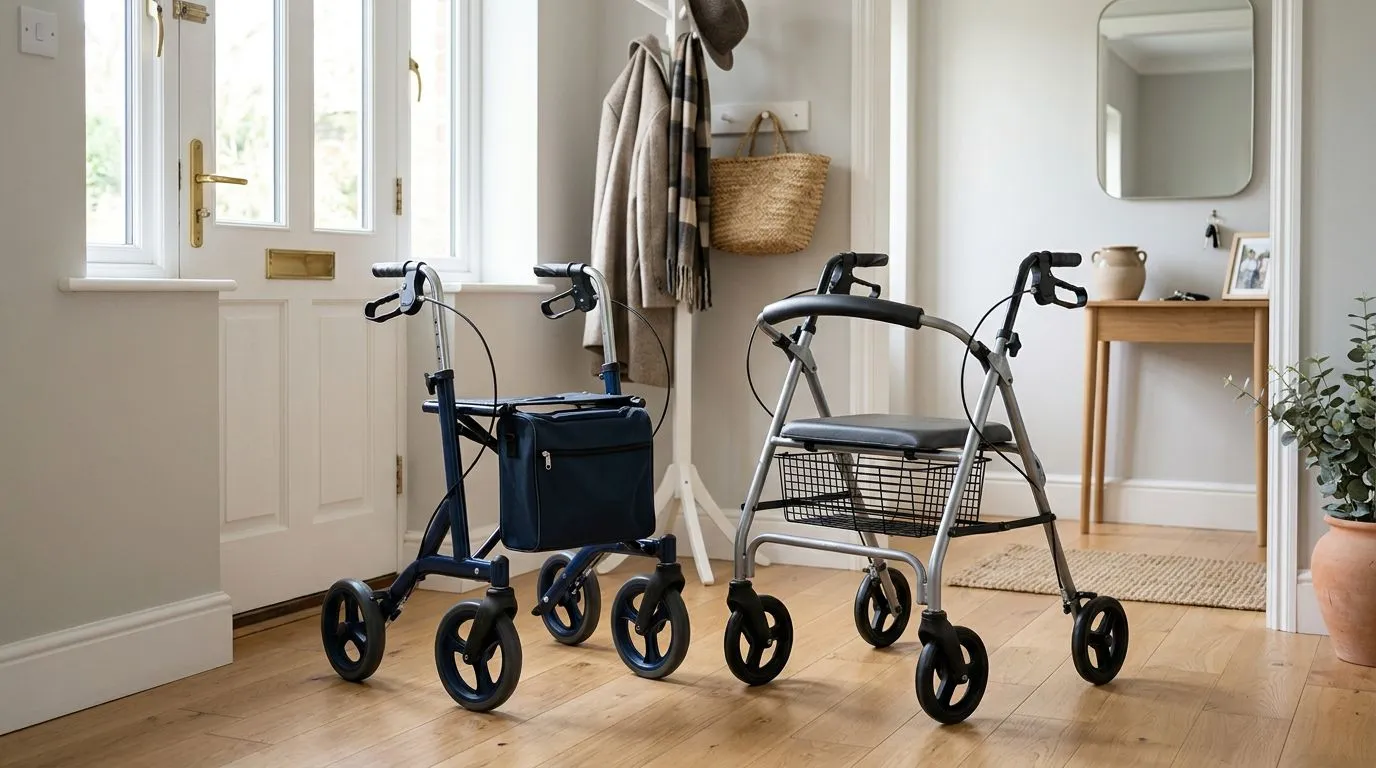
A travel-friendly rollator walker should be light enough for you or a helper to lift, compact enough for your car trunk, and accepted as a mobility device when you fly. For most buyers, that means checking folded width, total weight, handle height, brake style, seat size, and whether the frame stays securely folded in transport. Airlines in the U.S. generally allow rollators as assistive devices without counting them as standard baggage, but you should confirm gate-check procedures before you travel.
A rollator is not the same as a standard walker. A rollator has wheels, hand brakes, and usually a built-in seat; a walker may have no wheels or 2 front wheels and is often lighter, but it is not designed for seated rest breaks. If your main goal is errands, road trips, flights, and everyday transport, portability matters just as much as comfort.
Rollator vs. walker for travel: 4 differences that matter
The word walker is the broader, higher-volume term many people use for mobility aids, but rollators and walkers behave differently during travel. A standard folding walker may weigh around 5 to 8 lbs, while many 4-wheel rollators weigh closer to 14 to 22 lbs. That difference matters when you are lifting the frame into a trunk or onto a shuttle.
A no-wheel walker or 2-wheel walker is usually best when a person needs more stable, step-by-step support and does not need a seat. A rollator is better for someone who can safely manage wheels and hand brakes, wants smoother movement over longer distances, and needs a place to sit during outings. In airports, museums, parking lots, and shopping trips, the seat and storage pouch can be very useful.
| Mobility aid type | Typical travel advantage | Travel drawback | Best for |
|---|---|---|---|
| Standard folding walker, no wheels | Often light, simple, and easy to fold | No seat; must be picked up slightly with each step | Short trips, maximum stability, indoor use |
| 2-wheel walker | Easier to move than a no-wheel frame | Still no built-in seat; rear legs can drag | People who need support but not a rollator seat |
| 3-wheel rollator | Narrow turning and often compact folding | Usually no full seat; less stable than 4 wheels | Errands, tight stores, lighter travel loads |
| 4-wheel rollator | Seat, hand brakes, storage, smoother walking | Heavier and bulkier than basic walkers | Road trips, airports, longer outings |
| Upright rollator | Higher arm supports may help posture for some users | Often taller, heavier, and harder to fit in small trunks | Users fitted for upright support and longer walks |
If you are choosing between a walker and a rollator for travel, start with safety. A rollator should not roll away from you, and you must be able to squeeze and lock the brakes reliably. If that is difficult, a standard or 2-wheel walker may be the safer travel choice, even with fewer convenience features.
Folding size and weight: target numbers before you buy
For travel, the first number to check is total weight. Many portable rollators fall in the 11 to 20 lb range, while heavy-duty or upright styles may run above 20 lbs. If you need to lift it into a car yourself, test whether you can raise that weight from floor height to trunk height without twisting.
The second number is folded size. A compact side-folding rollator may fold to about 10 to 16 inches wide, while some traditional front-to-back folding frames stay wider and more awkward. Open width matters too. Many 4-wheel rollators are roughly 23 to 28 inches wide at the outside of the wheels, which can be tight in narrow bathrooms, older homes, and small hotel rooms.
Do not judge portability by open width alone. A rollator that folds flat but does not stay latched can be frustrating in a trunk. One that folds narrow but stands poorly may tip over in a restaurant or airport line. Look for a frame that folds in 1 or 2 steps, has an obvious lifting point, and does not require hand strength you do not have.
| Feature to measure | Useful travel target | Why it matters |
|---|---|---|
| Total weight | About 11 to 20 lbs for many portable rollators | Affects lifting into cars, buses, and hotel rooms |
| Folded width | Often about 10 to 16 inches on compact designs | Helps with trunks, closets, and airplane gate check |
| Open width | Commonly about 23 to 28 inches | Determines fit through doors and store aisles |
| Wheel size | Often 6 to 10 inches | Larger wheels usually handle bumps better but add bulk |
| Weight capacity | Match or exceed the user weight plus carried items | Protects frame integrity and safe handling |
Seat size is another practical detail. A wider seat may feel more comfortable, but it can increase frame width and trunk space. If the rollator is mainly for travel, balance comfort with the real places you go: the grocery aisle, the back seat footwell, the hotel elevator, and the airport restroom.
Car trunks and daily errands: measure in 3 steps
Before buying a rollator for car travel, measure 3 things: your trunk opening, the deepest usable cargo space, and the height you must lift over. Many sedan trunk openings are more restrictive than the trunk interior, so a rollator that technically fits inside may still be hard to load.
Use a tape measure at the narrowest points, not the widest. Measure the trunk opening width, opening height, and depth from the back edge to the rear seats. Then compare those numbers with the folded rollator size. If the rollator has large wheels or high handles that do not collapse, measure those too.
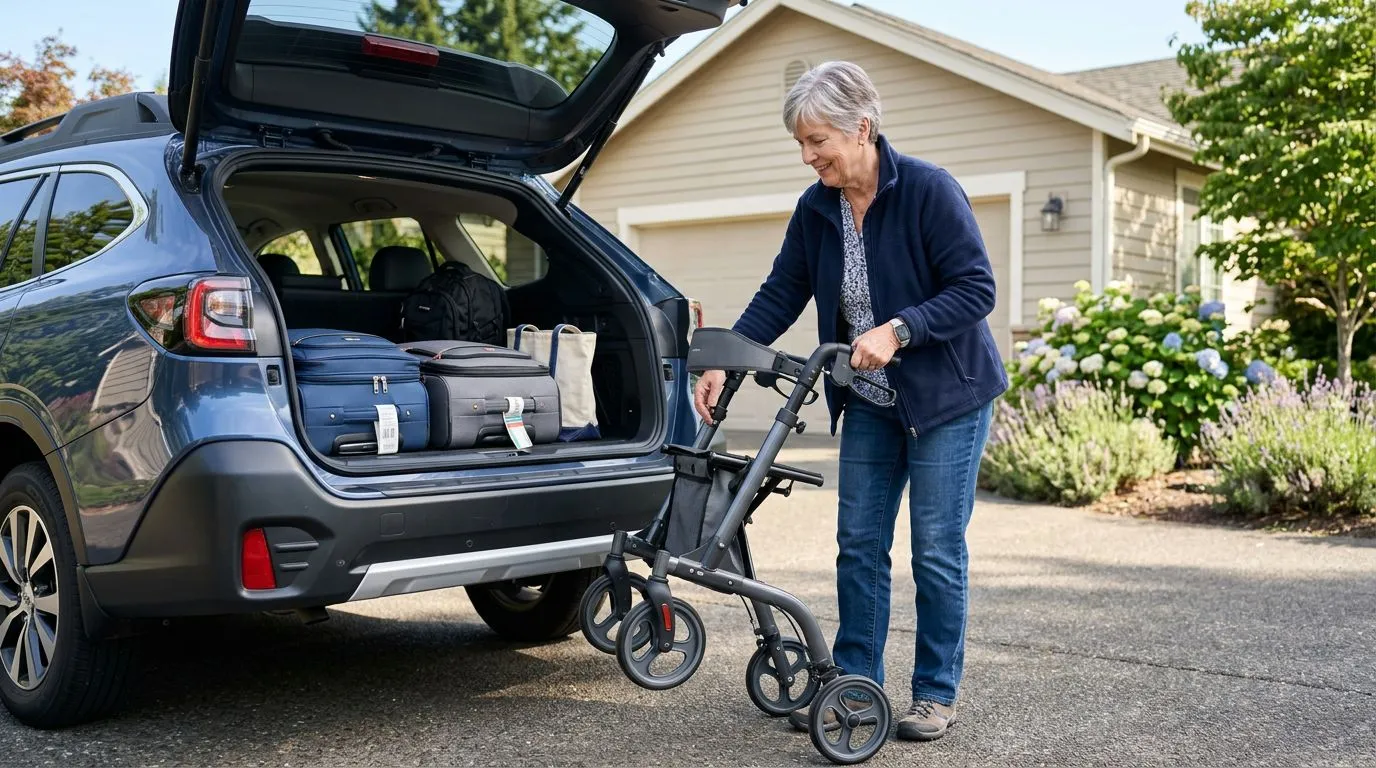
Loading technique matters. Keep the rollator close to your body, bend at the knees if you can, and avoid twisting while holding the frame. If you have back, shoulder, or balance concerns, ask a physical therapist or other qualified clinician to watch your loading method. A rollator that is safe to walk with may still be too heavy to load alone.
- For compact cars: prioritize low weight, narrow folded width, and removable accessories.
- For SUVs and crossovers: check lift height; the cargo floor may sit higher than a sedan trunk.
- For rideshare trips: choose a fold that a driver can understand in under 30 seconds.
- For grocery errands: make sure the brakes lock securely before you sit near the car.
Some travelers put a rollator in the back seat instead of the trunk. That can work, but it should be secured so it does not shift during sudden stops. Avoid leaving loose baskets, cane holders, or bags attached if they make the folded frame unstable.
Flying with a rollator: airline and TSA rules in 2026
In the United States, rollators are generally treated as assistive mobility devices, not ordinary luggage. Under common airline accessibility practices, mobility aids such as walkers and rollators are usually transported without counting against standard baggage limits. Rules and procedures can vary, so contact your airline before the trip, especially if you have a tight connection or international itinerary.
Most travelers use the rollator through the airport and gate-check it at the aircraft door. An airline employee typically tags it, places it in the cargo area, and returns it at the gate or jet bridge after landing when possible. Ask where it will be returned before you board; in some situations it may come to baggage claim, especially on smaller aircraft or complex routes.
TSA screening may include inspection of the frame, wheels, seat pouch, and any removable bag. If you can stand and walk through the scanner, officers may screen the rollator separately. If you cannot, request assistance. Keep medications, ID, keys, and essential items in a separate carry-on pouch rather than leaving them in the rollator storage bag.
Arrive early. A common planning window is 2 hours before domestic flights and 3 hours before international flights, but your airport and airline may recommend more time. The extra minutes help with check-in, security, restroom stops, preboarding, and careful gate-check instructions.
- Remove loose accessories before gate check.
- Lock the brakes before handing the rollator over, unless staff ask otherwise.
- Fold the frame yourself if you can, so staff see the correct fold.
- Take a photo of the rollator before travel in case you need to describe damage.
- Ask for preboarding if you need extra time to transfer safely.
Rollators without batteries are simpler for air travel. If your mobility setup includes powered accessories, lighting systems, or separate medical equipment, ask the airline about battery rules well before departure.
Which portable rollator type fits your trip? 5 common choices
Different travel plans call for different frames. A rollator for a weekly 1-mile boardwalk walk may not be the right rollator for a compact car trunk or a 3-flight travel day. Focus on the environment first, then the features.
3-wheel rollator
A 3-wheel rollator is often easier to steer in tight spaces and may fold more compactly than a full 4-wheel model. It is useful for errands, small apartments, and quick car trips. The tradeoff is that many 3-wheel designs do not include a full seat, and the triangular base can feel less stable for some users.
4-wheel rollator with seat
A 4-wheel rollator is the most common travel choice when rest breaks matter. It usually has hand brakes, a seat, a backrest or strap, and a storage pouch or basket. Expect more bulk than a basic folding walker, but better comfort over longer outings.
Lightweight rollator
Lightweight frames are appealing for anyone lifting a rollator into a trunk several times a week. Check the weight rating carefully, because lighter does not automatically mean appropriate for every body size or walking pattern. Also make sure the frame still feels steady when turning.
Upright or stand-up rollator
An upright rollator raises the support point closer to the forearms. Some users like the more upright walking position, but these rollators can be taller and heavier. Measure vehicle fit closely, especially if the frame height exceeds what your trunk can accept.
Bariatric rollator
A bariatric rollator is built for higher weight capacities and often has a wider seat and stronger frame. That added strength usually increases width and weight. For travel, confirm doorway clearance, trunk fit, and whether a helper is needed for lifting.
For some trips, a standard folding walker may still be the better choice. If you only need support for short transfers between the car, hotel room, and dining room, a walker can be simpler and lighter. If you need a seat while waiting in lines or walking longer distances, the rollator is usually more practical.
How to choose and measure: a 7-point portability checklist
Good fit is not optional. A rollator that is too tall, too short, too wide, or too heavy can make travel harder instead of easier. Use these 7 checks before you buy or before you commit to taking a rollator on a long trip.
- Handle height: Stand in your usual shoes with arms relaxed. The handles should generally line up near your wrist crease, with a slight elbow bend of about 15 to 20 degrees when holding them.
- Seat height: When seated, your feet should rest flat or nearly flat on the floor. A seat that is too high can feel unstable when sitting down.
- Open width: Compare the rollator width with your narrowest doorway, bathroom entry, and hallway. Many interior doors are around 28 to 32 inches wide.
- Folded size: Measure trunk space, closet space, and the area beside your bed or hotel luggage rack.
- Brake reach: Your fingers should wrap the brake handles comfortably without strain. Test both squeezing and locking.
- Weight capacity: Include body weight plus items in the pouch, such as a water bottle, jacket, or small bag.
- Lift comfort: Practice lifting the folded rollator at least 3 times in a row before relying on it for travel.
If you are between sizes, do not choose solely by folded dimensions. A compact rollator that does not fit your body is not a good travel solution. Safety and posture come first; trunk convenience comes second.
Packing, lifting, and maintenance for trips from 1 day to 2 weeks
A rollator used for travel gets bumped, folded, lifted, and rolled over rougher surfaces than one used only at home. Spend 5 minutes checking it before each trip. Look at the brakes, wheels, folding latch, seat, backrest, and any storage attachment.
Pack lightly. Many rollator pouches are meant for small personal items, not heavy luggage. A 5 to 10 lb bag can change the way the frame handles, especially on slopes or curbs. Never hang a heavy purse or suitcase from the handles; it can pull the rollator backward and create a tipping risk.
For road trips, keep the rollator accessible rather than buried under suitcases. If you stop every 2 or 3 hours, you do not want to unload the whole trunk just to reach it. For flights, keep essentials with you in a separate carry-on in case the rollator is temporarily out of reach after gate check.
- Check that all 4 wheels roll freely and are not clogged with gravel or hair.
- Test both brake locks before sitting.
- Wipe wet wheels after rain to protect floors and improve grip.
- Remove cup holders, trays, or loose accessories before flying.
- Label the frame with your name and phone number.
Hotel rooms can be tight. Fold the rollator when not in use if it blocks the bathroom path, but keep a clear walking route for nighttime trips. Do not use the rollator seat as a luggage rack if it makes the frame unstable or tempts someone to sit on it while loaded.
Common travel mistakes to avoid with a 10-minute test
Before your first major trip, run a 10-minute home test. Fold the rollator, lift it, place it in your vehicle or on a similar-height surface, unfold it, lock the brakes, sit, stand, and walk through a narrow doorway. This simple test reveals problems that product descriptions cannot.
The most common mistake is buying the smallest folded rollator without checking the user fit. The second is buying the lightest frame without considering stability, seat comfort, or weight capacity. The third is assuming all airlines handle mobility devices the same way.
Another mistake is traveling with brakes that are only partly adjusted. If the rollator moves when the brakes are locked, do not use the seat until the brakes are corrected. Hand brakes are central to rollator safety, especially in parking lots, airport ramps, and hotel entrances.
Finally, plan for fatigue. A rollator can support mobility and independence, but it does not remove every travel challenge. Build in rest breaks, use airport assistance when needed, and ask for help lifting if the frame is beyond your safe limit.
FAQ: 5 quick answers about rollator travel
Can I take a rollator walker on an airplane?
Yes, in most cases you can take a rollator through the airport and gate-check it at the aircraft door. Confirm the airline procedure before travel, and ask where it will be returned after landing.
Does a rollator count as luggage?
In the U.S., assistive mobility devices such as rollators are generally not counted as standard baggage. Policies can vary by airline and route, so verify before your flight.
What folded size is best for a car trunk?
There is no single best size because trunks vary. Many compact rollators fold to about 10 to 16 inches wide, but you should measure your trunk opening height, width, and depth before buying.
Is a 3-wheel or 4-wheel rollator better for travel?
A 3-wheel rollator may be easier in tight spaces and smaller cars, while a 4-wheel rollator usually offers a more practical seat for rest breaks. Choose based on stability, seat needs, and folded fit.
Should I travel with a standard walker instead of a rollator?
A standard or 2-wheel walker may be better if you need lighter weight and more step-by-step stability. A rollator is usually better if you can use hand brakes safely and need wheels, storage, and a seat.
FAQ
Frequently asked questions
What folded rollator size is best for a car trunk? +
There is no universal best size because trunk openings vary. Many compact rollators fold to about 10 to 16 inches wide, but you should measure your trunk opening width, opening height, and usable depth.
When is a standard walker better than a rollator for travel? +
A standard or 2-wheel walker may be better if you need a lighter frame, simpler folding, or more stable step-by-step support. A rollator is better when you can manage hand brakes safely and need wheels, storage, and a seat.
Keep reading
Related guides

Road Trips With a Walker or Rollator: Loading the Car, Planning Stops, and Staying Safe
15 min read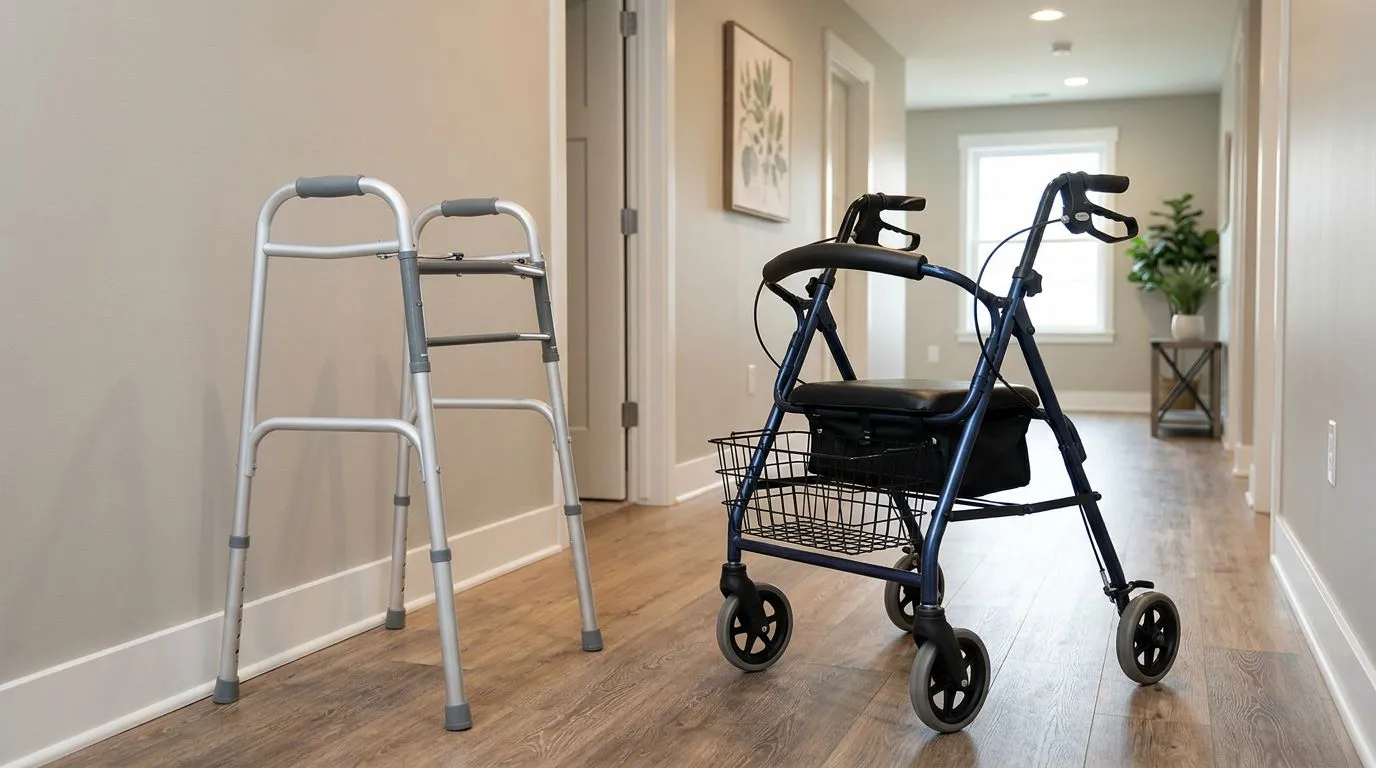
Mobility Walker With Seat vs Standard Walker: Which One Is Right for You?
14 min readWalker or Rollator for Cruises: Cabin Storage, Gangways, Shore Excursions, and Brake Safety
13 min read