Disclosure: We may earn a commission when you buy through links on this page, at no extra cost to you. We buy nothing, sell nothing and accept no payment for coverage — commissions never decide what we recommend. How we make money.
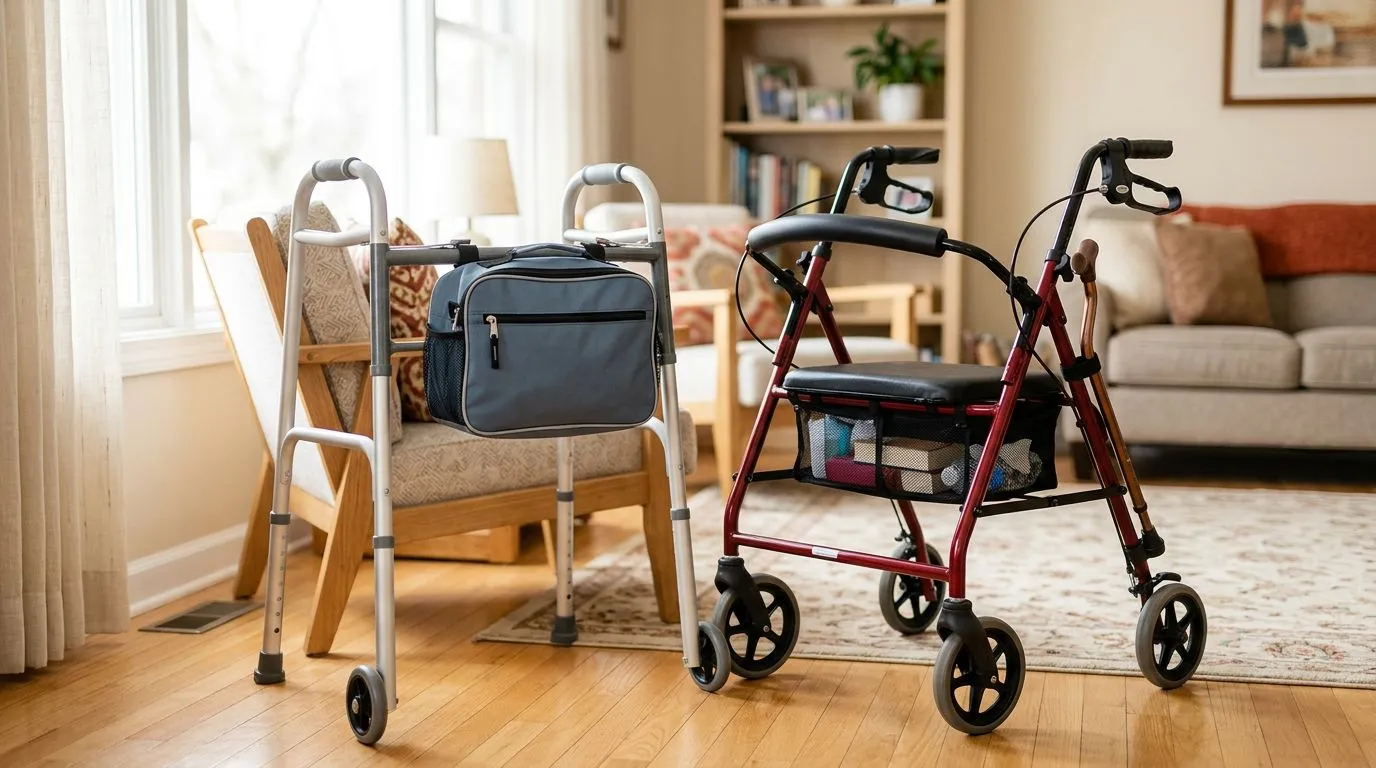
The most useful mobility walker accessories solve real daily problems without making a walker or rollator harder to use. Bags, baskets, trays, glides, grips, wheels, brake parts, and replacement tips can improve convenience and safety when they fit the frame correctly and do not interfere with walking, folding, braking, or sitting.
For standard walkers and folding walkers, accessories usually focus on carrying items, improving floor glide, and replacing worn rubber tips. For rollators, accessories often include under-seat bags, baskets, cup holders, backrests, brake cables, wheel parts, and hand grips. The right choice depends on your walker type, frame size, hand strength, home layout, and how you move through a normal day.
1-minute overview: walker vs. rollator accessories
A walker and a rollator are related mobility aids, but their accessories are not always interchangeable. A standard walker has 4 legs and may have no wheels or 2 front wheels. A rollator has 3 or 4 wheels, hand brakes, and usually a built-in seat. Those differences matter because an accessory that works well on a rollator may be unsafe or awkward on a basic walker frame.
Walkers are often chosen when someone needs steadier support and can lift or partly lift the frame with each step. Common walker add-ons include front baskets, side bags, trays, tennis-ball-style glides, ski glides, replacement rubber tips, grip covers, and wheel kits where appropriate. Because many standard walkers fold to about 4 to 6 inches thick, accessories should not block the folding mechanism.
Rollators are often chosen when a person can safely manage wheels and hand brakes and wants a seat for rest breaks. Rollator accessories may include under-seat storage bags, removable baskets, cane holders, cup holders, brake cables, brake handles, replacement wheels, seat pads, and backrest parts. A 4-wheel rollator is usually more stable than a 3-wheel rollator, while a 3-wheel rollator may turn more easily in narrow spaces.
| Mobility aid | Common accessories | Watch for |
|---|---|---|
| Standard or folding walker | Bags, baskets, trays, glides, tips, grips | Blocking the fold, adding front-heavy weight, wrong leg diameter |
| Two-wheel walker | Rear glides, rear tips, front wheel replacements, organizer bags | Uneven glide height, worn rear tips, wheels that do not roll straight |
| 3-wheel rollator | Small bags, baskets, brake parts, grips, cane holders | Limited seating, smaller storage, tipping risk if overloaded |
| 4-wheel rollator | Under-seat bags, baskets, trays, cup holders, brake parts, wheels | Seat height, brake adjustment, weight capacity, folded width |
| Upright or bariatric rollator | Forearm pads, larger bags, heavy-duty brake parts, wider backrests | Higher frame weight, wider door clearance, correct user weight rating |
5 accessory categories worth considering first
Most shoppers can narrow the search to 5 practical categories: storage, surface contact, hand comfort, braking control, and daily convenience. These cover the parts most likely to affect how a walker or rollator feels during everyday use.
Storage: bags, baskets, and pouches
Storage accessories help when you need to carry a phone, wallet, keys, glasses, medication organizer, mail, or a water bottle. A small walker bag on the front crossbar may be enough indoors. A rollator under-seat bag can hold more, but it should not be packed so heavily that it changes how the rollator steers.
A good rule is to keep frequently used items within easy reach and heavier items low and centered. Avoid hanging a heavy purse from one handle. Even a 5 lb load on one side can make a walker or rollator feel unbalanced, especially during turns.
Surface contact: tips, glides, skis, and wheels
Standard walkers depend on rubber tips or glides where they meet the floor. Tips provide grip but may drag on carpet. Glides reduce friction, especially on indoor surfaces, but they may be less secure outdoors or in wet areas. Two-wheel walkers often use wheels in front and glides or rubber tips in back.
Rollators rely on wheel condition and brake contact. If a wheel wobbles, squeaks, drags, or has visibly worn tread, inspect the axle, bearings, or wheel assembly. Many rollator wheels are in the 6 to 10 inch range, and wheel size affects how easily the rollator handles thresholds, sidewalks, and outdoor cracks.
Hand comfort: grips and covers
Hand grips wear down over time. Foam can compress, rubber can crack, and textured surfaces can become slick. Replacement grips or padded covers can help when hands are sensitive, but oversized covers may make the handle harder to hold for people with small hands or reduced grip strength.
Braking control: rollator brake parts
Brakes are central to rollator safety. A rollator typically uses hand brakes connected by cables to brake pads near the rear wheels. Brake handles, cables, housings, springs, and pads may need adjustment or replacement with use. Walkers without wheels do not have brakes, and two-wheel walkers generally depend on rear tips or glides instead of hand brakes.
Daily convenience: trays, cup holders, lights, and cane holders
Convenience accessories can be useful, but they should not get in the way. A tray may help move a plate or book across a room, but it can block folding or make the walker bulkier. A cup holder should keep liquid upright and should not stick out so far that it catches on a doorway. Many interior doorways are about 28 to 32 inches wide, so side-mounted accessories need extra attention.
3 storage choices: bags, baskets, and trays
Storage is often the first upgrade people consider because both hands should stay on the walker or rollator while moving. Carrying items in the hands can interfere with balance and posture. The best storage choice depends on whether the user has a standard walker, a two-wheel walker, or a rollator with a seat.
| Storage type | Best for | Walker fit | Rollator fit |
|---|---|---|---|
| Soft bag | Phone, wallet, tissues, mail, small items | Often attaches to front or side bars | Often attaches under seat or to front frame |
| Wire or plastic basket | Light groceries, books, larger items | May fit front crossbar on some frames | May fit under seat or front frame |
| Tray | Moving lightweight items across a room | Usually rests on top rails of some walkers | May fit over seat on some rollators |
Soft bags are forgiving. They fold with some walkers, do not rattle much, and are less likely to damage walls or furniture. Look for wide hook-and-loop straps, zippers or secure closures, and pockets that can be reached while seated or standing still. A front walker bag should not hang so low that it brushes the floor or feet.
Baskets hold their shape and make contents easy to see. They can also add width and may rattle on hard floors. For a standard walker, a basket mounted too far forward can make the frame feel front-heavy. For a rollator, a basket under the seat is usually more centered than one hanging from the handlebars.
Trays are best for short, careful indoor tasks. They are not a substitute for a stable kitchen cart, and they should not be overloaded. A cup of hot coffee on a tray can spill if the walker hits a threshold or rug edge. If a tray is used, test it empty first, then with lightweight items, and always keep both hands available for support while moving.
4 surface parts: rubber tips, glides, skis, and wheels
The parts that touch the floor affect stability, noise, effort, and wear. On a no-wheel walker, 4 rubber tips are often the main contact points. On a two-wheel walker, the front wheels roll while the rear tips or glides control friction. On a rollator, all wheels and brakes must work together.
Rubber tips are simple in concept and important in function. They should sit flat on the floor, fit snugly, and show tread or texture. Replace them when they are cracked, slick, uneven, or worn through. If a tip has a metal insert showing or leaves marks because it is breaking down, replacement is overdue.
Glides, including ski-style glides, can make a walker easier to move across carpet or smooth indoor flooring. They are common on the rear legs of two-wheel walkers. They may not be ideal on wet tile, loose gravel, steep outdoor surfaces, or slick ramps. Some users keep rubber tips for certain conditions and glides for others, but changes should be made carefully and consistently so the walker height remains even.
Wheels are different. Walker front wheels are usually smaller than rollator wheels and are designed to roll while the back of the walker remains controlled by tips or glides. Rollator wheels may be 6, 8, or 10 inches, with larger wheels generally handling outdoor cracks and thresholds better. If replacing a wheel, match diameter, width, axle style, and brake compatibility.
2 hand-contact upgrades: grips and grip covers
Hands guide the walker, control the rollator, and absorb some pressure during use. Even a small change in grip diameter can affect comfort and control. Many walker and rollator handles are roughly 1 inch in diameter before any cover is added, though designs vary.
Replacement grips are useful when the original handles are cracked, sticky, loose, compressed, or slippery. They should fit tightly and should not rotate during use. A rotating grip can be more than irritating; it can reduce control when turning or braking. If a grip slides on easily, it may slide off easily too unless it is designed to lock in place.
Grip covers add cushioning without replacing the handle. They may help with pressure sensitivity, but thicker is not always better. A bulky cover can make it harder to wrap the fingers around the handle or reach a rollator brake lever. This matters especially for people with arthritis, neuropathy, small hands, or limited hand strength.
For rollators, always check brake reach after adding any grip cover. The user should be able to keep the hand on the handle and squeeze the brake lever without stretching. If the brake lever feels farther away after padding is added, choose a thinner cover or ask a qualified technician to review the setup.
3 brake checks for rollators before buying parts
Rollator brakes deserve special attention because they help control speed and keep the rollator still when sitting or standing. A 4-wheel rollator seat should not be used unless the parking brakes hold securely on a level surface. If the brakes feel weak, uneven, noisy, or hard to squeeze, inspect the system before ordering random replacement parts.
Check 1: Does each brake stop the correct wheel?
Squeeze the right and left brake levers one at a time while standing beside the rollator. Each lever should engage the intended rear wheel without excessive delay. If one side stops and the other does not, the issue may be cable tension, a loose clamp, worn brake pad contact, or a damaged cable.
Check 2: Do the parking brakes hold?
Most rollators have a push-down parking brake or a lock built into the hand lever. On a flat floor, lock both brakes and gently try to move the rollator. It should resist rolling. Do not test this on stairs or a steep ramp. If the rollator moves with brakes locked, the brakes need adjustment, repair, or compatible replacement parts.
Check 3: Are the cables frayed or kinked?
Brake cables can stretch, fray, rust, kink, or loosen where they meet the handle or brake assembly. A frayed cable is not a comfort issue; it is a control issue. Replace damaged cables with parts that match the rollator design, cable length, end fittings, and brake mechanism.
If you are not confident adjusting brakes, get help from a mobility equipment provider, repair technician, or clinician familiar with rollators. Brake adjustment is not the place to guess.
6-step compatibility check before you buy
Compatibility is the difference between a helpful upgrade and a frustrating return. Before choosing accessories or replacement parts, spend 6 minutes measuring and inspecting the walker or rollator.
- Identify the mobility aid type. Is it a no-wheel walker, folding walker, two-wheel walker, 3-wheel rollator, 4-wheel rollator, upright rollator, or bariatric rollator?
- Measure tubing diameter. Many clamp-on accessories attach to round frame tubing, often near 1 inch, but sizes vary. Measure the outside diameter where the accessory will attach.
- Measure width and clearance. Check the total outside width of the walker or rollator, then consider doorways, hallways, bathroom spaces, and car trunks. An accessory that adds 2 inches per side can matter.
- Check folding points. Fold the walker or rollator fully. Note where crossbars, hinges, seats, and handles move. Accessories should not block a complete fold or pinch cables.
- Confirm weight limits. The walker or rollator has a user weight capacity, and some accessories have their own load limits. Storage should not be used to carry heavy items unless designed for it.
- Match left, right, front, and rear orientation. Brake parts, wheels, grips, and baskets may not be symmetrical. A right-side brake handle may not fit the left side.
When measuring height-related parts, keep the user in mind. Walker handles are commonly adjusted so the hand grips line up near the wrist crease when the user stands upright with arms relaxed, but personal needs vary. If posture, pain, or balance is an issue, ask a physical therapist or occupational therapist to check fit.
4 user profiles: who each accessory is best for
The best accessory depends on the person, not just the product. A helpful add-on for one user may be unnecessary weight for another. Here are 4 common situations.
For indoor walker users who carry small items
A lightweight front bag or side pouch is usually more practical than a large basket. It keeps hands free without adding much bulk. This is often a good fit for standard folding walkers used around the bedroom, bathroom, kitchen, or hallway.
For two-wheel walker users on carpet
Rear glides may reduce dragging on carpet, while front wheels do the rolling. The key is keeping both rear contact points even. If one glide is worn lower than the other by even a small amount, the walker can rock or feel uneven.
For rollator users who take rest breaks
Brake parts, seat-related parts, backrest condition, and under-seat storage matter most. A rollator seat is useful only when the brakes lock securely and the seat height allows safe sitting and standing. Under-seat bags are usually better than handle-hung bags because they keep weight lower.
For users with hand pain or weak grip
Grip covers may help, but rollator brake reach must be checked. Some people benefit more from brake adjustment than from thicker padding. If the brake lever requires too much force, do not ignore it; get the rollator inspected.
8 safety mistakes to avoid with walker and rollator add-ons
Accessories should make a mobility aid easier to live with, not less predictable. These 8 mistakes are common and avoidable.
- Overloading storage. Heavy groceries, large handbags, or oxygen accessories should not be added unless the walker or rollator is designed for that load and setup.
- Hanging weight from one handle. Side weight can pull the frame during turns.
- Blocking brake cables. Bags and cup holders should not pinch, rub, or bend rollator brake cables.
- Using worn tips too long. Smooth rubber tips reduce traction and can wear unevenly.
- Adding glides in the wrong environment. Glides may slide too easily on some wet or slick surfaces.
- Ignoring folded size. A walker that no longer folds properly may be harder to store, transport, or use safely.
- Covering reflectors or visibility features. If a rollator is used outdoors, do not hide reflective strips or bright frame areas.
- Assuming universal fit. Universal often means adjustable, not guaranteed.
Also be careful with rugs, cords, raised thresholds, and clutter. Accessories cannot compensate for a home environment that repeatedly catches wheels, tips, or glides. Small changes, such as removing a loose throw rug or adding better lighting, may be more valuable than another add-on.
10-minute maintenance routine for replacement parts
A simple 10-minute monthly check can catch many problems early. It does not replace professional service, but it helps users and caregivers notice wear before it affects daily use.
- Look at all floor-contact parts. Check 4 tips on a standard walker, rear tips or glides on a two-wheel walker, and all wheels on a rollator.
- Press and twist grips. They should not rotate, slide, crack, or feel sticky.
- Check screws, knobs, and clamps. Tighten only according to the design. Do not overtighten plastic parts.
- Inspect bags and baskets. Look for torn straps, loose snaps, bent hooks, or fabric dragging near wheels.
- Test rollator brakes. Squeeze both hand brakes and lock both parking brakes on a level surface.
- Fold and unfold the frame. Make sure accessories do not interfere with hinges, seats, or crossbars.
- Listen for new sounds. Clicking, scraping, or squeaking may point to a loose part or wheel issue.
Replace parts in pairs when wear affects symmetry. For example, replacing only one rear glide on a two-wheel walker can leave the walker uneven if the other glide is worn. The same idea applies to rubber tips and some wheel parts.
5 buying questions to decide what is worth it
Before buying any walker or rollator accessory, ask 5 plain questions. This keeps the decision practical and avoids cluttering the frame with add-ons that sound useful but rarely help.
| Question | Why it matters |
|---|---|
| What daily problem does this solve? | A bag for mail is clearer than buying storage just because it exists. |
| Will it fit this exact walker or rollator? | Frame tubing, width, folding style, and brake cables vary. |
| Will it change balance or steering? | Added weight can affect turns, thresholds, and narrow spaces. |
| Can the user operate it with 1 hand or limited grip? | Zippers, snaps, brake levers, and clamps should match hand ability. |
| Is maintenance simple? | Parts that loosen often or collect dirt may become frustrating. |
For many walker users, the best first purchase is a light storage bag and fresh rubber tips or glides if the old ones are worn. For many rollator users, brake inspection and properly fitted storage are higher priorities than decorative accessories. If the frame itself is bent, unstable, too low, too high, or the wrong type for the user, accessories are not a fix. The mobility aid may need refitting or replacement.
5 FAQs about walker accessories and rollator parts
Are walker accessories universal?
Some are adjustable, but none should be assumed to fit every walker. Check tubing diameter, frame width, folding clearance, and whether the accessory is intended for a standard walker, two-wheel walker, 3-wheel rollator, or 4-wheel rollator.
Can I put rollator accessories on a regular walker?
Sometimes, but not always. A small pouch may fit both, while a rollator basket, brake part, seat pad, or under-seat bag usually depends on rollator-specific frame features. Do not attach anything that blocks folding or changes the walker’s balance.
How often should walker tips or glides be replaced?
Replace them when they are cracked, smooth, uneven, loose, or worn through. Some users need replacements in a few months, while light indoor users may go longer. Inspect them at least monthly.
Why do my rollator brakes still slip after adjustment?
Possible causes include stretched cables, worn brake pads, worn wheels, loose hardware, or incompatible replacement parts. If the parking brakes do not hold on a level surface, stop using the seat until the brakes are repaired.
Is a bag or basket better for a walker?
A soft bag is usually lighter and less bulky, making it a good first choice for many folding walkers. A basket may hold larger items but can add width, rattle, or make the front of the walker feel heavier.
FAQ
Frequently asked questions
Can I use rollator accessories on a regular walker? +
Sometimes. A small pouch may fit both, but rollator baskets, brake parts, seat pads, and under-seat bags usually depend on rollator-specific frame features. Avoid any accessory that blocks folding or affects balance.
When should walker tips or glides be replaced? +
Replace walker tips or glides when they are cracked, slick, uneven, loose, or worn through. A monthly inspection is a good habit, especially for walkers used outdoors or on rough surfaces.
What should I check before replacing rollator brakes? +
Check whether each hand brake engages the correct wheel, whether the parking brakes hold on a level floor, and whether the cables are frayed, kinked, stretched, or loose. Match replacement parts to the rollator’s brake design.
Keep reading
Related guides
Budgeting for Walker and Rollator Accessories: What to Buy Now, What Can Wait, and What to Skip
11 min read
Walker and Rollator Accessories Guide: Bags, Trays, Cup Holders, Lights, and Comfort Add-Ons
14 min read
Walker Covers, Lights, and Reflective Accessories: Protect Your Walker and Improve Visibility
14 min read