Disclosure: We may earn a commission when you buy through links on this page, at no extra cost to you. We buy nothing, sell nothing and accept no payment for coverage — commissions never decide what we recommend. How we make money.

Walker covers, lights, and reflective accessories can help protect your walker or rollator from weather, scratches, and low-light visibility issues. The right add-ons depend on whether you use a standard walker, two-wheel walker, folding walker, or rollator with a seat and hand brakes. Start with safe fit: accessories should not block brakes, wheels, folding joints, hand grips, or your walking path.
These accessories do not make a walker safe for every condition, and they should not replace careful route planning or medical guidance. They can make everyday use easier, though, when you store your walker outdoors for short periods, travel by car, walk in dim hallways, or move through parking lots near dawn or dusk.
Why covers and visibility accessories matter after 30 minutes outdoors
A walker or rollator can collect moisture, dust, grit, and road salt in a single outing. Even 30 minutes on a wet sidewalk may leave water on hand grips, brake cables, folding hinges, wheel bearings, or the underside of a seat. Over time, moisture and dirt can make equipment harder to clean and less pleasant to use.
Visibility is a separate concern. Many older adults use mobility aids in places where lighting changes quickly: apartment corridors, garages, driveways, medical office parking lots, and shaded sidewalks. A dark walker frame may blend into shadows, especially if the user is moving slowly or crossing behind parked cars.
Walker covers and rollator covers protect the equipment during storage or transport. Lights and reflective accessories help other people notice the mobility aid sooner in low-light conditions. These are practical upgrades, not decorations. The best accessory adds protection or visibility without changing how safely you walk.
Walker vs rollator accessory needs: 0, 2, 3, and 4 wheels
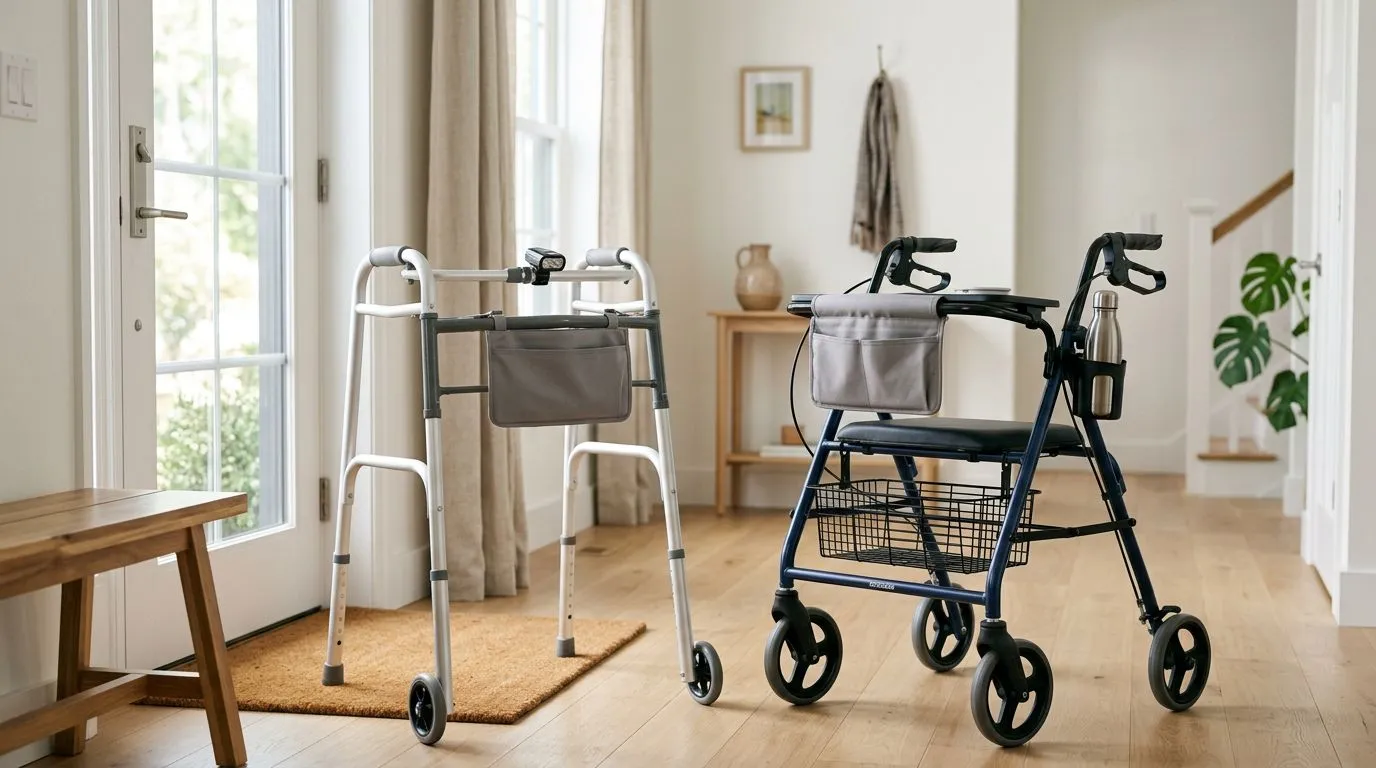
Walkers and rollators are related, but they are not the same. A standard walker or no-wheel walker frame is lifted and moved forward with each step. A two-wheel walker rolls at the front while the rear legs provide stability. A rollator is a wheeled walker, usually with 3 or 4 wheels, hand brakes, and often a built-in seat.
That difference affects accessories. A cover that fits a compact folding walker may not fit over a rollator seat and backrest. A light that works on a straight walker leg may not attach securely to a curved rollator frame. Reflective tape on a rear walker leg can be helpful, but tape near a rollator brake cable may interfere with inspection or adjustment.
| Mobility aid type | Common accessory priorities | Fit cautions |
|---|---|---|
| Standard or no-wheel walker | Frame protection, reflective tape, simple clip-on light | Do not cover rubber tips or folding buttons |
| Two-wheel walker | Front visibility, wheel-area dirt protection, hand-grip protection | Keep accessories away from front wheels and rear tips |
| Folding walker | Travel cover, storage sleeve, removable light | Confirm the walker still folds fully |
| 3-wheel rollator | Front light, reflective side strips, basket or pouch cover | Avoid blocking brake cables or swivel wheel movement |
| 4-wheel rollator | Seat cover, full weather cover, front and rear reflectors | Keep brakes, seat latch, and folding mechanism clear |
| Upright or bariatric rollator | Larger cover, higher-mounted reflectors, stronger attachment straps | Check frame diameter and higher handle height before buying |
Use the accessory label or sizing description as a starting point, then check your own equipment. Two walkers with the same height range can still differ in frame shape, wheel size, and folding mechanism.
Walker and rollator covers: 3 main jobs they should do
A good cover should do at least 1 of 3 jobs: protect the frame during storage, shield soft parts from rain and dust, or keep carried items more private. Some covers are made for full-equipment protection, while others cover only a seat, basket, pouch, or handles.
For a standard walker, a simple storage cover can reduce dust when the walker sits in a garage, closet, or car trunk. For a folding walker, a travel sleeve may help keep the frame from scratching the inside of a vehicle. For a two-wheel walker, a cover should avoid the wheels and rubber tips, since those parts need direct contact with the floor.
Rollators usually have more areas to protect. A 4-wheel rollator may have a padded seat, under-seat storage, a back strap, brake handles, and cables. A seat cover can help keep the sitting surface dry if the rollator is parked near an entrance. A basket or pouch cover can help shield personal items from light rain, though it should not be treated like a waterproof safe.
- Storage covers: Useful for garages, porches, closets, and car trunks.
- Weather covers: Helpful for short outdoor exposure, such as waiting 10 minutes at a pickup area.
- Seat or pouch covers: Best for rollators with built-in seats or under-seat storage.
- Handle covers: Can improve grip comfort, but they must not make handles slippery or oversized.
Be realistic about water resistance. Many fabric covers shed light rain but are not designed for heavy storms or standing water. If your walker or rollator gets wet, wipe it down and let it dry in a ventilated area before folding or storing it.
Lights for walkers and rollators: aim for 20 to 100 lumens, not glare
Walker lights and rollator lights should help you see the path and help others see you. For many indoor and sidewalk situations, a small light in the range of about 20 to 100 lumens is enough. Brighter is not always better. A harsh beam can reflect off polished floors or shine into another person’s eyes.
Clip-on lights are common because they are easy to remove for charging or battery replacement. Strap-on lights can fit round or oval tubing, but they need to be snug enough not to slide down the frame. Magnetic lights may be convenient on some metal frames, but not all walker or rollator frames are magnetic, and a weak attachment can fall off over bumps.
For standard and two-wheel walkers, a front-facing light mounted low to mid-frame can illuminate thresholds, floor transitions, and sidewalk cracks. Avoid placing a light where your knee, clothing, or hand will hit it. On a rollator, the front frame or handle area may work, as long as the light does not interfere with brake levers, brake cables, or folding.
| Light feature | Why it matters | What to check |
|---|---|---|
| Beam direction | Helps illuminate the walking path | Aim downward, not into faces |
| Battery access | Makes maintenance easier | Can you change or recharge it with limited hand strength? |
| Attachment style | Prevents slipping or rattling | Test it on your frame diameter before regular use |
| On/off button | Important for daily use | Look for a button you can press without pain or strain |
| Water resistance | Helps during drizzle or damp storage | Do not assume it can handle heavy rain unless stated |
Check the light every week if you rely on it. Batteries can weaken slowly, and rechargeable lights may lose charge between uses. A light that worked last month may not be ready for an early morning appointment today.
Reflective accessories: add visibility from 2 directions or more
Reflective tape, reflective sleeves, clip-on reflectors, and reflective flags help make a walker or rollator more noticeable when light hits them. Unlike powered lights, reflectors do not need batteries. Their limitation is that they only work well when another light source, such as a car headlight or hallway light, reaches them.
For better coverage, place reflective material where it can be seen from at least 2 directions, such as front and side, or rear and side. On a standard walker, the front crossbar and outer side legs are common locations. On a two-wheel walker, the front frame is especially important because it enters a space first. On a 3-wheel or 4-wheel rollator, consider front-facing and rear-facing placement because the rollator may be parked or moving in either direction near traffic areas.
Do not put reflective tape over moving joints, height-adjustment holes, brake cables, serial labels, or rubber tips. Tape can peel, collect dirt, or hide wear that should remain visible. If you use a walker outdoors in winter, inspect reflective pieces more often because moisture and salt can weaken adhesives.
- Use short strips rather than wrapping an entire tube if the frame folds.
- Keep reflective material smooth; wrinkles reduce reflectivity.
- Clean the frame first and let it dry for at least 10 minutes before applying adhesive tape.
- Replace peeling or cracked reflective tape instead of pressing it back repeatedly.
Reflective accessories are especially useful for people who wear dark coats, use black or gray mobility equipment, or walk through parking lots at dawn or dusk. Placed carefully, they are simple, low-maintenance additions.
Who these accessories are best for: 5 common situations
Walker covers, lights, and reflective add-ons are not necessary for every user. They are most helpful when a person’s daily routine includes storage challenges, transportation, or low-light movement. If your walker stays indoors in a bright, dry home, you may only need a small reflector or no accessory at all.
These add-ons are often worth considering in 5 situations. First, if you store a walker in a garage, entryway, shared hallway, or vehicle, a cover can reduce dust and scratches. Second, if you use a rollator with a seat outdoors, a seat cover can keep the sitting area cleaner and drier. Third, if you walk before sunrise or after sunset, a light and reflectors can improve visibility.
Fourth, if you live in an apartment or senior community with dim corridors, a small front light can help you notice thresholds and elevator gaps. Fifth, if caregivers or family members transport the walker several times a week, a folding cover or frame protector can reduce scuffs in the car and make handling cleaner.
- Best for standard walker users: Reflective strips, hand-grip protection, and simple storage covers.
- Best for two-wheel walker users: Front lights, front reflectors, and covers that avoid rear rubber tips.
- Best for folding walker users: Lightweight removable accessories that do not block folding.
- Best for 3-wheel rollator users: Side reflectors and compact lights that do not affect steering.
- Best for 4-wheel, upright, or bariatric rollator users: Larger covers, seat protection, and brake-safe light placement.
If you have poor vision, balance changes, neuropathy, or a history of falls, ask a clinician or mobility professional to review your setup. Accessories should support safe use, not compensate for a walker or rollator that is the wrong height or type.
How to choose and measure: use 4 fit checks before buying
Before choosing any walker or rollator accessory, measure and inspect the equipment you already use. A 1-inch difference in tube diameter or a few extra inches of seat width can determine whether a cover or light fits properly. Do not rely only on generic terms like “universal.”
Start with the overall dimensions. Measure the walker or rollator height from the floor to the hand grips. Measure the widest point, usually the outside of the rear legs or rear wheels. If it folds, measure the folded width and thickness, especially if you want a storage or travel cover.
Next, measure attachment areas. Frame tubes may be round, oval, or angled. A clip that fits a straight 1-inch tube may not hold well on a curved or padded section. For rollators, identify where the brake cables run and leave them uncovered. For upright rollators, check the forearm platform area and vertical handle supports, which may sit higher than a standard rollator handle.
| Fit check | What to measure or test | Why it matters |
|---|---|---|
| Height and width | Floor to grips; widest outside point | Helps choose a full cover that is not too tight |
| Folded size | Folded width, depth, and thickness | Important for travel covers and car storage |
| Tube diameter | Commonly around 1 inch, but it varies | Affects clips, straps, and light mounts |
| Moving parts | Folding buttons, hinges, wheels, brakes | Accessories must not block function |
| Hand contact areas | Grips, brake handles, forearm pads | Nothing should reduce control or comfort |
After installing an accessory, do a 5-minute home test. Fold and unfold the walker if applicable. Turn the rollator brakes on and off. Walk across a doorway threshold, turn in a hallway, and sit on the rollator seat if it has one. If anything shifts, rattles, catches your clothing, or changes your posture, adjust it or remove it.
Safety and maintenance: inspect accessories every 7 days
Accessories help only when they stay secure and clean. A loose light can drop near your feet. A stretched cover can catch in a wheel. A peeling reflector can distract you or leave sticky residue on the frame. A weekly inspection, about every 7 days, is a sensible habit for regular users.
Look first at contact points. Straps should be snug but not so tight that they pinch brake cables or deform padding. Covers should not drag on the floor. Reflective tape should lie flat. Lights should turn on easily, hold their angle, and have enough battery power for your next outing.
Cleaning is usually simple. Wipe hard plastic lights and reflectors with a slightly damp cloth. Let fabric covers air-dry before storing them. If a cover becomes stiff, mildewed, torn, or slippery, replace it. Do not use oily cleaners on hand grips, brake handles, seats, or any area you touch for support.
- Check rubber walker tips and rollator wheels after adding any accessory near the lower frame.
- Keep brake handles and cables fully visible on rollators.
- Remove travel covers before walking unless the cover is specifically designed for use while moving.
- Avoid hanging heavy items from lights, reflectors, or cover straps.
- Recheck all accessories after a car trip, flight, or bus ride.
Any new accessory should feel nearly invisible during normal walking. If you find yourself stepping around it, gripping differently, or worrying that it may fall off, it is not the right setup.
Indoor, outdoor, and travel use: plan for 3 different environments
The best accessory setup may change depending on where you use your walker or rollator. Indoor use, outdoor use, and travel each create different problems. Thinking in these 3 categories helps you avoid buying extra items that do not match your routine.
Indoors, visibility is often about floor changes, pets, thresholds, and dim hallways. A small downward-facing light may be useful, but large reflectors may not add much unless other people need to see the walker from a distance. Covers are usually for storage rather than active use.
Outdoors, weather and traffic awareness matter more. A rollator with a seat may benefit from a seat cover if it is parked at a bus stop or near a clinic entrance. Reflective strips on the front and sides of a walker can help in crosswalks and parking lots. Lights should be weather-resistant enough for drizzle, though users should still avoid unsafe walking conditions when possible.
For travel, foldability becomes the main test. A folding walker may need to collapse in seconds for a car trunk or ride service. A 4-wheel rollator may fold side-to-side or front-to-back, depending on the design. Any cover or reflector that slows folding, blocks a latch, or catches in a vehicle door can become a daily frustration.
If you travel often, choose removable accessories and keep a small checklist: light charged, reflectors attached, cover removed before use, brakes working, and tips or wheels clear. It takes less than 2 minutes and can prevent many avoidable problems.
FAQ: 5 practical questions about walker covers, lights, and reflectors
Can I leave a walker cover on while using the walker?
Usually, no. Full storage or travel covers should be removed before walking because they can block the frame, tips, wheels, or folding joints. Smaller handle, seat, pouch, or basket covers may be usable if they are secure and do not interfere with grip, brakes, or movement.
Where should I put a light on a walker?
Place a light where it points slightly downward and forward without blocking your hand placement or leg movement. On many standard and two-wheel walkers, the front frame is a good starting point. On a rollator, keep lights away from brake levers, cables, and folding parts.
Are reflective accessories enough for night walking?
Reflective accessories help others see you when light shines on them, but they do not light your path. For low-light walking, many users benefit from both reflectors and a small walker or rollator light. Avoid walking in conditions where you cannot see hazards clearly.
Will accessories affect rollator brakes?
They can if installed carelessly. Rollator brake handles and cables must stay clear and easy to inspect. After adding any light, cover, or reflector, test the brakes several times before leaving home.
How do I know if a cover will fit my rollator seat?
Measure the seat width and depth in inches, then compare those numbers with the cover’s stated size. Also check the back strap, folding latch, and under-seat storage so the cover does not block normal use.
Keep reading
Related guides

Weather, Visibility, and Protection Accessories for Walkers and Rollators
13 min read
Mobility Walker Accessories and Replacement Parts: Bags, Baskets, Glides, Grips, and Brakes
16 min read
Decorative Walker and Rollator Accessories: How to Personalize Without Creating a Safety Problem
13 min read