Disclosure: We may earn a commission when you buy through links on this page, at no extra cost to you. We buy nothing, sell nothing and accept no payment for coverage — commissions never decide what we recommend. How we make money.
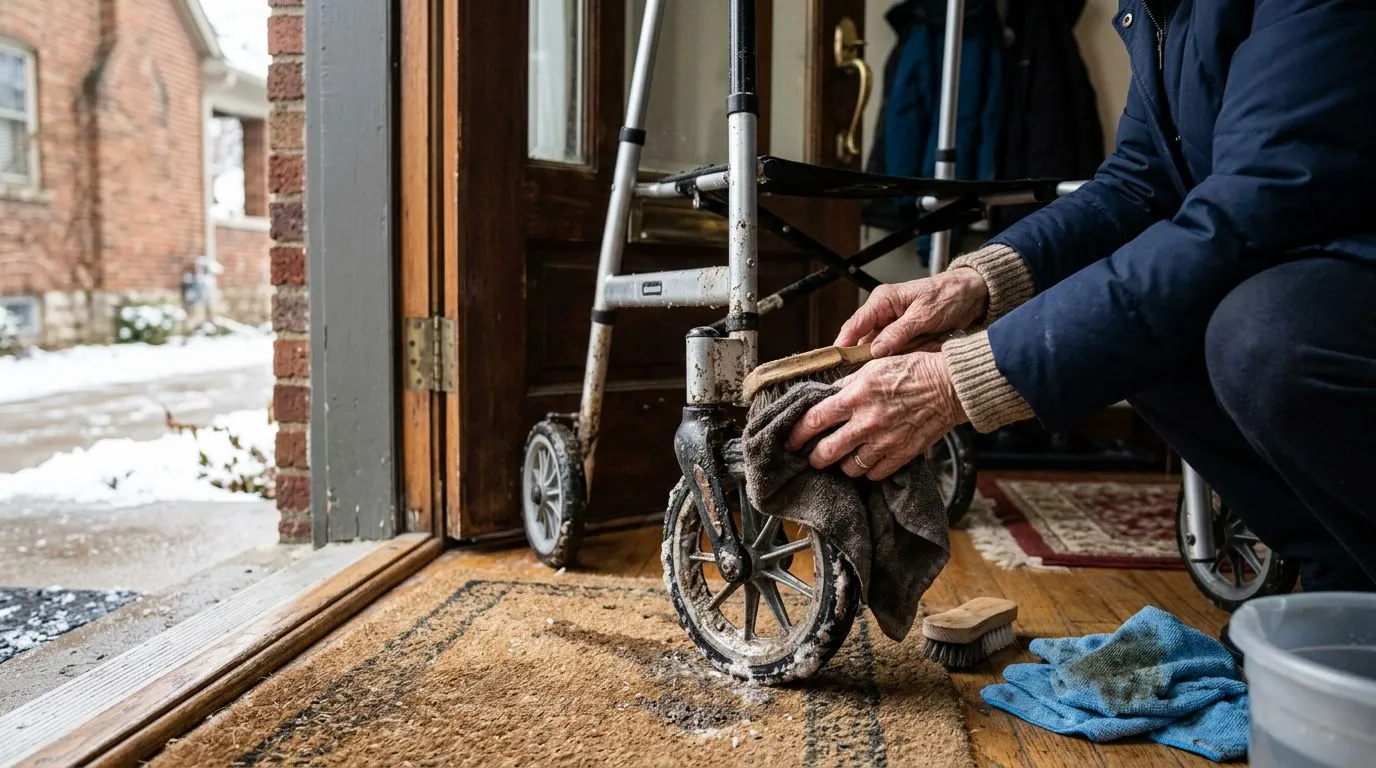
Outdoor walker care is simple: remove mud, moisture, grit, and road salt before they dry into moving parts or cause corrosion. After wet or dirty trips, wipe the frame, clean the feet or wheels, dry the brakes and folding joints, and check for rust spots before the next use.
This applies to both walkers and rollators, though the parts are different. A standard or two-wheel walker needs close attention at the tips, skis, front wheels, and folding buttons. A rollator also needs brake cables, wheel hubs, the seat area, and hand brakes kept clean and dry.
Why outdoor walker care matters after 15 minutes outside
A walker or rollator can collect a surprising amount of debris in just 15 minutes on wet sidewalks, gravel paths, grass, ramps, or winter-treated pavement. Mud packs around rubber tips and wheel forks. Sand and tiny stones get stuck in tread. Road salt dries into a gritty film that can irritate hands, damage finishes, and speed up rust on exposed metal.
Cleaning is not just about appearance. A walker that slides because the tips are muddy, or a rollator with brakes that feel weak after salty slush, can be harder to control. Routine care helps preserve traction, folding action, wheel movement, and brake response.
Walkers and rollators are built for support, but they are not immune to weather. Aluminum frames resist rust better than plain steel, yet screws, brake hardware, axles, and scratched areas can still corrode. A 5-minute wipe-down after a messy trip is usually easier than dealing with stuck wheels or rusted fasteners later.
Walker vs. rollator parts to clean: 2 different maintenance maps
Walkers and rollators serve a similar purpose, but their outdoor care needs are not the same. A walker is usually simpler: a frame, hand grips, height-adjustment holes, rubber tips, and sometimes 2 front wheels. A rollator is more complex: 3 or 4 wheels, hand brakes, brake cables or rods, a seat, a backrest, and often a storage pouch.
| Mobility aid type | Outdoor parts that collect grime | Care priority |
|---|---|---|
| Standard no-wheel walker | Rubber tips, lower legs, folding joints, hand grips | Keep tips clean and dry so they do not slide |
| Folding walker | Folding buttons, cross braces, tips or front wheels | Remove grit from moving and locking points |
| Two-wheel walker | Front wheels, rear tips, lower frame, height holes | Clear wheel tread and check rear tip wear |
| 3-wheel rollator | Three wheels, brake handles, cables, pouch, front fork | Keep wheels rolling freely and brakes responsive |
| 4-wheel rollator | Four wheels, seat, backrest, brakes, basket or pouch | Dry the seating area and clean brake hardware |
| Upright or stand-up rollator | Forearm platforms, tall frame, hand brakes, larger wheels | Wipe arm supports and inspect higher stress points |
| Bariatric rollator | Reinforced frame, wider seat, larger wheels, brakes | Check wheel wear and frame hardware regularly |
The biggest difference is braking. Standard walkers do not have hand brakes. Rollators do, and outdoor grime can change how they feel. If a rollator brake lever suddenly pulls farther than usual, sticks, squeaks, or does not hold the wheel securely when parked, stop using it until it is checked and adjusted according to the owner’s manual or by a qualified repair person.
A 5-minute after-trip routine for mud, rain, and grit
After an outdoor trip, a quick routine can prevent most common problems. Keep a small care kit near the door: 1 soft towel, 1 old toothbrush, mild dish soap, a small bowl of warm water, and a dry cloth. Avoid soaking the walker or rollator. The goal is to clean surfaces, not force water into bearings, brake lines, or frame openings.
- Step 1: Park safely. Place the walker or rollator on a flat surface. Lock rollator brakes before cleaning.
- Step 2: Knock off loose debris. Use a dry brush or cloth to remove mud clumps, grass, leaves, and gravel.
- Step 3: Wipe the lower frame. Clean the bottom 12 to 18 inches of the legs and supports, where splashes collect.
- Step 4: Clean tips or wheels. Scrub rubber tips, wheel tread, and wheel forks with a damp cloth or toothbrush.
- Step 5: Dry everything. Use a dry towel on grips, joints, brake handles, seat surfaces, and metal hardware.
For a standard walker, spend extra time on the rubber tips. Mud can create a slick layer between the tip and the floor. For a two-wheel walker, check both front wheels and the rear tips because they contact different surfaces. For a rollator, spin each wheel by hand after cleaning. It should turn smoothly without scraping, wobbling, or dragging.
Weekly 15-minute deep clean for outdoor walkers and rollators
If you go outside several times a week, plan a deeper cleaning about once every 7 days during wet or dusty seasons. A weekly 15-minute inspection is especially useful in spring mud, summer gravel, fall leaves, and winter slush.
Start with the frame. Wipe all exposed tubing with a damp cloth and mild soap, then dry it. Pay attention to joints, height-adjustment buttons, folding hinges, cross braces, and lower legs. Dirt tends to hide behind braces and under plastic trim pieces.
Next, inspect hand grips and arm supports. Grips should not twist freely, slide off, or feel sticky from dirt and sweat. Upright rollators may have forearm platforms that need wiping on both the top padding and underside. A dirty or damp arm platform can be uncomfortable and may break down sooner.
For rollators, clean the seat and backrest carefully. If the seat is padded, wipe it with a lightly damp cloth rather than soaking it. Let it air-dry completely before storage. Check the storage pouch or basket for damp tissues, leaves, sand, and small stones. Moisture trapped in a pouch can transfer to metal hardware or fabric seams.
Do not use harsh cleaners, bleach, abrasive pads, or pressure washers. High-pressure water can push grit into bearings and brake mechanisms. A garden hose may seem convenient after a muddy walk, but a controlled wipe-down is safer for most walkers and rollators.
Removing mud, grass, and gravel from 4 common trouble spots
Mud and gravel usually settle in 4 areas: rubber tips, wheel tread, wheel forks, and folding joints. Cleaning these spots first gives the biggest practical benefit.
1. Rubber tips on standard and folding walkers
Turn the walker slightly to inspect each tip, or ask someone to help if lifting it is not safe. Remove pebbles lodged in the bottom. Wipe away mud until the rubber surface is visible. If a tip is cracked, flattened, worn through, or uneven, replace it with the correct size listed for your walker.
2. Front wheels on two-wheel walkers
Two-wheel walkers often pick up hair, grass, string, and small stones around the axle. Use a cloth or soft brush to clear the wheel edge and fork. If the wheel no longer rolls freely after cleaning, the axle may need inspection.
3. Rollator wheels and forks
Rollator wheels, especially larger outdoor-style wheels in the 8-inch range, can carry grit into the home. Rotate each wheel slowly and look at the tread from all sides. Clean around the fork where the wheel sits. If debris is wrapped tightly around the axle, do not pull hard with sharp tools near brake parts; have it removed safely.
4. Folding joints and height holes
Sand and dried mud can collect near push buttons and adjustment holes. Wipe the area and press the button a few times to confirm it moves freely. The button should pop fully into the selected hole. If it does not, the walker or rollator should not be used until the lock works properly.
Rain, puddles, and wet ramps: dry key parts within 30 minutes
After rain exposure, aim to dry important parts within about 30 minutes of coming indoors. This is a practical target, not a medical rule, but it helps reduce water spots, slippery grips, and corrosion risk.
Start with the handles. Wet hand grips can reduce control, especially when moving from an outdoor ramp to indoor flooring. Wipe grips, brake handles, and arm platforms dry. If a rollator has hand brakes, squeeze and release each lever after wiping to make sure it returns normally.
Dry the lower frame and hardware next. Water often beads around screws, height-adjustment holes, and folding hinges. On a rollator, also dry the brake cables or rods where you can see them. Do not apply oil or lubricant to brake surfaces unless the owner’s manual specifically instructs it. The wrong product in the wrong spot can reduce braking performance.
Let fabric parts air out. Rollator seats, backrests, pouches, and baskets can stay damp longer than metal tubing. Open the pouch if it is wet. If the seat is removable only by tools or special steps, do not take it apart unless the manual allows it. Just wipe and air-dry it in a well-ventilated area.
Road salt and winter-treated pavement: rinse the residue within 24 hours
Road salt is one of the harshest outdoor exposures for walkers and rollators. If the frame, wheels, or tips contact salted sidewalks or slushy parking lots, clean the residue within 24 hours when possible. Salt attracts moisture, leaves a white film, and can speed corrosion on exposed metal parts.
Use a cloth dampened with warm water to dissolve salt on the lower frame, wheel forks, axles, brake hardware, and rubber tips. For stubborn residue, add a drop of mild dish soap to the water. Wipe again with plain water, then dry thoroughly.
Do not store a salty walker or rollator in a closed car trunk, garage corner, or entryway closet without cleaning it first. Salt and trapped moisture can keep working even when the device is not being used. If you live in a region with frequent winter treatment, such as the Midwest, Northeast, Mountain West, or parts of the Pacific Northwest, consider making salt removal part of every snowy-day routine.
Winter also changes traction. Rubber tips may become harder in cold conditions, and rollator wheels can pick up compacted slush. Before stepping onto smooth indoor tile after being outside, wipe the tips or wheels. A wet wheel can leave a slick trail, and a muddy rear walker tip can slip when weight is placed on it.
Rust checks: inspect 6 high-risk areas each month
Even if your walker or rollator is mostly aluminum, inspect 6 high-risk areas at least once a month: screws, bolts, folding hinges, height-adjustment holes, wheel axles, and brake hardware. Rust often begins where protective coating has been scratched or where water collects.
Light surface rust may appear as orange or brown discoloration. Wipe the area dry and check whether the metal is pitted, flaking, or weakened. Do not ignore rust on load-bearing areas, brake parts, or folding locks. If you see deep pitting, cracks, bent tubing, loose hardware, or rust around a weld, stop using the device until it is inspected.
A small cosmetic spot on a non-structural screw is different from corrosion around a brake mount or height-adjustment hole. When in doubt, be conservative. A mobility aid supports body weight and balance; guessing about structural damage is not worth the risk.
Preventing rust mostly comes down to dryness and storage. Store the walker or rollator indoors when possible, away from standing water and damp basement floors. If it must be kept in a garage, place it in a dry area and check it more often during humid months.
Who each outdoor mobility aid is best for in 5 real-life situations
Choosing between a walker and a rollator affects both outdoor use and maintenance. The right choice depends on balance, stamina, hand strength, terrain, and whether you need a seat. A clinician, physical therapist, or occupational therapist can help match the device to your needs.
| Situation | Often a better fit | Why | Care note |
|---|---|---|---|
| Short trips on uneven grass or a bumpy walkway | Standard walker or two-wheel walker | More controlled movement, especially for users who need firm support | Clean rear tips after each outdoor use |
| Longer walks on smooth sidewalks | 4-wheel rollator | Wheels and a built-in seat can help with rest breaks | Check brakes and wheel tread often |
| Tight apartment hallways plus occasional outdoor errands | 3-wheel rollator or folding walker | Narrower turning may help in small spaces | Clean the front wheel or tips where grit collects |
| Posture support while walking outdoors | Upright rollator, if clinically appropriate | Forearm supports and taller handles may reduce forward leaning for some users | Dry arm platforms after rain |
| Higher weight capacity needs | Bariatric walker or bariatric rollator | Wider, reinforced frames are designed for higher rated capacities | Inspect wheels, tips, and hardware more frequently |
A walker is usually best when maximum stability and slower, deliberate movement are priorities. A rollator is usually better when the user can safely manage wheels and hand brakes and needs smoother movement or a seat. Rollators should not be used like wheelchairs, and the seat should only be used when the brakes are locked and the device is on a stable, level surface.
How to choose and measure outdoor-friendly features within 1 inch
Fit matters before maintenance ever begins. Handle height is commonly set near the crease of the wrist when the user stands upright with arms relaxed at the sides, allowing a slight elbow bend of about 15 to 30 degrees. Because bodies and conditions differ, ask a healthcare professional to confirm fit, especially after surgery, injury, or a change in balance.
For outdoor walkers, look at the lower contact points. Standard walkers rely on rubber tips; they should be the correct diameter and in good condition. Two-wheel walkers need wheels that are large enough for the surfaces you actually use, but not so large that the walker becomes hard to control. Folding walkers should lock securely after cleaning and storage.
For rollators, consider wheel size, brake style, seat height, overall width, and weight capacity. Many outdoor-oriented rollators use larger wheels than basic indoor models, often around 8 inches, which may roll more easily over sidewalk seams and small cracks. A 4-wheel rollator usually offers more stability and a seat, while a 3-wheel rollator can be easier to maneuver in tight areas but typically has less seating support or no full seat design depending on configuration.
Measure doorways, car trunks, and storage spaces. A difference of 1 inch can matter in a narrow bathroom doorway or beside a bed. Check folded size if you need to lift the device into a vehicle. Also consider cleaning access: wheels with deep grooves may grip better on some surfaces but can trap more mud and gravel.
When to replace tips, wheels, brakes, or hardware after 3 warning signs
Cleaning cannot fix every problem. Replace or repair parts promptly if you notice 3 warning signs: reduced traction, poor braking, or loose structure. These issues can develop slowly, so compare how the walker or rollator feels now with how it felt when it was clean and properly adjusted.
- Replace rubber tips if they are cracked, smooth, uneven, loose, or worn through. All tips on a walker should sit evenly on the floor.
- Inspect wheels if they wobble, drag, squeak after cleaning, or have chunks missing from the tread.
- Service rollator brakes if the parking brake does not hold, the lever sticks, or the cable looks frayed or corroded.
- Check folding locks if the frame does not click securely into place or a push button fails to extend fully.
- Retire damaged frames if tubing is bent, cracked, deeply rusted, or unstable under normal use.
Use parts that match the device specifications. A tip that is close but not correct may fit poorly. A brake adjustment that seems simple can still affect safety. If you are not sure, bring the walker or rollator to a mobility equipment provider, repair technician, or clinician familiar with mobility aids.
5 FAQs about outdoor walker and rollator care
Can I hose off my walker or rollator after a muddy walk?
It is usually better to wipe it down by hand. A hose can force water into bearings, folding joints, brake hardware, or frame openings. Use a damp cloth, mild soap, and a dry towel instead.
How often should I clean a rollator used outside every day?
Wipe the wheels, brakes, handles, and seat after wet or dirty trips, and do a deeper 15-minute cleaning about once a week. In winter salt, clean residue within 24 hours when possible.
Is rust always a reason to replace a walker?
Not always. A tiny surface spot on non-structural hardware may be manageable, but rust near hinges, height holes, brake mounts, welds, or load-bearing tubing needs prompt inspection. Stop using it if the frame feels loose, bent, or unstable.
What should I do if rollator brakes squeak after rain?
Dry the brake handles, cables, and visible hardware first. If squeaking continues, the brake lever sticks, or the parking brake does not hold firmly, do not rely on it until it is checked or adjusted properly.
Do walkers and rollators need different winter care?
Yes. Walkers need careful cleaning of rubber tips and lower legs, while rollators need additional attention to wheels, axles, hand brakes, cables, and the seat area. Both should be dried after slush and cleaned of salt residue quickly.
Keep reading
Related guides
How to Keep a Walker or Rollator From Rusting: Rain, Snow, Salt, Storage, and Drying Tips
13 min read
How to Clean and Disinfect a Walker or Rollator Without Damaging It
12 min read
Using a Mobility Walker Outdoors: Curbs, Ramps, Gravel, Grass, and Wet Surfaces
13 min read