Disclosure: We may earn a commission when you buy through links on this page, at no extra cost to you. We buy nothing, sell nothing and accept no payment for coverage — commissions never decide what we recommend. How we make money.

Insurance may cover a standard walker, two-wheel walker, or rollator when a qualified healthcare provider orders it and the record shows it is medically necessary for use in the home. The best-covered option is usually the least complex mobility aid that safely meets the person’s documented needs, such as balance support, limited endurance, fall risk, or inability to use a cane.
A standard walker is often justified when maximum stability is needed. A two-wheel walker may fit when the person needs stability but cannot safely lift a no-wheel frame with every step. A rollator may be considered when wheels, hand brakes, and sometimes a seat are medically needed, not simply preferred for convenience.
How insurance usually evaluates walkers and rollators: 3 core requirements
Most US insurance plans, including many Medicare-style policies, treat walkers and rollators as durable medical equipment, often shortened to DME. DME is equipment expected to last at least 3 years, used for a medical reason, and appropriate for use in the home. Coverage rules vary by plan, but the main question is usually the same: does this device help the person complete necessary daily mobility more safely inside the home?
Three requirements appear often. First, there is usually a written order or prescription from a clinician. Second, the medical record must explain why a cane or no device is not enough. Third, the selected walker or rollator must match the person’s functional limitation.
That last point matters. Insurance is not just comparing product features. It is comparing medical need. If the chart says the person can walk 100 feet with a cane but wants a seat for shopping, a rollator may be viewed as a convenience item. If the chart says the person becomes short of breath after 30 feet, needs to stop frequently while moving between rooms, and can safely operate hand brakes, the same seat feature may have a stronger medical rationale.
Coverage can also depend on supplier rules. Some plans require the equipment to come from an in-network or enrolled DME supplier. Cost sharing may apply, and some policies cover only a basic allowance if a more feature-rich device is chosen. The safest approach is to confirm benefits before delivery, especially when the device has a seat, large wheels, an upright frame, or a bariatric weight capacity.
Standard walker, two-wheel walker, and rollator: 3 types compared
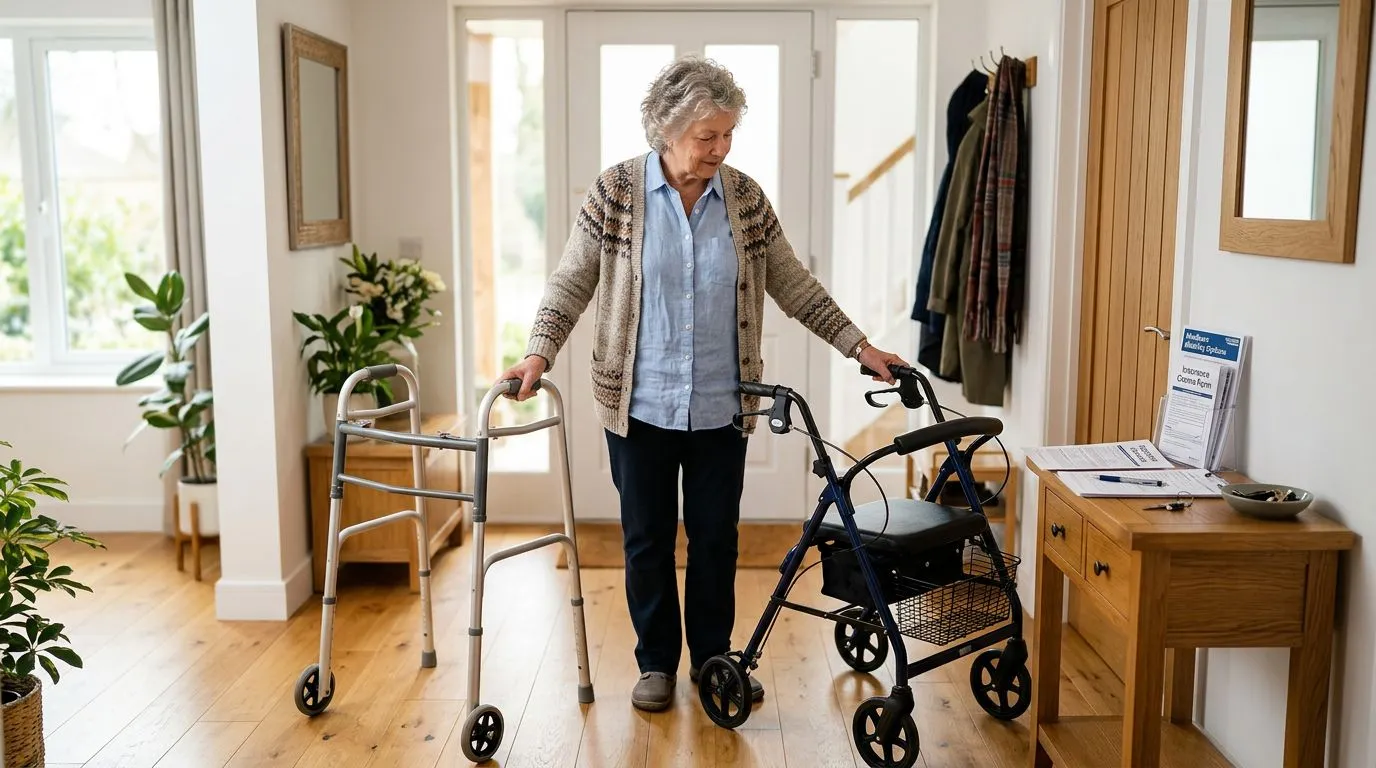
Walkers and rollators are related, but they are not the same. In everyday speech, many people call all of them walkers. For documentation and safety, it helps to separate them into 3 categories: standard walkers with no wheels, two-wheel walkers, and rollators with 3 or 4 wheels, hand brakes, and usually a built-in seat on 4-wheel versions.
| Mobility aid type | Typical design | Stability profile | Common documentation focus |
|---|---|---|---|
| Standard walker | No wheels; lifted and placed forward each step; often folds | Highest forward stability because all 4 legs contact the floor | Needs more support than a cane; unsafe balance; need for a very stable frame |
| Two-wheel walker | 2 front wheels and 2 rear legs or glides | Stable, but easier to move than a no-wheel frame | Needs walker-level support but cannot safely lift a standard walker repeatedly |
| 3-wheel rollator | 3 wheels, hand brakes, no full built-in seat on many designs | Highly maneuverable but less stable than a 4-wheel rollator | Needs wheeled mobility and brakes; narrow spaces; can control a lighter frame |
| 4-wheel rollator | 4 wheels, hand brakes, seat, backrest, and storage pouch or basket on many designs | Good mobility support, but rolls continuously unless braked | Needs brakes and rest breaks; adequate cognition, grip, and balance to use safely |
| Upright or stand-up rollator | 4 wheels with higher forearm or arm supports | Can encourage a more upright posture but requires careful fitting | Need for posture support or reduced hand/wrist loading, if documented |
| Bariatric walker or rollator | Wider, reinforced frame; higher weight capacity | Depends on wheels and frame style | Documented weight and size need; safe fit through home doorways |
A standard walker is usually the simplest and most stable option. It can be a strong fit after surgery, during rehabilitation, or for someone who needs to put weight through both hands before taking a step. The tradeoff is effort. The person must lift or partially lift the frame many times across a room.
A two-wheel walker keeps the rear legs in contact with the floor while the front wheels roll forward. This can reduce lifting. It may be useful when the person has shoulder weakness, limited endurance, or difficulty coordinating the repeated lift-place-step pattern of a standard walker.
A rollator is different because it is designed to roll continuously. The user controls it with hand brakes, and many 4-wheel rollators include a seat. This can help people who walk better with a smoother gait and need planned rest breaks. It can be risky for someone who leans heavily forward, forgets to lock brakes, or needs a device to stop immediately when they lose balance.
Who each option is best for: 0 wheels, 2 wheels, or 4 wheels
The right device is the one that matches the person’s worst safe walking situation, not just their best day. A person who walks well for 20 feet in a clinic may still need more support to get from bed to bathroom at 2 a.m. Insurers often look for that practical detail because home mobility is the core reason for DME coverage.
Standard walker: best for maximum stability
A standard walker may be best for someone who needs a broad, steady base and can safely lift the frame. It is often considered when the person has poor balance, recent lower-limb weakness, or a gait pattern that requires stopping between steps. Because all 4 legs can be planted before weight shifts forward, it provides more stop-and-go control than wheeled devices.
The documentation should explain why a cane is not enough and why wheels might be unsafe. For example, a note might describe frequent loss of balance, need for bilateral upper-extremity support, or unsafe speed with wheeled mobility. The goal is not dramatic wording; it is specificity.
Two-wheel walker: best for stability with less lifting
A two-wheel walker may be best for a person who still needs the structure of a walker but struggles to pick up a no-wheel frame. This can happen with shoulder arthritis, low endurance, mild weakness, or coordination challenges. The front wheels allow a smoother step pattern while the rear legs add friction and help slow the frame.
From an insurance perspective, the key distinction is why 2 wheels are needed. If the person can only walk 15 to 25 feet before tiring from lifting a standard walker, that is more persuasive than simply saying the two-wheel version is easier.
Rollator: best for controlled wheeled mobility and rest breaks
A rollator may be best for someone who can walk with a more continuous gait, has enough hand strength to use loop-style brakes, and needs a seat for medically related rest breaks. Many 4-wheel rollators have seats around 18 to 24 inches wide, though sizes vary. Upright rollators add forearm-style support and may be considered when posture, wrist pain, or hand loading is part of the documented need.
The user must be able to manage the brakes every time they stop, turn, or sit. A seat is only safe when the brakes are locked and the rollator is positioned correctly. If cognition, vision, reaction time, or grip strength makes brake use unreliable, a rollator may not be the safest option even if it seems more convenient.
Documentation insurers often look for: 5 details that help
Good documentation connects the device to daily function. It does not need to be complicated, but it should be specific enough for a reviewer to understand why the chosen walker or rollator is medically necessary.
| Documentation detail | Why it matters | Example of useful wording |
|---|---|---|
| Diagnosis or condition | Shows the medical reason for impaired mobility | Lower-extremity weakness, impaired balance, arthritis, neurologic condition, post-surgical limitation |
| Functional limitation | Links the condition to home movement | Unable to safely ambulate from bedroom to bathroom with cane |
| Distance or duration | Gives a concrete measure of limitation | Requires rest after 30 feet due to fatigue or shortness of breath |
| Why lesser aids are not enough | Supports the level of equipment requested | Cane does not provide adequate bilateral support |
| Why selected features are needed | Justifies wheels, brakes, seat, or bariatric frame | Needs hand brakes to control rolling frame and seat for medically necessary rest breaks |
Clinician notes are strongest when they describe the person’s real environment. A narrow hallway, 1 step into a sunken room, loose rugs, or a 40-foot path from bedroom to kitchen can affect device choice. A standard walker that is safe in a clinic may be too difficult to maneuver in a tight bathroom. A rollator that works outdoors may be too wide or fast indoors.
Insurance reviewers may also look for evidence that the person can use the equipment safely. For a standard or two-wheel walker, that may include the ability to grip both handles and follow a safe sequence. For a rollator, it may include safe brake use, ability to turn without tipping, and ability to sit and stand from the rollator seat without the device moving.
If a higher weight capacity is needed, the record should include the person’s current weight and why a standard frame is not appropriate. Many basic walkers are commonly rated around 250 to 300 lb, while bariatric frames may be rated higher depending on design. The exact rating must match the specific equipment supplied, not a guess.
Wheels, brakes, and seats: when features may be medically justified
Features matter most when they solve a documented safety or functional problem. A reviewer may approve a basic walker but question a rollator if the record does not explain why the extra features are needed. That does not mean rollators are never covered. It means the medical reason should be clear.
Wheels may be justified when lifting a no-wheel walker is unsafe or unrealistic. For instance, someone with shoulder pain may lose balance when repeatedly raising a standard frame. A two-wheel walker may reduce that strain while preserving some braking effect through the rear legs.
Hand brakes may be justified when the person needs a rolling device but must control speed during turns, stops, or slight indoor surface changes. Rollator brakes are not the same as the stationary stability of a standard walker. They require active use, often with both hands. Documentation should reflect that the person can squeeze and lock the brakes.
A seat may be medically relevant when the person needs frequent rest breaks during essential home mobility. The strongest examples involve necessary activities: walking from bedroom to bathroom, getting to the kitchen, moving to the front door for medical transportation, or completing basic grooming. Resting during a 200-foot recreational walk may matter to quality of life, but many plans focus first on in-home necessity.
Upright rollators need especially careful justification. They may help some users maintain a taller posture or reduce pressure through the hands and wrists, but they are not automatically safer. The armrest height, wheelbase, and brake position must match the user. If the person cannot control the device close to the body, an upright frame may increase risk.
How to measure and choose before the order is written: 4 practical checks
A poorly fitted device can undermine both safety and coverage. Before the order is finalized, it helps to check handle height, width, weight capacity, and the home route where the device will be used most often.
1. Handle height
For many walkers and rollators, handles are adjusted near wrist crease height when the person stands upright in supportive shoes with arms relaxed. This often allows about a 15-degree bend at the elbow, though a therapist or clinician may adjust based on posture, diagnosis, and comfort. Handles that are too low can encourage stooping. Handles that are too high can reduce control.
2. Overall width
Measure the narrowest doorway and bathroom path. Many interior doorways are about 28 to 32 inches wide, but older homes can be tighter. A bariatric rollator or wide walker may be medically necessary for body size yet still difficult to use if it cannot pass safely through the bedroom or bathroom doorway.
3. User weight and frame rating
The device’s weight capacity should exceed the user’s current weight according to the equipment specifications. Do not assume all walkers share the same rating. Standard, lightweight, heavy-duty, and bariatric frames can differ by 50 lb, 100 lb, or more.
4. Safe turning and stopping
Test the most important home tasks if possible: bed to bathroom, chair to kitchen, and entryway to living area. A standard walker may be stable but slow. A two-wheel walker may turn more easily. A rollator may move smoothly but require more brake control. The best choice is the one the person can use safely during ordinary daily movement, not the one with the most features.
Common coverage gaps and what to do next: 2 paths after a denial
A denial does not always mean the device is never covered. It may mean the plan needs clearer documentation, prior authorization, a different equipment code, or proof that the supplier is eligible. Denial letters often include a response deadline, such as 30, 60, or 180 days, depending on the plan and appeal level.
One path is correction. If the order is missing a diagnosis, home-use statement, or explanation of why a cane is insufficient, the clinician may be able to update the documentation. This is common when the medical need exists but was not stated in a way the plan can evaluate.
The second path is appeal. An appeal may include therapy notes, a clinician letter, fall history, gait assessment, oxygen or endurance limitations if relevant, and measurements showing why a standard option does not fit. Keep the appeal focused on necessary mobility and safety. Avoid arguing that a feature is nicer, newer, or more comfortable unless comfort directly affects safe use.
There may also be partial coverage. A plan might cover a basic walker allowance while the user pays the difference for a rollator with added features. Before accepting an upgrade charge, ask the supplier to explain what is covered, what is not, and whether the more complex device can be submitted with additional medical documentation.
When unsure, involve the prescribing clinician, physical therapist, occupational therapist, or DME supplier early. A 10-minute fitting conversation can prevent weeks of paperwork. More importantly, it helps the person end up with a walker or rollator that supports safer movement at home.
Bottom line: match the device to documented medical need, not just preference
For insurance purposes, a standard walker, two-wheel walker, or rollator is most defensible when the record clearly explains the mobility problem and why that specific device solves it. A standard walker often fits the need for maximum stability. A two-wheel walker can make sense when lifting a no-wheel frame is the barrier. A rollator may be appropriate when controlled wheeled mobility, hand brakes, and medically necessary seated rest breaks are part of safe daily function.
The practical goal is not to get the most complex device approved. It is to choose the safest mobility aid the person can use consistently in real rooms, through real doorways, and during real daily routines.
FAQ
Frequently asked questions
Does insurance usually cover a rollator with a seat? +
Insurance may cover a rollator with a seat when the medical record shows that wheeled mobility, hand brakes, and seated rest breaks are medically necessary for safe movement at home. If the seat is mainly for convenience outside the home, coverage may be limited or denied.
Is a two-wheel walker easier to get covered than a rollator? +
It depends on the documented need. A two-wheel walker may be easier to justify when the person needs walker-level stability but cannot safely lift a standard walker. A rollator needs additional support in the record, such as safe brake use and a medical need for controlled rolling mobility or rest breaks.
What should a prescription for a walker include? +
A helpful order usually identifies the type of device, the medical condition causing mobility limits, why a cane is not enough, and whether specific features such as wheels, brakes, a seat, or bariatric capacity are needed. Plans and suppliers may have their own forms.
Can insurance deny a walker if it is mostly needed outdoors? +
Yes, some plans focus DME coverage on necessary use inside the home. Outdoor needs may still matter, but documentation is usually strongest when it explains essential indoor activities such as getting to the bathroom, kitchen, bedroom, or entryway.
Will insurance pay for an upright rollator? +
An upright rollator may require stronger documentation than a basic walker because it has more specialized features. The record should explain why standard handles are not appropriate and show that the person can safely control the upright frame and brakes.
Who can help decide which walker or rollator is medically appropriate? +
A prescribing clinician, physical therapist, occupational therapist, or qualified DME supplier can help evaluate balance, endurance, grip strength, home layout, handle height, and weight capacity before equipment is ordered.
Keep reading
Related guides

Medicare Advantage, Medicaid, and Private Insurance Coverage for Walkers and Rollators: What to Ask Before You Buy
13 min read
Are Upright, Tall, or Heavy-Duty Walkers and Rollators Covered by Medicare?
13 min read
Will Medicare Pay for a Rollator Walker With a Seat?
12 min read