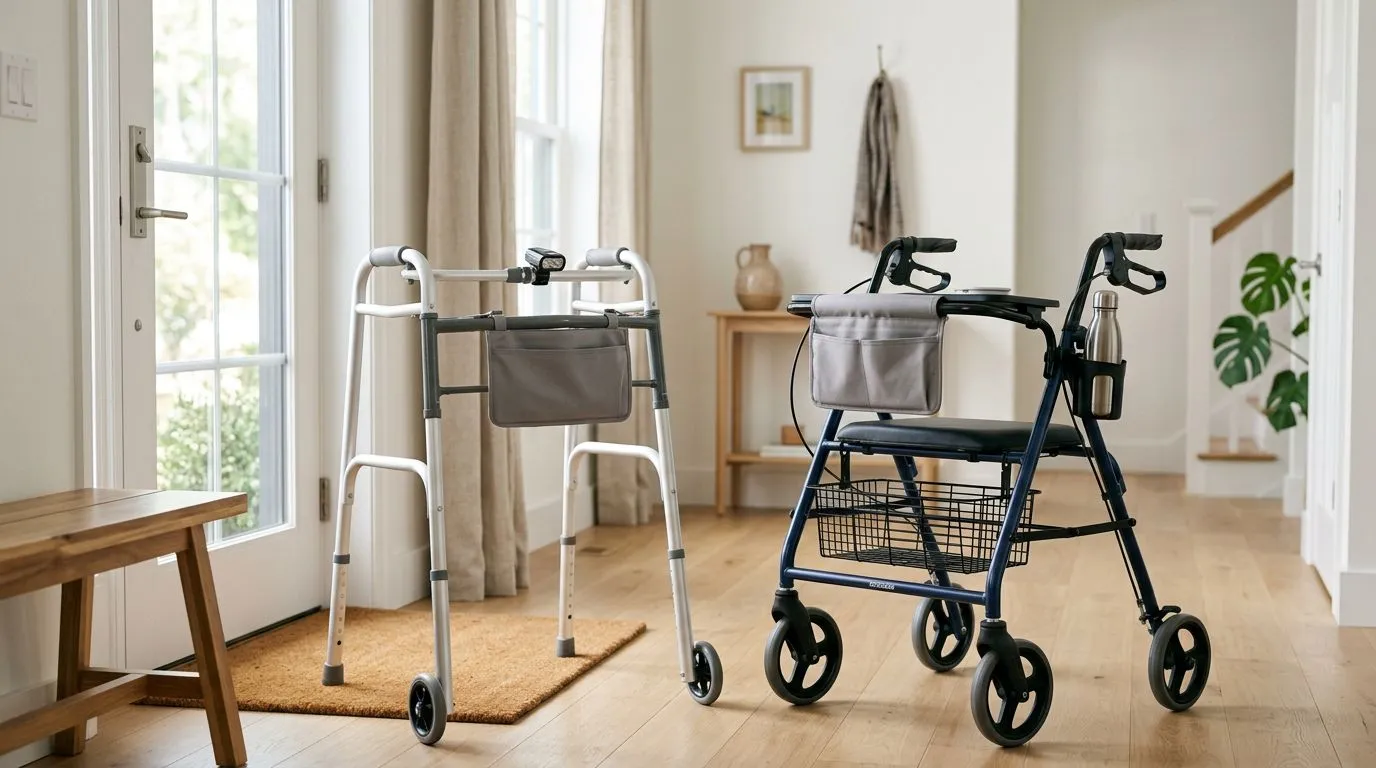
Disclosure: We may earn a commission when you buy through links on this page, at no extra cost to you. We buy nothing, sell nothing and accept no payment for coverage — commissions never decide what we recommend. How we make money.
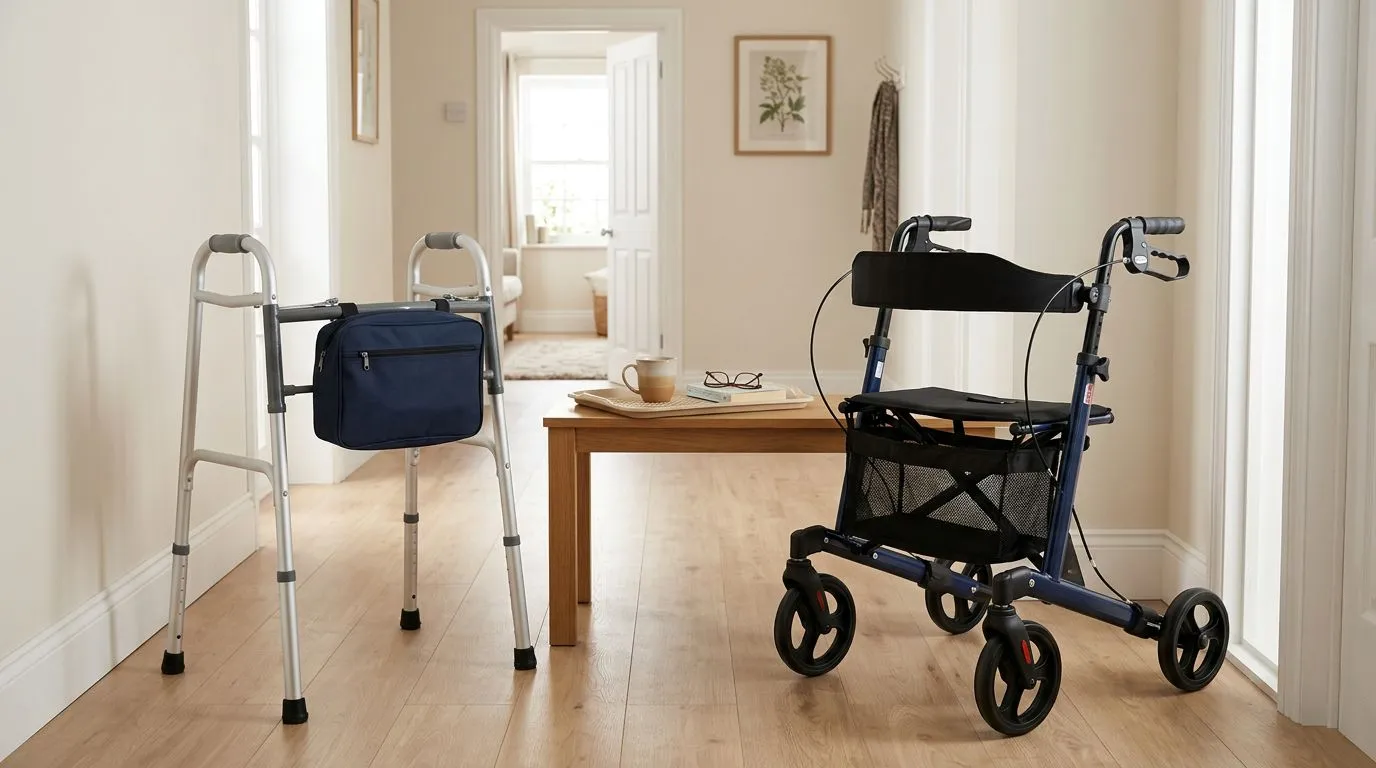
A walker tray, basket, or storage bag can make it easier to carry everyday items, but the safest choice depends on how you use it, how much you carry, and whether you have a walker or a rollator. In general, trays are best for short, flat indoor trips with light items, baskets work well for small essentials, and soft bags are usually the most forgiving option for balance, folding, and doorway clearance.
The main rule is simple: keep weight low, light, and centered. Any accessory that sticks out, blocks your brakes, interferes with folding, or makes the walker harder to control should be adjusted, replaced, or removed.
Why carrying items on a walker or rollator changes safety in 3 ways
A walker or rollator is designed first for support, not cargo. Even a small load can change how it handles by adding weight, shifting the center of gravity, or getting in the way of your hands, brakes, or walking path.
This matters most with standard walkers and two-wheel walkers because you lift or partially lift the frame with each step. A 2 lb drink bottle, book, and phone may not sound heavy, but if they sit on one side of the frame, the walker can feel uneven. With a rollator, the concern is different: you are not lifting the frame as much, but added items can affect steering, brake access, and stability on turns.
Most carrying problems fall into 3 categories:
- Balance: Items placed high, far forward, or on one side can make the walker or rollator feel tippy.
- Control: Bulky accessories can limit hand position, block hand brakes, or make the frame harder to fold.
- Clearance: A basket, tray, or side bag can add 2 to 6 inches of width or depth, which matters in narrow halls, bathrooms, and doorways.
Walkers and rollators meet different mobility needs. A standard walker offers maximum stability but very little built-in storage. A rollator usually includes a seat, hand brakes, and often a pouch or basket, but it rolls more easily and requires safe brake use. Your storage choice should respect that difference.
Walker tray vs basket vs storage bag: 1 quick comparison table
The best accessory is not the one that carries the most. It is the one that carries enough without changing how safely you move. For many people, that means keeping routine loads around 1 to 5 lb unless a clinician has advised otherwise and the walker or rollator instructions allow it.
| Accessory type | Best use | Main safety advantage | Main drawback | Better for walkers or rollators? |
|---|---|---|---|---|
| Tray | Carrying a plate, cup, mail, or light household items across a room | Flat surface keeps items visible and reachable | Can raise the load and may block folding or hand placement | Often used on standard or folding walkers; less common on rollators |
| Basket | Phone, glasses case, medication organizer, remote, small groceries | Open design makes items easy to drop in and remove | Can rattle, protrude, or catch on furniture | Works on both, but placement matters more on rollators with brakes |
| Storage bag | Personal items, paperwork, water bottle, light clothing layer | Soft sides reduce snagging and often fold with the frame | Items may sink or become harder to find | Works well on walkers and rollators when mounted securely |
For indoor use, a tray may be the most convenient. For mixed indoor and outdoor errands, a bag or low-mounted basket is often more practical. For a rollator, any add-on must leave the brake cables, brake handles, and seat area clear.
Walker trays: best for light indoor carrying under about 5 lb
A walker tray creates a flat surface across the front or top rails of a walker. It can help when moving a sandwich, a cup with a lid, reading glasses, or folded laundry from one room to another. Many trays are sized to fit the width of a standard folding walker, often around 18 to 24 inches wide, though exact fit varies by frame.
Trays make the most sense for people who use a standard walker, folding walker, or two-wheel walker inside the home. They are less ideal for 3-wheel and 4-wheel rollators because rollators already have hand brakes, seats, and folding mechanisms that a tray may interfere with.
Who a tray is best for
- Someone who mostly walks on level indoor floors.
- Someone who needs to carry a meal or cup a short distance, such as 10 to 30 feet.
- Someone who can stop, set the tray up, and move slowly without rushing.
- Someone whose walker remains stable with the tray attached and lightly loaded.
Tray safety tips
- Use cups with lids. Open liquids can spill and create a fall hazard.
- Keep the load centered between the walker handles.
- Do not stack items high enough to block your view of the floor.
- Remove the tray if it prevents the walker from folding fully for the car or closet.
- Avoid using a tray as a table to push down on. It is for carrying, not weight-bearing support.
The biggest tray concern is height. Items sit higher than they would in a bag or low basket, which can make the walker feel less steady if the load is heavy or uneven. If the tray wobbles, slides, or changes your grip, it is not a safe fit.
Walker and rollator baskets: useful for small items, but watch the extra 3 to 6 inches
A basket is a rigid or semi-rigid carrier that attaches to the front, under the seat, or occasionally the side of a walker or rollator. Baskets are popular because they are easy to use: drop items in, take them out, and keep walking.
On a standard walker, a front basket may be fine for light essentials. On a rollator, a basket is often placed under the seat or in front of the frame. Under-seat placement can be more stable because the load is lower, though it may be harder to reach without stopping and locking the brakes.
Who a basket is best for
- Someone who carries several small items, such as keys, a phone, tissues, and a glasses case.
- Someone who wants items visible and does not want to unzip a pouch.
- Someone using a rollator for errands where the basket stays within the frame width.
- Someone who can tolerate a little extra depth at the front of the walker.
Basket safety concerns
The most common issue is clearance. If a basket adds 4 inches to the front of a walker, it may bump cabinets, door trim, or the back of a chair before you expect it. On a rollator, a basket that sticks forward can also make it harder to judge curbs, thresholds, and elevator doors.
- Choose a basket that does not extend wider than the walker or rollator frame.
- Avoid side baskets in narrow homes, especially where doorways are 24 to 30 inches wide.
- Check that the basket does not press against brake cables on a rollator.
- Do not place loose heavy items where they can slide from side to side.
Baskets can be safe and convenient, but they are not grocery carts. If the basket makes the frame pull forward or steer to one side, carry less or switch to a lower, softer storage option.
Storage bags and pouches: often the best everyday choice for 1 to 10 small items
A storage bag is usually made of fabric and attaches with straps, loops, snaps, or hook-and-loop closures. It may sit on the front crossbar of a walker, hang below the handles, attach under a rollator seat, or fasten to the backrest area of a rollator.
For many users, a bag is the safest daily choice because it is soft, compact, and less likely to snag than a rigid basket. It can also fold more easily with a folding walker or rollator, especially if it is not overfilled.
Who a storage bag is best for
- Someone who carries personal items most days.
- Someone who folds a walker or rollator for a car ride several times a week.
- Someone who uses narrow doorways, crowded waiting rooms, or small bathrooms.
- Someone who wants items covered or less visible in public.
Bag placement matters
For walkers, a front-mounted bag should hang high enough that it does not brush the floor but low enough that it does not interfere with your hands. For rollators, under-seat or front-inside placement is usually cleaner than side placement because it keeps the width closer to the original frame size.
The tradeoff is organization. Soft bags can swallow small items, which may tempt someone to search while standing. A safer setup uses 2 or 3 pockets: one for a phone, one for keys or a wallet, and one for larger items. Stop walking before reaching into the bag.
How to choose and measure: 5 checks before you buy any walker accessory
Fit is not universal. A tray, basket, or bag that works on one folding walker may not attach safely to another, and rollators vary widely by seat height, brake cable routing, and frame shape. Measure first, then choose.
1. Measure frame width and available mounting space
Use a tape measure across the front of the walker or rollator. Many adult walkers are roughly 24 to 28 inches wide at the outside legs, while compact rollators may be narrower and bariatric rollators may be wider. The accessory should not make the total width harder to manage in your home.
2. Check doorway clearance
Interior doors in many homes are about 28 to 32 inches wide, but bathroom doors can be narrower. Measure the tightest doorway you use daily. If your walker is 26 inches wide and the accessory adds 3 inches to one side, that may be too close for comfort.
3. Check hand and brake access
On a standard walker, both hands need a firm grip on the handles. On a rollator, you must be able to reach and squeeze both hand brakes without shifting your grip. If a bag strap crosses a brake handle or cable, it is not positioned safely.
4. Confirm folding and transport
Fold the walker or rollator with the accessory attached and empty. If it prevents the frame from locking, folding flat, or fitting in the car, decide whether you are comfortable removing it every time. Many people stop using accessories that require too many steps.
5. Keep weight within a practical limit
Always follow the walker or rollator instructions if you have them. In daily use, lighter is safer. A phone, keys, wallet, and water bottle may weigh 2 to 4 lb together. A full shopping bag can quickly reach 10 lb or more, which may be too much for a walker frame and awkward even on a rollator.
Best accessory by walker type: 4 common setups compared
The safest carrying option depends heavily on the mobility device. A no-wheel walker frame behaves differently from a 4-wheel rollator with a seat and brakes.
| Mobility device | Usually safest carrying choice | Use caution with | Why it matters |
|---|---|---|---|
| Standard or no-wheel walker | Light front bag or removable tray | Heavy front baskets | The frame is lifted with each step, so extra weight is noticeable. |
| Two-wheel walker | Front bag or small centered basket | Bulky trays on uneven floors | The rear legs still need steady contact and predictable movement. |
| 3-wheel rollator | Compact bag or small front pouch | Large side bags or wide baskets | Three-wheel designs turn tightly but may have less cargo space. |
| 4-wheel rollator with seat | Under-seat pouch, low basket, or front bag inside the frame | Anything blocking brakes or the seat | The seat, hand brakes, and folding hinge must remain clear. |
| Upright or stand-up rollator | Low storage bag that does not affect forearm supports | High-mounted bags near armrests | Arm platforms and brake controls need open space. |
| Bariatric walker or rollator | Accessory rated for the frame style and mounted symmetrically | Universal accessories that attach loosely | Wider frames and higher weight capacities still need balanced loads. |
For standard walkers, less is usually more. For rollators, storage can be more integrated, but brakes and sitting safety come first. Never hang a loaded shopping bag from one handle; that can twist the frame and pull the device off line.
Balance, braking, folding, and clearance: 6 safety rules that prevent common problems
Most accessory-related problems are preventable with a short safety check. Spend 2 minutes testing the setup before using it across the house or outside.
- Keep weight centered. Place heavier items near the middle of the frame, not on one handle or one side.
- Keep weight low. A low bag or under-seat pouch is usually steadier than a high tray loaded with several items.
- Protect the brakes. On a rollator, both brake handles must remain fully reachable, and brake cables should move freely.
- Do not block your feet. Nothing should swing into your shins or change your step length.
- Test the fold. Fold and unfold the frame 3 times while the accessory is empty to confirm it does not jam the hinge.
- Practice in a clear area. Walk 10 to 15 feet, turn, stop, and back up before using the accessory in a tight bathroom or busy store.
If you use a rollator seat, lock the brakes before sitting every time. Storage should not make it harder to reach the brake locks, position yourself in front of the seat, or stand back up safely.
What to carry and what not to carry: examples under 2 lb and over 10 lb
Some items are well suited to walker storage. Others are better moved another way, especially if they are hot, sharp, heavy, or likely to spill.
| Usually reasonable | Use extra caution | Better not to carry on a walker or rollator |
|---|---|---|
| Phone, keys, wallet, tissues | Open cup of coffee or soup | Large pot of hot liquid |
| Medication list or small organizer | Glass items that can break | Sharp kitchen knives or tools |
| Remote control, mail, paperback book | Several canned goods | Heavy grocery bags over about 10 lb |
| Light sweater or folded towel | Laundry piled above handle height | Pets, oxygen tanks not designed for that carrier, or medical equipment without proper mounting |
For meals, consider smaller trips instead of one heavy trip. A covered mug, a lidded container, and a napkin on a tray are safer than an open drink and a full plate balanced near the edge. If you regularly need to move meals, laundry, or groceries, an occupational therapist can help set up safer home routines.
When to choose a tray, basket, or bag: 3 practical recommendations
If you are choosing one accessory for daily use, start with your most common task. The right answer for carrying breakfast 12 feet is not always the right answer for going to a medical appointment for 2 hours.
- Choose a tray if you use a standard or folding walker indoors and mostly need a flat surface for light meals, mail, or small household items. Keep it removable if you fold the walker often.
- Choose a basket if you want open access to several small items and the basket stays within the walker or rollator footprint. Favor low, centered placement over wide side placement.
- Choose a storage bag if you want the most flexible everyday option, especially for a folding walker, 3-wheel rollator, 4-wheel rollator, upright rollator, or travel use.
For many walker users, a light front bag plus an occasional removable tray is a good combination. For many rollator users, an under-seat pouch or low front bag is simpler than adding a tray. Avoid layering multiple accessories until the frame becomes bulky; two half-full bags can create more problems than one well-placed pouch.
The safest setup should feel almost invisible. You should be able to grip both handles, see the floor ahead, turn in a hallway, use brakes if your device has them, and fold the frame without a struggle. If carrying items makes walking feel less steady, the accessory is not helping enough to justify the risk.
FAQ
Frequently asked questions
Is a tray, basket, or bag safest for a standard walker? +
For most standard walkers, a light front storage bag is the safest everyday option because it is soft, compact, and less likely to affect folding. A removable tray can be useful indoors for short trips with light items, while a heavy basket may make the walker harder to lift.
Can I use a walker tray on a rollator? +
Sometimes, but it is often not the best fit. Rollators have hand brakes, seats, cables, and folding parts that a tray can block. If you use a rollator, a low basket or under-seat storage bag usually works better as long as it does not interfere with braking or sitting.
How much weight can I carry on a walker or rollator? +
Always follow the instructions for your specific device and accessory. In daily use, keep loads light and centered; items like a phone, keys, wallet, and water bottle are usually more appropriate than heavy groceries. Avoid hanging heavy bags from one handle.
Where should a storage bag attach on a rollator? +
A rollator storage bag is usually safest when it stays low and inside the frame, such as under the seat or on the front without widening the device. It should not block the hand brakes, brake cables, seat, backrest, or folding mechanism.
Will a basket make my walker too wide for doorways? +
It can. Measure your walker or rollator at its widest point, then measure your narrowest doorway. If a basket adds several inches to the side or front, it may catch on door trim, cabinets, or furniture.
What should I avoid carrying on a walker tray? +
Avoid open hot drinks, large bowls of hot liquid, sharp tools, breakable glass, and tall stacks that block your view. Use lidded containers, keep the load centered, and move slowly on level floors.
Keep reading
Related guides
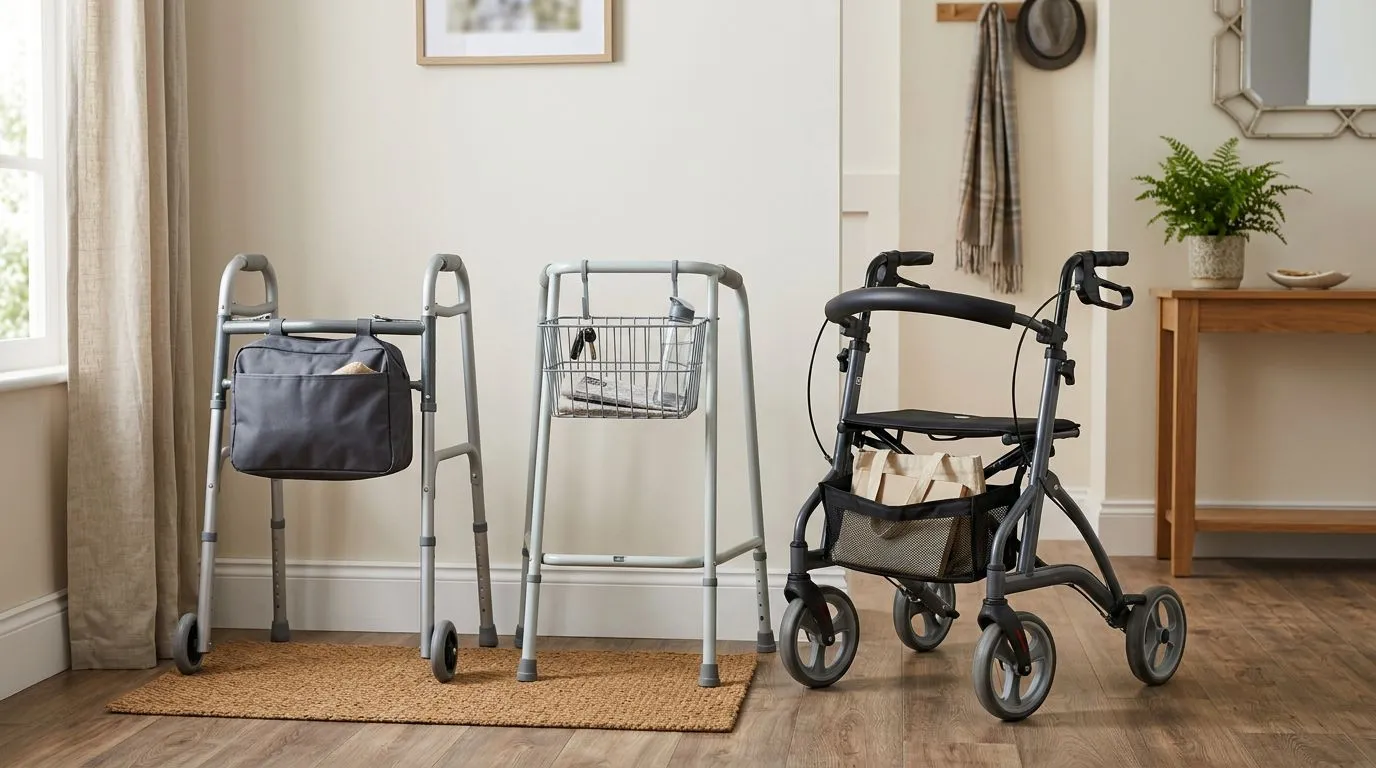
Walker Bags vs Baskets vs Under-Seat Storage: How to Choose the Right Carrying Option
13 min read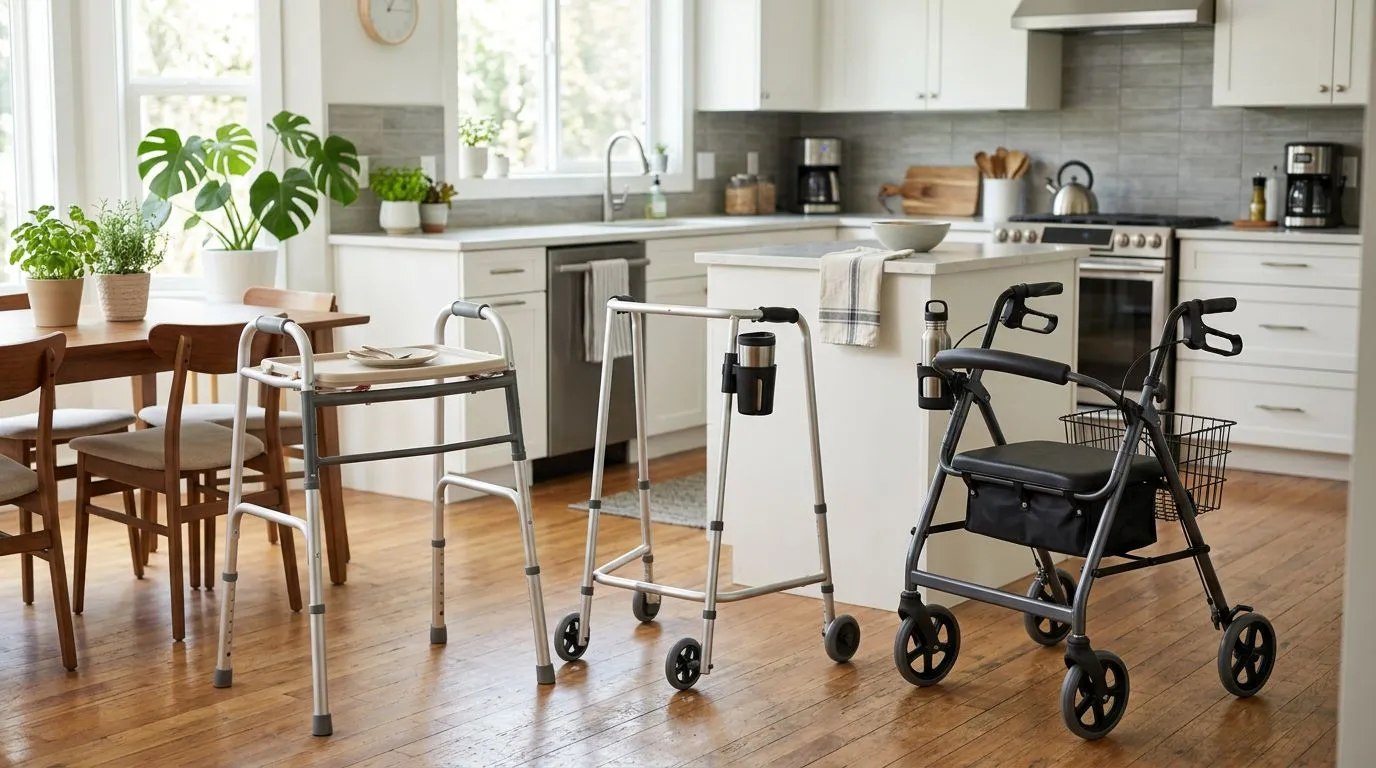
Walker Trays and Cup Holders: What Works Best for Standard Walkers, Two-Wheel Walkers, and Rollators
15 min read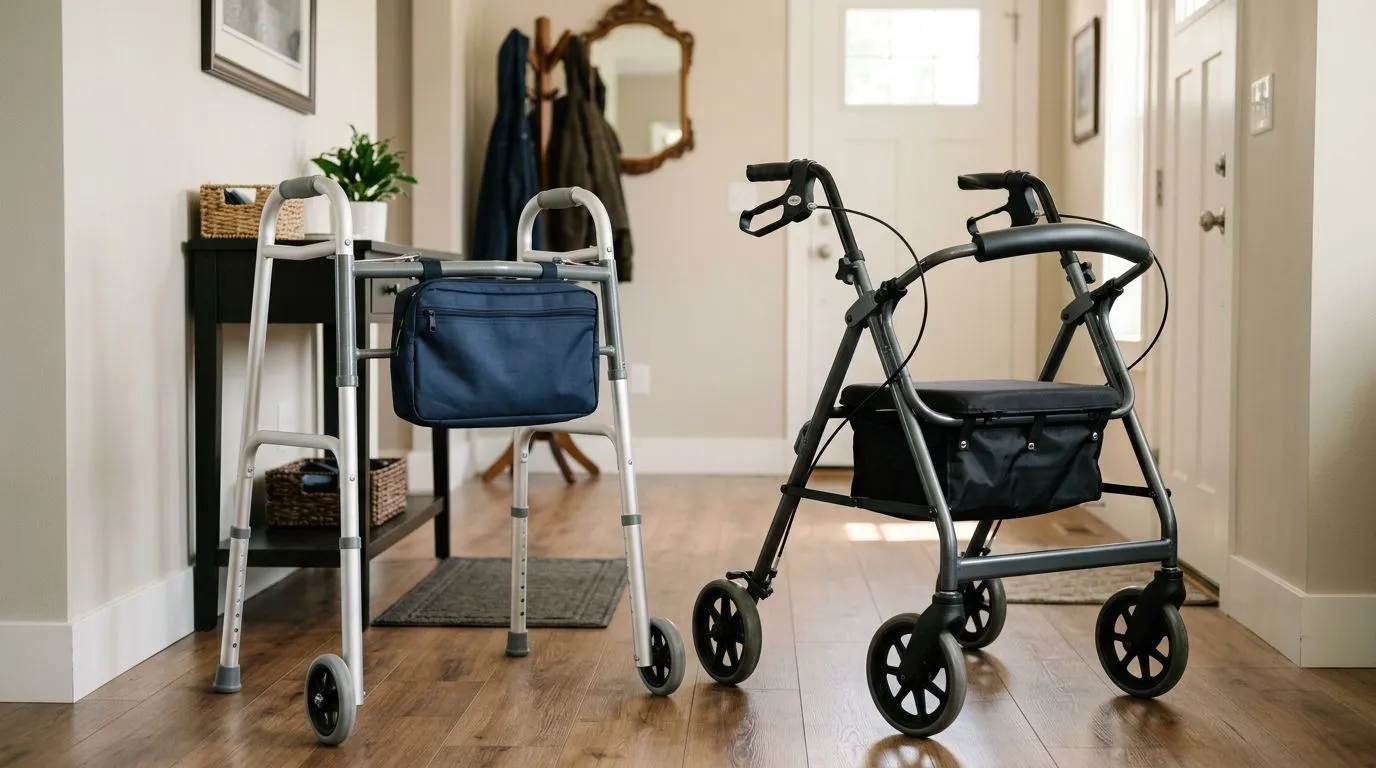
Walker Bags, Baskets, and Carriers: Safer Ways to Carry Items on Walkers and Rollators
15 min read