Disclosure: We may earn a commission when you buy through links on this page, at no extra cost to you. We buy nothing, sell nothing and accept no payment for coverage — commissions never decide what we recommend. How we make money.
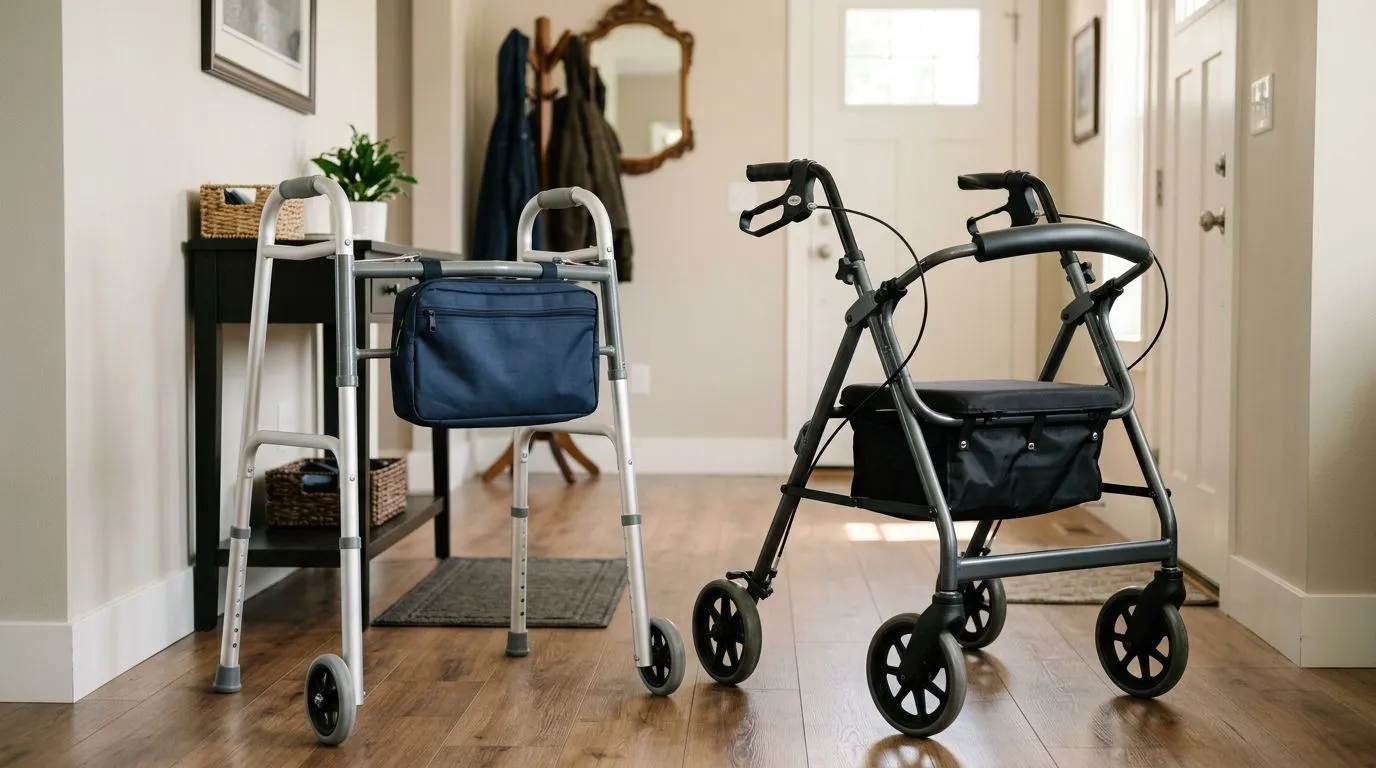
Walker bags, baskets, and carriers help you move everyday items without tying up your hands, but the safest choice depends on whether you use a standard walker, a two-wheel walker, or a rollator with a seat and hand brakes. As a rule, choose lightweight front or side storage for walkers and built-in under-seat or frame-mounted storage for rollators, keeping the load low, balanced, and clear of wheels, brakes, and folding points.
The goal is simple: carry the essentials without changing the way your mobility aid supports you. A small pouch for a phone is very different from a basket holding groceries, and a rollator seat bag fits differently than a bag on a folding walker frame. This guide covers the main storage options, how to measure for fit, and which choices are usually safest for different users and daily routines.
Why Carrying Items on a Walker or Rollator Requires Care: 3 Main Safety Issues
A walker or rollator is designed first for support, not hauling cargo. Even a light 2 lb purse can affect balance if it swings from one handle, and a heavier 8 to 10 lb grocery bag can make some frames harder to steer or lift. The right carrier should reduce one-handed carrying without creating a new tipping or tripping hazard.
There are 3 common safety issues to watch for. First, weight placed too high can make the frame feel top-heavy. Second, bags that hang low or loose can brush wheels, walker tips, or your feet. Third, storage placed across a rollator seat or near hand brakes can interfere with sitting, braking, or folding.
Walkers and rollators also move differently. A standard walker or no-wheel frame is lifted and set down with each step, so extra weight on the front can make it more tiring to use. A two-wheel walker rolls forward but still needs rear legs or glides to stay stable. A rollator has 3 or 4 wheels, hand brakes, and usually a built-in seat, so it can carry items more easily when storage is designed around the seat, frame, and brake cables.
Walker vs. Rollator Storage: 7 Fit Differences That Matter
Before choosing a bag or basket, identify the type of mobility aid you use. Most adult walkers are about 24 to 28 inches wide at the handles or front frame, while many rollators are roughly 23 to 30 inches wide depending on wheel size, seat width, and weight capacity. Those few inches can decide whether a carrier fits cleanly or rubs against the frame.
| Mobility aid type | Common storage choices | Fit concerns | Best for |
|---|---|---|---|
| Standard or no-wheel walker | Front pouch, small basket, side bag | Must not block hand grips or rubber tips; added weight makes lifting harder | Light daily items such as phone, keys, glasses, mail |
| Folding walker | Soft front bag, removable pouch, snap-on or strap-on carrier | Must not cross the center folding mechanism unless made to flex or detach | Users who fold the walker for cars or storage |
| Two-wheel walker | Front bag, front basket, tray | Must clear front wheels and not swing into rear legs | Indoor errands, kitchen tasks, light transport |
| 3-wheel rollator | Frame pouch, front bag, small basket | No full seat on many designs; tighter triangular frame space | Narrow hallways, quick trips, small personal items |
| 4-wheel rollator | Under-seat bag, seat-back pouch, basket | Must not interfere with seat, backrest, or brake cables | Personal items, shopping, longer outings with rest breaks |
| Upright rollator | Under-seat or lower frame bag | Arm supports and higher handles limit where bags can attach | Users who need a taller posture and clear hand brake access |
| Bariatric rollator | Wide under-seat bag, reinforced basket, side pouch | Frame width and higher weight capacity do not automatically mean higher cargo capacity | Larger users who need a wider seat and sturdy frame |
The main point: storage should match the frame, not just the person. A bag that works well on a folding walker may be awkward on a rollator with a seat, and a rollator basket may not attach securely to a no-wheel walker.
6 Common Walker and Rollator Carrier Types Compared
Most people choose among 6 storage styles: soft bags, wire baskets, trays, under-seat bags, side pouches, and cup or bottle holders. Each solves a different problem. A bag protects items from falling out, while a basket makes objects easier to see and remove quickly.
| Carrier type | Typical placement | Strengths | Watch-outs |
|---|---|---|---|
| Soft walker bag | Front crossbar, side frame, or inside frame | Lightweight, often flexible, may have pockets | Can sag if overloaded; fabric straps need secure attachment |
| Wire or plastic basket | Front of walker or rollator frame | Open view, easy to clean, holds firm-shaped items | May add bulk; small items can fall through gaps unless lined |
| Tray | Across walker or rollator seat area | Useful for plates, cups, mail, or small household items | Not for uneven surfaces; liquids can spill; must not replace safe hand placement |
| Under-seat rollator bag | Below the rollator seat | Low center of gravity, often protected by the seat | Only for rollators with compatible seat frames; access may require lifting the seat |
| Side pouch | Outer or inner side rail | Good for phone, remote, glasses case, paperback | One-sided weight can pull slightly; avoid overloading |
| Cup or bottle holder | Handle tube or side frame | Keeps drink upright and accessible | Must clear brakes, cables, knees, and doorways |
For walkers, soft front bags and small baskets are the most common options because they attach to the front frame and leave the hand grips open. For rollators, under-seat bags often fit more cleanly because the storage sits low between the wheels and does not hang from the handles. Upright rollators may require more careful placement because the arm supports, brake levers, and tall frame leave less simple attachment space near the user.
Who Each Storage Option Is Best For: 5 Real-Life Examples
The best carrier is the one that fits your routine. Someone who carries a phone and tissues across the house needs a different setup than someone who takes a rollator to a weekly grocery trip. Think about your most common 5 items, not a rare once-a-month load.
For indoor use and room-to-room carrying
A soft walker bag or small side pouch is usually enough for a phone, glasses, medication list, TV remote, or book. This is especially useful on a standard walker because you can keep both hands on the grips instead of trying to carry objects while lifting the frame.
For kitchen tasks
A tray can help move a sandwich, napkin, or light dish a short distance on a smooth floor. Keep it modest. A full hot drink, soup bowl, or heavy plate may spill if the walker bumps a threshold. For rollators, never use the seat as a loose tray while walking unless the item is stable and the seat surface is designed to hold it securely.
For mail, paperwork, and appointments
A front pouch with flat pockets works well for envelopes, appointment papers, ID, and a small wallet. On a rollator, an under-seat compartment can keep these items more private than an open basket. If you need quick access to a phone, a small upper pocket is easier than reaching under the seat every time.
For shopping and errands
A 4-wheel rollator with an under-seat bag or compatible basket is usually better than a standard walker for carrying light shopping, because the frame rolls and the storage can sit low. Still, avoid using a rollator like a shopping cart. Heavy bags on the handles can reduce steering control and may make the rollator tip backward or sideways.
For narrow homes or tight hallways
A slim side pouch or compact front bag is often better than a wide basket. If your hallway is 30 inches wide and your mobility aid is already 25 inches wide, a basket that adds 2 inches on each side can make turns harder. Measure your tightest doorway before choosing bulky storage.
How to Measure for a Walker Bag or Basket in 10 Minutes
You do not need special tools. A tape measure and 10 minutes can prevent a poor fit. Measure the frame before you shop, and recheck anything that folds, pivots, or carries brake cables.
- Measure the front frame width. On walkers, measure the distance between the front vertical tubes or the front crossbar attachment area. Many adult walkers fall near 24 to 28 inches wide, but compact and bariatric frames vary.
- Measure tube diameter. Many walker and rollator tubes are around 1 inch in diameter, but not all are the same. Straps, clamps, and hooks need to fit the tube securely without sliding.
- Check handle clearance. Leave the hand grips completely open. Your palm should wrap the grip normally with no strap, buckle, or bag edge in the way.
- Check wheel clearance. For two-wheel walkers and rollators, make sure the bag or basket stays at least 1 to 2 inches away from wheels during turns.
- Find folding points. If your walker folds in the center, storage should detach easily or flex without blocking the folding button or hinge.
- Check brake access. On rollators, squeeze and lock the brakes after attaching the carrier. Nothing should catch the brake cables or limit lever travel.
- Test sitting clearance. On a rollator with a seat, sit down only after confirming the bag does not block the seat, backrest, or your feet as you turn.
If the carrier uses straps, look for a stable 2-point or 4-point attachment rather than one loose loop. A swinging bag can be more distracting than no bag at all. For baskets, check that the top edge sits below your line of sight and does not protrude into your knees or shins.
Weight, Balance, and Placement: Keep Loads Under Control by the Pound
There is no single safe cargo limit for every walker or rollator. The right limit depends on the mobility aid, the carrier, the user, and the surface. Even so, many everyday carrier loads are safest when kept light, often in the 2 to 5 lb range for small walker bags and only higher when the rollator and storage are specifically designed for it.
Weight placement matters as much as total weight. On a standard walker, a heavy front basket can make the walker harder to lift. On a rollator, heavy items hung from the handles can pull the frame backward, especially when the user sits down or parks on a slope. Under-seat storage usually keeps weight lower and closer to the center of the frame.
- Carry dense items, such as water bottles or canned goods, low and centered.
- Do not hang grocery bags from handles unless the user manual specifically allows it.
- Split small items into multiple pockets instead of letting one large bag swing.
- Keep brake levers, folding buttons, and height-adjustment holes visible.
- Remove storage before lifting the walker into a car if it makes the frame awkward.
Consider the user, not only the frame. If lifting a walker is already tiring after 20 steps, even a few pounds on the front may be too much. If balance changes, foot placement changes, or the frame starts veering, lighten the load.
Best Storage Choices for Standard, Folding, and Two-Wheel Walkers: 4 Practical Setups
Walkers need storage that does not compromise the user’s grip or the frame’s stability. A no-wheel or standard walker may be lifted dozens of times in a short trip across the home, so even small weight changes can matter. For most walker users, simple and lightweight is better.
Setup 1: Front soft bag for daily essentials
This is a good match for a folding walker when the bag attaches with straps around the front bars and can stay flexible as the walker folds. Use it for light items such as tissues, phone, keys, and a small water bottle. Avoid packing it until the front panel bulges toward your knees.
Setup 2: Small basket for visible items
A basket works well when you want to see what you are carrying, such as mail or a paperback. It is less ideal for tiny items unless it has a liner. On a two-wheel walker, confirm the basket clears the front wheels during a tight turn.
Setup 3: Side pouch for compact homes
A side pouch can keep the front of the walker open and reduce bulk. Keep the load light and balanced. If one side feels heavier or the walker twists as you lift it, move items to a front pouch or reduce the load.
Setup 4: Tray for short, smooth indoor tasks
A tray can be helpful for moving small household items 10 to 20 feet across a smooth floor. It should not cover the hand grips or require you to push down on the tray for support. Use both hands on the walker handles whenever you are walking.
Best Storage Choices for 3-Wheel, 4-Wheel, Upright, and Bariatric Rollators: 4 Fit Checks
Rollators usually offer more storage options than walkers because they roll on 3 or 4 wheels and often include a seat. The tradeoff is complexity: brake cables, seat hinges, backrests, and folding frames all need clearance. Always test the rollator with the carrier attached before using it outside.
Check 1: Under-seat storage on 4-wheel rollators
Under-seat bags are popular because they sit low and centered. They are best for personal items, a light sweater, paperwork, or small purchases. Make sure you can open the seat without pinching your fingers or scraping the bag.
Check 2: Front pouches on 3-wheel rollators
Many 3-wheel rollators have a triangular frame and less built-in seating space. A front pouch or compact basket can be useful, but the load should stay close to the frame. If the pouch swings when you turn, tighten the attachment or reduce the contents.
Check 3: Upright rollator clearance
Upright rollators place the forearms higher, often with taller handles and arm platforms. Storage should not crowd the brake levers, armrests, or your stride. A lower frame bag is often better than a high handle bag because it keeps weight away from the steering area.
Check 4: Bariatric rollator capacity
Bariatric rollators are built with wider frames and higher user weight capacities, but that does not mean any carrier can hold heavy cargo. Check the carrier’s stated load limit and the rollator instructions. A wider seat may allow a wider under-seat bag, yet the safest load still needs to stay low, secure, and clear of brakes.
Features Worth Looking For: 9 Details That Make Daily Use Easier
Small design details can make a carrier safer and less frustrating. Look beyond color and pocket count. The best walker bag or rollator carrier is easy to attach, easy to reach, and secure enough that you forget about it while walking.
- Secure attachment points: Four straps, snaps, or hook-and-loop tabs often reduce swinging better than a single center strap.
- Lightweight material: Fabric bags add less weight than metal baskets, which matters on standard walkers.
- Washable surfaces: Smooth liners or wipeable fabric are helpful for spills, crumbs, and outdoor use.
- Contrasting pockets: Light-colored lining can make keys, cards, and medication lists easier to find.
- Covered storage: Zippers, flaps, or drawstrings help keep items from bouncing out.
- Open access: Baskets are helpful when dexterity is limited, as long as items are not too small.
- Low-profile shape: Slim carriers reduce doorway bumps and hallway snags.
- No handle interference: Nothing should wrap over the hand grips or change your wrist position.
- Reflective trim: A small reflective strip can improve visibility in parking lots or low light.
If hand strength or dexterity is limited, test closures before relying on them. A zipper that is hard to pull may be less useful than a flap. If memory is a concern, clear pockets or consistent pocket locations can make daily routines easier.
Storage Choices to Avoid: 6 Common Mistakes
Some carrying methods seem convenient but make the mobility aid harder to use. A walker or rollator should move predictably on every step, doorway, and turn. If storage changes that feeling, adjust it right away.
- Heavy bags on handles: This can pull a rollator backward or make a walker harder to control.
- Loose shoulder bags: Straps can slide, swing, or catch on brake cables and furniture.
- Blocked brakes: Any rollator carrier that limits braking should be removed.
- Covered folding buttons: Do not force a walker or rollator to fold around a bag.
- Low-hanging fabric: Bags near wheels, walker tips, or feet can create a tripping risk.
- Overfilled baskets: Tall items can block your view of thresholds, pets, or floor changes.
Be cautious with homemade modifications, too. A simple tied-on tote may work for a few tissues, but it may not stay centered or secure with heavier items. If you are unsure, ask an occupational therapist, physical therapist, or mobility equipment professional to review the setup.
A Simple 5-Step Buying Checklist Before You Choose
Use this quick checklist to narrow your options without getting lost in product claims. It works for walkers, folding walkers, two-wheel walkers, 3-wheel rollators, 4-wheel rollators, upright rollators, and bariatric rollators.
- Name your mobility aid type. Walker storage and rollator storage are not always interchangeable.
- List your usual items. Choose for your daily 3 to 5 essentials first, not your heaviest possible errand.
- Measure the frame. Check width, tube diameter, folding points, wheel clearance, and brake cable paths.
- Choose the lowest practical placement. Low and centered storage is usually easier to control than high handle storage.
- Test before regular use. Walk 20 to 30 steps indoors, turn, brake, sit if using a rollator, and fold the frame if needed.
A good carrier should feel boring in the best way. It should hold what you need, stay out of the way, and let the walker or rollator do its main job: help you move with steadier support. If a bag, basket, or tray makes you change your hand position, shorten your stride, or fight the frame, choose a smaller or better-fitting option.
FAQ
Frequently asked questions
Can I use the same bag on a walker and a rollator? +
Sometimes, but not always. A soft strap-on bag may fit both if the frame width and tube size work, but rollators have brake cables, seats, and folding mechanisms that need extra clearance. Always test braking, turning, sitting, and folding before regular use.
Is a basket or a soft bag safer for a walker? +
For many walker users, a soft bag is lighter and less bulky, which can be helpful on standard and folding walkers. A basket can be useful for visible items, but it should stay small, secure, and clear of wheels, tips, and your knees.
How much weight can I carry on a walker or rollator? +
Check the mobility aid and carrier instructions for stated limits. In daily use, keep loads as light as practical, especially on standard walkers that must be lifted. Avoid hanging heavy bags from handles, and keep weight low and centered when possible.
Can I put groceries in a rollator bag? +
Light groceries may be fine if the rollator storage is designed for them and the load does not affect steering, braking, or seat use. Do not treat a rollator like a shopping cart, and avoid hanging heavy grocery bags from the handles.
Will a walker bag stop my folding walker from closing? +
It can if the bag crosses the folding hinge, blocks the release button, or is packed too full. Choose a flexible or removable bag for a folding walker, and test the fold with the bag attached and with your usual items inside.
Where is the safest place to attach storage on a rollator? +
Under-seat or lower frame storage is often the most stable because it keeps weight low and centered. The safest placement also depends on your rollator design, so confirm that the carrier does not touch the wheels, brake cables, seat, or backrest.
Keep reading
Related guides
Walker Bags vs Baskets vs Under-Seat Storage: How to Choose the Right Carrying Option
13 min read
Walker Tray vs Basket vs Storage Bag: Safer Ways to Carry Items on a Walker or Rollator
14 min read
Travel Bags and Covers for Folding Walkers and Rollators: What to Look For Before a Trip
15 min read