Disclosure: We may earn a commission when you buy through links on this page, at no extra cost to you. We buy nothing, sell nothing and accept no payment for coverage — commissions never decide what we recommend. How we make money.
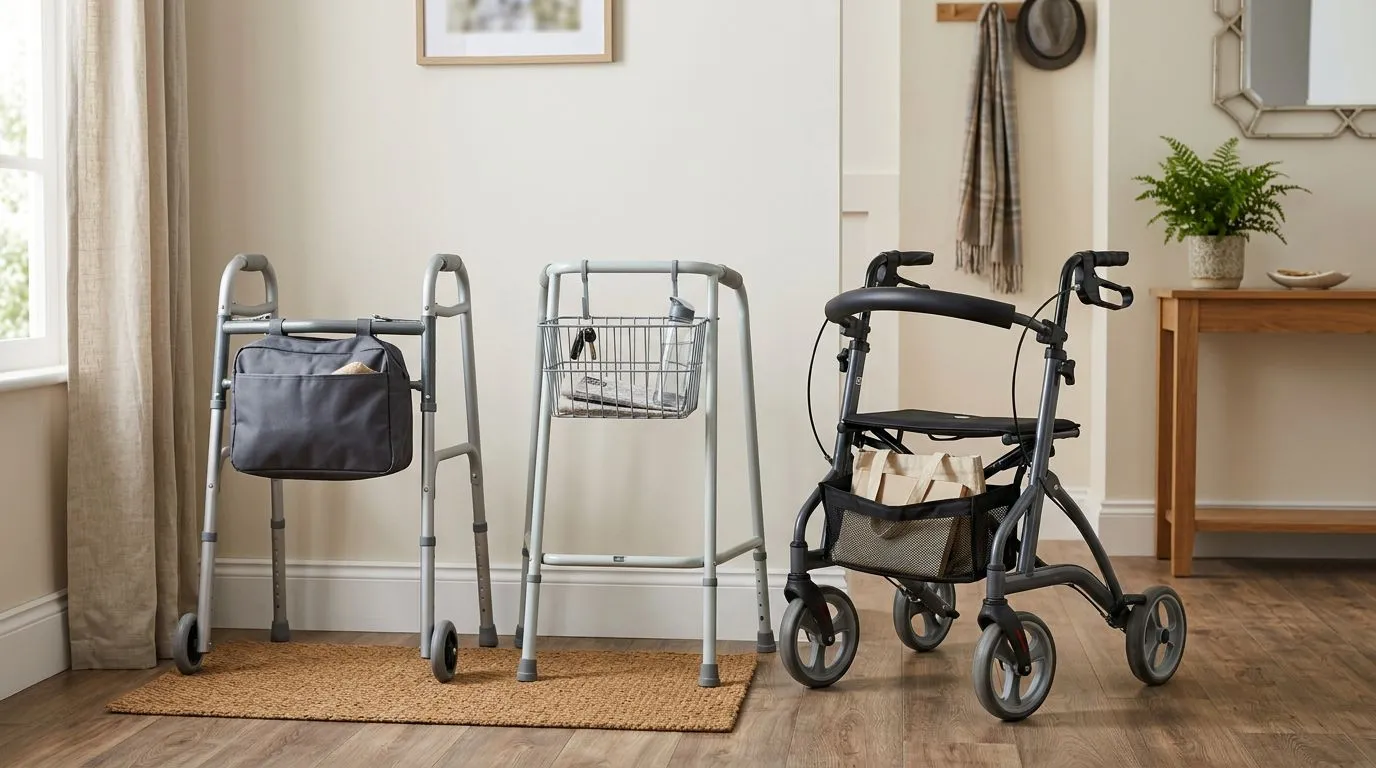
The best carrying option depends on the mobility aid you use and what you carry most often. A walker bag is usually the most versatile choice for standard, folding, and two-wheel walkers. A basket works best when you want quick visibility and easy cleaning. Under-seat storage is mainly for rollators with a built-in seat and hand brakes.
For light household items, mail, a phone, or medical papers, a soft walker bag is hard to beat. For groceries, a water bottle, or items you want to spot at a glance, a basket may be the better fit. If you use a 3-wheel or 4-wheel rollator, the under-seat pouch or bag can keep weight centered and out of the way while you walk.
Quick answer: 3 carrying options for walkers and rollators
There are 3 common ways to carry items on a mobility aid: a soft bag, a basket, or built-in under-seat storage. Each one solves a different problem. The right choice depends on your walker or rollator frame, your balance, and the size and weight of what you carry.
A traditional walker, including a standard no-wheel walker, a folding walker, or a two-wheel walker, usually does not have a seat. Storage is added to the front, side, or crossbar of the frame. A rollator, by contrast, has 3 or 4 wheels, hand brakes, and often a built-in seat; many 4-wheel rollators include a storage pouch or basket under the seat.
| Storage type | Best fit | Typical use | Main caution |
|---|---|---|---|
| Walker bag | Standard, folding, and two-wheel walkers; some rollators | Phone, wallet, mail, glasses, medical papers | Do not let it swing or drag |
| Walker basket | Many front-frame walkers and some rollators | Water bottle, small groceries, visible items | Bulky items can affect clearance |
| Under-seat storage | Mostly 4-wheel rollators; some 3-wheel rollators use front pouches | Errands, appointments, personal items | Must stay within the rollator’s weight limit |
If you are choosing for a standard walker, start with a bag or basket. If you are choosing for a rollator, compare the built-in storage first, then decide whether you still need an added pouch or cup holder.
Walker bags: best for soft items up to about 5–10 lb
A walker bag is a soft pouch that attaches to the front, side, or inside of a walker frame. Many use hook-and-loop straps, snaps, buckles, or ties. For a standard walker or two-wheel walker, this is often the simplest carrying option because it adds storage without changing how the walker legs meet the floor.
Walker bags are especially useful for small, flat, or personal items. Think reading glasses, a cell phone, a wallet, tissues, mail, medication lists, appointment papers, or a paperback book. The soft sides help keep items from rattling, and pockets make it easier to separate things you use often.
For many users, a bag also feels less bulky than a basket. That matters in tight spaces such as bathrooms, hallways, kitchens, and medical exam rooms. A front-mounted bag can fold with some folding walkers, although you may need to remove bulky contents before closing the frame.
Who a walker bag is best for
- People using a standard, folding, or two-wheel walker for indoor mobility.
- Users who carry light personal items several times a day.
- Anyone who wants pockets, privacy, and a softer look than a wire basket.
- Caregivers who want emergency information, keys, or a phone kept in one predictable place.
The main drawback is structure. A soft bag can sag if it is overloaded, and long straps can loosen over time. If the bottom of the bag hangs low enough to brush the floor or hit the walker legs, it can become a tripping or snagging hazard.
As a practical rule, keep a walker bag light. Even if a bag appears strong, carrying 10 lb on the front of a walker can make the frame feel different, especially when lifting a no-wheel walker with each step. Check the accessory instructions and the walker manual, and avoid hanging heavy items from the hand grips.
Walker baskets: best for visible items on trips under 10 lb
A walker basket is usually a rigid wire, mesh, or plastic carrier that mounts to the front of a walker or rollator. It gives you an open storage area where items are easy to see and reach. For short errands, this can be more convenient than searching through pockets.
Baskets are often preferred for items with shape or stiffness: a water bottle, small grocery items, a folded newspaper, a glasses case, or a compact handbag. Some users like a basket for moving items around the house, such as carrying a TV remote and a snack from the kitchen to the living room.
Because baskets are rigid, they do not sag like a soft bag. They may also be easier to wipe clean after carrying food packaging or pharmacy items. A basket liner can help prevent small objects from slipping through wire openings.
Who a walker basket is best for
- People who want to see everything at a glance.
- Users who carry a water bottle or small household items often.
- Anyone who finds zippers, flaps, or pockets hard to manage.
- Short indoor or paved outdoor trips where the basket will not bump furniture or doorways.
The tradeoff is bulk. A basket can make a walker longer or wider, depending on the mounting position. If your walker already has to fit through a narrow bathroom doorway, around a bed, or beside a car door, measure carefully before adding anything rigid.
Weight placement matters, too. A heavy load in a front basket can change how a walker feels when you lift it or steer it. On a rollator, too much weight high and forward may make the rollator harder to control on slopes, ramps, or uneven pavement. Keep loads modest, centered, and below the accessory’s stated limit.
Under-seat rollator storage: best when your rollator has a 12–15 inch seat
Under-seat storage is most common on 4-wheel rollators with a built-in seat. The storage area is usually a pouch, fabric basket, wire basket, or removable bag located below the seat platform. Many rollator seats are roughly 12 to 15 inches wide, though bariatric and compact designs can vary.
This storage style is different from a walker bag or basket because it is built into the rollator’s center area. That can be a real advantage. Items sit lower and closer to the frame, which may help the rollator feel more balanced than a heavy front-mounted basket.
Under-seat storage is helpful for errands and appointments. It can hold a small purse, medical paperwork, a light jacket, a pharmacy pickup, or personal items you want to keep out of immediate view. On some rollators, the seat must be lifted to access the pouch; on others, the bag can be reached from the front.
Who under-seat storage is best for
- People who use a 4-wheel rollator for community mobility.
- Users who need a built-in seat for rest breaks during longer walks.
- Anyone who wants storage that stays inside the rollator footprint.
- Shoppers who carry small purchases but do not want a front basket.
There are limits. Under-seat storage is not available on a standard no-wheel walker because there is no seat. A 3-wheel rollator may have a front pouch or basket instead of a true under-seat compartment, since many 3-wheel designs do not include a seat.
Do not assume the storage area can carry the same weight as the user weight capacity. A bariatric rollator may have a high seat weight rating, but the pouch or basket may still be intended for lighter personal items. Always follow the storage weight limit in the instructions.
Walker vs rollator storage: 6 key differences to compare
Walkers and rollators are related, but they are not the same. A standard walker is lifted or partly lifted as you move, while a rollator rolls continuously on 3 or 4 wheels and uses hand brakes for control. That difference affects which carrying option is safest and most practical.
| Feature | Walker storage | Rollator storage |
|---|---|---|
| Common frame type | No-wheel, folding, or two-wheel walker | 3-wheel or 4-wheel rollator with hand brakes |
| Typical storage choices | Front bag, side bag, front basket, tray | Under-seat pouch, front pouch, basket, small accessory bag |
| Seat access | Usually no seat | Often has a built-in seat, especially 4-wheel models |
| Weight effect | Added load may make the walker harder to lift | Added load may affect steering and braking |
| Best for | Indoor use, short trips, stable support | Longer walks, errands, rest breaks |
| Storage caution | Do not hang heavy bags from hand grips | Do not overload or block brake cables |
If you use a walker because you need firm, stable support with each step, prioritize balance over capacity. A smaller bag that stays tight to the frame is usually better than a large basket packed full.
If you use a rollator because you walk farther and need a seat for rest breaks, under-seat storage is often the cleanest choice. It keeps items within the frame and avoids adding much width. Still, the rollator must remain easy to brake, turn, and fold.
How to choose: measure 4 things before you buy
Before choosing a bag, basket, or under-seat carrier, take 4 measurements: frame width, attachment bar spacing, floor clearance, and folded size. A tape measure can prevent a lot of frustration, especially with folding walkers and compact rollators.
1. Measure the front frame width
Measure the area where the bag or basket would attach. Many walker accessories are designed to fit common adult walker frames, but frame shapes vary. If the accessory is wider than the usable front area, it may rub the legs of the walker or interfere with folding.
2. Check attachment points
Look for horizontal bars, side rails, or seat supports where straps or hooks can attach securely. On a two-wheel walker, make sure the carrier does not touch the wheels. On a rollator, keep straps away from brake cables, wheel forks, and folding hinges.
3. Confirm floor clearance
After attaching a soft bag, check that it does not hang near the floor. A simple target is at least 2 inches of clearance when the bag is loaded with typical items. More clearance is better if you cross thresholds, rugs, or sidewalk cracks.
4. Test folding and storage
If your walker folds to fit in a car trunk or beside a chair, test that routine with the carrier installed. A thin bag may stay on the frame. A rigid basket may need to be removed, which matters if you fold the walker 2 or 3 times a day.
Also consider reach. The best storage option is one you can use without leaning far forward, twisting, or taking both hands off the grips for too long. If reaching a front basket causes you to step around the walker unsafely, a side pocket or caregiver-accessible pouch may be better.
Best option by situation: 7 everyday examples
Daily routines matter more than accessory labels. A person who mainly moves around the house has different needs than someone who walks several blocks to a clinic or rides in a car to appointments twice a week.
| Situation | Best carrying option | Why it works |
|---|---|---|
| Carrying mail from the front door | Walker bag | Light, flat items fit in pockets and stay secure |
| Moving a water bottle and snack room to room | Basket | Rigid shape keeps items upright and visible |
| Medical appointment with paperwork | Walker bag or rollator under-seat pouch | Keeps papers, ID, and phone together |
| Small pharmacy pickup | Rollator under-seat storage | Items stay centered and less exposed |
| Grocery aisle with a few light items | Basket or under-seat rollator storage | Easy loading without carrying a separate bag |
| Narrow apartment hallway | Low-profile walker bag | Adds less bulk than a front basket |
| Outdoor walk with rest breaks | 4-wheel rollator under-seat pouch | Pairs storage with a seat and hand brakes |
For household use, choose something simple and low-profile. For errands, choose storage that protects your items and does not make the walker or rollator harder to maneuver. For medical visits, look for pockets or compartments that keep ID, insurance cards, medication lists, and appointment papers easy to find.
If you routinely carry more than a few light items, rethink the load rather than buying a larger carrier. A walker or rollator is a mobility aid first, not a shopping cart. Large, heavy, or shifting loads can reduce control.
Safety and setup: a 10-minute check before daily use
Once you install a bag or basket, spend 10 minutes testing it before you rely on it outside the home. Load it with the items you actually carry, then walk a short loop on a flat surface. Turn, stop, fold the walker if needed, and check whether anything shifts.
- Keep both hand grips clear. Do not hang purses, shopping bags, or oxygen tubing from the handles unless the mobility aid instructions specifically allow it.
- Watch the brakes. On rollators, storage straps should not touch brake cables or interfere with squeezing the hand brakes.
- Keep weight low and centered. Heavy items placed high or far forward can change steering and stability.
- Avoid swinging loads. A bag that swings with each step can bump the frame or your legs.
- Check fasteners weekly. Straps, snaps, and hooks can loosen with use.
- Protect small items. Use a liner or zippered pocket for keys, cards, coins, and medication bottles.
- Do not block folding hinges. A jammed hinge can damage the walker or make transport harder.
When in doubt, ask a physical therapist, occupational therapist, or medical equipment professional to look at the setup. They can help confirm that the carrier does not change your posture, stride, or ability to use the mobility aid correctly.
This is especially important after a fall, surgery, or new diagnosis. Storage can make daily life easier, but it should not replace a proper fit, safe walking technique, or the right mobility device for your needs.
FAQ: 5 questions about walker and rollator storage
Can I put a bag on any walker?
Not every bag fits every walker. Check the frame width, attachment points, folding mechanism, and clearance from the floor. A bag should stay secure without blocking the hand grips, wheels, or folding hinges.
Is a basket safer than a walker bag?
Neither is automatically safer. A basket may keep items upright and visible, while a bag may add less bulk and keep items more secure. The safer choice is the one that fits tightly, stays within the weight limit, and does not change how you walk.
Can I use under-seat storage on a regular walker?
Usually no. Under-seat storage is designed for rollators that have a built-in seat, most often 4-wheel rollators. Standard walkers and two-wheel walkers typically use front or side bags, baskets, or trays instead.
How much weight can a walker bag or basket hold?
Many carrying accessories are intended for light personal items, often in the range of about 5 to 10 lb, but limits vary. Always follow the accessory instructions and the walker or rollator manual. Do not use the user weight capacity as the storage limit.
What is best for doctor visits?
A walker bag or rollator under-seat pouch is often best for medical visits because it can hold paperwork, ID, glasses, phone, and medication lists in one place. Choose pockets or a closure if you want better organization and privacy.
FAQ
Frequently asked questions
What storage option is best for doctor visits? +
A walker bag or rollator under-seat pouch is often best because it can keep paperwork, ID, phone, glasses, and medication lists organized and easy to reach.
Keep reading
Related guides
Walker Tray vs Basket vs Storage Bag: Safer Ways to Carry Items on a Walker or Rollator
14 min read
Walker Bags, Baskets, and Carriers: Safer Ways to Carry Items on Walkers and Rollators
15 min read
Walker Trays and Cup Holders: What Works Best for Standard Walkers, Two-Wheel Walkers, and Rollators
15 min read