Disclosure: We may earn a commission when you buy through links on this page, at no extra cost to you. We buy nothing, sell nothing and accept no payment for coverage — commissions never decide what we recommend. How we make money.
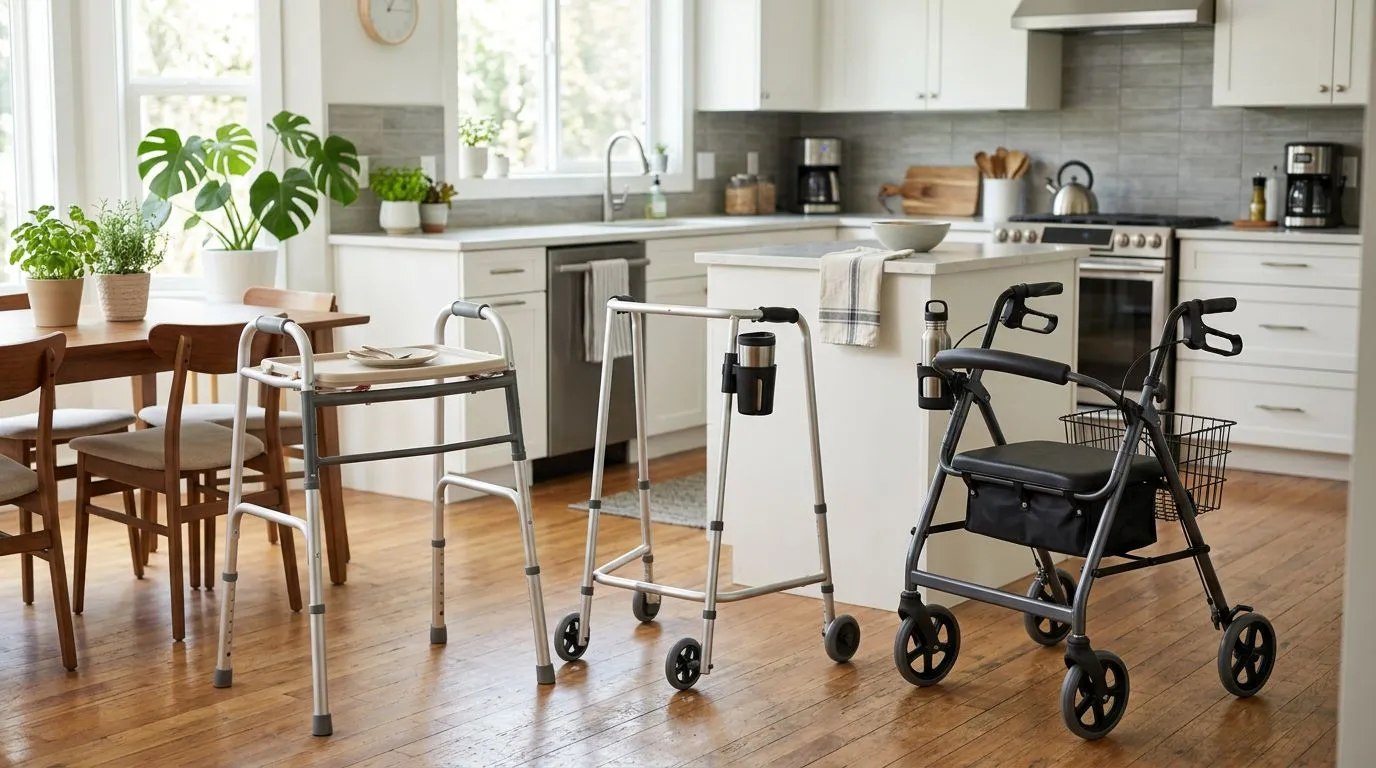
The best walker tray or cup holder depends on the mobility aid you use: standard walkers and two-wheel walkers usually work best with lightweight trays and simple cup holders, while rollators often do better with lower-profile storage, seat trays, or frame-mounted drink holders. The safest setup keeps weight low, does not block your grip, and leaves enough clearance for doorways, knees, wheels, and brakes.
If you want to carry a mug, plate, phone, glasses, mail, or medication from room to room, the accessory matters almost as much as the walker or rollator itself. A poorly fitted tray can make a walker harder to lift, and an oversized cup holder can catch on a doorway. The goal is not to carry more. It is to carry a few useful items without changing how your walker or rollator supports you.
Why carrying items is different on a walker than on a rollator
A standard walker, a two-wheel walker, and a rollator all support mobility, but they handle added weight differently. A typical standard walker has 4 legs and no wheels, so the user lifts and sets it down with each step. A two-wheel walker has wheels in front and glides in a straighter path, while the rear legs still provide friction and stability. A rollator has 3 or 4 wheels, hand brakes, and usually a built-in seat, making it easier to push but more sensitive to weight placement and braking control.
That difference matters when you add a tray or cup holder. On a standard walker, the tray moves every time the frame is lifted. A full cup on a tray may slosh because the walker rises and lowers several inches with each step. On a rollator, the frame rolls continuously, so a drink may move less, but the rollator can also be pulled off line if weight is too far forward, too far to one side, or above the seat.
Think of the accessory as part of the balance system. A 12-ounce drink, a dinner plate, a phone, and reading glasses may not seem heavy, but together they can change how the device feels. For most indoor carrying, smaller and lighter is safer than larger and more convenient.
Quick comparison: trays and cup holders by mobility aid type
The table below compares common accessory choices for the 3 most common situations: standard walkers, two-wheel walkers, and rollators. Many walker frames are about 22 to 26 inches wide at the front, while many interior doorways are 28 to 32 inches wide, so even a small side-mounted cup holder can matter in tight spaces.
| Mobility aid | Works best for | Tray considerations | Cup holder considerations |
|---|---|---|---|
| Standard walker, no wheels | Very short indoor carries, plates, mail, tissues, remote controls | Use a lightweight tray that sits securely over the top rails; avoid tall cups or heavy items because the walker is lifted with every step. | Choose a snug holder for covered drinks; side mounts may bump furniture because the walker must be lifted and repositioned. |
| Two-wheel walker | Room-to-room movement, light meal transport, water bottle, phone | A tray can work well if it clears the front wheels and does not shift when the rear legs contact the floor. | Frame-mounted holders work best when placed inside the walker width or high enough to clear wheel hardware. |
| 3-wheel rollator | Small items, narrow spaces, water bottle, wallet, keys | Full trays are less common and may be less stable because of the triangular frame; use caution with meals or open drinks. | A compact cup holder can work, but avoid mounting it where it interferes with folding or turning. |
| 4-wheel rollator | Drinks, snacks, small plates, personal items, seated rest breaks | Seat trays or removable trays may work when the rollator is stopped and brakes are locked; avoid pushing fast with an open cup. | Cup holders often work well on upright tubes below the handles, as long as they do not block brake cables or hand movement. |
| Upright or bariatric rollator | Larger users, higher handles, indoor/outdoor carrying, bottles with lids | Check handle height, seat width, and frame shape before buying; a wide frame can already fill much of a doorway. | Use a secure clamp or strap, and keep the holder below armrest level so it does not interfere with forearm support or brakes. |
Walker trays: what works on standard walkers and two-wheel walkers
For standard walkers and two-wheel walkers, the most common tray style rests across the upper side rails and creates a flat surface between the hand grips. Many trays are roughly 16 to 21 inches wide and include shallow raised edges or cup depressions. Those small lips matter. Even a 1/2-inch edge can help keep a plate, napkin, or phone from sliding when the walker changes direction.
Standard walkers are the hardest option for open drinks because the user lifts the frame again and again. A tray may help with a covered bowl, sandwich, medication organizer, mail, or a lightweight breakfast plate. It is less suitable for a full mug of hot coffee. If a standard walker is your primary aid, a covered travel cup or water bottle is usually safer than an open cup placed on a tray.
Two-wheel walkers are more forgiving. The front wheels roll while the rear legs touch down, so the tray does not bounce as much as it does on a no-wheel walker. Still, the tray should not rest on loose hand grips, brake-like glide accessories, or any part of the walker that moves independently. It should sit level and should not rock when you press lightly on each corner with one finger.
Pay attention to how the tray affects your normal grip. Some trays cover the top rails or sit close to the handles. If you have to reach around the tray to hold the walker, it is the wrong setup. Your hands should stay on the grips in the same position your clinician, therapist, or fitter recommended.
Cup holders: secure drinks without widening the frame too much
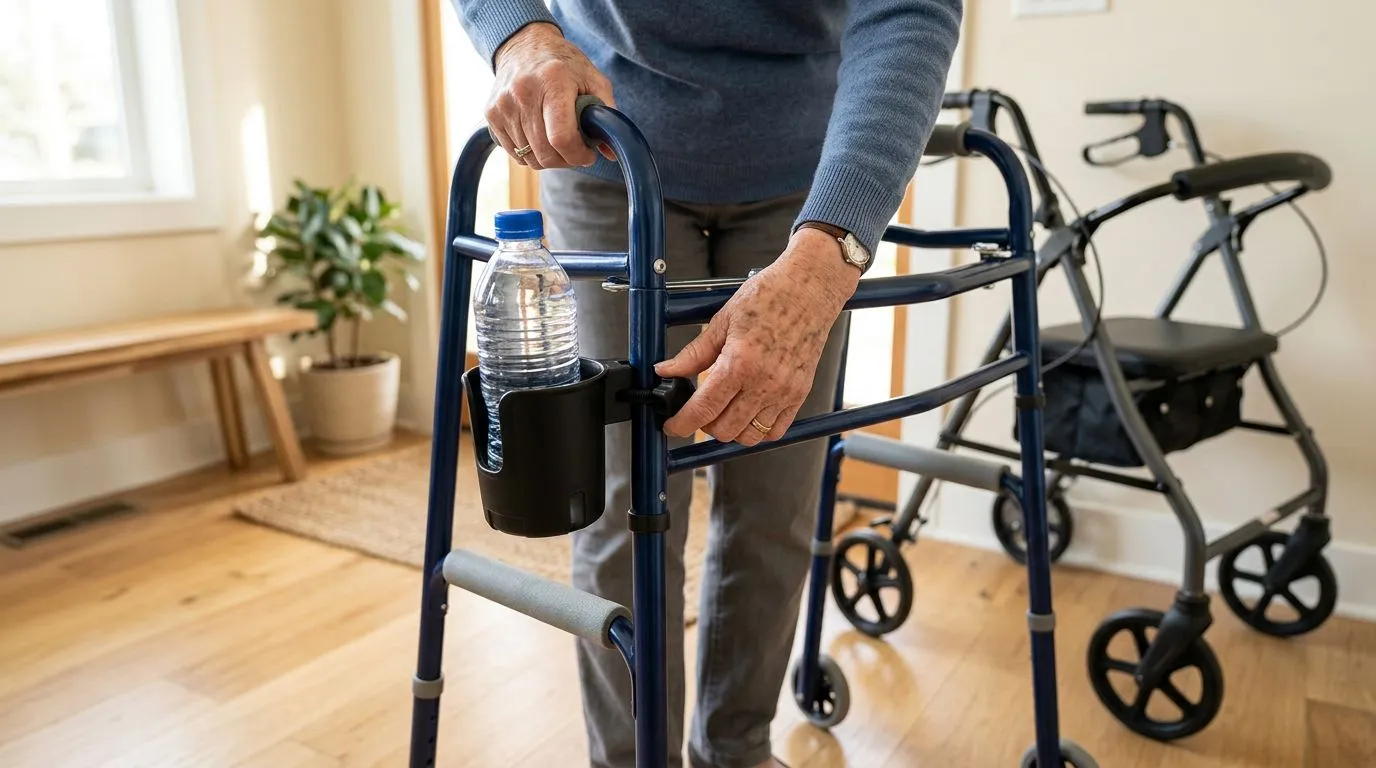
A cup holder seems simple, but placement is everything. Many clamp-on or strap-on holders fit round tubing in the 3/4-inch to 1-inch range, which is common on walker and rollator frames, but not universal. Before choosing one, check the tube shape, the available straight section, and whether the holder would sit inside or outside the frame width.
For standard walkers, a cup holder attached to the front or inside side rail is often better than one that sticks far out to the side. A side-mounted holder can catch on chairs, cabinets, bedding, and door trim. It also gives you one more thing to manage when you lift and turn the walker.
For two-wheel walkers, keep the cup holder away from the wheel fork and any glide caps or skis on the rear legs. When the walker is angled over a threshold, the holder should not tilt enough to spill. Test with an empty cup first, then with a half-full covered drink.
For rollators, cup holders usually perform best on a vertical or slightly angled frame tube below the hand grip. Leave at least 2 inches of clearance around brake levers and cables. If your rollator folds side-to-side, make sure the holder does not collide with the opposite frame tube when folded.
Drink shape matters. A narrow water bottle may rattle in a wide holder, while a large insulated tumbler may sit too high and become top-heavy. In most cases, a lidded 12- to 20-ounce drink is more practical than an open mug.
Rollator trays, baskets, and seat-top surfaces
Rollators are often better at carrying items than standard walkers because the frame rolls and many models already include a seat, pouch, basket, or under-seat storage. A typical 4-wheel rollator seat may be around 12 to 18 inches wide, depending on frame size, and some users add a removable tray that rests over the seat or attaches to the frame.
The safest way to use a rollator tray is usually with the rollator stopped, both hand brakes locked, and the tray serving as a temporary surface. For example, it may hold a snack plate while seated or support a small item during a transfer of belongings. Pushing a rollator quickly with a loaded seat tray is different; the wheels can turn, the tray can shift, and the user may need both hands for braking.
Many rollator users are better served by a storage pouch or basket for non-spill items and a separate cup holder for a lidded drink. Storage below the seat keeps weight lower than a tray on top. Lower weight generally feels steadier, especially when turning in a kitchen or moving through a hallway.
Three-wheel rollators need extra care. Their narrow, triangular footprint can be useful in small apartments and crowded rooms, but it gives less side-to-side support than many 4-wheel rollators. A compact cup holder or small pouch is usually more reasonable than a broad tray filled with items.
Upright rollators add another detail: arm platforms and higher handles. A cup holder should not block the forearm supports or force the user to change posture. On bariatric rollators, the frame may have a higher weight capacity, sometimes 300 pounds, 400 pounds, or more depending on the product, but that does not mean the tray or cup holder can carry heavy loads. Accessory limits are separate from frame limits.
Feature comparison: stability, attachment, clearance, and cleaning
Four features decide whether a walker tray or cup holder will be useful day after day: stability, attachment, clearance, and cleaning. A tray that is easy to wipe but slides on the frame is not a good trade. A cup holder that grips firmly but adds 4 inches to the side may be frustrating in a narrow bathroom.
| Feature | What to look for | Why it matters |
|---|---|---|
| Stability | Raised edges, snug fit, non-slip surface, low item height | Reduces sliding and tipping when the walker is lifted or the rollator turns. |
| Attachment | Clamps, straps, hooks, or molded channels sized for the frame | A secure attachment prevents shifting and avoids blocking the hand grips. |
| Clearance | At least 1 to 2 inches from wheels, brakes, knees, and folding joints | Prevents rubbing, catching, or interference with normal walking and folding. |
| Capacity | Light daily items, ideally just 1 meal plate or 1 lidded drink at a time | Heavy loads can make the device harder to control, even if the frame feels strong. |
| Cleaning | Smooth surfaces, removable parts, no deep grooves where spills collect | Food and drink accessories should be easy to wipe after each use. |
Do not ignore noise and vibration. A rattling cup holder may seem harmless, but it can distract a user who is already concentrating on balance, foot placement, or pain. If the holder shakes when empty, it will usually shake more when loaded.
Who each accessory is best for
For a person walking 10 to 30 feet from a kitchen counter to a table, a tray may be enough. For someone moving through multiple rooms, making several turns, or using a rollator outdoors, a lidded cup holder and low storage pouch may be more practical. Matching the accessory to the task is better than choosing the biggest surface available.
Best fit for a standard walker
A lightweight tray is best for short, slow indoor carries with flat items: a sandwich plate, mail, glasses case, phone, small book, or napkin. A cup holder is best only if the drink is covered and the holder does not make the walker awkward to lift. If the user has limited hand strength, avoid accessories that make the walker heavier or require twisting knobs every day.
Best fit for a two-wheel walker
A two-wheel walker can handle a tray more smoothly because the front of the frame rolls. It is a good match for people who need walker support but still want to carry a light meal from counter to table. Keep total carried weight modest; even 3 to 5 pounds can feel like much more when placed high on the frame.
Best fit for a rollator
A rollator is often the best choice for a cup holder, under-seat storage, or a small removable tray used while stopped. It suits users who can safely manage hand brakes and do not need to lean heavily on the device for weight-bearing support. A rollator rolls easily, which helps with carrying, but it also means brake habits matter.
Best fit for an upright or bariatric rollator
Upright and bariatric rollators may have more frame space, but accessories still need careful placement. Choose lower mounting points for drinks, keep trays clear of arm supports, and confirm the added item does not interfere with sitting, standing, or locking the brakes.
How to choose and measure before you buy
Take 5 minutes with a tape measure before choosing a tray or cup holder. Measure the outside width of the walker or rollator, the distance between the top rails, the diameter or shape of the tube where the accessory will attach, and the clearance near wheels and brakes. Write those numbers down; guessing from a photo often leads to a poor fit.
- Measure frame width: Check the widest point, including wheels or existing attachments. Compare it with your narrowest doorway or bathroom entrance.
- Measure top rail spacing: For a tray, measure inside-to-inside and outside-to-outside distances between the upper side rails.
- Check handle access: Place your hands on the grips. Any tray or cup holder should leave your grip and wrist position unchanged.
- Check folding: Fold the walker or rollator with the accessory in place, if you plan to leave it attached. If it binds, remove it before folding.
- Test wheel and brake clearance: Turn the wheels fully, squeeze the brakes, and lock the brakes. The accessory should not touch cables, levers, or wheel hardware.
- Simulate the load: Start with an empty cup, then a half-full lidded cup, then the real item. Walk slowly over the surfaces you use daily.
If you use your walker near rugs, thresholds, oxygen tubing, pet bowls, or narrow furniture gaps, test in those exact places. A setup that works in an open living room may be annoying in a galley kitchen with 36 inches between counters.
Safety trade-offs to keep in mind
Every carrying accessory adds a trade-off. A tray gives you surface area, but it may block your view of the floor. A cup holder frees your hands, but it may add width. A basket holds more, but extra weight can make steering harder. Even a small accessory can change the feel of a walker or rollator over a 20-foot walk.
Hot liquids deserve special caution. If you must carry coffee, tea, or soup, use a sealed or lidded container and avoid filling it to the top. Open mugs are risky on standard walkers because lifting can cause spills; they are also risky on rollators if you need to brake suddenly.
Do not overload a tray with groceries, cookware, or multiple heavy dishes. A walker is not a cart, and a rollator is not a serving trolley. The device’s first job is mobility support. Carrying should never interfere with hand placement, posture, brake use, or the ability to stop and recover balance.
If a new accessory makes you feel less steady, remove it. People with recent falls, new weakness, dizziness, vision changes, or major balance concerns should consider asking a physical therapist, occupational therapist, or qualified mobility professional to review the setup. That guidance is especially useful when choosing between a standard walker, two-wheel walker, and rollator for daily household tasks.
Practical setup ideas for meals, drinks, and small items
For a simple breakfast carry of 15 to 20 feet, a two-wheel walker with a fitted tray and a covered cup can work well. Put heavier items toward the center of the tray, not on the front edge. Keep one hand ready on the grip, move slowly, and avoid turning sharply with a loaded tray.
For a standard walker, consider making the load smaller instead of increasing accessory size. Carry a sandwich on a small plate, use a lidded cup in a snug holder, and make two trips if needed. A smaller load is often faster than cleaning a spill or recovering from a near trip.
For a 4-wheel rollator, place non-spill items in the pouch or basket and use the cup holder for a lidded drink. If you use a tray over the seat, lock the brakes before loading or unloading it. When seated, keep the tray light enough that you can remove it without twisting or reaching too far.
For narrow homes, measure before adding side accessories. If your rollator is 25 inches wide and your bathroom doorway is 28 inches wide, a cup holder that sticks out 3 inches may be the difference between smooth access and constant bumping. In that case, an inside-frame mount, front mount, or soft pouch may be the better choice.
The best accessory is the one you barely notice. It should help you carry one or two daily items while preserving the stability, clearance, and hand control that make your walker or rollator useful in the first place.
FAQ
Frequently asked questions
Can I put a tray on any standard walker? +
Not always. The tray must match the walker’s top rail spacing and should sit level without covering the hand grips. Measure the frame before buying and avoid trays that rock, slide, or make the walker harder to lift.
Is a cup holder safer than a walker tray? +
It depends on what you are carrying. A snug cup holder with a lidded drink is often safer than placing an open cup on a tray, especially on a standard walker. A tray may be better for flat, light items such as a plate, mail, or phone.
Can I use a rollator tray while walking? +
Use caution. Many rollator trays are best used when the rollator is stopped and the brakes are locked. If you walk with a loaded tray, keep items light, use covered drinks, and make sure you can still grip and brake normally.
Where should a cup holder be mounted on a rollator? +
A good spot is usually on a vertical or slightly angled frame tube below the hand grip, away from brake levers, cables, folding joints, and wheels. It should not widen the rollator so much that it bumps doorways or furniture.
How much weight should I carry on a walker tray? +
Keep it light. Many users do best with one small plate, a covered drink, or a few personal items rather than a heavy meal or grocery load. Even 3 to 5 pounds placed high on the frame can change how stable the walker feels.
Are trays better for walkers or rollators? +
Trays can work on both, but they are used differently. On standard and two-wheel walkers, they help with short indoor carries. On rollators, a tray is often more useful as a temporary surface when stopped, while a pouch or basket carries items more securely during movement.
Keep reading
Related guides
Walker Tray vs Basket vs Storage Bag: Safer Ways to Carry Items on a Walker or Rollator
14 min read
Walker and Rollator Accessories Guide: Bags, Trays, Cup Holders, Lights, and Comfort Add-Ons
14 min read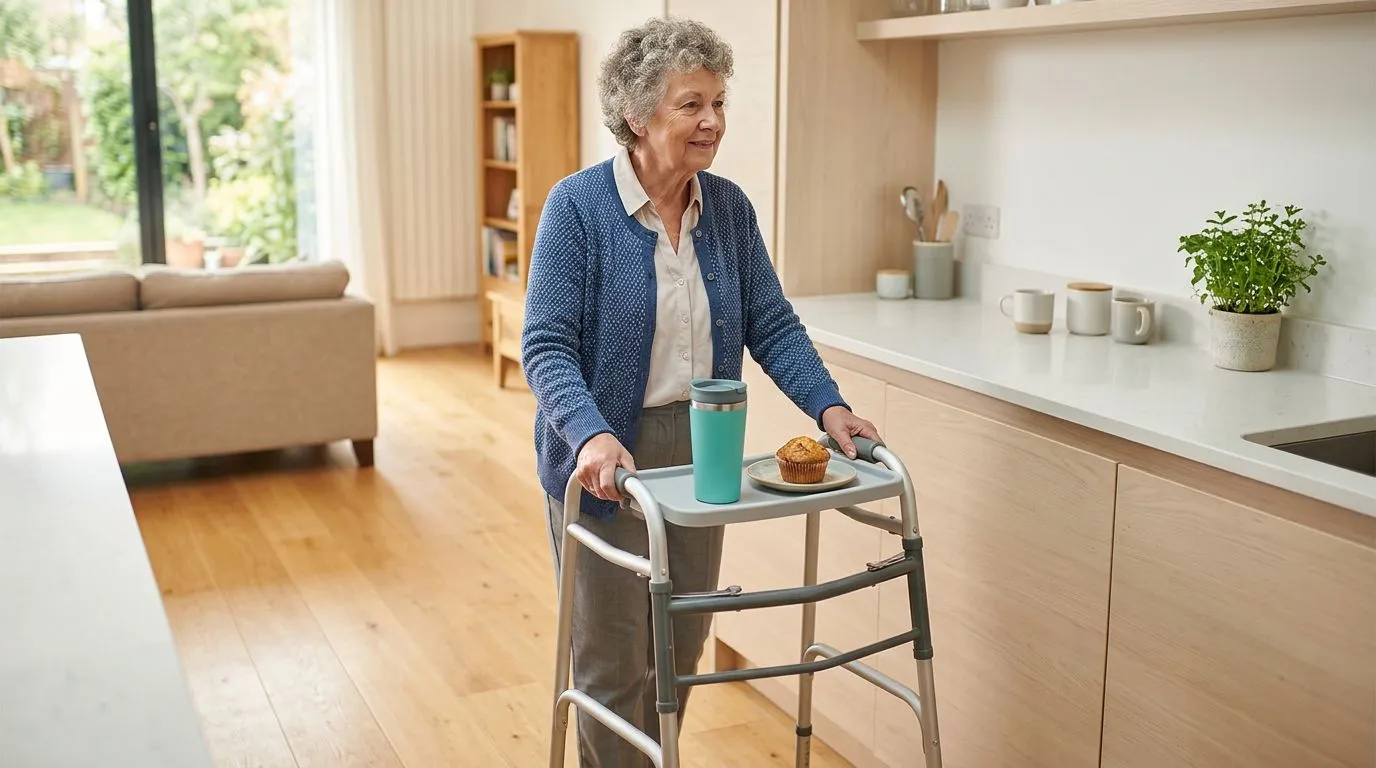
Walker Trays and Clip-On Tables: Benefits, Safety Limits, and When They Make Sense
13 min read