Disclosure: We may earn a commission when you buy through links on this page, at no extra cost to you. We buy nothing, sell nothing and accept no payment for coverage — commissions never decide what we recommend. How we make money.

A standard walker should fit with the handgrips near your wrist crease when you stand tall and let your arms relax at your sides. When you hold the grips, your elbows should bend slightly, usually about 15 to 30 degrees. The frame should also be wide enough for your body without making you reach out to the sides.
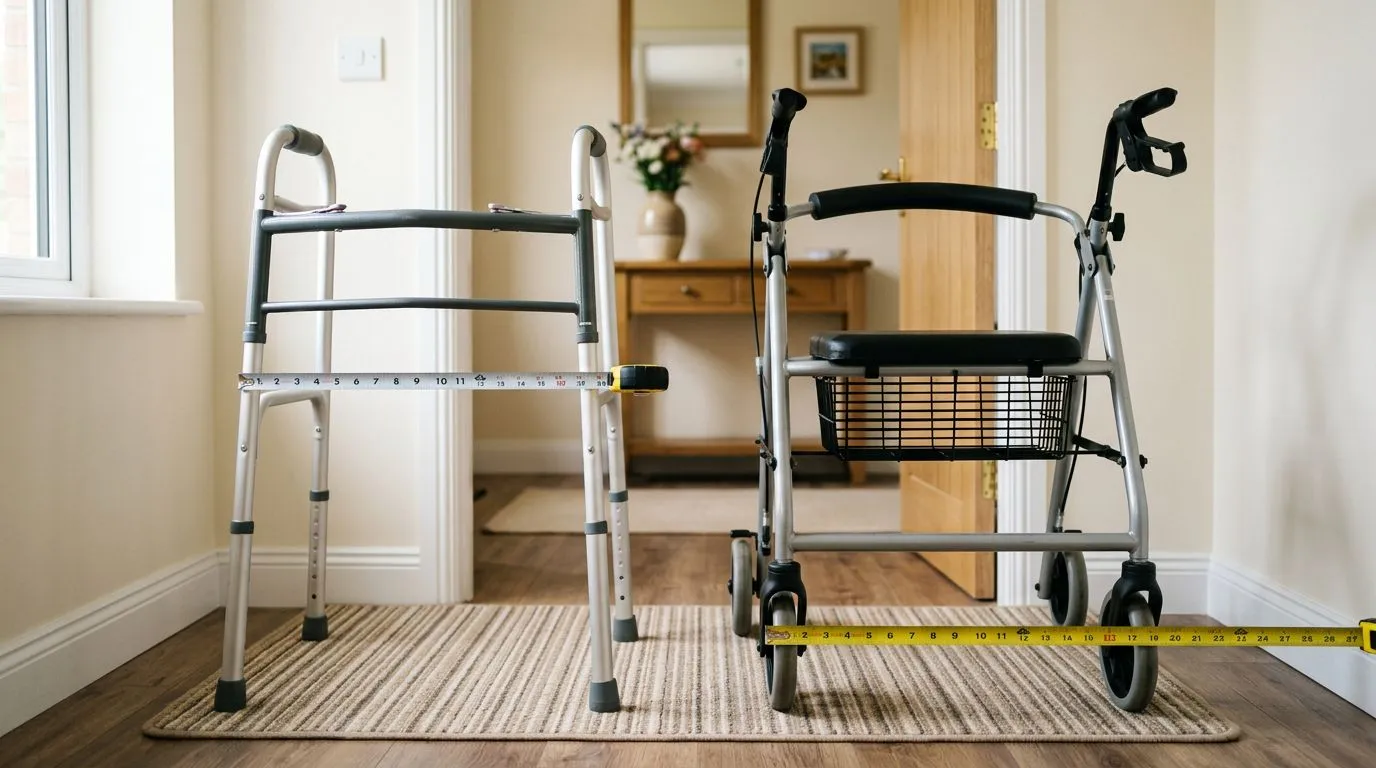
This guide focuses on no-wheel walkers and two-wheel walkers, not rollators. Rollators have 3 or 4 wheels, hand brakes, and often a seat; standard walkers are simpler support frames for people who need more stability and controlled, step-by-step movement.
Why 1 inch of walker height can change your posture
Walker height may seem like a small adjustment, but even 1 inch can affect how you stand, how your shoulders feel, and how safely you put weight through your arms. A walker that is too tall often pushes the shoulders up toward the ears. One that is too low can make you lean forward and add strain to the back, wrists, and neck.
The goal is not for the walker to carry your full body weight. It should provide a steady base of support while you step, turn, and transfer. For most adults, the right handle height creates a soft bend at the elbow instead of a locked arm or deep crouch.
Standard walkers are often adjustable in 1-inch increments. Common adult handle-height ranges are roughly 32 to 39 inches, though petite and tall frames may adjust lower or higher. Because these ranges vary by frame type, measure the person first rather than choosing by height label alone.
Fit matters most for people who use a walker many times per day: walking from the bedroom to the bathroom, standing at a sink for 3 minutes, or crossing a carpeted living room. Small sizing errors become more noticeable with repeated use.
No-wheel vs two-wheel walker sizing: 2 front wheels make a difference
No-wheel walkers and two-wheel walkers look similar, but they move differently. A no-wheel walker has four rubber tips on the floor. The user lifts or partly lifts the frame, places it forward, then steps into it. A two-wheel walker has wheels on the front legs and rubber tips or glide caps on the back legs, so the frame can roll forward without being fully lifted.
The basic height measurement is the same for both types: wrist crease at the handgrip, with a slight elbow bend while holding. Width and support needs may differ because a two-wheel walker moves more easily, while a no-wheel walker usually feels more planted.
| Walker type | Typical best fit | Support feel | Common sizing notes |
|---|---|---|---|
| No-wheel standard walker | People who need maximum stability and can lift or advance the frame safely | Most stable because all 4 legs contact the floor | Check that all 4 tips land flat after height adjustment |
| Two-wheel walker | People who need support but have trouble lifting a full frame each step | Stable, but easier to move forward | Front wheel size is often about 5 inches; rear tips or glides must stay even |
| Rollator | People with better balance who can steer and use hand brakes | Moves continuously on 3 or 4 wheels | Not sized the same way because brakes, seat height, and wheelbase matter |
A rollator can be useful for some people, especially when a seat and hand brakes are needed, but it is not a direct substitute for a standard walker. If the main need is slow, stable, weight-bearing support, a no-wheel or two-wheel walker is often the better category to evaluate with a clinician.
How to measure walker handle height in 3 steps
Use a tape measure, supportive shoes, and a flat floor. Measure in the shoes the person normally wears indoors or for daily walking. A thick sneaker sole can add 1 inch or more compared with slippers, which may change the best setting.
- Stand upright. The user should stand as tall as comfortable, with shoulders relaxed and arms hanging naturally at the sides. Do not hunch forward to meet the walker.
- Find the wrist crease. Measure from the floor to the crease on the inside of the wrist. This number is the target handgrip height.
- Confirm with elbow bend. After adjusting the walker, the elbows should bend about 15 to 30 degrees when both hands rest on the grips.
For example, if the wrist crease measures 34 inches from the floor, start with the walker grips at about 34 inches. If the walker adjusts only in 1-inch increments, try the closest setting and watch posture through several steps.
Check both sides. Some people stand with one shoulder slightly higher, have one leg that bears less weight, or lean because of pain. The walker still needs to be level unless a physical therapist or occupational therapist recommends otherwise for a specific reason.
After adjustment, press down lightly on both handgrips. The legs should not rock, and each push button should be fully locked into the same numbered hole on both sides. Uneven leg settings can make a walker wobble even when the handle height seems right.
Walker width: allow 1 to 2 inches of side clearance
Width is easy to overlook because many shoppers focus only on height. A walker should be wide enough for the user to stand between the handgrips without hips, thighs, or clothing rubbing on the side frame. As a practical starting point, allow at least 1 to 2 inches of clearance on each side of the body.
Measure the user at the widest point that will pass through the walker opening, usually the hips or thighs. Then compare that number with the walker's inside width, not just the overall outside width. The inside width is the space the user actually has available.
Many standard adult walkers have an inside width around 17 to 20 inches and an outside width around 24 to 26 inches. Narrow walkers may be closer to 21 to 23 inches outside, while heavy-duty or bariatric frames may be wider, sometimes around 27 to 30 inches outside. These are general ranges, so the actual frame specifications matter.
Doorways are the other half of the width decision. Many interior doorways in US homes are about 28 to 32 inches wide, and bathroom doorways in older homes may be tighter. A walker that fits the person but cannot pass through the bathroom door may become frustrating or unsafe in daily use.
| Measurement | What to check | Why it matters |
|---|---|---|
| Inside walker width | Space between the side frames or handgrip area | Determines whether the user can stand comfortably inside the frame |
| Outside walker width | Widest point of the frame | Determines doorway and hallway clearance |
| User hip width | Widest point while standing | Helps avoid a frame that is too narrow |
| Doorway width | Narrowest door used daily, often bathroom or bedroom | Prevents choosing a walker that cannot pass through key spaces |
If a person needs a wider frame for comfort or weight capacity, measure the home before choosing. Check the bathroom, bedside path, kitchen, hallway turns, and any doorway used several times a day.
Support and weight capacity: check the 250 to 300 lb range first
Many standard adult walkers have weight capacities in the 250 to 300 lb range. Heavy-duty and bariatric walkers may be rated higher, often 350 lb, 400 lb, 500 lb, or more depending on frame design. The safest choice is one that clearly meets or exceeds the user's current body weight plus any normal clothing or carried items.
Do not guess on weight capacity. It is a structural limit, not a comfort suggestion. A walker that is too narrow, too light-duty, or flexes under pressure may feel unstable even if the handle height is correct.
Support also depends on how the person uses the walker. Someone recovering strength may place light pressure through the hands for balance. Another person may rely more heavily on the frame when standing from a chair or stepping onto a threshold. The more support needed, the more important frame rigidity, correct height, and tip condition become.
No-wheel walkers usually provide the most stop-and-go stability because all four tips contact the floor. Two-wheel walkers reduce the need to lift the frame, which can help someone with limited arm strength, but the rear legs still need proper contact and control. Neither style should slide away during standing transfers.
- Choose a capacity above the user's body weight, not equal to it if options are close.
- Look for a frame width that matches the user's body, not just a higher weight rating.
- Inspect rubber tips regularly; worn tips reduce grip on smooth floors.
- Avoid hanging heavy bags from one side, which can change balance.
If a person needs to put substantial body weight through the walker, has recent falls, or has a new medical condition affecting balance, fitting should be confirmed by a licensed professional.
Who standard walkers are best for: 4 common user situations
Standard walkers are best for people who need a stable frame more than speed. They are often used indoors, during recovery, or when balance is limited enough that a rollator may move too freely. The right choice depends on strength, coordination, home layout, and how much support the person needs with each step.
| User situation | Likely walker type to consider | Fit priority |
|---|---|---|
| Needs maximum stability while walking short distances | No-wheel standard walker | Level legs, correct grip height, non-worn rubber tips |
| Cannot comfortably lift a walker for every step | Two-wheel walker | Front wheels roll smoothly; rear legs remain controlled |
| Lives in a home with narrow bathroom access | Narrow folding walker if body width allows | Outside width and turning space |
| Needs a higher weight capacity or wider stance | Heavy-duty or bariatric walker | Weight rating, inside width, doorway clearance |
A folding walker can help with transport or storage, especially when placing it in a car trunk or beside a bed. Folding ability does not replace proper fit. The frame still needs the correct height, enough inside width, and a secure locking mechanism when open.
Two-wheel walkers can be a good middle ground for people who need more stability than a rollator but less lifting than a no-wheel frame. They are not ideal for everyone. If the user tends to push the frame too far ahead or cannot control forward motion, a no-wheel walker or professional gait training may be safer.
Rollators belong in a different decision path. A 4-wheel rollator may include a seat, storage pouch, larger wheels, and hand brakes. Those features can help with longer distances, but they also require braking skill, steering control, and enough balance to manage a rolling base.
Home fit check: test 5 everyday spaces before deciding
A walker can fit the body and still fail in the home. Before settling on a size, test or measure the places where the walker will be used every day. Five key areas are the bedroom path, bathroom doorway, toilet approach, kitchen workspace, and main hallway or living room route.
Start with the narrowest doorway. Measure the clear opening from the inside edge of one door stop to the other. If a door is 28 inches wide but the walker is 26 inches outside width, there may be only 1 inch of clearance on each side, and less if the user approaches at an angle.
Turning space matters too. A standard walker does not pivot as easily as a person walking without equipment. In a small bathroom, the user may need to approach the sink, turn toward the toilet, and back up carefully. If the frame is too wide, each movement becomes harder.
- Bedroom: Leave a clear path from the bed to the door, ideally without loose rugs or cords.
- Bathroom: Measure the doorway and the space beside the toilet or vanity.
- Kitchen: Check whether the walker fits between counters, table legs, or an island.
- Hallway: Look for tight turns, floor transitions, and clutter.
- Entryway: Test thresholds, mats, and the first few steps inside the door.
Floor surfaces affect fit and function. Rubber tips grip differently on tile, hardwood, carpet, and vinyl. Rear glides on a two-wheel walker may move well on carpet but too freely on slick floors. Any change in tips, glides, or wheels should be tested slowly.
Common sizing mistakes: avoid a frame 2 inches too tall or too narrow
A walker that is about 2 inches too tall often causes raised shoulders, locked elbows, or hands pressing down from an awkward angle. The user may complain of shoulder fatigue or feel as if the walker is hard to control. Lowering the grips by one hole can make a noticeable difference.
A walker that is too short tends to pull the user forward. You may see a rounded back, bent neck, or the walker positioned too far ahead of the body. This can encourage short, shuffling steps and poor posture. Raising the grips may help, but only if the frame still stays level.
Width mistakes matter just as much. If the frame is too narrow, the user may not step fully into it, or the side bars may bump the hips. If the frame is too wide, it may not fit through key doorways and may require wider arm placement than is comfortable.
Another common error is setting the front and back legs unevenly. On many walkers, each leg adjusts with a spring button and a series of holes. All legs should usually be set to the matching height holes so the walker stands level. With two-wheel walkers, confirm that wheel legs and rear legs are adjusted as designed for that specific frame.
- Do not size a walker while the user is sitting.
- Do not rely only on the user's overall height, such as 5 feet 6 inches.
- Do not ignore shoe height if the walker is used outside the home.
- Do not assume a bariatric walker automatically fits through household doors.
- Do not use worn, cracked, or missing rubber tips.
Final fit checklist: confirm 6 points before daily use
Once the walker is adjusted, do a short fit check in a safe area. Keep a sturdy chair nearby and, if needed, have another person present. A 5-minute review can catch the most common problems before the walker becomes part of daily routines.
| Fit point | What good fit looks like |
|---|---|
| Handle height | Grips line up near the wrist crease when standing tall |
| Elbow angle | Elbows bend slightly, about 15 to 30 degrees |
| Frame width | User can stand inside without hip or thigh rubbing |
| Floor contact | All tips or wheels contact the floor evenly |
| Doorway clearance | Walker passes through daily doorways without scraping or twisting |
| Support rating | Weight capacity is clearly above the user's body weight |
The best standard walker is the one that fits both the person and the setting. For many users, that means a no-wheel walker for maximum steadiness or a two-wheel walker when lifting the frame is difficult. Height, width, weight capacity, and home clearance all need to line up.
If there is uncertainty, ask a physical therapist, occupational therapist, physician, or qualified mobility professional to review the fit. Walker sizing is practical, but it is also personal. A well-fitted frame should support safer movement without forcing awkward posture or making the home harder to navigate.
FAQ
Frequently asked questions
How high should the handles be on a standard walker? +
The handles should usually line up with the crease of your wrist when you stand upright with your arms relaxed at your sides. When you hold the grips, your elbows should have a slight bend, typically about 15 to 30 degrees.
Is a no-wheel walker more stable than a two-wheel walker? +
A no-wheel walker generally feels more stable because all four rubber tips contact the floor before each step. A two-wheel walker is easier to move forward because the front legs roll, but it still needs good control and properly fitted rear tips or glides.
How do I know if a walker is too narrow? +
A walker is likely too narrow if your hips, thighs, or clothing rub the side frame, or if you cannot stand comfortably inside the walker while holding the grips. As a practical guide, aim for about 1 to 2 inches of clearance on each side when possible.
Can I choose a walker based only on my height? +
Height charts can help narrow the search, but they are not enough. Wrist-to-floor measurement, elbow bend, body width, doorway clearance, weight capacity, and shoe height all affect proper walker fit.
What is the difference between a standard walker and a rollator? +
A standard walker is a support frame with no wheels or two front wheels and no built-in seat. A rollator has 3 or 4 wheels, hand brakes, and often a seat, so it moves more continuously and requires more steering and brake control.
Keep reading
Related guides
Bariatric Walker and Rollator Fit: Seat Width, Frame Width, and Weight Capacity Checklist
15 min read
How to Measure for a Mobility Walker or Rollator: Handle Height, Elbow Bend, and Posture Checks
15 min read
Inside Width vs Overall Width: How Much Room You Need in a Walker or Rollator
13 min read