Disclosure: We may earn a commission when you buy through links on this page, at no extra cost to you. We buy nothing, sell nothing and accept no payment for coverage — commissions never decide what we recommend. How we make money.
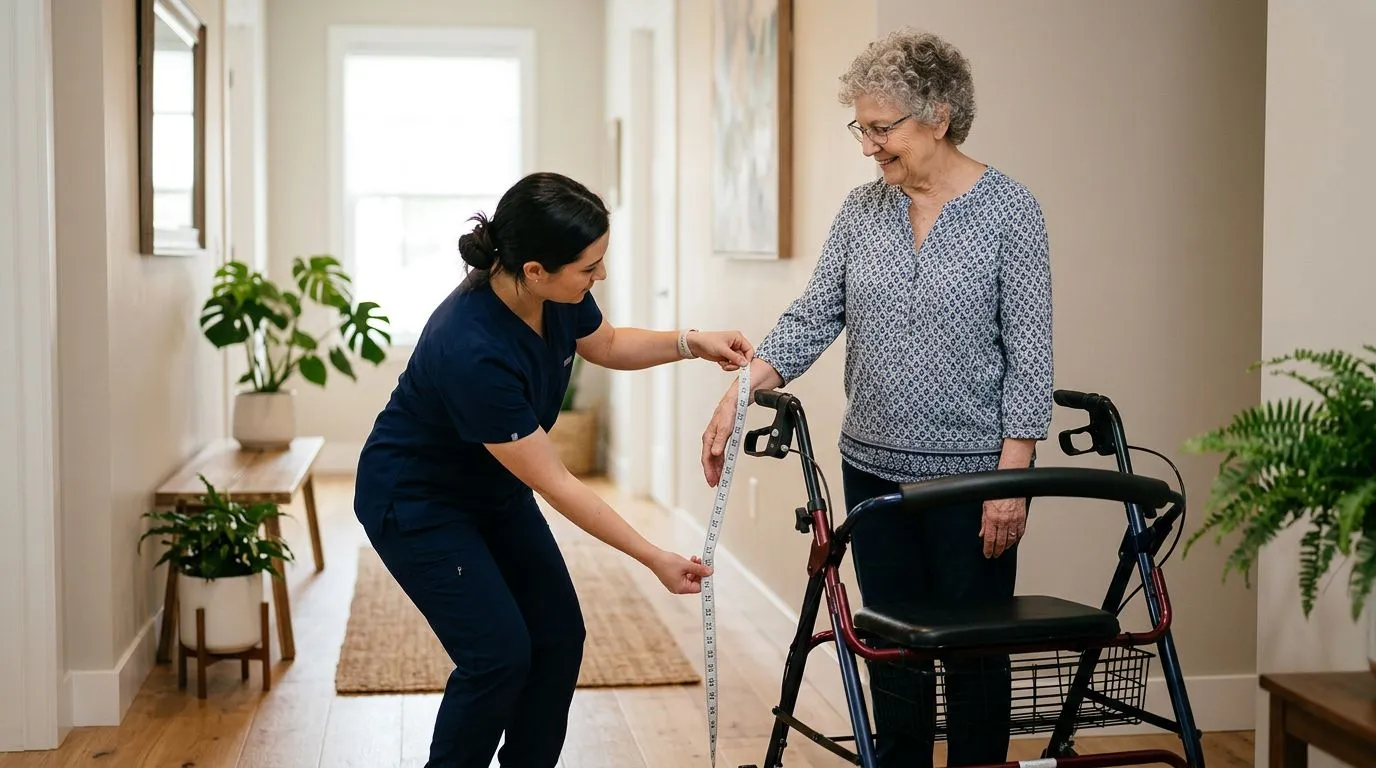
A rollator fits correctly when the handles line up near your wrist crease as you stand tall in your walking shoes, and the seat lets you sit with both feet flat and your knees close to a 90-degree angle. For many adults, handle height falls around 30 to 38 inches, while seat height commonly ranges from about 18 to 24 inches. The right fit improves posture, braking control, and comfort when you stop to rest.
Seat and handle height are not minor details. They affect how much you lean forward, how easily you reach the brakes, and whether standing up from the seat feels steady or awkward. This guide explains how to measure at home, how rollator types differ, and which sizing mistakes to avoid before you buy.
Why rollator fit matters: 2 measurements affect every step
A rollator is a wheeled walker with hand brakes and, on most 4-wheel designs, a built-in seat. Unlike a standard walker, which is lifted or partially lifted with each step, a rollator rolls continuously and relies on good hand position for control. That makes handle height and brake reach especially important.
Handle height affects your standing posture. If the handles are even 2 inches too low, many users compensate by bending at the waist, rounding the shoulders, and looking down. If the handles are too high, the shoulders may lift and the elbows may stay too bent, making steering and braking feel less natural.
Seat height matters for safe resting. A seat that is too low can be hard to rise from, especially if you have knee or hip stiffness. A seat that is too high may leave your feet dangling or barely touching the floor, which reduces stability while seated.
| Fit area | What to measure | Why it matters |
|---|---|---|
| Handle height | Floor to wrist crease while standing in shoes | Supports upright posture and easier brake control |
| Seat height | Floor to the crease behind the knee, then compare to listed seat height | Helps feet stay flat and knees near 90 degrees |
| Seat width | Hip width while seated, plus about 1 to 2 inches | Improves comfort without making the frame too wide |
| Weight capacity | User weight plus any carried items | Keeps use within the manufacturer’s stated limit |
A well-fitted rollator should not force you into a different walking style. It should support the safest version of your natural gait.
Rollator vs walker sizing: 4 wheels, brakes, and a seat change the fit
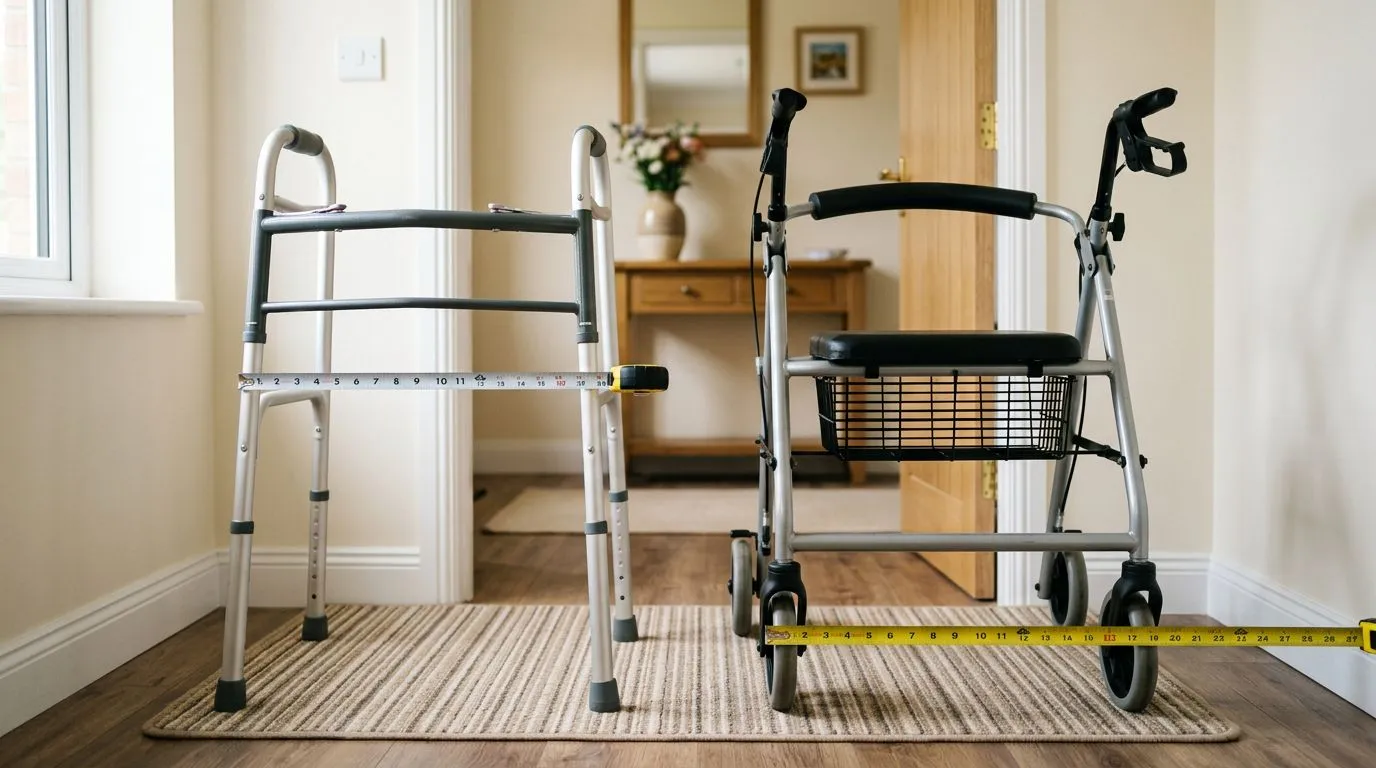
The terms walker and rollator are often used loosely, but they are not the same device. A standard walker or folding walker usually has no seat and may have no wheels or 2 front wheels. A rollator typically has 3 or 4 wheels, bicycle-style hand brakes, and a seat on many models.
That difference changes the fitting process. With a standard walker, handle height is the main measurement because the frame is used for step-by-step support. With a rollator, you still measure handle height, but you also need to consider seat height, brake reach, wheel size, and whether the frame feels controllable while rolling.
| Device type | Common setup | Seat? | Best fit focus |
|---|---|---|---|
| Standard walker | No wheels, lifted with each step | No | Handle height and arm position |
| Two-wheel walker | 2 front wheels, rear legs or glides | No | Handle height and stability |
| 3-wheel rollator | 3 wheels, hand brakes, narrow turning | Usually no built-in seat | Handle height, brake reach, maneuverability |
| 4-wheel rollator | 4 wheels, hand brakes, built-in seat | Yes | Handle height, seat height, seat width, brakes |
| Upright rollator | 4 wheels with higher forearm supports | Often yes | Forearm support height and frame control |
If you need maximum stability and move slowly, a walker may still be the better choice. If you walk more continuously, need a place to rest, and can safely control hand brakes, a rollator may fit your daily routine better. When in doubt, ask a physical therapist, occupational therapist, or qualified medical professional to assess your gait and balance.
How to measure rollator handle height in 5 minutes
You can measure handle height at home with a tape measure, supportive shoes, and a wall or sturdy chair nearby. The goal is to match the rollator handles to your relaxed wrist crease, not your fingertips or your elbow.
- Put on the shoes you wear most often outside or around the home.
- Stand as tall as comfortably possible with your arms relaxed at your sides.
- Let your shoulders relax. Do not reach down or shrug upward.
- Have another person measure from the floor to the crease at the inside of your wrist.
- Compare that number with the rollator’s adjustable handle range.
When you place your hands on the handles, your elbows should usually bend slightly, often around 15 to 30 degrees. Your shoulders should not hike up, and your back should not have to fold forward just to reach the grips.
Here is a practical example: if your wrist crease measures 34 inches from the floor, look for a rollator with handles that adjust to 34 inches, ideally with at least 1 inch of adjustment above and below that setting. That extra range helps if you change shoes, add orthotics, or need a small posture adjustment after trying the rollator indoors.
Handle height is also tied to brake access. With your hands resting on the grips, you should be able to squeeze the brake levers without shifting your palm far forward. If you have arthritis, reduced grip strength, numbness, or one weaker hand, test the brake action carefully before relying on the rollator in public.
How to measure rollator seat height with the 90-degree knee rule
Rollator seat height is usually measured from the floor to the top of the seat. Many standard rollator seats are roughly 20 to 23 inches high, though petite and tall options may fall outside that range. The best height depends on your leg length, not just your overall height.
To estimate seat height, sit in a firm dining chair with your feet flat and your knees bent near 90 degrees. Measure from the floor to the top surface of the chair seat. If that chair feels easy to sit on and rise from, its height is a useful reference point for rollator shopping.
You can also measure your lower leg. While seated, measure from the floor to the crease behind your knee. A rollator seat close to that number often allows both feet to rest flat. If you have long legs, a 19-inch seat may feel too low. If you are shorter, a 23-inch seat may feel too high.
Standing up is part of the test. Sit on the locked rollator seat only after positioning it on level ground and setting the parking brakes. Your feet should be flat, your knees should not be sharply higher than your hips, and you should be able to stand without rocking several times to gain momentum.
Important safety note: a rollator seat is for resting, not for being pushed like a wheelchair unless the device is specifically designed and rated for transport use. Most rollators are not intended to carry a seated person while another person pushes from behind.
Seat comfort, width, and weight capacity: allow 1 to 2 inches
Height is only one part of rollator seat comfort. Width, depth, padding, back support, and frame capacity all matter. A seat that is the right height but too narrow can still feel unsafe or uncomfortable after 5 minutes of resting.
To estimate seat width, sit on a firm chair and measure across the widest part of your hips or thighs in a natural seated position. Add about 1 to 2 inches for comfort. If your seated hip width is 18 inches, a seat around 19 to 20 inches wide may feel more comfortable than one that matches your body exactly.
Seat depth is worth checking, too. A very shallow seat may not support enough of the thighs, while an overly deep seat can press behind the knees. Many rollator seats are compact because the frame must still fit through doors and turn in tight spaces. A common interior doorway in the US is about 30 to 32 inches wide, so wider bariatric rollators may require more planning indoors.
Weight capacity is not a comfort feature. It is a safety limit. Standard rollators often list capacities around 250 to 300 pounds, while bariatric rollators may be rated higher, sometimes 350 pounds or more depending on the design. Always follow the stated limit for the specific rollator and include carried items such as a bag, oxygen equipment, or personal belongings.
| Feature | What to look for | Common sizing mistake |
|---|---|---|
| Seat height | Feet flat, knees near 90 degrees | Choosing by overall height only |
| Seat width | Hip width plus 1 to 2 inches | Ignoring hip comfort to get a narrower frame |
| Seat depth | Enough thigh support without pressure behind knees | Assuming all seats feel the same |
| Backrest | Comfortable contact when sitting upright | Leaning too far back on a flexible strap |
| Capacity | User weight plus carried items within limit | Using capacity as an estimate instead of a firm limit |
How to choose by rollator type: 3-wheel, 4-wheel, upright, and bariatric sizes
Different rollator styles fit different bodies and settings. Someone who needs a compact frame for a small apartment may choose differently than someone who wants a higher seat for longer outdoor walks.
3-wheel rollators
A 3-wheel rollator is often narrower and easier to turn in tight spaces. Many do not have a built-in seat, so seat height may not apply. Handle height, brake reach, wheel size, and folded width are the key fit points. This style may suit users who walk steadily but want light rolling support and better maneuverability.
4-wheel rollators
A 4-wheel rollator is the common choice when someone wants a seat for rest breaks. Measure both handle and seat height carefully. Many 4-wheel models have seats in the 18 to 24 inch range and handle ranges around 30 to 38 inches, but those are only general ranges. Compare your measurements to the listed specifications.
Upright rollators
Upright or stand-up rollators use higher forearm supports instead of standard hand grips alone. They are often chosen by people who feel more comfortable walking with a taller posture. Fit is more complex because you must measure forearm support height, elbow position, hand grip angle, and brake access. Some upright rollators adjust into the 40 to 50 inch range, but the correct number depends on your forearm position and shoulder comfort.
Bariatric rollators
Bariatric rollators are built with wider frames, reinforced components, and higher weight capacities. They may offer wider seats, stronger frames, and sometimes higher seat heights. The tradeoff is size. A wider rollator may be harder to maneuver through 30-inch doorways, narrow bathrooms, or crowded restaurants. Measure your home, not just your body.
| Rollator type | Who it is often best for | Fit priority |
|---|---|---|
| 3-wheel | Users who need turning ease and no seat | Handle height and brake reach |
| 4-wheel | Users who want a built-in rest seat | Handle height, seat height, seat width |
| Upright | Users seeking a taller walking posture | Forearm height and shoulder comfort |
| Bariatric | Users needing higher capacity or a wider seat | Capacity, seat width, doorway clearance |
Common sizing mistakes to avoid before a 30-day return window ends
Many rollator problems show up during the first week of real use. If the seller allows returns for a limited period, test the fit early and indoors before taking the rollator outside on rough surfaces.
- Buying by user height alone. Two people who are 5 feet 6 inches tall can have different arm and leg lengths. Measure wrist height and seat height directly.
- Setting handles too low. Low handles can encourage a forward lean and make the rollator feel like it is getting away from you.
- Ignoring brake reach. If your fingers barely reach the brake levers, the handle height may look right but still be unsafe.
- Choosing a seat that is too low. A low seat may be comfortable for resting briefly but difficult to rise from, especially after fatigue sets in.
- Forgetting shoe height. Measuring barefoot and then walking in thick-soled shoes can change your ideal handle setting by about 1 inch.
- Overlooking indoor width. A comfortable wide seat is useful, but the rollator still needs to pass through hallways, doors, and bathroom entries.
- Assuming bigger wheels fix poor fit. Larger wheels may roll more smoothly outdoors, but they do not correct handle height, brake reach, or seat height.
Also check the locking mechanism after adjusting the handles. Adjustment buttons or knobs should be fully engaged at the same height on both sides. Uneven handles can subtly twist your posture.
A 10-point at-home rollator fit checklist
Once the rollator is assembled and adjusted, test it on level flooring with another adult nearby if balance is a concern. Take at least 10 slow steps, turn, brake, sit, and stand before deciding the fit is right.
- Handles line up near your wrist crease when standing tall.
- Elbows bend slightly, about 15 to 30 degrees.
- Shoulders stay relaxed, not raised.
- You can squeeze both brakes without changing your grip.
- The rollator does not feel too far ahead of your body.
- Both feet rest flat when seated.
- Knees are close to a 90-degree bend while seated.
- You can stand from the seat without rocking repeatedly.
- The seat feels wide enough, with about 1 to 2 inches of comfort space if possible.
- The frame fits through the tightest doorway or hallway you use daily.
If one item fails, adjust and retest. If several items fail, the size or rollator type may not be a good match. A standard walker, two-wheel walker, or different rollator style may be safer depending on balance, endurance, and brake control.
FAQ: 5 rollator seat and handle height questions
What height should rollator handles be?
Rollator handles should usually be set near the crease of your wrist when you stand upright in your regular walking shoes with your arms relaxed at your sides. This often creates a slight elbow bend of about 15 to 30 degrees.
How high should a rollator seat be?
A rollator seat should let you sit with both feet flat on the floor and your knees close to 90 degrees. Many seats are about 18 to 24 inches high, but your leg length matters more than the average range.
Is a rollator better than a walker?
Not always. A rollator may be better for someone who can control hand brakes, walks more continuously, and needs a seat for rest breaks. A standard or two-wheel walker may be better for someone who needs slower, more stable step-by-step support.
Can I use a rollator seat like a wheelchair?
Usually no. Most rollator seats are for stationary rest with the brakes locked. Do not have someone push you while seated unless the device is specifically designed and rated for transport use.
What if I am between two rollator sizes?
Choose the size that best matches both handle height and seat height, not just one measurement. If the handles fit but the seat is too low or too high, keep looking or ask a mobility professional for help.
FAQ
Frequently asked questions
How do I measure myself for a rollator? +
Measure from the floor to your wrist crease for handle height while standing in shoes. For seat height, compare the rollator seat to a firm chair height that lets your feet stay flat and your knees bend comfortably.
Can someone push me while I sit on a rollator? +
Most rollators are not designed to be pushed while someone is seated. Use the seat only for stationary rest with the brakes locked unless the device is specifically rated for transport use.
Keep reading
Related guides

Best Walker Features for Tall People, Larger Adults, and Higher Weight Capacities
13 min read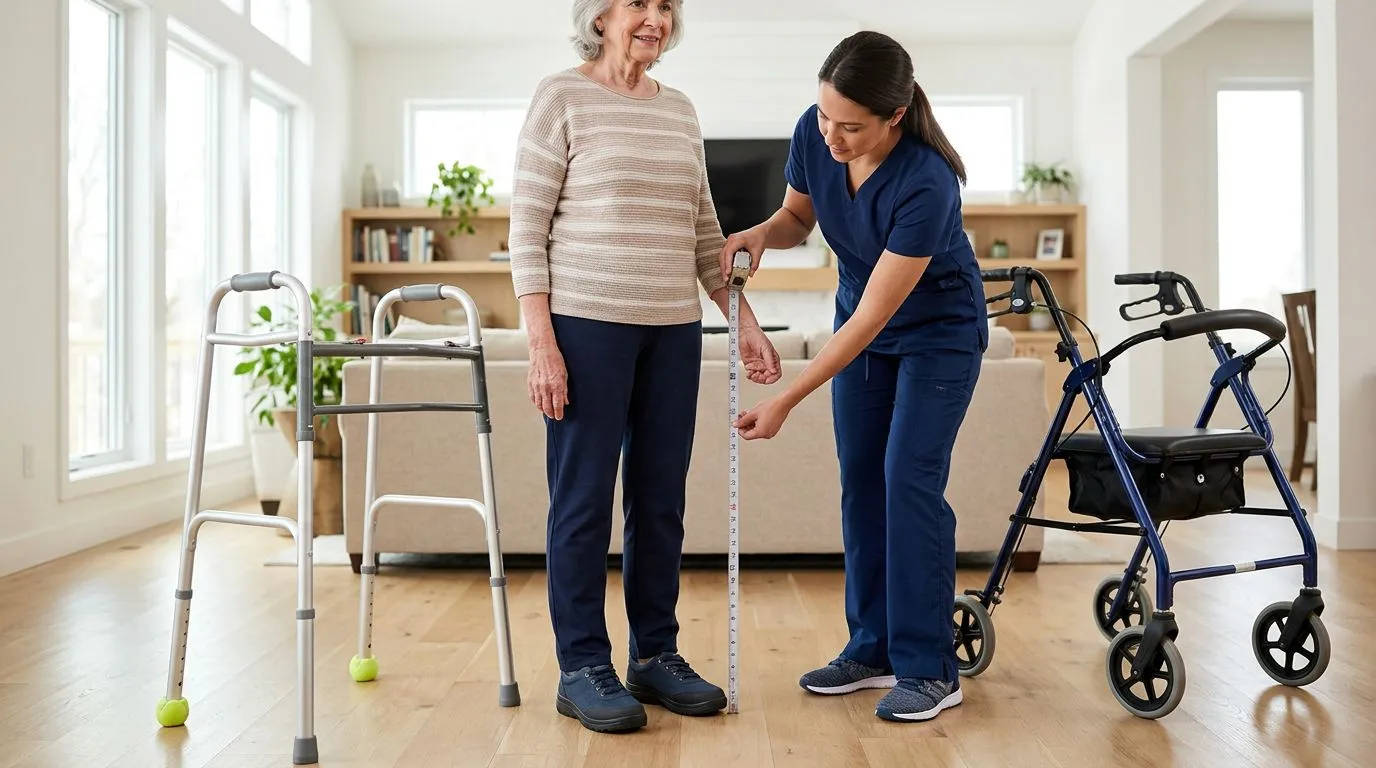
How to Measure for a Mobility Walker or Rollator: Handle Height, Elbow Bend, and Posture Checks
15 min read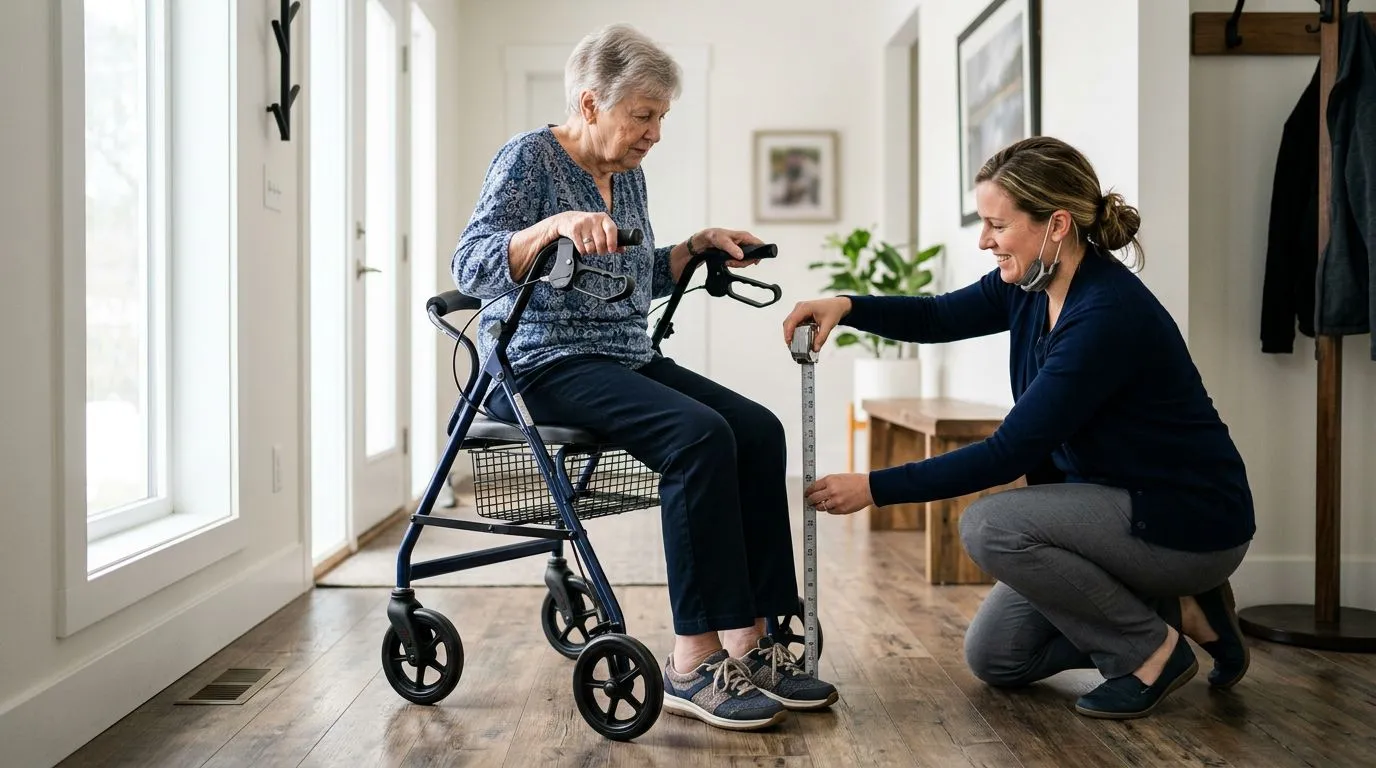
Rollator Seat Comfort Guide: Width, Depth, Padding, Backrests, and Resting Posture
14 min read