Disclosure: We may earn a commission when you buy through links on this page, at no extra cost to you. We buy nothing, sell nothing and accept no payment for coverage — commissions never decide what we recommend. How we make money.

The right walker or rollator handle height is usually level with the crease of your wrist when you stand upright in your regular shoes, with your arms relaxed at your sides. When you hold the handles, your elbows should bend slightly, about 15 to 30 degrees, without your shoulders rising or your back hunching forward. This same starting point works for standard walkers, two-wheel walkers, and rollators, though rollators also need brake reach, seat height, and posture checks.
A poor fit can make a good mobility aid feel harder to use. Handles set too low may encourage leaning, while handles set too high can lift the shoulders and reduce control. The goal is simple: steady support, relaxed posture, and a walking pattern that feels natural rather than forced.
Why 1 inch can change walker comfort and control
Walker and rollator handles often adjust in 1-inch increments, and that small difference can matter. A handle that is 1 inch too low may not seem dramatic in a store aisle, but over a 10-minute walk it can encourage the user to bend at the waist, push down harder through the arms, or take shorter steps.
Handle height affects three practical things: posture, arm position, and control. The best fit keeps the user looking forward, with shoulders relaxed and hands resting comfortably on the grips. The mobility aid should support balance and stability, not pull the person into a crouched or reaching position.
This matters especially for people choosing between a standard walker and a rollator. A standard walker or no-wheel walker frame is lifted and placed with each step, so the handles must allow a stable downward push without locking the elbows. A two-wheel walker rolls forward on the front legs but still needs enough downward control through the rear tips. A rollator has 3 or 4 wheels, hand brakes, and often a seat, so the fit must also let the user reach and squeeze the brakes without leaning.
If measurements fall between two settings, start with the one that keeps posture more upright and elbows slightly bent. Then test it in a real walking position for at least 20 to 30 steps, not just while standing still.
Walker vs. rollator fit: 0, 2, 3, or 4 wheels matters
Walkers and rollators are related, but they are not the same tool. A walker is usually a standard frame with no wheels or two front wheels, used for more stable step-by-step support. A rollator is a wheeled walker, commonly with 3 or 4 wheels, hand brakes, and a built-in seat on many 4-wheel designs.
Because the designs work differently, handle height is only one part of the fit. A standard walker prioritizes stable weight-bearing through the frame. A rollator prioritizes smooth rolling, braking control, and safe posture while the user keeps moving.
| Type | Typical design | Fit priority | Who it is best for |
|---|---|---|---|
| Standard walker | No wheels, 4 rubber tips | Wrist-height handles and steady downward support | People who need maximum stability and can lift or advance the frame safely |
| Folding walker | No wheels or 2 wheels, folds for storage | Correct handle height after folding locks are fully open | People who need easier transport in a car or tight home storage |
| Two-wheel walker | 2 front wheels, rear glide caps or tips | Upright posture while pushing lightly forward | People who need support but have difficulty lifting a full no-wheel frame every step |
| 3-wheel rollator | 3 wheels, hand brakes, usually no full seat | Brake reach and turning control | People who want a narrower, more maneuverable wheeled aid for indoor or light outdoor use |
| 4-wheel rollator | 4 wheels, hand brakes, built-in seat | Handle height, brake reach, and seat height | People who walk longer distances and may need a place to rest |
| Upright rollator | 4 wheels with higher forearm or hand supports | Forearm support height and tall posture | People who are advised to use a more upright stance and can safely manage brakes and turns |
| Bariatric walker or rollator | Wider reinforced frame, higher weight capacity | Handle height, inside width, and rated capacity | People who need a wider frame or higher weight rating, often 300 lb, 400 lb, or more depending on the design |
For a walker, do not judge fit by wheel size or folding convenience alone. For a rollator, do not judge fit only by the seat. The handles must match the user first because every step, turn, brake squeeze, and rest break depends on that position.
Step-by-step: measure handle height in 5 minutes
You can get a useful handle-height measurement in about 5 minutes with a tape measure and a helper. Measure the person who will use the walker or rollator, not someone of similar height. Two people who are both 5 feet 6 inches tall can need different handle settings because arm length, posture, shoe height, and walking style vary.
1. Wear the shoes used most often
Measure in the shoes the person will typically wear while walking. A cushioned walking shoe can add about 0.5 to 1 inch compared with bare feet. That is enough to change the preferred handle setting on many adjustable walkers and rollators.
2. Stand on a flat surface
Stand on level flooring with feet about hip-width apart. Avoid thick carpet for the measurement because it can compress unevenly and change how the person stands. The person should look straight ahead, not down at the tape measure.
3. Let the arms hang naturally
Ask the person to relax the shoulders and let both arms hang at the sides. Do not lock the knees or force a military-straight posture. The measurement should reflect the most upright comfortable stance the person can realistically use.
4. Measure from the floor to the wrist crease
Measure from the floor up to the crease on the inside of the wrist, where the hand bends. This is the starting handle height. If the wrist crease is 34 inches from the floor, look for a walker or rollator that adjusts to about 34 inches at the handgrip.
5. Confirm with elbow bend
After the mobility aid is adjusted, the user should stand inside or just behind the frame, place hands on the grips, and check the elbows. A slight bend of about 15 to 30 degrees is the usual target. Straight, locked elbows often mean the handles are too low or the person is standing too far away. Sharply bent elbows may mean the handles are too high.
For rollators, add one more check: the fingers should reach the brake levers comfortably while the wrists stay fairly neutral. If the user must stretch the fingers, twist the wrist, or lean forward to squeeze the brakes, the rollator is not set up well even if the height measurement looks correct.
Posture checks to do in the first 30 steps
Standing measurements help, but walking shows the real fit. After adjusting the handles, take 20 to 30 slow steps on a clear, flat surface. Watch from the side if possible. The user should be able to walk with the head up, shoulders relaxed, and hips close enough to the frame to avoid reaching.
With a standard walker, the person typically moves the walker forward first, then steps into it. The handles should allow a controlled downward press while both feet move. If the user has to lean far forward to advance the frame, the height may be too low or the walker may be positioned too far ahead.
With a two-wheel walker, the front wheels should roll forward smoothly without the rear tips dragging excessively. If the user pushes the walker far out in front and then shuffles to catch up, recheck both handle height and instruction on safe use. A two-wheel walker is not meant to race ahead like a shopping cart.
With a rollator, the user should walk between the rear wheels rather than far behind them. A common goal is to keep the body close enough that the elbows remain slightly bent during movement. If the rollator gets 12 inches or more ahead of the body, control and braking may suffer.
- Shoulders: They should stay relaxed, not shrugged toward the ears.
- Back: A small natural forward lean can be normal, but the user should not be folded over the handles.
- Wrists: They should rest comfortably, without a sharp upward or downward angle.
- Steps: The user should not need to take tiny steps only because the mobility aid feels too close or too far away.
- Brake reach: On a rollator, the user should be able to squeeze and lock the brakes without changing posture.
If posture improves when the handles move up or down 1 inch, take that change seriously. Comfort and safe control matter more than matching a chart exactly.
How to choose an adjustable height range before buying online
Before buying a walker or rollator online, compare the user’s wrist-crease measurement with the listed handle-height range. Many adult walkers and rollators have an adjustable handle range somewhere around the low 30s to upper 30s in inches, but compact, tall, upright, and bariatric designs can vary. The key is to make sure the measurement falls inside the range, ideally not at the very top or bottom setting.
For example, if the user’s wrist measurement is 35 inches, a handle range of 32 to 38 inches gives several adjustment options. A range of 35 to 39 inches may still work, but it leaves no lower setting if the user changes shoes, posture, or preference. A range of 29 to 34 inches is likely too low for that person.
| Measurement or feature | Why it matters | What to check |
|---|---|---|
| Wrist-crease height | Sets the starting handle height | Measure floor to wrist in regular shoes |
| Handle adjustment range | Determines whether the device can fit the user | Look for the wrist measurement inside the listed range |
| Adjustment increments | Changes fine-tuning options | Many frames adjust in about 1-inch steps |
| Overall width | Affects doorways and halls | Compare with narrow home spaces, often around 28 to 32 inches for interior doors |
| Weight capacity | Must match the user safely | Choose a rated capacity above the user’s body weight and consider carried items |
| Seat height on rollators | Affects safe sitting and standing | Feet should rest on the floor, with knees comfortable, when seated |
Do not ignore the minimum and maximum handle height. A mobility aid that barely reaches the user’s measurement may be less forgiving. Also check whether the listed height is measured to the top of the grip, the center of the grip, or another point. Listings can vary, so allow some margin when possible.
If the user is unusually short or tall, a standard adult range may not fit. Petite users may need lower handle settings and a shorter overall frame. Tall users may need extended-height handles or an upright rollator designed for greater height. Bariatric users should check both handle height and frame width, not just weight capacity.
Seat, brake, and frame checks for rollators: 3 details beyond handle height
Rollators need extra fit checks because they move faster and include brakes. Handle height still comes first, but a rollator that fits at the handles can still be wrong if the brakes are hard to reach, the seat is too high, or the frame feels too wide in the home.
First, check brake reach. The user should be able to place the hands on the grips and wrap the fingers around the brake levers without sliding forward. Squeezing the brakes should feel controlled, not strained. Locking parking brakes should be simple enough to do every time before sitting.
Second, check seat height if the rollator has a built-in seat. When seated, the person’s feet should touch the floor, and the knees should not be forced too high or left dangling. Many rollator seats are roughly in the 18- to 23-inch range, though exact heights vary by design. A seat that is too low can make standing up difficult; a seat that is too high can feel unstable.
Third, check the frame width and turning space. A 4-wheel rollator may feel smooth outdoors but bulky in a small bathroom or narrow hallway. A 3-wheel rollator can be easier to maneuver in tight spaces, but it may not provide the same seating option as many 4-wheel models. Measure the narrowest doorway or path the user travels daily. Many interior doorways are around 28 to 32 inches wide, but older homes and bathrooms can be tighter.
Upright rollators add another measurement: forearm or platform support height. The user’s forearms should rest comfortably without lifting the shoulders. If the supports are too high, the shoulders and neck may tense; too low, and the user may lean forward.
Common measuring mistakes that throw fit off by 1 to 2 inches
Most fitting errors are small, but even small errors can affect daily use. A 1- to 2-inch mismatch may contribute to sore shoulders, awkward steps, or a habit of leaning too heavily on the mobility aid.
- Measuring barefoot: Shoes change height. Measure in the footwear used most often.
- Measuring to the palm instead of the wrist crease: The wrist crease is the usual starting reference point.
- Standing too stiffly: A forced posture can create an unrealistic measurement.
- Ignoring elbow bend: Wrist height is a starting point, not the final answer.
- Assuming all walkers fit the same: Folding walkers, two-wheel walkers, and rollators can feel different at the same handle number.
- Choosing by user height only: Overall height charts are less precise than measuring arm position directly.
- Forgetting brake reach on rollators: A correct handle height is not enough if the brakes are difficult to operate.
Another common mistake is standing too far behind the mobility aid during the fit check. With a walker, the user should step into the frame rather than trail behind it. With a rollator, the user should stay close enough to control the wheels and brakes. If the device feels better only when it is far ahead, the height, style, or instruction may need review.
Who each fit style is best for: stability, speed, and rest breaks
The best mobility aid is not the one with the most features. It is the one the person can use safely and consistently in the places they actually walk, whether that is a 20-foot hallway, a grocery aisle, or a paved path outside.
A standard walker is often best for someone who needs more stability and can lift or advance the frame as instructed. The handle height should allow a firm but comfortable downward press. This type may be useful indoors, after a medical event, or when slower step-by-step movement is appropriate under professional guidance.
A two-wheel walker can fit someone who needs support but has trouble lifting a no-wheel frame each step. The front wheels reduce lifting effort, while the rear tips help slow and stabilize the frame. Handle height should keep the user from pushing it too far ahead.
A 3-wheel rollator can suit someone who wants a lighter-feeling, more maneuverable wheeled aid and can reliably use hand brakes. It is often easier to steer in tight spaces than a wider 4-wheel rollator, but it may not provide a full seat. Brake control is a major part of fit.
A 4-wheel rollator is often chosen for longer walks, outdoor paths, or situations where a seat is useful for rest breaks. The user must be able to manage hand brakes, turn safely, and sit only when the parking brakes are locked. Handle height, seat height, and frame width all matter.
An upright rollator may help some users maintain a more upright posture, but it is not automatically the safest choice for everyone. It can have a larger turning radius and a different center of control. People with balance concerns should try this type carefully and consider professional fitting advice.
A bariatric walker or bariatric rollator should be chosen when the user needs a higher weight capacity, wider stance, or reinforced frame. Check the stated weight rating, handle range, seat width if applicable, and the width of doorways at home. A high capacity number alone does not guarantee a comfortable fit.
When a 10-minute professional fit check is worth it
A quick fit check with a physical therapist, occupational therapist, durable medical equipment professional, or qualified clinician can be valuable, especially if the user has had recent surgery, a fall, stroke, Parkinson’s disease, significant arthritis, dizziness, neuropathy, or changing strength. Even 10 minutes of skilled observation can catch problems that a tape measure misses.
Professional guidance is also helpful when the person is choosing between a walker and a rollator. A rollator can support smoother walking for the right user, but it is not a substitute for the stability of a standard walker when stronger support is needed. Because rollators have wheels on all legs and require brake use, they can move away more easily if the user leans heavily or cannot react quickly.
Bring the user’s typical shoes and, if possible, test the device on more than one surface. A walker or rollator that feels fine on a polished showroom floor may feel different on carpet, thresholds, ramps, or outdoor pavement. The fit should work where the person actually lives and walks.
Recheck the height after major changes. New shoes, weight changes, posture changes, pain flare-ups, or recovery progress can all affect comfort. Many people benefit from revisiting handle height after the first week of use, then again if walking habits change. A mobility aid is not a set-it-and-forget-it item; it should be adjusted to the person, not the other way around.
The safest buying approach is to measure first, choose a device with an appropriate handle range, and then fine-tune with posture and walking checks. For walkers, focus on stable support and correct frame position. For rollators, confirm handle height, brake reach, seat fit, and control. A careful measurement before buying can prevent frustration and make the device easier to use from the first day.
FAQ
Frequently asked questions
What is the correct handle height for a walker or rollator? +
A good starting point is the crease of the wrist when the user stands upright in regular shoes with arms relaxed at the sides. After adjustment, the elbows should bend slightly, usually about 15 to 30 degrees, while the shoulders stay relaxed.
Should walker handles be higher or lower if the measurement falls between settings? +
Choose the setting that gives the best posture and a slight elbow bend during walking. Because many walkers adjust in 1-inch increments, testing both nearby settings for 20 to 30 steps can show which one feels more controlled.
Is rollator handle height measured the same way as a standard walker? +
Yes, wrist-crease height is still the basic starting measurement. Rollators also need extra checks for brake reach, parking brake use, seat height, and whether the user can stay close to the frame while walking.
Can a walker or rollator be too tall? +
Yes. Handles that are too tall can raise the shoulders, bend the elbows too much, and make the device harder to control. The user should not feel like the hands are lifted high or the shoulders are shrugged.
How often should walker or rollator height be rechecked? +
Recheck height after new shoes, posture changes, recovery progress, pain changes, or any major change in walking ability. It is also smart to review the fit after the first week of regular use.
Do I need a professional to fit a walker or rollator? +
Many people can take a basic measurement at home, but professional help is worthwhile after a fall, surgery, stroke, balance problems, or if the user is unsure whether a walker or rollator is safer. A clinician can watch posture, gait, brake use, and turning control.
Keep reading
Related guides

How to Fit a Walker to Your Height Without Hunching or Reaching Too Far
15 min read
Best Walker Features for Tall People, Larger Adults, and Higher Weight Capacities
13 min read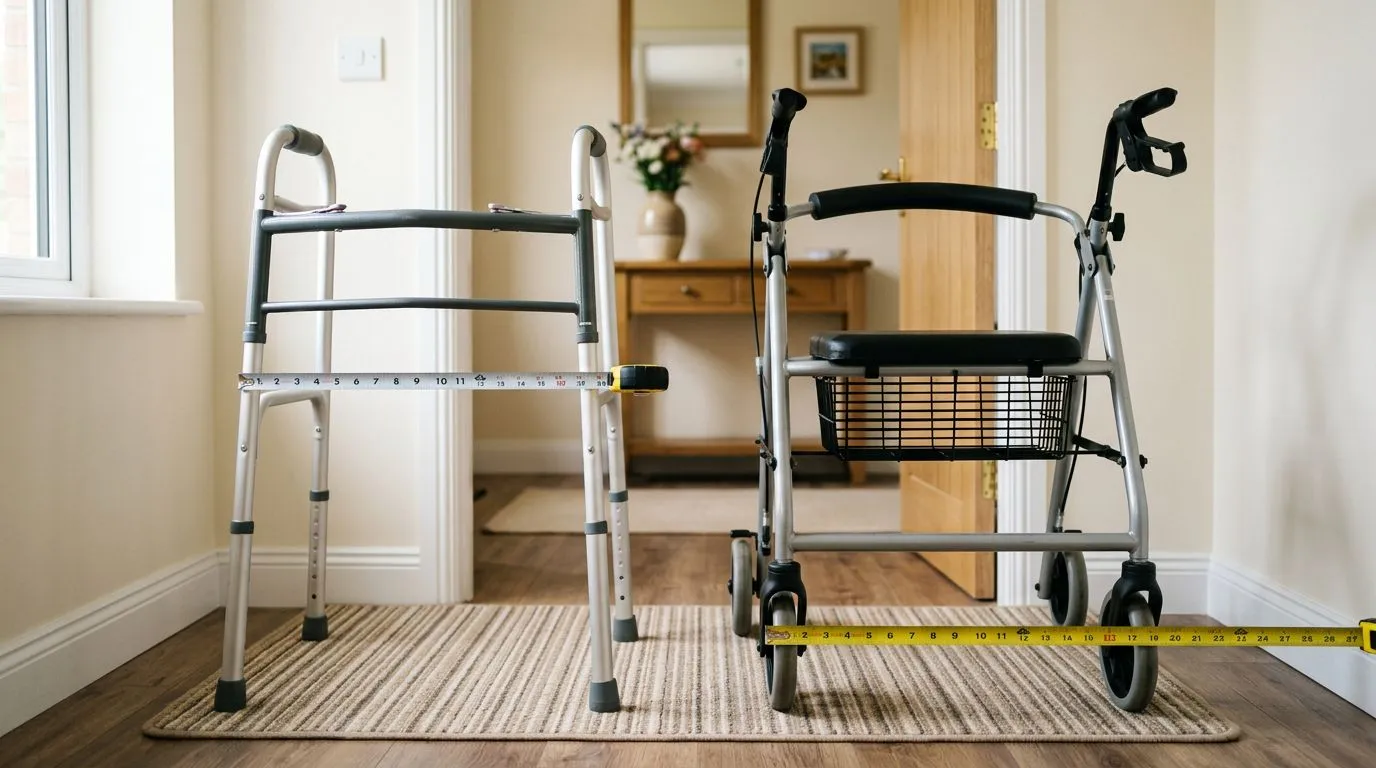
Bariatric Walker and Rollator Fit: Seat Width, Frame Width, and Weight Capacity Checklist
15 min read