Disclosure: We may earn a commission when you buy through links on this page, at no extra cost to you. We buy nothing, sell nothing and accept no payment for coverage — commissions never decide what we recommend. How we make money.
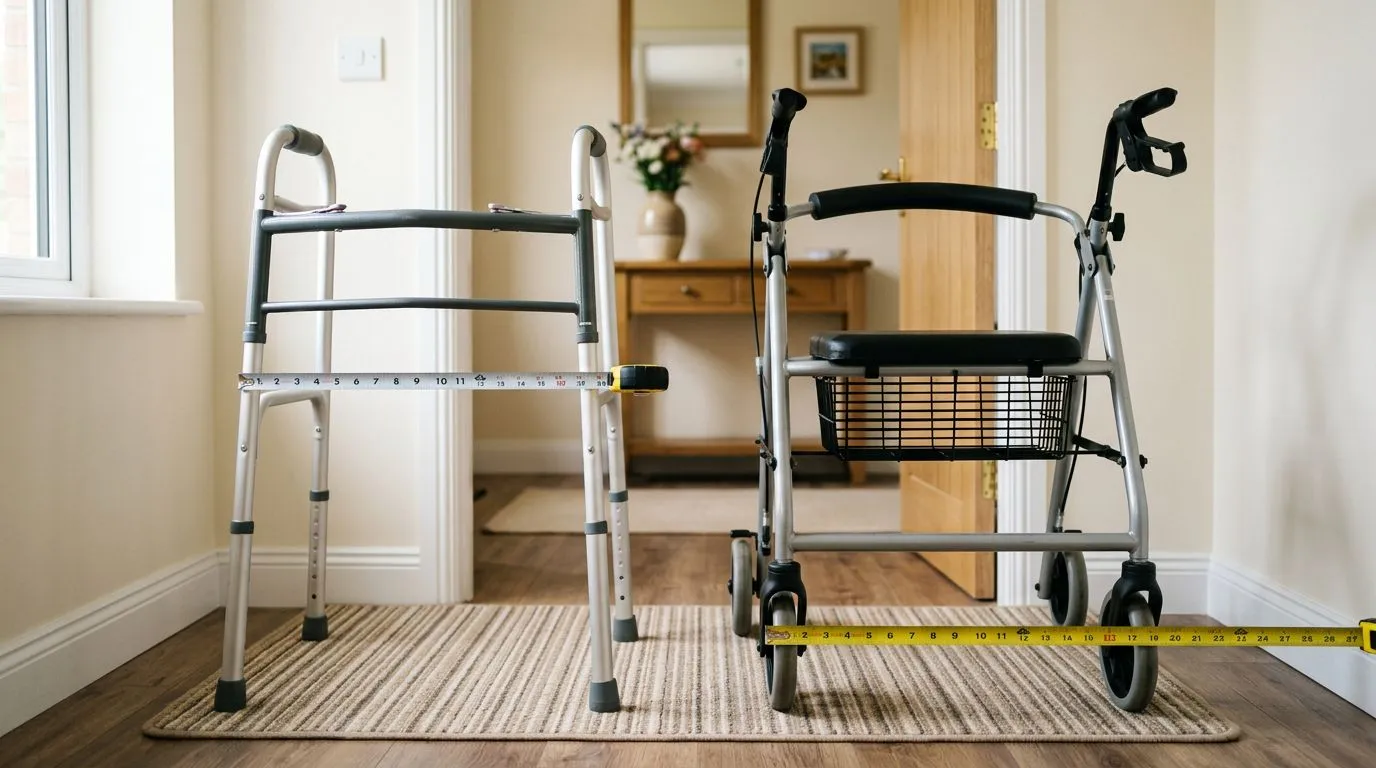
A bariatric walker or bariatric rollator should fit your body, your home, and your daily routine—not just match a weight rating on a label. The safest fit usually means choosing a frame with enough weight capacity, a seat wide enough to use comfortably if it is a rollator, a frame narrow enough for your doorways, and handles that adjust to about wrist height when you stand tall.
Weight capacity matters, but it is only one checkpoint. A heavy-duty walker may support more body weight yet still feel awkward if the handles are too low, the frame is too wide for a 28-inch bathroom doorway, or a rollator seat presses against the hips. Use the checklist below to compare bariatric walkers and rollators by fit, not hype.
Why bariatric fit is more than a 300 lb or 500 lb rating
Many standard mobility walkers are commonly rated around 250 to 300 lb, while bariatric walkers and bariatric rollators often start above that and may be rated for 350 lb, 400 lb, 500 lb, or more depending on the design. That number matters because the frame, crossbars, wheels, seat platform, and brake hardware are engineered around a maximum load. Still, the rating alone does not tell you whether the device will be comfortable or practical.
Two people at the same weight can need very different mobility aids. One may have broad hips and need a wider rollator seat. Another may be tall and need handles that adjust above 37 inches. Someone in a small apartment may need a folding walker that fits through tighter halls, even if a wider rollator feels better outdoors.
Bariatric mobility equipment also tends to be heavier than standard equipment. A basic folding walker may be light enough for many users to lift into a car, while a heavy-duty 4-wheel rollator with a reinforced frame and wide seat can weigh noticeably more. If the user or caregiver must lift it several times a week, the product weight becomes part of the fit decision.
For safety, do not use any walker or rollator as a ladder, step stool, wheelchair, or transport chair unless it is specifically designed for that purpose. A rollator seat is meant for stationary resting with the brakes locked, not for being pushed while seated.
Walker vs rollator for bariatric users: 2 wheels, 4 wheels, brakes, and seats
A bariatric walker and a bariatric rollator are related, but they are not the same tool. A walker is usually a frame you lift or slide forward, available as a no-wheel standard walker, a folding walker, or a two-wheel walker with rear tips or glides. A rollator is a wheeled walker, usually with 3 or 4 wheels, hand brakes, and a built-in seat for resting.
The right choice depends on balance, walking speed, endurance, hand strength, and where the device will be used. Walkers generally provide a slower, more stable pattern because the user places the frame before stepping. Rollators move continuously, which can feel smoother but requires reliable brake use and enough control to keep the device from moving too quickly.
| Type | Common bariatric fit points | Who it is best for |
|---|---|---|
| Standard or folding walker | No seat; often narrower than heavy-duty rollators; must match handle height and weight rating | People who need maximum steadiness, move at a slower pace, or use the device mostly indoors |
| Two-wheel walker | Front wheels reduce lifting; rear tips add drag; check frame width and wheel size | Users who can manage forward motion but still need a controlled walker feel |
| 3-wheel rollator | Typically more maneuverable; usually no full seat; check brake reach and frame rating | People who need turning ease in tight spaces and do not need a seated rest platform |
| 4-wheel bariatric rollator | Seat width, seat height, brake strength, wheel size, and total frame width all matter | Users who walk longer distances, need rest breaks, and can safely operate hand brakes |
| Upright or stand-up rollator | Forearm supports and taller adjustment ranges; often wider and heavier | Users who are appropriate for a more upright posture aid and can control a larger rolling frame |
If balance is uncertain, ask a physical therapist, occupational therapist, or qualified clinician to watch the user walk with the device. A 10-minute in-person fit check can reveal problems that specifications do not show, such as leaning too far forward, gripping too tightly, or struggling to stop on a slight slope.
Weight capacity checklist: choose a margin of at least 25 to 50 lb when possible
Start with the listed maximum user weight, then consider a practical safety margin. If a person weighs 365 lb, a device rated exactly 365 lb leaves no room for clothing, carried items, normal weight fluctuation, or the extra downward force that happens when standing up, leaning, or catching balance. When options allow, many shoppers look for a rating at least 25 to 50 lb above current body weight.
Do not assume a higher rating automatically means a better fit. A 500 lb rollator can still be a poor choice if the seat is too narrow or the frame cannot fit through the home. Likewise, a high-capacity walker with handles that adjust too low may encourage a bent posture and awkward steps.
- Check the user weight rating: Compare it to current body weight, not a goal weight.
- Check the seat rating on rollators: The frame and seat should both be designed for seated resting within the stated limit.
- Check carried load: A basket, pouch, oxygen equipment, or personal items add weight and may affect balance.
- Check use patterns: Frequent sit-to-stand transfers place more stress on a rollator than occasional outdoor walks.
- Check floor conditions: Thick carpet, thresholds over 1 inch, and uneven sidewalks can increase force on wheels and frame.
For a no-wheel or two-wheel bariatric walker, look closely at the frame tubing, cross brace design, leg tips, and folding mechanism. For a bariatric rollator, also evaluate wheel assemblies, axle placement, brake hardware, seat support, and how the frame flexes when weight is applied.
Seat width and seat height: allow about 1 to 2 inches of hip clearance
Seat fit applies to rollators, not standard walkers. A walker frame generally has no built-in seat, while a 4-wheel bariatric rollator commonly includes one for rest breaks. Seat width is one of the most important comfort measurements because a seat that pinches the hips may discourage use, while a seat that is excessively wide may make the overall frame too large for the home.
To estimate seat width, sit on a firm chair and measure across the widest part of the hips or thighs while wearing typical clothing. Add about 1 to 2 inches of total clearance. For example, if the seated hip width is 22 inches, a rollator seat around 23 to 24 inches wide may feel more appropriate than a narrow seat. The exact fit depends on body shape, clothing, and how the seat edges are designed.
Seat height matters too. A higher seat can make standing easier for taller users, while a seat that is too high may leave the feet unsupported. When seated on a rollator, the user should be able to rest both feet on the floor with reasonable control. If the user must slide forward to touch the floor, the seat may be too high or too deep.
| Measurement | How to check | Fit goal |
|---|---|---|
| Seated hip width | Measure across the widest point while seated | Add about 1 to 2 inches total clearance |
| Seat height | Compare to chair height that is easy to stand from | Feet should reach the floor while seated |
| Seat depth | Measure from back of hips toward back of knees | Avoid pressure behind the knees |
| Backrest position | Sit fully back with brakes locked | Back support should not push the user forward |
A rollator seat is for resting, not long sitting sessions. If the user needs extended seated mobility or caregiver-pushed transport, a different mobility device may be more appropriate than a rollator.
Frame width and doorway clearance: measure 3 common spaces before buying
Frame width can decide whether a bariatric walker or rollator works in daily life. A heavy-duty frame may be wider to improve strength and seat size, but that extra width can become a problem in bathrooms, bedrooms, kitchens, and older homes. Interior doorways are often around 28 to 32 inches wide, but trim, hinges, rugs, and furniture can reduce usable space.
Measure at least 3 places: the narrowest doorway, the main bathroom entrance, and the tightest hallway or turn. Use the actual clear opening from inside edge to inside edge, not the door size printed on a plan. If the bathroom doorway provides only 27 inches of usable clearance, a 29-inch-wide bariatric rollator may not pass through without angling, which can increase fall risk.
Walkers and rollators differ here. A folding walker may be easier to angle through a tight space, and some no-wheel walkers are narrower than heavy-duty rollators. A 4-wheel bariatric rollator with a wide seat, large wheels, and outside-mounted brakes can be harder to maneuver in a small bathroom even if it feels excellent in a hallway.
- Doorways: Measure the clear opening, especially bathroom and bedroom doors.
- Turning spaces: Check whether the user can turn 90 degrees near the bed, toilet, and favorite chair.
- Floor transitions: Note thresholds, carpet edges, and ramps, especially those close to 1 inch high.
- Storage: Confirm the folded size fits in a closet, car trunk, or beside a recliner.
- Outdoor paths: Measure gates, porch steps, and walkway width if the device will be used outside.
Do not forget hand clearance. A frame may technically fit through a doorway while the user’s hands, hips, or brake cables rub the door trim. That is not a comfortable everyday fit.
Handle height and posture: wrists should meet the grips within about 1 inch
Handle height affects posture, arm comfort, and control. A common fitting method is to have the user stand upright in supportive shoes with arms relaxed at the sides. The walker or rollator handgrips should line up near the crease of the wrist, often within about 1 inch, so the elbows bend slightly when holding the grips.
If the handles are too low, the user may bend forward and place extra load through the shoulders and wrists. If the handles are too high, the shoulders may rise and the device can feel harder to steer. Bariatric users who are very tall, very short, or have longer arms should pay close attention to the adjustment range rather than assume a heavy-duty frame will fit.
Upright rollators use a different fit because the forearms rest on supports instead of the hands carrying all contact at standard grips. These devices can help some users maintain a more upright position, but they are not automatically safer for everyone. The forearm pads must adjust to the correct height, the brakes must be reachable, and the larger frame must still fit the user’s environment.
| Fit sign | What it may mean | What to check |
|---|---|---|
| User hunches forward | Handles may be too low or frame too far ahead | Raise handles if adjustment allows; review walking pattern |
| Shoulders feel lifted | Handles may be too high | Lower grips and recheck elbow bend |
| Hands slip outward | Grip spacing may not match shoulder width | Compare grip width to comfortable arm position |
| Hard to squeeze brakes | Brake reach or hand strength may be an issue | Test brake engagement before choosing a rollator |
Fit should be checked while wearing the shoes used most often. A 1-inch shoe sole difference can change handle height enough to matter.
Wheels, brakes, and surfaces: 6-inch to 10-inch wheels behave differently
Wheel size and brake control are central for rollators and still relevant for two-wheel walkers. Smaller wheels may turn easily indoors, while larger wheels often roll more smoothly over sidewalk seams, low thresholds, and outdoor surfaces. Many rollators use wheels in the 6-inch to 10-inch range, with bariatric and outdoor-friendly designs often leaning larger.
A rollator requires working hand brakes. The user should be able to squeeze the brake levers while walking, lock the brakes before sitting, and unlock them without losing balance. For bariatric rollators, brake confidence is especially important because a heavier user and a heavier frame create more momentum on ramps or sloped driveways.
Two-wheel walkers do not use rollator-style hand brakes. They rely on the user’s stepping pattern, rear tips or glides, and body control. This can be a better fit for someone who should not use a fast-rolling device, but it may require more effort than a rollator over distance.
- Indoor smooth floors: Smaller wheels may be adequate if thresholds are low and turns are tight.
- Carpet: Test rolling resistance, especially with thick pile or rugs.
- Sidewalks: Larger wheels can help with cracks and uneven joints, but do not remove fall risk.
- Ramps: Brake control matters before using any rollator on an incline.
- Wet surfaces: Slow down; wheels and tips can slip on slick floors.
Rubber tips on walkers wear down over time. Rollator brakes can also need adjustment. A good fit on day 1 can become less safe after months of use if tips are smooth or brakes no longer hold firmly.
How to measure at home in 15 minutes
You can gather most fit information in about 15 minutes with a tape measure, a firm chair, shoes, and a helper if available. Write the numbers down before comparing product specifications, because memory estimates are often off by 1 or 2 inches.
- Measure current body weight: Use the most accurate recent weight available and choose a walker or rollator capacity above it.
- Measure hip width for a rollator seat: Sit on a firm chair and measure the widest seated point. Add about 1 to 2 inches of clearance.
- Measure comfortable chair height: Measure from floor to top of a chair seat that is easy to stand from. Compare it with rollator seat height.
- Measure wrist height: Stand tall in usual shoes with arms relaxed. Measure floor to wrist crease for walker or rollator handle height.
- Measure doorways: Record the narrowest clear width at bathroom, bedroom, and main entry points.
- Measure storage and transport space: Check the car trunk, closet, or bedside storage area if folding size matters.
If measurements point in different directions, prioritize the limiting factor. For example, a user may need a 24-inch seat, but if the home has a 27-inch bathroom doorway, a wide bariatric rollator may not work in that bathroom. A bariatric walker for indoor use plus a rollator for longer outdoor distances may sometimes be discussed with a clinician, depending on the user’s abilities and environment.
Who heavy-duty walkers and bariatric rollators are best for: 4 common scenarios
Bariatric walkers and rollators are designed for people who need a higher weight capacity, wider dimensions, or a sturdier feel than standard mobility walkers provide. The best choice depends on the task, not only body size.
| Scenario | Better starting point | Why |
|---|---|---|
| Mostly indoor use in tight rooms | Bariatric folding walker or two-wheel walker | Often easier to control at slow speed and may fit tighter spaces |
| Needs frequent seated rest breaks | 4-wheel bariatric rollator | Built-in seat and brakes allow planned rests when used correctly |
| Outdoor walks on sidewalks | Bariatric rollator with suitable wheels | Rolling design may reduce lifting effort over distance |
| Concern about device rolling away | Standard or two-wheel walker | Less free-rolling than a 4-wheel rollator |
A bariatric walker is often best for users who need steadiness, controlled steps, and simple mechanics. A bariatric rollator is often best for users who can walk with a rolling aid, operate hand brakes reliably, and benefit from a seat during rest breaks. Neither choice is automatically superior.
Some users need different devices for different places. The most stable option for a bathroom may not be the most practical option for a long hallway in a clinic or an outdoor walkway. If two devices are used, both should be fitted and practiced with—not treated as interchangeable without training.
Fit-testing before daily use: try at least 3 real tasks
Before relying on a new bariatric walker or rollator every day, test it in realistic situations. A device that feels fine during a short straight walk may reveal problems when turning, sitting, or crossing a threshold. Try at least 3 tasks: walking 20 to 30 feet, turning around in the tightest room, and approaching a chair or toilet area.
For a walker, watch whether the user places the frame too far forward or steps outside the rear legs. The feet should stay within a controlled base of support. For a rollator, practice locking the brakes, turning to sit, sitting down slowly, standing back up, and unlocking the brakes only after standing securely.
- Test straight walking: Look for smooth, even steps and upright posture.
- Test turns: Make sure the frame does not catch on hips, furniture, or door trim.
- Test sitting on a rollator: Brakes locked, rollator stable, feet on floor, no sliding.
- Test thresholds: Practice common transitions such as bathroom tile to hallway carpet.
- Test caregiver handling: If someone assists, they should be able to fold, lift, and position the device safely.
Stop using a device and reassess if it tips, flexes noticeably, rolls faster than the user can control, or causes pain, numbness, or unusual fatigue. Those signs do not always mean the device is defective; they may mean the fit is wrong for the user or setting.
Maintenance and recheck schedule: inspect tips, brakes, and bolts every 30 days
Fit is not a one-time event. Body weight, strength, shoe style, flooring, and walking ability can change. A simple 30-day inspection helps catch problems early, especially for users who rely on a walker or rollator every day.
For walkers, inspect rubber tips, wheel movement on two-wheel models, folding buttons, and frame joints. Tips should have tread, not smooth worn bottoms. For rollators, check that brakes stop both wheels evenly, the parking brake holds while seated, the seat and backrest are secure, and wheels spin without wobbling.
Recheck measurements after major changes such as surgery, a new brace, a significant weight change, new shoes, or a move to a different home. Even a 2-inch change in seat cushion height at home can alter how easy it is to stand and turn with a walker nearby.
The best bariatric walker or rollator fit is the one that supports safe, repeatable movement in the places the user actually goes. Start with weight capacity, then confirm seat width, frame width, handle height, brakes, wheels, and the real-world spaces of daily life.
FAQ
Frequently asked questions
Is weight capacity the most important measurement for a bariatric walker? +
Weight capacity is essential, but it is not the only fit point. Also check handle height, frame width, grip comfort, folding size, and whether the walker fits through the user’s most important doorways.
How wide should a bariatric rollator seat be? +
Measure the widest part of the hips or thighs while seated, then look for about 1 to 2 inches of total clearance. The seat should not pinch, but an overly wide seat may make the rollator too wide for indoor use.
Can a bariatric rollator be used as a wheelchair? +
No. A standard rollator seat is for stationary resting with the brakes locked. It should not be used to push someone while seated unless the device is specifically designed and rated for transport use.
Which is safer for a heavier adult: a walker or a rollator? +
It depends on balance, brake ability, walking speed, and the environment. A walker may be better for slower, more controlled movement, while a rollator may suit someone who can safely manage wheels and hand brakes and needs seated rest breaks.
What doorway width should I measure before buying a bariatric walker or rollator? +
Measure the clear opening of the narrowest doorway, especially the bathroom and bedroom. Many interior doorways are about 28 to 32 inches, but trim and hinges can reduce usable space.
How do I know if rollator brakes fit my hands? +
The user should be able to reach and squeeze the brake levers comfortably while standing in walking position, then lock and unlock the parking brakes without losing balance or straining the hands.
Keep reading
Related guides

Standard Walker Fit Guide: Sizing No-Wheel and Two-Wheel Walkers for Height, Width, and Support
13 min read
Buying Your First Walker or Rollator: Questions to Ask Before You Order
15 min read
How to Measure for a Mobility Walker or Rollator: Handle Height, Elbow Bend, and Posture Checks
15 min read