Disclosure: We may earn a commission when you buy through links on this page, at no extra cost to you. We buy nothing, sell nothing and accept no payment for coverage — commissions never decide what we recommend. How we make money.

If you are buying your first walker or rollator, begin by matching the device to your balance, stamina, home layout, and hand strength. A standard or two-wheel walker usually gives steadier support, while a rollator is better for people who can walk safely with wheels, hand brakes, and a built-in seat. Before you order, check handle height, weight capacity, width, wheel size, brake style, folding size, and whether insurance paperwork must be completed before purchase.
The best choice is not always the one with the most features. A seat, large wheels, or an upright frame can help, but only if the device fits your body and daily routine. Use the questions below as a practical buying checklist to compare walkers and rollators without relying on brand names or model hype.
1. Do you need maximum stability or easier rolling?
The first decision is whether you need a walker or a rollator. A walker is a frame you lift or lightly push forward, often with no wheels or 2 front wheels. A rollator has 3 or 4 wheels, hand brakes, and usually a seat; it rolls continuously and does not have to be picked up with each step.
For many first-time buyers, this is the most important safety question. If you feel unsteady when standing still, have trouble controlling speed, or need firm support with every step, a standard walker or two-wheel walker may be the safer place to start. If your balance is reasonably good but you tire after walking 100 to 300 feet, a rollator may help because it moves smoothly and gives you a place to sit.
| Type | Best fit | Key tradeoff |
|---|---|---|
| Standard walker, no wheels | Highest stability for short indoor distances | Must be lifted with each step |
| Two-wheel walker | Steady support with easier forward movement | Less smooth than a rollator outdoors |
| 3-wheel rollator | Tight spaces and quick turns | Usually no full seat |
| 4-wheel rollator | Longer walks, seat breaks, outdoor use | Requires brake control and balance |
| Upright rollator | People who need a taller, forearm-supported posture | Bulkier and needs careful fitting |
Think through your most common walking day. If it is mainly bedroom to bathroom, kitchen, and living room, a walker may be enough. If it includes hallways, sidewalks, appointments, or waiting in lines for 10 to 20 minutes, a rollator seat may be more useful.
2. Who is each type best for: 5 common first-buyer situations
A device that works well for one person may frustrate another. Body strength, balance, living space, and fatigue level matter more than the label on the box.
Standard walker or folding walker
This is best for someone who needs the most stable base and can lift the frame a few inches to move it forward. Many standard walkers fold for storage and transport, which helps if you need to place it in a car trunk or beside a bed. They are commonly used indoors because they are simple, light, and controlled.
Two-wheel walker
This is best for someone who wants more stability than a rollator but less lifting than a no-wheel frame. The 2 front wheels roll forward while the rear legs or glide tips help slow movement. It can be a good middle option when a standard walker feels tiring but a 4-wheel rollator feels too fast.
3-wheel rollator
This is best for people who move through narrow spaces and do not need a full built-in seat. The triangular frame turns tightly, which may help in smaller apartments, kitchens, or hallways under about 36 inches wide. Many 3-wheel rollators include a storage pouch, but the resting surface is often limited or absent.
4-wheel rollator
This is best for someone with enough balance to manage a rolling device and enough hand function to use brakes. The seat is useful during longer errands or walks where rest breaks are predictable. A 4-wheel rollator is often the default choice for active users, but it is not automatically safer than a walker.
Upright or stand-up rollator
This is best for someone who has been advised to avoid a hunched posture or feels more comfortable with forearm platforms and taller handles. Upright rollators can improve comfort for some users, but they are often wider, heavier, and more demanding to maneuver. Always check the user height range and overall width before ordering.
3. Where will you use it most: measure 3 doorways first
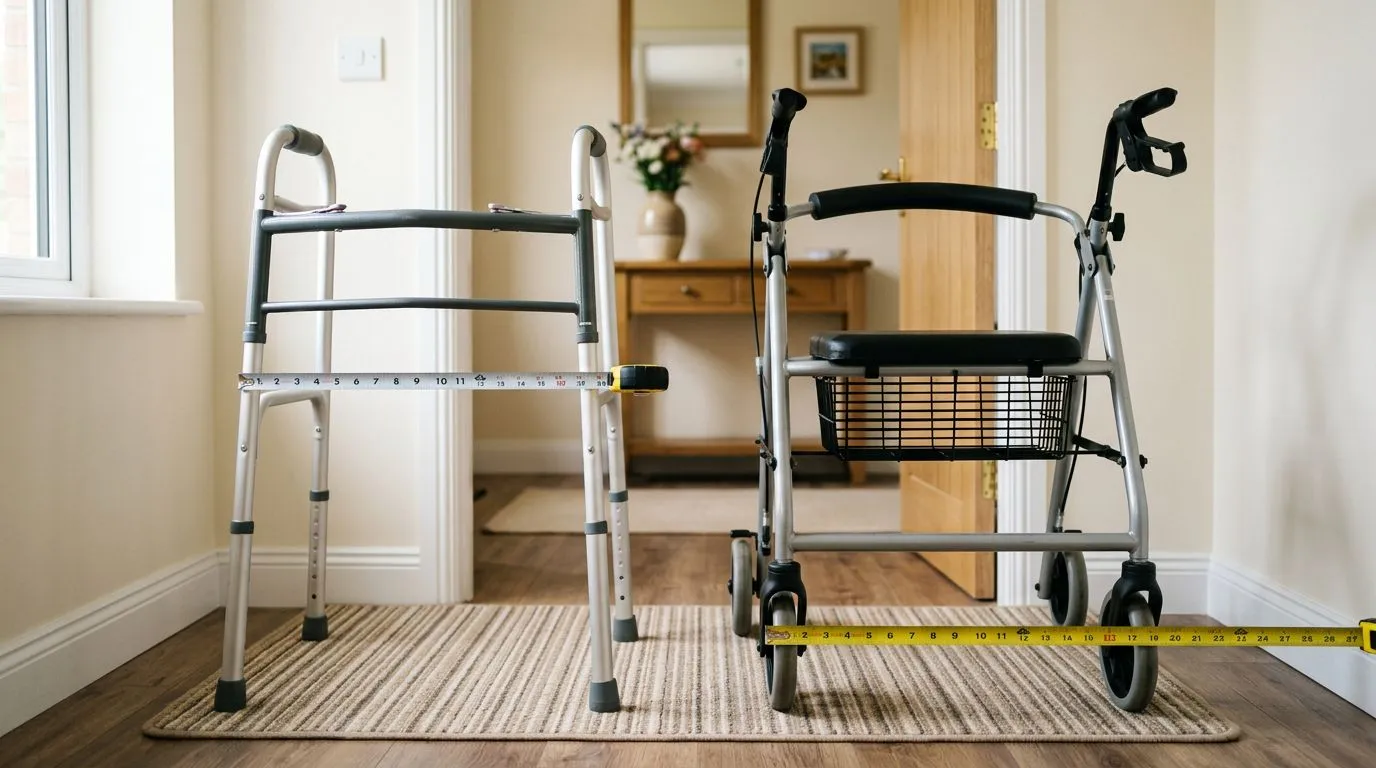
Before ordering, measure the spaces the device must pass through every day. Check at least 3 doorways: bathroom, bedroom, and main entry. Many interior doorways are about 28 to 32 inches wide, while some older bathrooms may be narrower.
Compare those measurements with the overall width of the walker or rollator, not just the seat width. A device that is 24 inches wide may pass easily through a 30-inch doorway, but turning around in a small bathroom can still be difficult. Measure the space between furniture, the width of hallways, and the area beside your bed too.
- For tight indoor spaces: consider a standard walker, two-wheel walker, or narrow 3-wheel rollator.
- For sidewalks and parking lots: larger wheels, often 8 inches or more, may roll better over cracks and uneven surfaces.
- For mixed indoor and outdoor use: check both width and wheel size instead of choosing by appearance.
- For car travel: confirm folded length, folded width, and lifting weight before you buy.
Do a realistic route check. Walk from your favorite chair to the bathroom, then to the kitchen, then to the front door. If you have to make a tight turn in less than 4 feet of space, maneuverability matters as much as stability.
4. Do you need wheels, and if so, how many?
Wheel choice changes how the device behaves. No-wheel walkers feel planted but require lifting. Two-wheel walkers reduce lifting but still provide drag from the rear legs. Rollators with 3 or 4 wheels move with less effort, but they also require brake awareness.
For indoor floors, smaller wheels can work well on smooth surfaces. For outdoor routes, wheel size becomes more noticeable. A 6-inch wheel may handle level indoor flooring, while 8-inch wheels are often easier over sidewalk seams, thresholds, and low-pile transitions. Very large wheels can make rolling more comfortable but may increase overall size and weight.
| Wheel setup | How it feels | Good to ask |
|---|---|---|
| No wheels | Most controlled and stable | Can you lift it repeatedly without strain? |
| 2 front wheels | Stable with easier forward motion | Will the rear tips glide on your floors? |
| 3 wheels | Quick turning and compact | Do you need a true seat? |
| 4 wheels | Smooth rolling and seated rests | Can you use hand brakes every time? |
If you are unsure, do not assume more wheels mean more safety. A rollator can move away from you if the brakes are not used correctly. A walker may feel slower, but slow and steady may be exactly what you need during recovery, early balance changes, or nighttime bathroom trips.
5. Is a seat necessary, or just nice to have?
Most standard walkers do not include a seat. Most 4-wheel rollators do. That difference matters if fatigue, shortness of breath, pain, or long appointments make sitting breaks part of your daily mobility plan.
Ask how often you need to rest and where you usually are when it happens. If you can comfortably walk for 5 minutes and always have chairs nearby, a seat may be optional. If you need a break in a grocery aisle, clinic hallway, or during an outdoor walk, a rollator seat can be a practical feature.
Seat dimensions vary, so check width, depth, and seat height. Common rollator seat heights are often in the general range of 18 to 24 inches, but fit depends on leg length and how easily you can stand. A seat that is too low can make standing difficult; a seat that is too high may feel unstable when resting.
- Look for a seat that supports your body size without crowding your hips.
- Check whether the backrest is padded, curved, removable, or height-adjustable.
- Confirm that the brakes lock before sitting.
- Never use a rollator as a wheelchair unless the product is specifically designed for transport use.
A built-in seat helps only when it is used correctly. Park on a level surface, lock both brakes, turn carefully, and sit down slowly. If that sequence feels confusing or difficult, ask a clinician or caregiver to practice with you before relying on it in public.
6. Can you operate the brakes with both hands?
Rollators have hand brakes; walkers typically do not. That single feature can determine whether a rollator is appropriate. You should be able to squeeze the brake handles while walking and push or press the brake locks before sitting.
Hand strength, arthritis, neuropathy, tremor, and one-sided weakness can all affect brake use. If your grip strength is limited, look for brake handles that are easy to reach and operate, but do not rely on marketing language alone. The safer test is practical: can you stop the rollator from moving, lock both brakes, and unlock them without pain?
Brake cables also need occasional checking. If a rollator is used daily, inspect the brakes at least once a week for looseness, uneven stopping, or cable damage. On a walker with no brakes, inspect rubber tips or glide caps instead; worn tips can reduce traction and should be replaced when they become smooth, cracked, or uneven.
If only one hand works reliably, do not guess. Some users need specialized brake setups or a different mobility aid, and that choice is best made with professional guidance. The goal is safe control, not just forward movement.
7. How to measure handle height in under 2 minutes
Correct handle height helps you avoid leaning too far forward or walking with raised shoulders. A simple at-home measurement takes less than 2 minutes and only requires your regular walking shoes.
- Stand upright in the shoes you wear most often.
- Let your arms hang naturally at your sides.
- Have someone measure from the floor to the crease of your wrist.
- Choose a walker or rollator with handle adjustment that includes that height.
When you hold the grips, your elbows should usually have a slight bend, often around 15 to 30 degrees. If the handles are too low, you may hunch or push the device too far ahead. If they are too high, your shoulders may feel tense and your control may suffer.
For upright rollators, the measurement is different because your forearms rest on supports rather than holding only low handles. Check the manufacturer’s stated user height range and forearm support adjustment range. If you are near the very bottom or top of the listed range, fitting becomes more important.
Do not skip this step when ordering online. Many returns happen because the device is technically strong enough but does not fit the user’s height. Adjustable handles are helpful, but they still have limits.
8. What weight capacity and frame size do you need?
Weight capacity is not the same as comfort, width, or durability in daily use. Many standard walkers and rollators have listed capacities around 250 to 300 pounds, while bariatric walkers and bariatric rollators may be rated higher, sometimes 350 pounds or more depending on the design. Always follow the stated capacity for the exact device you buy.
If you are close to the listed weight limit, choose a higher-capacity frame rather than treating the limit as flexible. Also check seat width on rollators, the distance between handles, and overall frame width. A bariatric rollator may offer a wider seat and stronger frame, but it may also be heavier and harder to lift into a vehicle.
| Specification | Why it matters | Beginner tip |
|---|---|---|
| Weight capacity | Safety margin for the frame and seat | Do not exceed the listed limit |
| Device weight | Lifting into a car or over a threshold | Check pounds, not just folded size |
| Seat width | Comfort and safe sitting on rollators | Allow enough room without forcing posture |
| Overall width | Doorways, bathrooms, hallways | Measure home spaces before ordering |
Frame material also affects handling. Lighter frames are easier to transport, while heavier frames may feel more planted. The best choice depends on whether you value portability, higher capacity, or a steadier feel.
9. Will it fold, store, and travel the way you need?
Many walkers and rollators fold, but not all of them fold the same way. A folding walker may collapse front-to-back and become very flat. A 4-wheel rollator may fold side-to-side or inward, but the seat, wheels, and backrest can still take up space.
If you ride in a car, measure the trunk opening and cargo area. A device that folds to 10 inches thick may still be too long for a small vehicle. Check whether you or a caregiver can lift the device safely as well; even a difference of 5 pounds can matter when loading it several times a day.
- For apartment storage, check folded depth and whether it stands upright when folded.
- For medical appointments, ask whether it fits in elevators, waiting rooms, and restroom stalls.
- For air or bus travel, look for simple folding mechanisms and secure latches.
- For caregiver transport, make sure the folding steps are easy to repeat.
Practice folding and unfolding before you need to leave the house. A latch that seems simple in a video can be awkward when you are tired, standing in a parking lot, or wearing gloves.
10. Should you talk with a clinician before ordering?
If you are buying because of a fall, surgery, new weakness, dizziness, or a diagnosis that affects walking, it is wise to ask a healthcare professional before choosing. A physical therapist, occupational therapist, physician, or qualified durable medical equipment provider can help match the device to your gait, home setup, and safety risks.
This is especially important if you have fallen more than once in the past 6 months, have one-sided weakness, cannot feel your feet well, or get lightheaded when standing. Those details can change the recommendation. A rollator may look convenient, but a walker may provide safer control during early recovery. In other cases, a rollator may reduce fatigue and support longer community walking when balance and brakes are adequate.
Bring your measurements to the conversation: wrist height, doorway widths, body weight, typical walking distance, and whether you need a seat. Concrete details make the recommendation more useful than saying you need something for general support.
11. Insurance timing: ask before you pay out of pocket
If you hope to use insurance, ask about coverage before ordering. In the United States, walkers and rollators may be treated as durable medical equipment, but coverage rules depend on your plan, medical need, documentation, and supplier requirements.
For Medicare Part B, durable medical equipment generally requires a prescription or order from a Medicare-enrolled clinician and purchase or rental through a Medicare-enrolled supplier. Deductibles and coinsurance may apply, and supplemental coverage can change your final cost. Private insurance, Medicare Advantage, Medicaid, and VA benefits may have different networks or authorization steps.
Call your plan and ask these 5 items before you buy:
- Is a walker or rollator covered for my diagnosis or mobility limitation?
- Do I need a prescription, prior authorization, or in-network supplier?
- Will the plan cover a rollator with a seat, or only a basic walker?
- What documentation must be submitted before purchase?
- If I buy online first, can I be reimbursed later?
That last question matters. Some plans will not reimburse a device bought from a non-approved seller or purchased before paperwork is complete. Waiting 2 or 3 business days to confirm coverage can prevent an expensive mistake.
12. A first-time buyer checklist: 12 details to confirm
Before you place an order, review the device as if you were fitting it to your real life, not just comparing features on a screen. The right walker or rollator should match your support needs, measurements, and daily routine.
- Type: standard walker, folding walker, two-wheel walker, 3-wheel rollator, 4-wheel rollator, upright rollator, or bariatric option.
- Primary use: indoors, outdoors, appointments, errands, or mixed use.
- Overall width: narrow enough for your tightest doorway and bathroom route.
- Handle height: adjustable to your wrist crease or correct upright support height.
- Weight capacity: safely above your body weight and appropriate for sitting if it has a seat.
- Device weight: light enough for you or a caregiver to lift when needed.
- Wheels: no wheels, 2 wheels, 3 wheels, or 4 wheels based on control and terrain.
- Wheel size: suitable for thresholds, carpet, sidewalks, or uneven pavement.
- Brakes: easy to squeeze, lock, and unlock with your hands.
- Seat: needed for rest breaks, with usable seat height and width.
- Folding: compact enough for storage, car loading, and travel.
- Insurance: coverage, prescription, supplier rules, and reimbursement timing confirmed before payment.
If two options look similar, choose the one that fits your measurements and environment better. A walker that clears your bathroom doorway by 3 inches may serve you better than a rollator with features you cannot use safely. A rollator with dependable brakes and a correctly sized seat may be worth it if fatigue limits your independence outside the home.
Your first mobility aid should make daily movement safer and more manageable. Start with the support level you need, measure carefully, confirm the details that affect fit, and ask for professional guidance when your balance, strength, or medical situation is changing.
FAQ
Frequently asked questions
Is a walker or rollator better for a first-time user? +
It depends on balance, strength, and stamina. A standard or two-wheel walker usually gives more controlled support, while a rollator is better for someone who can safely manage wheels and hand brakes and needs a seat for rest breaks.
How do I know what walker handle height I need? +
Stand upright in your usual shoes with your arms relaxed at your sides. Measure from the floor to the crease of your wrist, then choose a walker or rollator with handles that adjust to that height.
Do all rollators have seats? +
Most 4-wheel rollators have a built-in seat, but many 3-wheel rollators do not have a full seat. If resting is a major reason for buying, check the seat height, width, depth, and brake locks before ordering.
Can insurance pay for a walker or rollator? +
Many insurance plans may cover walkers or rollators as durable medical equipment when medically necessary, but rules vary. Ask your plan about prescriptions, prior authorization, approved suppliers, and reimbursement before buying.
What weight capacity should I choose? +
Choose a device with a listed weight capacity safely above your body weight, and never exceed the stated limit. For rollators, also check seat width and seat capacity because sitting places stress on the frame.
Are bigger rollator wheels always better? +
Not always. Larger wheels, such as 8-inch wheels, can roll more smoothly outdoors, but they may add size or weight. For indoor use, overall width and turning space may matter more than wheel size.
Keep reading
Related guides

Where to Buy a Rollator Walker Near You: In-Store vs Online Shopping Guide
13 min read
Folding Mobility Walker Buying Guide: Choosing a Compact Walker or Rollator
15 min read
No-Wheel Walker vs Two-Wheel Walker vs Rollator: How Wheels Change Stability, Effort, and Control
13 min read