Disclosure: We may earn a commission when you buy through links on this page, at no extra cost to you. We buy nothing, sell nothing and accept no payment for coverage — commissions never decide what we recommend. How we make money.
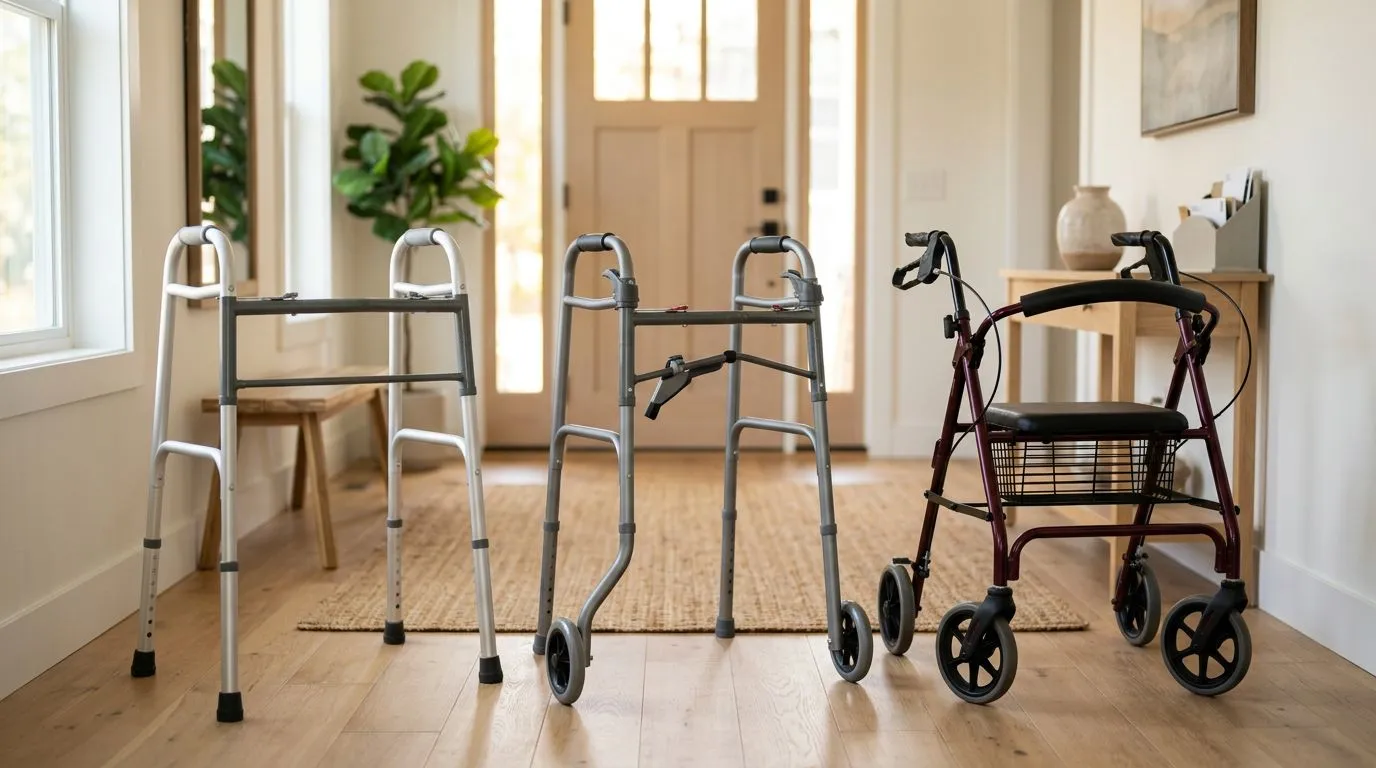
A no-wheel walker usually gives the most stop-and-start stability because all 4 legs are planted before each step. A two-wheel walker reduces lifting effort while keeping the rear tips on the floor for control. A rollator rolls continuously on 3 or 4 wheels and requires hand brakes, steering, and more awareness of balance.
The right choice depends on how much support you need, where you plan to use it, and whether you can safely manage wheels and brakes. More wheels can make movement smoother, but they can also reduce the fixed support the device provides at any one moment.
How wheels change support, effort, and control in 3 main ways
Adding wheels to a walker changes three practical things: how much the device resists movement, how much effort it takes to advance it, and how much control you must provide with your hands, posture, and attention. A standard no-wheel walker is advanced by lifting or sliding it forward, then stepping into it. A two-wheel walker rolls forward on the front legs while the rear legs or glide tips help slow it down. A rollator is designed to roll freely and is controlled with hand brakes.
Think of the wheel setup as a trade-off. With 0 wheels, the frame tends to stay where you place it. With 2 wheels, it moves more easily but still has some drag. With 3 or 4 wheels, it takes the least effort to move, which helps over longer distances but requires more braking skill and judgment.
That does not mean one type is always safer. A person who tires quickly may become less stable with a no-wheel walker if lifting it is exhausting after 20 feet. Another person may feel unsafe with a rollator because it can move ahead too quickly. Fit, strength, balance, home layout, and training matter as much as the number of wheels.
Quick comparison: 0 wheels, 2 wheels, and 3- or 4-wheel rollators
The table below compares the main walker and rollator categories by how they typically behave. Exact dimensions vary, but many adult walkers are roughly 24 to 27 inches wide, and many rollators are between about 23 and 30 inches wide depending on frame style and weight capacity.
| Type | Wheel setup | Stability feel | Effort to move | Control demands | Common features |
|---|---|---|---|---|---|
| No-wheel walker | 0 wheels, 4 rubber tips | Most planted when used correctly | Highest, because it must be lifted or advanced deliberately | Low rolling control, but requires step timing | Folding frame, adjustable height, lightweight aluminum |
| Two-wheel walker | 2 front wheels, 2 rear tips or glides | Stable with easier forward movement | Moderate, less lifting than a no-wheel walker | Moderate; rear legs help prevent runaway rolling | Folding frame, 5-inch front wheels common, optional glides |
| 3-wheel rollator | 3 wheels, usually triangular frame | Maneuverable, less seated support | Low, rolls continuously | Higher; requires steering and brakes | Hand brakes, basket or pouch, narrow turning |
| 4-wheel rollator | 4 wheels with hand brakes | Steady for rolling mobility, not for heavy leaning | Low to moderate depending on surface | Higher; user must brake before sitting or stopping | Seat, backrest, storage, folding frame |
| Upright rollator | 4 wheels, forearm supports on many designs | Encourages taller posture for some users | Low rolling effort, larger frame | Higher; braking and turning take practice | Forearm platforms, hand brakes, seat on many units |
No-wheel walkers: 4 planted legs for maximum pause-and-step support
A no-wheel walker, sometimes called a standard walker, has 4 legs with rubber tips and no rolling front wheels. Its main advantage is that it stays still when weight is placed through the handles, as long as the tips are in good condition and the floor is dry. That planted feel can be reassuring for short indoor distances, transfers, and people who need a firm frame between steps.
The trade-off is effort. Each forward movement requires the user to lift the frame slightly or move it in a controlled way, place all 4 tips down, then step. This can be tiring for someone with limited arm strength, shoulder pain, poor endurance, or trouble sequencing movements. A no-wheel walker can also be awkward on carpet because the tips may catch.
Many standard walkers fold to a depth of about 4 to 6 inches for storage or car travel. They are often lighter than rollators because they do not have a seat, brake cables, or large wheels. Weight capacity commonly starts around 250 to 300 pounds, with heavy-duty or bariatric walker frames available at higher ratings. Always check the stated capacity of the specific device, including any accessories.
A no-wheel walker is not meant to be pushed far ahead like a shopping cart. For safer use, the frame is usually placed about one step ahead, and then the user steps into the space between the handles. If the walker is too far forward, the person may lean, lose upright posture, and reduce the support the frame can provide.
Two-wheel walkers: 2 front wheels reduce lifting without fully free-rolling
A two-wheel walker is often the middle ground. The front legs have wheels, commonly around 5 inches in diameter, while the back legs have rubber tips or glides. Because the front rolls, the user does not have to lift the entire frame with every step. Because the rear tips stay in contact with the floor, the walker still has built-in drag and stopping resistance.
This setup can help people who are reasonably steady but find a no-wheel walker too tiring. It also works well for many indoor routes: bedroom to bathroom, kitchen to dining table, or short hallway trips. The frame still feels like a walker, not a rollator, because it does not roll freely on all legs.
Rear tips create more friction than glides. That friction can improve stopping control, but it may also make the walker harder to move on carpet. Rear glides or skis can smooth movement, especially over rugs, but they reduce some of the braking effect. Tennis balls are sometimes used as makeshift glides, but they can wear unevenly and collect dirt; purpose-made glides are usually more predictable.
The biggest mistake with a two-wheel walker is pushing it too far forward. Since it moves more easily than a no-wheel frame, users may let it drift out of their base of support. A good starting point is to keep the back legs near the toes before stepping, then move the walker only a short distance forward.
Rollators: 3 or 4 wheels, hand brakes, and a seat change the rules
A rollator is a wheeled walker with 3 or 4 wheels and hand brakes; most 4-wheel rollators include a built-in seat and backrest. It is made for people who can walk but need balance assistance, a place to rest, or less effort over longer distances. Because every leg is on a wheel, a rollator moves easily across smooth floors, sidewalks, clinics, senior centers, and shopping areas.
That rolling convenience brings responsibility. The user must be able to squeeze the hand brakes, steer around obstacles, control speed on slight slopes, and lock the brakes before sitting. A rollator is not designed for heavy leaning while walking in the same way a planted walker is. If someone puts a large amount of body weight through the handles and cannot control forward movement, the rollator can roll away from them.
Four-wheel rollators are the most familiar style. They usually offer a seat width in the range of about 12 to 18 inches, though designs vary widely. A 3-wheel rollator is often narrower and turns tightly, which can help in small apartments, but it usually does not provide the same seated rest option as a 4-wheel rollator. Some 3-wheel styles have a pouch or basket instead of a seat.
Upright rollators, sometimes called stand-up rollators, use higher handles or forearm supports to encourage a more upright posture. They can be useful for some people who hunch over a standard rollator, but they are often larger and may feel less stable during sharp turns. Bariatric rollators use wider, reinforced frames and higher weight capacities; the added width may make doorway clearance more important.
Who each option is best for: 5 common shopper profiles
Choosing between a no-wheel walker, two-wheel walker, and rollator is less about age and more about strength, balance, endurance, and environment. These 5 common profiles can help narrow the choice, but a physical therapist, occupational therapist, or clinician can provide the safest fit when fall risk, surgery recovery, or neurological conditions are involved.
Best fit for a no-wheel walker
A no-wheel walker may suit someone who needs firm, step-by-step support and walks short distances indoors. It can be appropriate when standing balance is limited, when the person benefits from pausing after every step, or when a clinician recommends a more stable frame during recovery. It is also practical for tight indoor routes if the user can lift and place it safely.
Best fit for a two-wheel walker
A two-wheel walker may fit someone who needs more support than a cane but struggles to lift a standard walker repeatedly. It is often a good compromise for short to moderate indoor walking, especially when the person can control the frame and does not need a built-in seat. It may also be easier for caregivers to manage than a full rollator in narrow rooms.
Best fit for a 3-wheel rollator
A 3-wheel rollator can work for a user who is fairly steady, wants easy maneuvering, and needs help carrying small personal items. Its turning radius is often tighter than a 4-wheel rollator, which is useful around furniture. The main limitation is rest: many 3-wheel styles do not have a seat, so they are not ideal for someone who must sit every few minutes.
Best fit for a 4-wheel or upright rollator
A 4-wheel rollator may be best for someone who can use hand brakes reliably and needs a rest seat during errands, appointments, or walks longer than a room or two. Upright rollators may help some users maintain a taller position, but they should be tested carefully because higher support points can change steering feel. Bariatric rollators may be appropriate when the user needs a higher weight rating or wider seat, but the frame must still fit through the home.
How to choose and measure in 5 minutes at home
Before comparing features, measure both the spaces and the person. A device that looks safe on paper can be frustrating if it cannot pass through a 28-inch bathroom doorway or fit beside a bed. Use a tape measure, the shoes normally worn for walking, and a clear 10-foot path for a basic fit check.
- Handle height: Stand upright with arms relaxed at the sides. The handgrips should usually line up near the wrist crease, creating a slight elbow bend of about 15 to 30 degrees when holding the handles.
- Doorway clearance: Measure the narrowest doorway, hallway turn, and bathroom entrance. Compare that with the overall outside width of the walker or rollator, not just the seat width.
- User weight and seat needs: Check the stated weight capacity. For rollators, also confirm seat width, seat height, and whether the user can sit and stand without pulling the device backward.
- Hand strength: For rollators, test whether the brakes can be squeezed and locked without pain. Brake control is not optional; it is central to safe use.
- Floor surfaces: Note carpet, thresholds, tile, outdoor cracks, gravel, and ramps. Small wheels can be fine indoors but may bump more on uneven outdoor surfaces.
If possible, try the device over a 10- to 20-foot path that includes a turn and a stop. Watch whether the user stays between the handles, keeps the device close, and can stop without leaning forward. If the frame pulls the person out of posture, the setup may be too low, too tall, too wide, or simply the wrong category.
Feature trade-offs: wheels, brakes, seats, and frame size in real use
Features should solve a real problem. A seat is useful only if the user can brake, turn, back up, and sit safely. Larger wheels may smooth outdoor travel, but they can add bulk. A narrow frame may fit small rooms, but it may not provide enough space for a comfortable walking stance.
| Feature | Why it helps | What to watch |
|---|---|---|
| Rubber tips | Grip the floor and provide stopping resistance | Must be replaced when worn, cracked, or smooth |
| Front wheels | Reduce lifting effort on a walker | Can roll too far if the user pushes ahead |
| Hand brakes | Control rollator speed and lock for sitting | Require grip strength, memory, and regular adjustment |
| Seat and backrest | Provide rest during longer outings | Not a transport chair; brakes must be locked before sitting |
| Folding frame | Helps with car trunks and closets | Latch must lock fully before walking |
| Higher weight capacity | Supports larger users when rated appropriately | Often increases width and total device weight |
Do not overlook maintenance. Rubber tips and glide caps can wear down in months with daily use. Rollator brakes may need cable adjustment, and wheels should spin freely without wobbling. A quick weekly check takes less than 2 minutes and can catch problems before they affect safety.
Indoor and outdoor safety: a 1-inch threshold can change the feel
Small environmental details matter. A 1-inch door threshold, a thick rug edge, or a sloped driveway can feel very different depending on the wheel setup. No-wheel walkers may catch on transitions. Two-wheel walkers may roll over the front edge but drag at the rear. Rollators may cross more smoothly, yet they can gain speed on ramps or sloped sidewalks.
Inside the home, remove loose throw rugs when possible, improve lighting, and keep walking paths at least wide enough for the frame plus a few inches of clearance. Bathrooms deserve special attention because wet tile reduces grip and space is limited. A walker or rollator is not a substitute for grab bars where transfers are needed.
Outdoors, consider wheel size and braking. Smaller wheels may work on smooth pavement but can jolt on cracked sidewalks. Larger rollator wheels can make outdoor use easier, though they do not eliminate the need for careful steering. On hills, brakes should be used to control speed, not just to park the rollator.
Car travel is another difference. A no-wheel or two-wheel folding walker is often lighter to lift into a trunk. A rollator may fold, but the seat, wheels, and brake hardware usually make it heavier. If the user or caregiver must load it several times a week, total weight can matter as much as walking performance.
Bottom line: more wheels mean less lifting, not automatically more support
Choose a no-wheel walker when planted stability and short, deliberate steps are the priority. Choose a two-wheel walker when lifting effort is the main problem but the user still benefits from rear-floor contact and a slower frame. Choose a rollator when the user can manage hand brakes, steer safely, and needs smoother movement or a seat for rest.
The safest choice is the one that fits the person and the setting. Test the fit, measure the home, check grip and brake ability, and ask a qualified clinician for guidance if falls, dizziness, surgery recovery, or major weakness are part of the picture. Wheels can make walking easier, but control has to come with them.
FAQ
Frequently asked questions
Is a walker without wheels more stable than a rollator? +
Often, yes. A no-wheel walker stays planted on 4 rubber tips when used correctly, so it usually offers more fixed support between steps. A rollator rolls on wheels and depends on the user’s balance, steering, and brake control.
Who should use a two-wheel walker instead of a standard walker? +
A two-wheel walker may help someone who needs walker-level support but has trouble lifting a standard walker repeatedly. The front wheels reduce effort, while the rear tips or glides still add some stopping resistance.
Can you sit on any rollator? +
No. Only rollators designed with a built-in seat should be used for sitting. The brakes must be locked before sitting, and the rollator should be on a level surface.
Are 3-wheel rollators safer than 4-wheel rollators in small spaces? +
Not automatically. A 3-wheel rollator can turn more easily in tight spaces, but many do not include a seat and may feel less supportive for some users. Safety depends on the user’s balance, brake control, and the layout of the home.
How high should walker or rollator handles be? +
A common starting point is handle height near the wrist crease when standing upright in regular walking shoes. When holding the grips, the elbows should have a slight bend, often around 15 to 30 degrees.
When should I ask a clinician for help choosing a walker or rollator? +
Ask a physical therapist, occupational therapist, or healthcare professional if there is a history of falls, recent surgery, dizziness, major weakness, neurological symptoms, or uncertainty about braking and balance.
Keep reading
Related guides

Standard Walker vs Two-Wheel Walker: Which Basic Walker Style Should You Buy?
11 min read
Buying a Mobility Walker for an Older Parent: Questions to Ask Before You Shop
13 min read
3-Wheel Rollator Safety: When Tight Turning Helps and When It Adds Risk
12 min read