Disclosure: We may earn a commission when you buy through links on this page, at no extra cost to you. We buy nothing, sell nothing and accept no payment for coverage — commissions never decide what we recommend. How we make money.

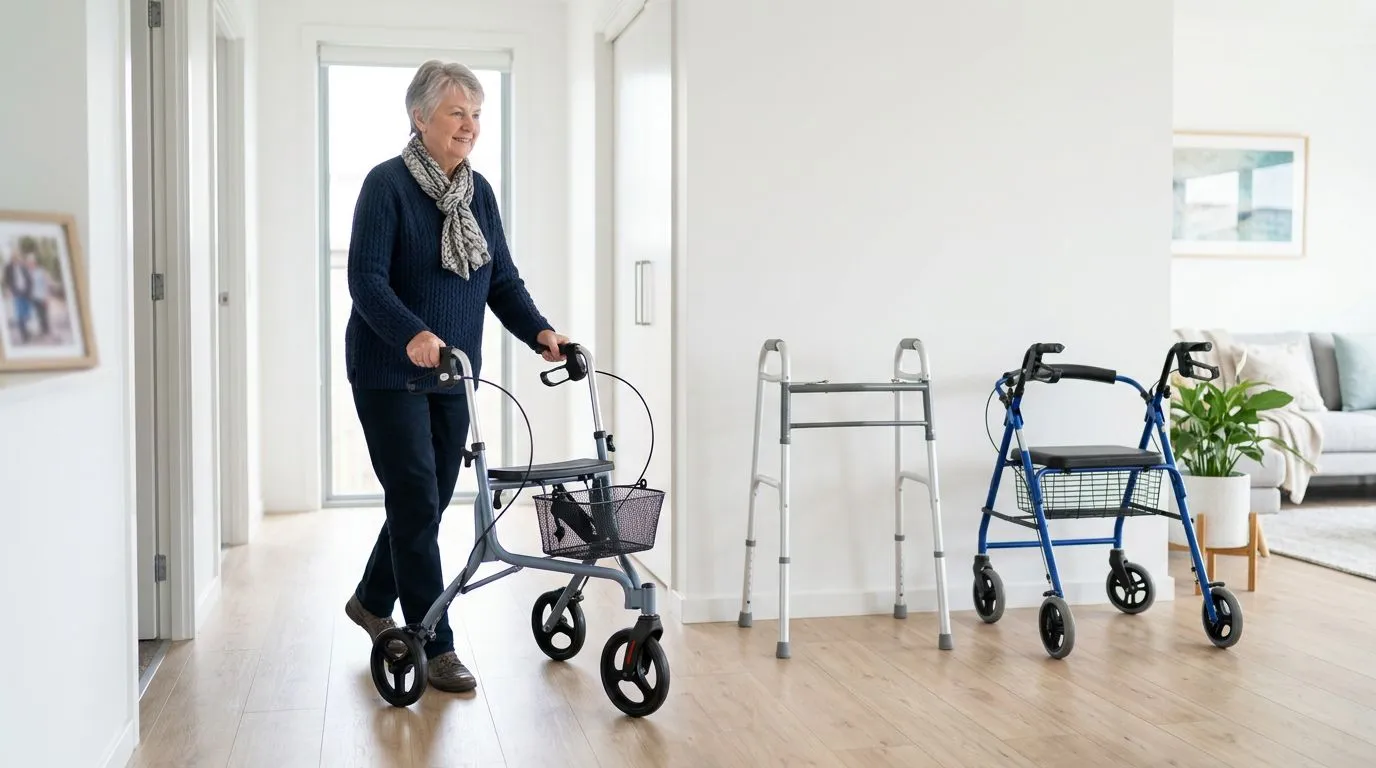
A standard walker is usually the better choice if you need maximum stability with every step. A two-wheel walker is often easier if you have enough balance to roll the front legs forward. Both are basic walkers, not rollators: they do not have a built-in seat, four wheels, or bicycle-style hand brakes. The safest choice depends on your balance, arm strength, walking pattern, home layout, and whether lifting the frame is realistic for daily use.
Quick answer: 0 wheels vs 2 wheels in 30 seconds
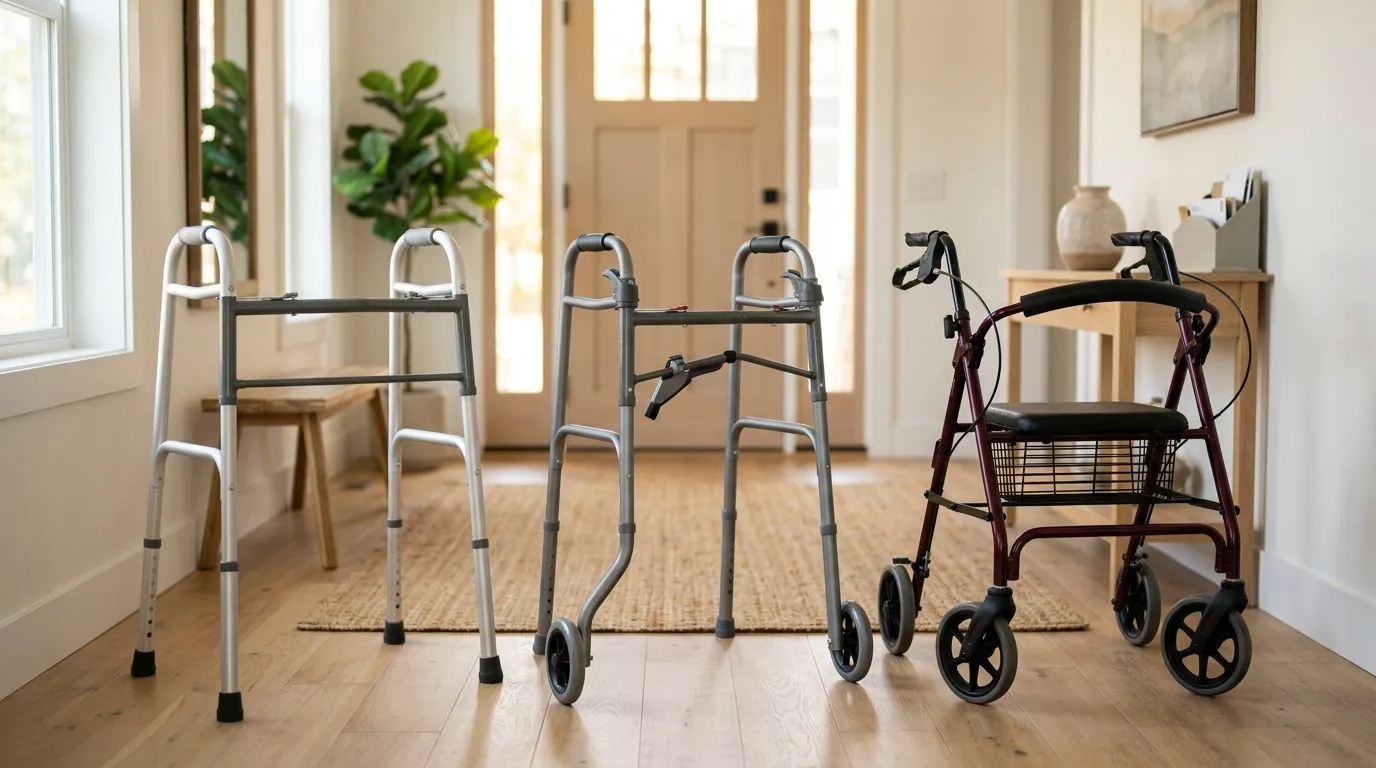
A standard walker has 4 legs and no wheels. To move, you lift the entire frame, place it ahead of you, then step forward into it. That stop-and-step pattern is slow, but it gives many people a very steady base of support.
A two-wheel walker has 2 front wheels and 2 rear legs with rubber tips or glides. You do not have to lift the front of the frame every time. You push or roll it forward a short distance, let the rear legs stabilize, then step.
For shoppers comparing these two basic walker styles, the tradeoff is simple: a standard walker offers more braking-by-design because all 4 tips contact the floor. A two-wheel walker reduces lifting and may feel smoother for repeated movement across rooms. Neither is meant to be used like a fast 4-wheel rollator.
| Basic walker style | Best everyday fit | Main advantage | Main caution |
|---|---|---|---|
| Standard walker, no wheels | People who need the most stable frame for short, careful steps | All 4 legs stay planted when weight is applied | Requires lifting the frame with each step cycle |
| Two-wheel walker | People who need support but struggle to lift a full frame repeatedly | Front wheels make forward movement easier | Can roll too far if pushed carelessly or used on a slope |
How standard walkers work with 4 planted legs
A standard walker is the simplest walker frame: usually aluminum, height-adjustable, foldable, and supported by 4 rubber-tipped legs. The user moves it by lifting the frame a few inches, setting it down, and stepping forward only after the walker is stable.
That movement pattern is important. With a no-wheel walker, the frame does not roll away when you place weight through your hands. For many people recovering from weakness, managing poor balance, or learning a slower gait pattern, that planted feel is reassuring.
The tradeoff is effort. Even a lightweight folding walker still has to be picked up again and again. If someone walks 40 feet from a bedroom to a kitchen, that may mean lifting and setting the walker down many times. Fatigue can lead to rushed movements, dragging, or placing the walker too far ahead.
Standard walkers are most often used indoors on flat floors. They can be awkward on thick carpet, uneven thresholds, gravel, grass, or long outdoor distances. The design favors control over speed.
How two-wheel walkers work with 2 front wheels
A two-wheel walker keeps the same basic frame shape but adds 2 wheels to the front legs. The rear legs usually have rubber tips, skis, or glide caps, depending on floor surface and user needs. The front wheels often measure about 3 to 5 inches in diameter, though sizes vary.
This style reduces the need to lift. Many users simply nudge the walker forward, keeping the rear legs close to the floor or briefly unweighted. Because the front wheels roll, the walker can feel less tiring during repeated trips around the house.
It is still not a rollator. A two-wheel walker does not usually include a seat, storage basket, or hand brakes. The rear legs provide friction and stopping control, while the user controls the frame through body position and hand pressure.
For some people, that front-wheel design is the sweet spot: more controlled than a rollator, easier than a no-wheel frame. For others, the rolling front can feel less secure, especially if balance is unpredictable or the user tends to lean hard forward.
Stability and effort compared in 5 daily situations
The best walker choice often becomes clearer when you picture ordinary routines. A walker is not just a medical device; it has to work at 2 a.m. on the way to the bathroom, in a narrow hallway, and beside a favorite chair.
| Daily situation | Standard walker | Two-wheel walker |
|---|---|---|
| Standing from a chair | Very stable once all 4 legs are flat, but users should push from the chair first, not pull on the walker | Stable when rear legs are grounded, but front wheels may shift if pulled |
| Walking 10 to 30 feet indoors | Slow and controlled, with repeated lifting | Smoother and often less tiring |
| Turning in a small bathroom | May require lift-and-place adjustments | Front wheels can make small turns easier, if controlled |
| Crossing a threshold | May need to be lifted over the raised edge | Front wheels may roll over low thresholds, but rear legs can catch |
| Walking outdoors | Can be difficult on uneven ground | Better than no wheels on some hard surfaces, but still limited compared with outdoor rollators |
If the user has strong arms and needs a very predictable base, the standard walker usually wins. If the user is stable enough to manage a rolling front end and gets tired from lifting the frame, the two-wheel walker may be the more usable choice.
Who a standard walker is best for: 4-point support
A standard walker is often best for someone who needs maximum support from a basic walker and can safely lift the frame. It creates a 4-point base on the floor, which can help people who take short, deliberate steps or need frequent pauses.
This style may be a good fit if the user:
- Feels unsteady with rolling devices.
- Needs to put meaningful weight through the hands for support.
- Walks short indoor distances, such as from bed to bathroom or chair to kitchen.
- Can lift the frame without shoulder, wrist, or hand pain.
- Has enough memory and attention to follow a step-by-step walking pattern.
A standard walker can also help when speed is not the goal. The design naturally slows the user down. For some people, that is safer than a walker that moves too freely.
There are limits. If lifting causes pain, breathlessness, or unsafe shuffling, the added stability may not be worth the effort. A walker that is theoretically stable but too tiring to use correctly can create its own risk.
Who a two-wheel walker is best for: 2 wheels plus rear braking
A two-wheel walker is often best for someone who needs more stability than a rollator may provide but does not want to lift a walker every few steps. The 2 front wheels help with forward motion, while the rear legs add friction when the user places weight down.
This style may be a good fit if the user:
- Has fair balance but limited endurance.
- Finds a standard walker too tiring to lift repeatedly.
- Walks mostly indoors on hard, level flooring.
- Needs a slower, more controlled device than a 3-wheel or 4-wheel rollator.
- Can keep the walker close instead of pushing it far ahead.
Two-wheel walkers can be especially practical in homes with longer hallways or open kitchen and living areas. The user can move more continuously while still avoiding the free-rolling feel of a rollator.
The main concern is control. If the person leans heavily forward, takes fast steps, or cannot stop the walker from moving ahead, a front-wheel walker may not be safe without training or a different setup. A physical therapist or occupational therapist can help assess this in a real walking environment.
How to measure walker fit in 3 steps
Fit is just as important as style. A poorly adjusted walker can make a stable frame feel awkward. Most adult walkers have adjustable legs, commonly in 1-inch increments, so small changes can make a noticeable difference.
1. Check handle height at the wrist crease
Have the user stand as upright as comfortably possible in supportive shoes. With arms relaxed at the sides, the walker handles should line up near the crease of the wrist. When holding the grips, the elbows should be slightly bent, often around 15 to 30 degrees.
2. Check width through doors and halls
Many interior doorways are about 28 to 32 inches wide, and some bathroom doors are narrower. Measure the walker at its widest point, then compare it with the tightest doorway, hallway turn, and space beside the bed. A walker that cannot enter the bathroom is not a practical choice.
3. Check step position inside the frame
The user should step into the walker, not trail far behind it. If the walker is constantly 12 inches or more ahead of the body, the user may lean forward and lose control. The right position keeps the frame close enough for support while leaving room for the feet to step naturally.
If one leg is weaker, if there are weight-bearing restrictions, or if the user is recovering after surgery, ask a clinician for specific gait instructions. The safest sequence can vary.
Feature checklist: 8 details that matter
Standard walkers and two-wheel walkers look simple, but small details affect daily safety and comfort. Before buying, compare features based on how the walker will be used, not on extras that sound impressive.
| Feature | What to look for | Why it matters |
|---|---|---|
| Weight capacity | Choose a walker rated above the user’s body weight | Frames commonly list limits such as 250, 300, or higher pounds depending on type |
| Handle height range | Match the user’s wrist height while wearing normal shoes | Incorrect height can strain shoulders or reduce control |
| Walker weight | Consider whether the user or caregiver must lift it into a car | Lighter frames are easier to transport, but still must feel sturdy |
| Foldability | Look for a simple folding mechanism | Helpful for storage, car trunks, and tight rooms |
| Grip comfort | Check grip diameter and texture | Painful hands or arthritis can make hard grips difficult |
| Rear tips or glides | Match rubber tips, skis, or glides to the floor surface | Too much drag or too little friction can both be unsafe |
| Front wheel size | For two-wheel walkers, compare wheel diameter | Larger front wheels may handle minor thresholds better |
| Accessories | Use trays, pouches, or baskets cautiously | Added weight can affect balance and folding |
Do not ignore weight capacity. Bariatric walkers and heavy-duty frames are available for users who need a higher rated capacity or a wider frame. The right choice should support the person safely without making the walker too wide for the home.
Walker vs rollator: 3 reasons a basic walker may be safer
A rollator is a wheeled walker with 3 or 4 wheels, hand brakes, and usually a built-in seat. Rollators can be excellent for people who walk longer distances, need rest breaks, and can safely control brakes. They are different from standard walkers and two-wheel walkers.
A basic walker may be safer than a rollator when:
- The user needs a device that does not roll freely.
- The user leans heavily through the arms for support.
- The user has trouble remembering or squeezing hand brakes.
Rollators move more easily, but that is not always an advantage. A 4-wheel rollator can get ahead of the user if balance, reaction time, or brake use is unreliable. A 3-wheel rollator may turn tightly, but it typically does not provide the same broad, planted support as a basic walker.
Upright rollators and bariatric rollators serve important needs, but they are still rollators: they rely on wheels and brakes. If the main concern is maximum stability at slow indoor speeds, a standard walker or two-wheel walker often deserves the first look.
Home safety test: try a 30-minute route before deciding
If possible, test the walker style on the actual routes the user takes every day. A 30-minute home review can reveal problems that a store aisle or online description cannot.
Walk the route from bed to bathroom, favorite chair to kitchen, front door to car, and any hallway turn used daily. Notice whether the walker catches on rugs, fits beside the toilet, clears the bedroom doorway, and can be positioned safely at the sink.
Remove loose throw rugs when possible. Check cords, pet bowls, clutter, and low furniture. Even the most stable walker cannot compensate for a walkway blocked by a laundry basket or a slippery mat.
Lighting matters too. A walker used at night should be paired with clear pathways and easy-to-reach lights. If the person uses the walker 5 or more times overnight or feels rushed to reach the bathroom, talk with a healthcare professional about fall-risk reduction strategies.
Buying recommendation: choose in 2 practical steps
Start with the user’s weakest moment, not their best moment. Someone may walk well across a bright living room at noon but struggle in the bathroom at night. The safer walker is the one they can control consistently.
Step 1: decide whether lifting is safe. If the user can lift and place the frame without pain, fatigue, or loss of balance, a standard walker gives the most planted support. If lifting causes unsafe effort, a two-wheel walker is often more realistic.
Step 2: decide whether rolling is controlled. If the front wheels move smoothly without pulling the person forward, a two-wheel walker can be easier for daily use. If the walker rolls away, turns unpredictably, or encourages leaning, return to a standard walker or seek professional guidance.
For many shoppers, the best answer is not the most advanced device. It is the walker style that matches the person’s balance, strength, home, and habits. A standard walker favors maximum stability. A two-wheel walker favors easier movement while keeping more control than a rollator. When in doubt, have a clinician watch the user walk 10 to 20 feet with each style; that short observation can prevent an expensive and unsafe mismatch.
FAQ
Frequently asked questions
Is a standard walker safer than a two-wheel walker? +
A standard walker is usually more stable because all four legs stay planted when weight is applied. A two-wheel walker may be safer for someone who cannot lift a standard walker repeatedly, as long as they can control the rolling front wheels.
Can you put wheels on a standard walker? +
Some standard walkers can accept front wheel attachments, but compatibility depends on the frame design. If adding wheels, make sure the walker remains level, the rear tips or glides are appropriate, and the user can control the new movement pattern.
Who should not use a two-wheel walker? +
A two-wheel walker may not be appropriate for someone who leans heavily forward, cannot control rolling movement, walks on steep or uneven surfaces, or needs the walker to stay completely still before each step. A clinician can help assess safety.
Is a two-wheel walker the same as a rollator? +
No. A two-wheel walker has front wheels and rear legs, usually without hand brakes or a seat. A rollator has three or four wheels, hand brakes, and typically a built-in seat for rest breaks.
How high should walker handles be? +
Walker handles should usually line up near the crease of the wrist when the user stands upright in normal shoes with arms relaxed. When holding the grips, the elbows should have a slight bend, often about 15 to 30 degrees.
Keep reading
Related guides
No-Wheel Walker vs Two-Wheel Walker vs Rollator: How Wheels Change Stability, Effort, and Control
13 min read
Mobility Walker With Seat vs Standard Walker: Which One Is Right for You?
14 min read
Buying a Mobility Walker for an Older Parent: Questions to Ask Before You Shop
13 min read