Disclosure: We may earn a commission when you buy through links on this page, at no extra cost to you. We buy nothing, sell nothing and accept no payment for coverage — commissions never decide what we recommend. How we make money.
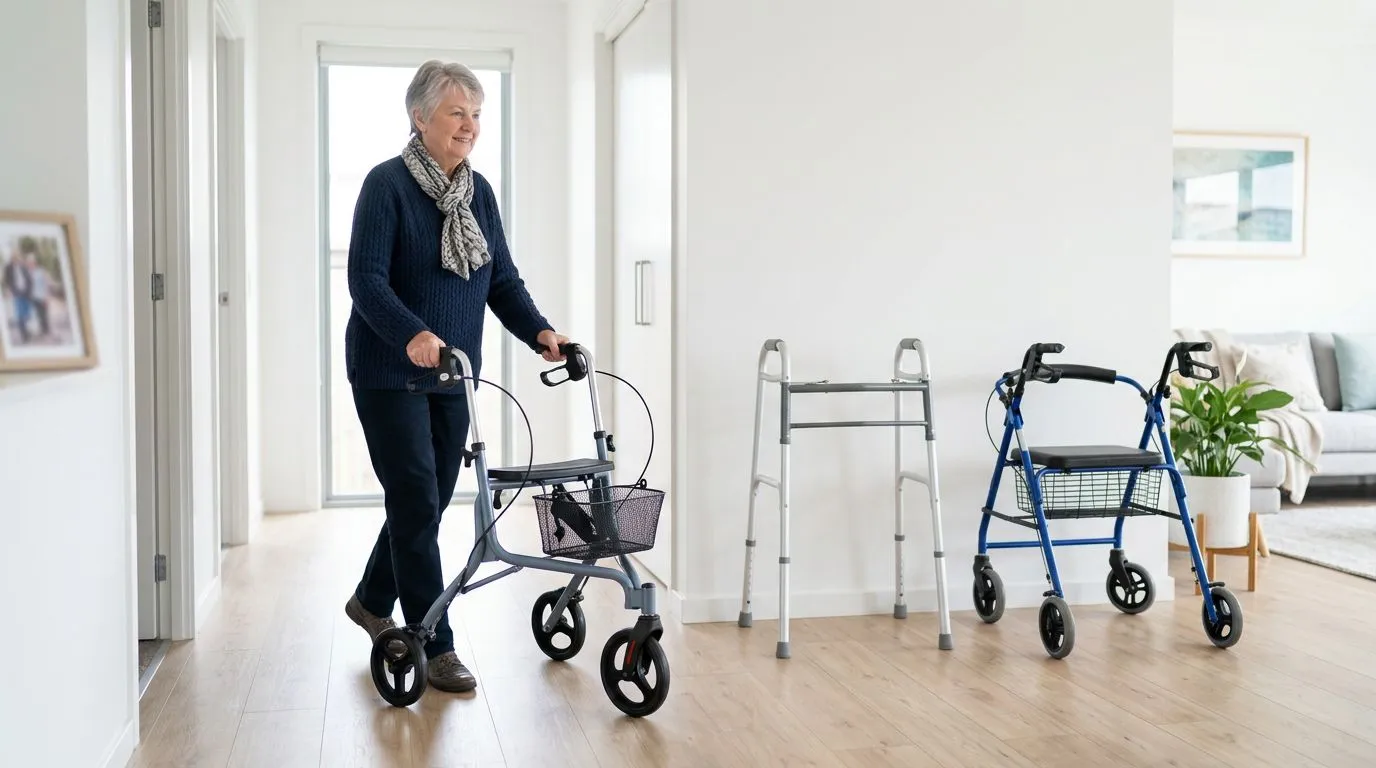
A standard walker is usually best when you need the most stable, straightforward support for short distances, transfers, or indoor use. A mobility walker with a seat is usually a rollator: it has 3 or 4 wheels, hand brakes, and a built-in seat for planned rest breaks during longer walks. The right choice depends on whether you need maximum stability and controlled movement, or easier rolling mobility with a safe place to pause.
Both devices can support safer everyday movement, but they solve different problems. A standard walker asks you to move more slowly and deliberately. A rollator moves with you, which can help outdoors, in hallways, and on errands, but it also requires good brake control, steering awareness, and the ability to sit down and stand up from the seat safely.
1. The main difference: 4 wheels and a seat change how the device works
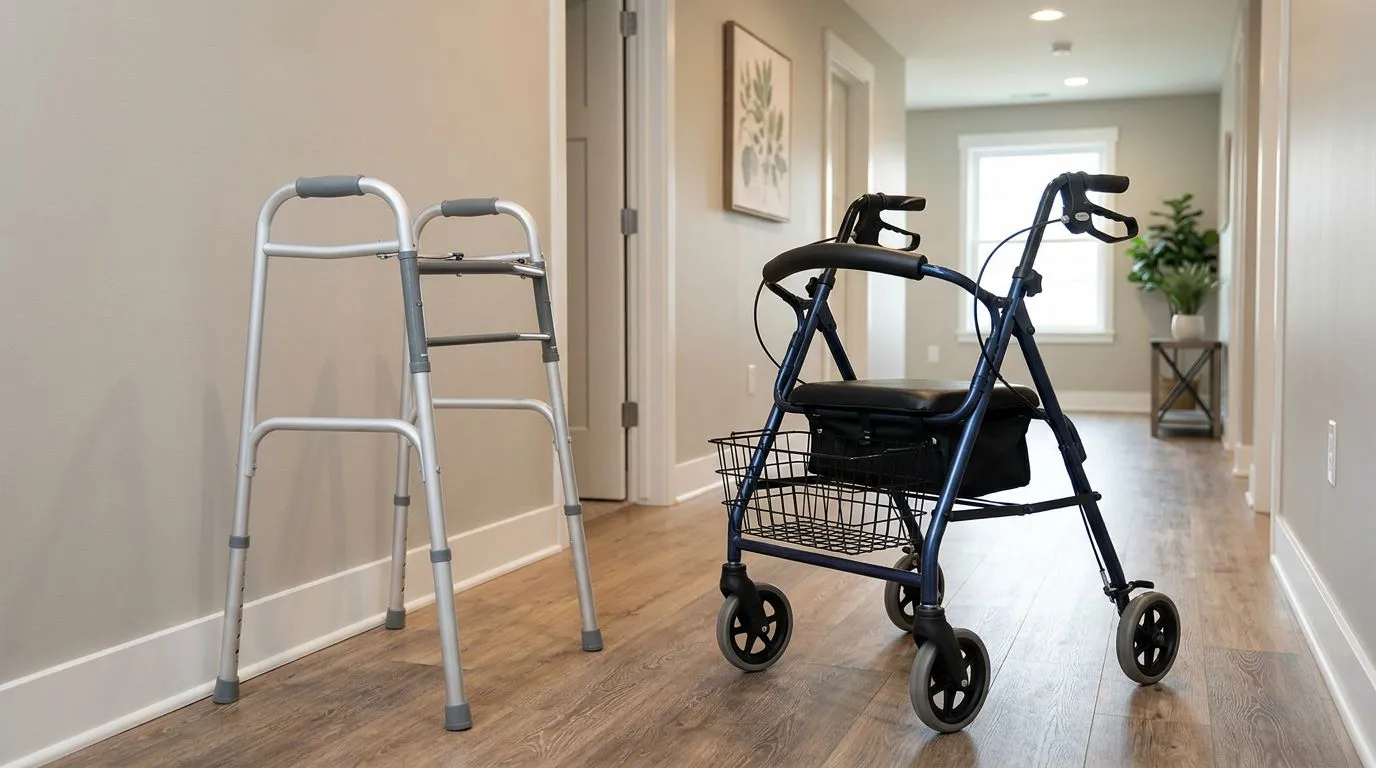
The biggest difference is not just the seat. It is how the frame moves. A standard walker, including a no-wheel walker frame or a two-wheel walker, is designed to be placed or nudged forward, then stepped into. A rollator is designed to roll continuously on 3 or 4 wheels and stop with hand brakes.
That changes the feel right away. A standard walker offers a wide, steady base that stays put when your weight shifts onto it. A rollator moves easily, so it feels smoother for walking but less fixed under your hands unless the brakes are engaged. For many shoppers, this becomes the deciding point.
If your main concern is basic support over 10 to 50 feet inside the home, a standard or folding walker may be the practical choice. If you want to walk around a store, take a 15-minute stroll, or rest halfway down a long hallway, a rollator with a seat may fit better.
2. What a standard walker offers: simple support in a 20 to 25 inch wide frame
A standard walker is the classic aluminum frame many people picture first. It may have no wheels, or it may have 2 front wheels with rear glide caps or rubber tips. Most adult walkers are roughly 20 to 25 inches wide, though exact dimensions vary, so doorway and bathroom clearance matter.
A no-wheel walker gives the most controlled movement because it does not roll away. You lift it slightly, place it forward, and step. That pattern can feel slow, but sometimes slow is the point. It helps people who need clear, deliberate steps and a device that stays still when weight is applied.
A two-wheel walker is a middle ground. The front wheels reduce lifting, while the back legs help keep the frame from rolling too freely. Many standard walkers also fold, often with a push-button or paddle release, which can make storage in a closet or car trunk easier.
Standard walkers usually do not include a seat, hand brakes, or a storage basket built into the frame. Some accessories exist, but adding too much to a basic walker can change how it handles. If seated rest breaks are a daily need, a true rollator is usually the more appropriate category to compare.
3. What a walker with a seat really is: a rollator with 3 or 4 wheels
In everyday shopping language, many people say walker with seat. In mobility equipment terms, that usually means a rollator. A rollator is a wheeled walker with hand brakes and a built-in seat, most often in a 4-wheel design. Some 3-wheel rollators have storage and hand brakes but may not include a seat, so check the actual type before assuming.
A 4-wheel rollator is popular because it combines rolling movement, a seat, and a backrest or back strap. The seat height commonly falls somewhere around 18 to 24 inches from the floor, depending on the frame size. This matters because a seat that is too low can make standing difficult, while a seat that is too high can feel insecure.
Rollators are useful for people who can walk but need pacing support. For example, someone may be comfortable walking 200 feet but need to sit for 2 minutes before continuing. The seat should be used only when the rollator is fully stopped, the brakes are locked, and the surface is level.
There are also upright or stand-up rollators. These place the forearm supports or handles higher to encourage a more upright posture. They can help some users, but they are larger and require careful fitting. Bariatric rollators are built with higher weight capacities and wider frames, but the wider footprint can be harder to manage in narrow bathrooms or older homes.
4. Walker vs rollator comparison: 8 practical shopping factors
Use the table below to compare the features that affect daily use. The best choice is rarely about one feature. It is about the combination of support, control, resting needs, and where you walk most often.
| Factor | Standard walker | Mobility walker with seat / rollator |
|---|---|---|
| Typical movement | Lift and place, or push front wheels only | Rolls continuously on 3 or 4 wheels |
| Seat | Usually none | Usually included on 4-wheel models |
| Brakes | Usually none | Hand brakes with parking lock |
| Best indoor distance | Short, controlled trips such as 10 to 50 feet | Longer indoor routes such as hallways or facilities |
| Outdoor use | Possible, but slower and harder on uneven surfaces | Often easier on sidewalks and smooth paths |
| Stability feel | More planted when weight is applied | More mobile, but requires brake control |
| Storage | Many fold flatter | Folds, but usually bulkier because of wheels and seat |
| Learning curve | Step-by-step rhythm | Steering, braking, and safe seating technique |
Here is the plain-language takeaway: a standard walker prioritizes stability and control; a rollator prioritizes mobility and rest breaks. If you are unsure, pay close attention to how much weight you put through your hands. Rollators are not meant to be used like a rigid frame you lean heavily on while walking.
5. Who a standard walker is best for: people who value control over speed
A standard walker may be the better fit if you need a device that stays steady during each step. It is often preferred for short indoor routes, getting from a bed to a chair, moving through tight spaces, or rebuilding confidence with a slower walking pattern.
It may also make sense if hand strength is limited. Since most standard walkers do not rely on squeeze-style hand brakes, they remove one task from the walking process. That said, you still need enough arm and shoulder function to move the frame, especially with a no-wheel walker.
Consider a standard walker if these sound familiar:
- You walk mostly inside the home, often less than 5 minutes at a time.
- You need a very stable frame before stepping forward.
- You do not need to sit during most walks.
- You have narrow rooms, tight turns, or small bathrooms.
- You prefer a lighter, simpler device with fewer moving parts.
A two-wheel walker may be worth considering if lifting a no-wheel frame feels tiring. It still gives more control than a full rollator while reducing the effort needed to advance the walker.
6. Who a rollator with a seat is best for: people who need rest breaks every few minutes
A rollator may be the better fit if you can walk with a smoother gait but need to conserve energy, pace yourself, or sit during outings. The seat is especially useful in places where chairs may be far apart, such as long medical office corridors, apartment lobbies, parks, or large stores.
Rollators are also helpful when carrying small personal items is part of the day. Many include an under-seat pouch or basket, which can hold light items such as a water bottle, phone, or folded jacket. Avoid hanging heavy bags from the handles, because that can affect balance and steering.
Consider a seated rollator if these sound familiar:
- You often walk more than 100 to 200 feet at a time.
- You need predictable seated rests during errands or appointments.
- You can squeeze and lock hand brakes reliably.
- You can steer around turns without the frame getting ahead of you.
- You walk on sidewalks, community hallways, or other open areas.
A rollator is not the safest choice for everyone. If you tend to push down heavily, lose balance when the device rolls, or forget to lock brakes before sitting, a standard walker may be safer. A physical therapist or occupational therapist can help assess this in a few minutes during a fitting or training session.
7. How to choose and measure: handle height, seat height, width, and weight capacity
Fit matters. A poorly sized walker or rollator can make walking feel awkward, even if the device type is correct. Start with handle height. When standing upright in your usual shoes, arms relaxed at your sides, the top of the hand grip should be near the crease of your wrist. When holding the grips, your elbows should usually bend about 15 to 30 degrees.
For a rollator, seat height matters too. Your feet should touch the floor when seated, and you should be able to stand without sinking too low. Many standard adult rollator seats are roughly 18 to 24 inches high. Petite and tall frames exist because one seat height does not work for everyone.
Check width before buying. Measure the narrowest doorway or hallway turn you use every day. Many interior doorways are around 28 to 32 inches wide, but bathrooms can be tighter. A wider bariatric rollator may offer a higher weight capacity, sometimes listed well above 300 pounds, but it must still fit through your home.
Use this measuring checklist:
- Handle height: wrist crease level while standing in shoes.
- Elbow bend: about 15 to 30 degrees when holding the grips.
- Seat height: feet flat or comfortably supported when seated.
- Overall width: narrow enough for your tightest doorway and bathroom path.
- Weight capacity: above the user weight, with no guesswork.
- Device weight: light enough to lift into a car if transport is needed.
If possible, test the device over the surfaces you actually use: carpet, tile, pavement, thresholds, and ramps. A rollator that feels easy on a showroom floor may feel different on a sloped driveway.
8. Wheels, brakes, and surfaces: 6 inch wheels are not the same as 8 inch wheels
Wheel size affects how a rollator handles. Smaller wheels, such as 6-inch wheels, may work well indoors on smooth floors. Larger wheels, such as 8-inch wheels, often roll more easily over sidewalk seams, low thresholds, and lightly uneven surfaces. Bigger wheels can also make the frame feel bulkier.
Standard walkers are different. A no-wheel frame can feel very secure indoors but inconvenient outdoors. A two-wheel walker may handle indoor thresholds better, but it is still not designed for fast rolling or long outdoor routes the way a rollator is.
Brakes are central to rollator safety. Most rollators use loop-style hand brakes: squeeze to slow or stop, push down to lock for parking. The parking brake should be locked every time before sitting. This is not optional. Sitting on an unlocked rollator can cause the device to move.
If hand arthritis, numbness, or grip weakness makes braking hard, test the brakes before choosing a rollator. Brake tension can often be adjusted, but the user still needs to operate them confidently. For shoppers comparing a rollator to a standard walker, brake ability can be the deciding factor.
9. Seats, posture, and storage: helpful features with limits
A rollator seat is for short rests, not all-day sitting. Many seats are around 13 to 18 inches wide, though heavy-duty and bariatric designs may be wider. The seat should feel stable, the back support should be positioned correctly, and both feet should be on the floor before relaxing.
Do not use a rollator as a transport chair unless it is specifically designed and labeled for that purpose. A typical rollator is not meant for someone else to push you while seated. The wheels, brakes, and frame geometry are built for walking support and rest breaks, not passenger transport.
Upright rollators add another posture option. They may help some people avoid leaning far forward, but they must be adjusted carefully. If the arm supports are too high, too low, or too far forward, the device may become tiring or difficult to steer. Taller frames can also be harder to fold and load into a vehicle.
Storage is useful, but keep loads modest. A small pouch with 5 pounds of items is very different from a heavy grocery bag hanging from one side. Uneven weight can pull the frame off line, especially during turns.
10. Everyday scenarios: choosing for home, errands, travel, and appointments
For a small apartment, a standard folding walker may be easier to manage than a 4-wheel rollator. It can turn in tight spaces, fit beside a bed, and fold flatter for storage. If most movement happens between a chair, kitchen, bathroom, and bedroom, the seat on a rollator may not add much value.
For errands, a rollator can be more practical. Imagine walking from a parking lot across 150 feet of pavement, entering a store, and standing in line for 5 minutes. A seated rollator can provide a planned rest point, as long as there is safe space to stop and lock the brakes.
For medical appointments, think about distance. Some clinics have long corridors, elevators, and waiting areas where chairs may not be close. A rollator may reduce the stress of finding a place to sit. A standard walker may still be better if the user needs more support while turning, stepping on a scale, or transferring.
For travel by car, compare folded size and weight. A basic folding walker is often easier to lift. A rollator usually weighs more because it includes wheels, brakes, a seat, and a stronger frame. If one caregiver must load it several times a day, 5 extra pounds can matter.
11. Quick decision guide: 5 questions before you buy
Before choosing between a standard walker and a rollator with a seat, answer these 5 questions honestly. If possible, ask a clinician, caregiver, or family member who has watched you walk in real settings.
- Do you need to sit during typical walks? If yes, a rollator may be worth considering.
- Do you lean heavily on the device? If yes, a standard walker may offer better control.
- Can you use hand brakes every time? If no, be cautious with rollators.
- Are your spaces narrow? Measure doors, bathroom turns, and hallway clearance.
- Will you lift it into a car? Compare device weight and folded size before buying.
If your answers point in different directions, a two-wheel walker may be the compromise. It is not a seated rollator, but it rolls more easily than a no-wheel frame while keeping more stop-and-go control than a 4-wheel rollator.
12. FAQ: standard walkers and seated rollators
Is a walker with a seat the same as a rollator?
Usually, yes. In most cases, a walker with a seat is a 4-wheel rollator with hand brakes and a built-in seat. Some 3-wheel rolling walkers do not have seats, so always check the design.
Which is safer, a standard walker or a rollator?
Neither is automatically safer. A standard walker is often more stable for heavy weight-bearing and slow indoor walking. A rollator may be safer for someone who walks longer distances and needs seated rest breaks, provided they can steer and use the brakes correctly.
Can you sit on a rollator and be pushed?
Not unless the device is specifically designed for that purpose. A typical rollator seat is for resting while stopped with the brakes locked. It is not a transport chair.
Should I choose 3 wheels or 4 wheels?
A 3-wheel rollator can be easier to maneuver in tight spaces, but it often has no seat. A 4-wheel rollator is usually the better seated option and may feel more stable during rest breaks.
How do I know if the handles are the right height?
Stand in your usual shoes with arms relaxed. The grips should line up near your wrist crease, and your elbows should bend about 15 to 30 degrees when you hold the handles.
The best choice is the one that fits your body, your home, and your daily walking pattern. Choose a standard walker when you need simple, steady support. Choose a seated rollator when you need rolling mobility, hand-brake control, and reliable rest breaks along the way.
FAQ
Frequently asked questions
Can you sit on a rollator and be pushed by someone else? +
A typical rollator should not be used that way unless it is specifically designed and labeled for transport use. Most rollator seats are for short rests while stopped, with the parking brakes locked.
Who should choose a standard walker instead of a seated rollator? +
A standard walker may be better for someone who walks short distances, needs a very stable frame, has narrow spaces at home, or cannot reliably use hand brakes.
How should walker or rollator handle height be measured? +
Stand in your usual shoes with your arms relaxed. The top of the grip should be near your wrist crease, and your elbows should bend about 15 to 30 degrees when holding the handles.
Keep reading
Related guides

When a Rollator May Not Be the Safest Choice: Balance, Fall Risk, and Caregiver Considerations
11 min read
Sitting and Standing Safely With a Walker or Rollator
13 min read
Best Walker Features for Tall People, Larger Adults, and Higher Weight Capacities
13 min read