Disclosure: We may earn a commission when you buy through links on this page, at no extra cost to you. We buy nothing, sell nothing and accept no payment for coverage — commissions never decide what we recommend. How we make money.

A rollator may not be the safest choice if the person cannot reliably control speed, use hand brakes, stand without leaning heavily, or turn without losing balance. In those cases, a standard walker or two-wheel walker often provides more stability because it does not roll away as easily and supports the user at all 4 corners. The safest choice depends on balance, strength, cognition, home layout, and whether a caregiver must assist.
Rollators help many older adults because they move smoothly, include hand brakes, and often have a built-in seat. Still, they are not simply an upgrade from a walker. A rollator requires the user to manage wheels, brakes, posture, turning, and stopping all at once. For someone with a high fall risk, that can be too much.
Rollator vs. standard walker: 4 key stability differences
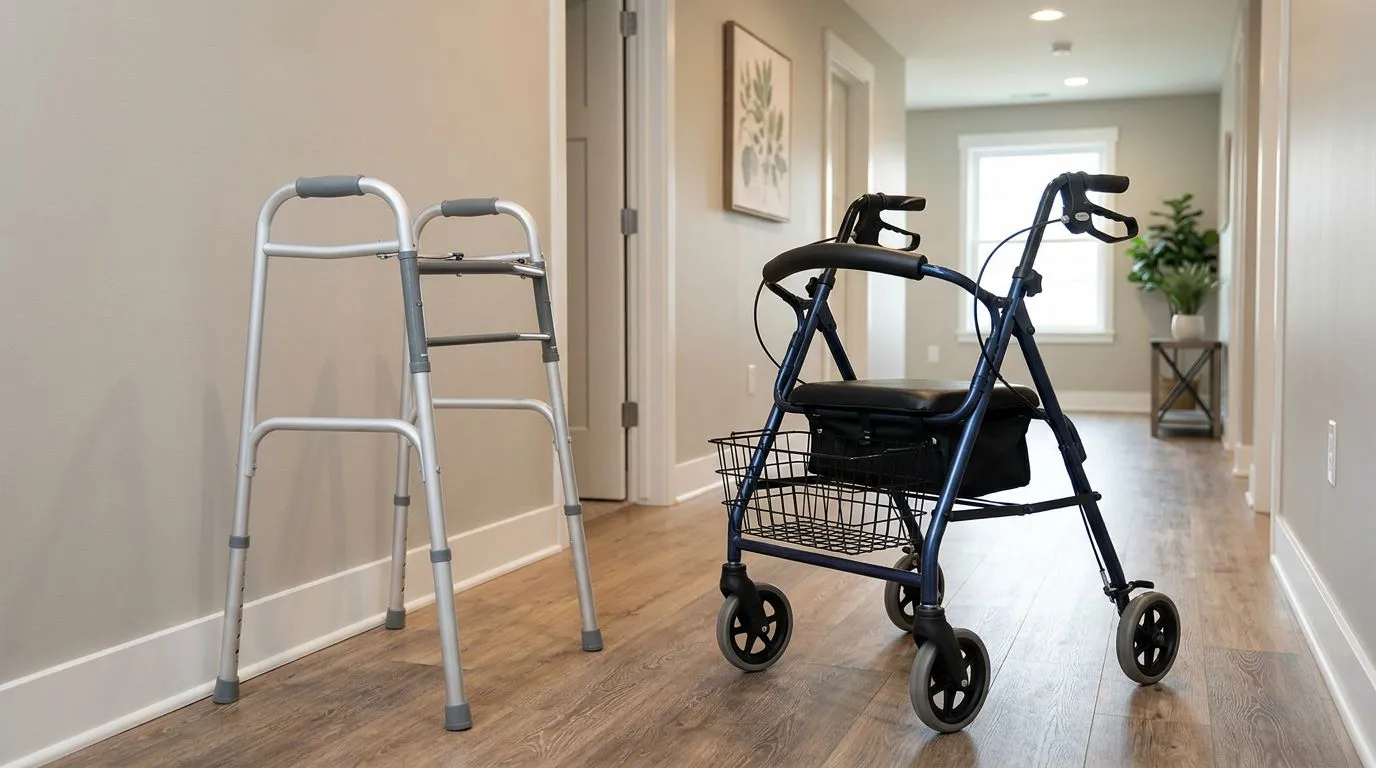
The main difference is motion. A standard walker, including a folding walker or no-wheel walker frame, is lifted or placed forward, then stepped into. A two-wheel walker rolls at the front but has rear legs or glides that slow movement. A rollator has 3 or 4 wheels, hand brakes, and usually a seat, so it keeps moving unless the brakes are applied.
That single design difference changes safety. A standard walker is slower, but it provides a more fixed base of support. A rollator is easier to push over longer distances, but it can move away if the user leans too much or forgets to brake.
| Mobility aid type | Typical design | Stability profile | Best for |
|---|---|---|---|
| Standard walker | 4 legs, no wheels, often folds | Most stable when used correctly because it stays put between steps | People who need firm support and can lift or advance the frame |
| Two-wheel walker | 2 front wheels, 2 rear legs or glides | More stable than a rollator, easier to advance than a no-wheel frame | People who need support but cannot lift a walker repeatedly |
| 3-wheel rollator | 3 wheels, hand brakes, usually no full seat | Turns easily but may feel less stable side-to-side | Narrow spaces and users with good balance control |
| 4-wheel rollator | 4 wheels, hand brakes, seat, storage pouch or basket | Stable for walking when controlled, but can roll away if misused | People who walk longer distances and can brake reliably |
| Upright rollator | 4 wheels with higher forearm supports | Encourages taller posture but still requires brake and steering control | Users who can manage a larger wheeled frame safely |
| Bariatric rollator | Wider reinforced frame, higher weight capacity | Can be supportive, but may be harder to maneuver in tight rooms | Users needing higher capacity, often 300 lb or more depending on the product |
Most walkers and rollators have adjustable handle heights in roughly 1-inch increments. That matters because even a well-matched device can become unsafe when the handles are too low, too high, or too far in front of the body.
6 signs a rollator may increase fall risk
A rollator is not unsafe by default. The concern is whether the device fits the person. Watch for these 6 warning signs during real use, not only while the person is standing in a store or clinic hallway.
- The rollator gets ahead of the user. If the front wheels are 12 inches or more in front of the feet during walking, the person may be chasing the device rather than controlling it.
- The user leans heavily on the handles. Rollators are designed for balance support, not full body-weight support. Heavy leaning can cause the frame to roll forward.
- Hand brakes are confusing or difficult. If arthritis, weakness, neuropathy, or memory changes make braking inconsistent, stopping becomes unreliable.
- Turning causes loss of balance. A rollator pivots easily, especially a 3-wheel rollator. Quick 90-degree turns can be risky for someone who shuffles or crosses their feet.
- The person forgets to lock the brakes before sitting. A rollator seat should only be used with brakes locked and the frame positioned safely. Sitting on an unlocked rollator is a common hazard.
- The home has tight spaces or uneven flooring. Doorways around 28 to 30 inches wide, thick rugs, thresholds, and clutter can make a wider wheeled device harder to control.
Fatigue matters, too. Some people walk well for the first 2 minutes, then start leaning, rushing, or dragging a foot. A short trial may miss that problem. A safer test includes walking, turning, stopping, reaching, and sitting under supervision.
Who a standard walker may be safer for: 3 common situations
A standard walker is often the safer first choice when the person needs a stable frame more than speed. It is less convenient outdoors and can be tiring to lift, but it offers a more controlled pattern: place the walker, step forward, pause.
1. Significant balance loss or recent falls
If someone has had 1 or more falls in the past few months, especially while turning or backing up, a no-wheel walker or two-wheel walker may provide better control. The goal is not to slow the person down unnecessarily. The goal is to reduce uncontrolled movement.
2. Weakness after illness, surgery, or hospitalization
After a hospital stay, some older adults have reduced leg strength and endurance for several weeks. A rollator may feel easy at first because it rolls, but the user may not be ready to manage speed and braking. A folding walker or two-wheel walker can serve as a temporary bridge while strength and confidence improve.
3. Cognitive or vision changes
Using a rollator safely means remembering to brake, locking the wheels before sitting, judging distance, and navigating obstacles. If someone has dementia, delirium, poor depth perception, or low vision, a simpler walker may reduce the number of steps they must remember.
A walker is not automatically better for every person with fall risk. Some users trip because they lift a standard walker poorly or place it too far forward. Fit and training matter. A physical therapist or occupational therapist can help compare devices in the home, where the real hazards are.
How to measure and test fit in 10 minutes
A quick fit check can show whether a walker or rollator is helping or adding risk. Set aside about 10 minutes, use the person’s usual shoes, and test on the surfaces they use every day.
Handle height
Have the person stand upright with arms relaxed at their sides. The handles should be near the wrist crease. When holding the grips, elbows should be slightly bent, often around 15 to 30 degrees. If the shoulders are shrugged, the handles may be too high. If the person bends forward, they may be too low.
Width and doorway clearance
Measure the narrowest doorway, hallway, or bathroom path. Many interior doorways are about 28 to 32 inches wide. A standard walker may be narrower than some bariatric or upright rollators, but all devices vary. Make sure there is room for the frame, the user’s hands, and safe turning.
Walking pattern
With a standard walker, the person should move the frame forward a short distance, place all legs down, then step into it without leaning far ahead. With a two-wheel walker, the rear legs should stay in enough contact to control speed. With a rollator, the user should stay close to the handles, walk inside the frame, and avoid pushing it far ahead.
Brake check for rollators
Ask the person to stop 5 times in a row using the hand brakes. Then ask them to lock the brakes, turn, and sit on the seat if the rollator has one. If they miss a step, cannot squeeze the brakes, or sit before locking, the rollator may not be safe without more training or supervision.
Real-room test
Do not test only in a clear hallway. Try a bathroom doorway, kitchen turn, bedroom path, and a threshold if one exists. A device that works in a 50-foot clinic hallway may fail in a small bathroom with a rug, hamper, and narrow door swing.
Caregiver considerations: 5 questions before choosing
Caregivers often notice problems before the user does. A rollator may feel freeing to the older adult, while the caregiver sees rushing, near falls, or unsafe sitting. These 5 questions can turn concern into a practical decision.
- Can the person stop on command within 1 to 2 steps? If not, a rolling device may be too hard to control.
- Can they use both hands consistently? Rollator brakes generally require hand function on both sides. One-sided weakness may require professional guidance.
- Do they remember safety steps? Locking brakes before sitting is not optional. It has to be automatic.
- Will the caregiver need to lift or transport the device? Folding walkers are often easier to load into a car than heavier rollators, though weights vary widely.
- Does the home support the device? Measure the tightest path, remove loose rugs, and check lighting before deciding.
Caregivers should also watch for the “furniture walking” pattern, where the person leaves the device behind and grabs counters, chairs, or walls. If that happens, the issue may be convenience, fit, or denial. A lighter folding walker, a better storage spot, or home therapy training may help more than simply switching devices.
Safer alternatives and setup changes under 30 minutes
Sometimes the right answer is not only “walker or rollator.” A few setup changes can improve safety in under 30 minutes, especially when the device is almost right but the environment is not.
- Remove loose throw rugs. Even a rug edge under 1 inch high can catch walker legs or rollator wheels.
- Clear a 30-inch walking path where possible. Move baskets, cords, pet bowls, and small tables away from main routes.
- Add night lighting. A plug-in night light can reduce poor-visibility trips to the bathroom.
- Check rubber tips and glides. Worn walker tips can slip. Damaged rollator wheels or loose brakes need attention before use.
- Practice sit-to-stand transfers. The user should not pull up on a rollator unless brakes are locked and the device is positioned safely; even then, chairs with armrests are usually more stable.
If a rollator is too fast but a no-wheel walker is too tiring, a two-wheel walker may be a useful middle ground. If an upright rollator improves posture but is too large for the bathroom, it may be better for outdoor or hallway use while a standard walker stays inside. Some people use more than 1 mobility aid in different locations, but that should be planned carefully so the person does not switch to an unsafe device out of habit.
When to ask a professional: 2 specialists who can help
If there has been a fall, a near fall, a new diagnosis, or a major change in strength, ask for help before buying or continuing to use a device. A physical therapist can assess gait, balance, leg strength, endurance, and proper device type. An occupational therapist can evaluate the home setup, bathroom transfers, kitchen tasks, and whether the person can use brakes and seats safely.
A medical professional can also check whether dizziness, medication side effects, blood pressure changes, vision problems, foot pain, or neuropathy are contributing to fall risk. The walker or rollator is only one part of the safety picture. Good footwear, clear pathways, strength work, and medication review may matter just as much.
FAQ: 5 questions about rollator safety and walkers
Is a rollator safer than a walker?
Not always. A rollator can be safer for someone with good balance, enough hand strength for brakes, and the endurance to walk longer distances. A standard walker or two-wheel walker may be safer for someone who needs more stable support or cannot control a rolling frame.
Why would a rollator increase fall risk?
A rollator can increase risk if it rolls ahead of the user, the brakes are not used correctly, the person leans heavily on the handles, or the home has tight spaces and obstacles. The built-in seat also creates risk if the brakes are not locked before sitting.
Who should consider a standard walker instead?
Someone with recent falls, major balance problems, confusion, poor brake control, one-sided weakness, or heavy reliance on the device may need a standard walker or two-wheel walker. A clinician can help decide which type fits the person’s walking pattern.
Can a caregiver push someone while they sit on a rollator?
No. A rollator is not a transport chair. The seat is intended for stationary rest with the brakes locked, not for being pushed while seated. Using it that way can damage the device and create a serious fall risk.
How do I know if the handle height is correct?
With the person standing in normal shoes, the grips should be near the wrist crease when arms hang relaxed. When holding the handles, elbows should have a slight bend, commonly around 15 to 30 degrees.
FAQ
Frequently asked questions
What are signs a rollator is not safe for someone? +
Warning signs include the rollator rolling too far ahead, forgetting to use or lock the brakes, leaning heavily on the handles, losing balance while turning, or being unable to stop within a step or two.
When should a senior use a standard walker instead of a rollator? +
A standard walker may be better after recent falls, during recovery from illness or surgery, with significant balance problems, or when memory, vision, or hand strength make rollator brakes difficult to use safely.
Can someone sit on a rollator while a caregiver pushes it? +
No. A rollator is not designed to be pushed like a wheelchair or transport chair. The seat is for resting while stationary with the brakes locked.
How should walker or rollator handles be measured? +
Have the person stand in their usual shoes with arms relaxed. The handle grips should be near the wrist crease, with elbows slightly bent when holding the handles.
Keep reading
Related guides
Mobility Walker With Seat vs Standard Walker: Which One Is Right for You?
14 min read
How to Use a Walker or Rollator Safely: Basic Training for Seniors and Caregivers
14 min read
Caregiver Training for Walker and Rollator Users: Assist Without Raising Fall Risk
12 min read