Disclosure: We may earn a commission when you buy through links on this page, at no extra cost to you. We buy nothing, sell nothing and accept no payment for coverage — commissions never decide what we recommend. How we make money.

Caregivers should assist a walker or rollator user by staying close, offering clear cues, and guarding from the side or slightly behind—not by pulling the person or pushing the device. The safest help usually combines proper fit, a clutter-free path, practiced transfers, and knowing when to use brakes, slow down, or call for professional training.
This guide is for family caregivers helping someone use a standard walker, folding walker, two-wheel walker, or rollator at home and in public. It is informational and is not a substitute for individualized instruction from a physical therapist, occupational therapist, or clinician.
Know the device first: 0, 2, 3, and 4 wheels change how you help
A caregiver should not assist every mobility aid in the same way. A no-wheel walker frame is lifted and placed. A two-wheel walker rolls forward but still needs steady hand pressure. A 3-wheel or 4-wheel rollator moves more easily, usually has hand brakes, and may include a seat. These differences can affect fall risk within the first 10 steps.
The key distinction is simple: walkers are generally more stable but slower; rollators are easier to move but require better brake control and judgment. A person who leans heavily on the device may be safer with a walker than a rollator, because a rollator can roll away if the brakes are not set.
| Mobility aid type | Common features | Caregiver focus |
|---|---|---|
| Standard or folding walker | No wheels, 4 legs, often lightweight and foldable | Help cue lift, place, step; do not drag it forward for the user |
| Two-wheel walker | 2 front wheels, 2 rear tips or glides | Watch speed and rear leg clearance over rugs and thresholds |
| 3-wheel rollator | Triangular frame, hand brakes, no full seat on many designs | Guard turns; 3 wheels can feel nimble but less steady than 4 wheels |
| 4-wheel rollator | 4 wheels, hand brakes, seat, backrest on many designs | Teach brake use before sitting, standing, doors, and slopes |
| Upright or stand-up rollator | Forearm supports or higher handles, hand brakes, larger frame | Check posture, turning space, and brake reach before public use |
| Bariatric walker or rollator | Wider frame, higher weight capacity, reinforced parts | Confirm fit through doorways and never exceed listed capacity |
Before helping, look at the person and the device as one system. Are the handles level? Are the brakes within easy reach? Does the person put one hand on furniture instead of both hands on the walker? Small details like these matter.
Do a 15-minute fit and safety check before walking
A short setup check can prevent many caregiver mistakes. Plan on about 15 minutes the first time you help, and repeat a quick version whenever shoes, flooring, or fatigue changes.
For most walkers and rollators, handle height is commonly set near the crease of the wrist when the user stands tall with arms relaxed at the sides. The elbows should usually bend slightly, often around 15 to 30 degrees, when the hands rest on the grips. If the handles are too low, the person may hunch. If they are too high, the shoulders may rise and the device can feel harder to control.
- Check footwear: closed-back shoes with firm soles are safer than slippers that slide off.
- Check floor hazards: remove loose throw rugs, cords, pet toys, and low clutter from at least a 3-foot path.
- Check walker tips and wheels: worn rubber tips, stuck wheels, or loose parts should be addressed before use.
- Check rollator brakes: the user should be able to squeeze to slow and push down or engage the parking brake before sitting, depending on the brake style.
- Check seat height: if using a rollator seat, feet should reach the floor and the user should not have to drop heavily onto the seat.
Weight capacity matters too. Many standard mobility aids list capacities in the range of roughly 250 to 300 pounds, while bariatric designs may be rated higher. Always follow the device label or manual; do not guess based on appearance.
If the walker or rollator was adjusted months ago, reassess it. A change of just 1 inch in handle height can alter posture, stride, and how much the person leans on the device.
Use the 1-step guarding method instead of pulling or pushing
The safest caregiver position is usually close enough to help quickly, but not so close that you bump the device. In many home situations, that means standing about 1 step to the side and slightly behind the person, on the weaker or more affected side if one side is known to be less steady. Keep your hands ready, not grabbing.
Do not pull on the person’s arm. Pulling can twist the shoulder, shift balance backward, and surprise the user. Do not push the walker or rollator forward for them either. That can move the support away before their feet are ready.
Use short, calm cues. For a standard walker, a common rhythm is: walker, weak leg, strong leg. For a two-wheel walker, the cue may be: roll the walker a small distance, step in, then bring the other foot through. For a rollator, emphasize: slow down, keep it close, use the brakes.
If a gait belt has been recommended and you have been trained to use it, hold the belt from the back or side as instructed by a professional. A gait belt is not a handle for lifting someone off the floor or dragging them upright. It is a tool for guiding and steadying during a loss of balance.
What to say instead of grabbing
- Pause here.
- Bring the walker closer.
- Stand tall and look ahead.
- Lock the brakes before you sit.
- Small steps on the turn.
- Let’s rest for 60 seconds.
Good assistance often looks quiet. You are scanning ahead, watching the feet, monitoring fatigue, and giving one cue at a time. Too many instructions at once can make walking less safe.
Safe walker assistance at home: 3 rooms that need extra attention
Most falls at home do not happen in wide, empty hallways. They happen during turns, transfers, bathroom trips, and doorway transitions. Three areas deserve extra caregiver attention: the bedroom, bathroom, and kitchen.
In the bedroom, make sure the walker can fit beside the bed and that the person can stand without reaching more than a few inches for the grips. If the walker is parked too far away, the first step of the day becomes risky. At night, use a light source that turns on before the person stands; even a small plug-in night-light can reduce confusion in a dark path.
In the bathroom, space is tighter. A standard walker or two-wheel walker may not fit well around the toilet or shower entry. Do not pull the person sideways to make the device fit. Instead, pause, square the walker to the body as much as the room allows, and use installed supports if a clinician has recommended them. Towel bars are not grab bars.
In the kitchen, discourage carrying hot food, full cups, or plates while using a walker. A walker basket or tray may help some users, but it should not overload the front of the frame. Even 5 extra pounds placed unevenly can make a lightweight walker feel awkward.
Walker transfer basics for chairs and beds
For sitting, the person should back up until they feel the chair or bed behind both legs, reach back with at least one hand when appropriate, and lower down slowly. For standing, they should push from the chair or bed, not pull up on the walker. Pulling on a walker to stand can tip it backward.
Caregivers often want to lift under the arms. Avoid that. It can injure the shoulders and does not teach safer movement. If the person cannot stand without being lifted, that is a sign to get professional guidance and possibly different equipment.
Rollator assistance in public: brakes, seats, curbs, and crowds in 4 steps
A rollator can be excellent for community outings because it rolls smoothly and provides a built-in seat. It also introduces 4 common public-use challenges: brake timing, turning space, uneven surfaces, and crowd pressure.
Before leaving home, ask the user to demonstrate the brakes 3 times: slow, stop, and park. If they cannot reliably engage the parking brakes, they should not use the rollator seat without close supervision and more training.
On sidewalks, stay beside and slightly behind. Watch for cracks, curb cuts, wet leaves, gravel, and slopes. A rollator with larger wheels may handle rougher surfaces better than smaller wheels, but no rollator makes uneven ground risk-free.
When approaching a curb, slow down early. Many rollators are not intended to be used like a shopping cart pushed off a curb. If there is a curb cut within 20 to 30 feet, use it. If there is not, consider turning back or asking for accessible entry rather than improvising.
For sitting on a rollator seat, follow a consistent sequence: stop, turn carefully, back up until the legs touch the seat edge, lock both brakes, reach for the frame or seat area as instructed, and sit slowly. Never let the person sit while the rollator is moving.
| Public situation | Caregiver action | Why it matters |
|---|---|---|
| Store entrance mat | Slow down and keep wheels straight | Edges can catch wheels or rear tips |
| Elevator | Enter straight, turn only after inside | Reduces rushed pivoting in a small space |
| Restaurant aisle | Ask for a wider route or end table | Rollators often need more turning room than walkers |
| Downhill sidewalk | Cue light braking and shorter steps | Prevents the rollator from getting ahead |
| Waiting line | Lock brakes before resting or sitting | Prevents rolling during weight shift |
Crowds can make people speed up. Your job is to protect the pace. A calm phrase such as take your time is often better than physically steering the rollator.
Who it’s best for: matching caregiver help to 5 mobility situations
The right device and the right amount of caregiver help depend on strength, balance, endurance, cognition, home layout, and medical instructions. A person who can walk 150 feet but needs rest breaks may need different support than someone who takes 10 careful steps from bed to bathroom.
| Situation | Often fits better | Caregiver role |
|---|---|---|
| Needs maximum stability and moves slowly | Standard or folding walker | Cue lift-place-step pattern and guard closely |
| Can bear weight through hands but struggles to lift a frame | Two-wheel walker | Watch that the walker does not roll too far ahead |
| Needs outdoor mobility and frequent seated rests | 4-wheel rollator | Train brake use and safe sitting every time |
| Has narrow indoor spaces and good balance | 3-wheel rollator or compact walker, if appropriate | Guard turns and confirm doorway clearance |
| Requires higher capacity or wider support | Bariatric walker or bariatric rollator | Check listed weight rating, seat width, and doorway fit |
A rollator is not automatically an upgrade from a walker. It is a different tool. If the person pushes the device far ahead, forgets brakes, becomes dizzy, or needs to lean heavily on the handles, a rollator may increase risk rather than reduce it.
An upright rollator may help some people who have difficulty tolerating a forward-bent position, but it still requires steering, braking, and enough space. It should be fitted carefully, especially if forearm supports change the user’s balance point.
How to choose and measure: a 6-point caregiver checklist
Choosing between a walker and rollator is not just about preference. Use a 6-point checklist: handle height, width, weight capacity, brake ability, turning space, and transport needs.
- Handle height: compare grips to wrist crease while the user stands in regular shoes.
- Overall width: measure narrow doorways. Many interior doors are about 28 to 32 inches wide, but older homes can vary.
- User weight and seat rating: follow the listed capacity for both frame and seat, especially on rollators.
- Brake control: the user should squeeze and lock brakes without pain, confusion, or excessive effort.
- Turning radius: practice a 180-degree turn in the smallest room where the device will be used.
- Folding and lifting: if the caregiver must load it into a car, confirm the folded size and weight are manageable.
Measure the home, not just the person. Check the route from bed to bathroom, favorite chair to kitchen, and front door to car. If a device cannot pass the tightest daily route, the caregiver may be tempted to pull, push, or lift in unsafe ways.
For car trips, practice before an appointment day. Some folding walkers are light enough for many caregivers to lift with one hand, while rollators can be heavier because of wheels, brakes, and seats. Use proper body mechanics and ask for help if lifting causes strain.
Practice plan: 10-minute drills that build safer habits
Short practice sessions work better than one long lecture. Try 10 minutes at a time, once or twice a day, when the person is rested. Stop if pain, dizziness, shortness of breath beyond usual, confusion, or unusual weakness appears.
Start with straight walking over 10 to 20 feet. Then practice stopping on command. Add turns only after the person can keep the walker or rollator close. For rollator users, include brake drills every session. For walker users, include safe placement and chair transfers.
A simple home practice sequence
- Stand from a firm chair using the armrests.
- Pause for 5 seconds before stepping.
- Walk 10 feet with one caregiver cue at a time.
- Turn with small steps, not a fast pivot.
- Return to the chair, back up fully, and sit slowly.
- Rest for 1 minute and discuss what felt difficult.
Keep notes. If the person needs more help at 6 p.m. than at 10 a.m., fatigue may be part of the plan. Schedule showers, outings, and appointments around the safest time of day when possible.
When to get professional help after 1 fall or repeated near-falls
Caregiver training has limits. Get professional guidance if the person has had 1 fall, repeated near-falls, new dizziness, sudden weakness, trouble following safety cues, or a major change in walking. A clinician can assess strength, balance, vision, medications, pain, and whether the current walker or rollator is appropriate.
Call urgent medical services if there is a head injury, chest pain, suspected fracture, new confusion, one-sided weakness, or inability to get up safely after a fall. Do not lift someone from the floor if you are unsure whether they are injured or if lifting would put either of you at risk.
Family caregivers provide essential support, but the goal is not to control every step. The goal is to create conditions where the walker or rollator user can move as safely and independently as their situation allows: fitted equipment, clear paths, steady cues, and help that protects balance instead of taking it away.
FAQ
Frequently asked questions
Should I pull someone up by the arms when they use a walker? +
No. Pulling by the arms can injure the shoulders and shift the person off balance. They should push from a stable chair or bed when standing, with caregiver guarding from the side if needed.
Is a rollator safer than a standard walker? +
Not always. A standard walker is usually more stable but slower. A rollator moves easily and may offer a seat, but it requires good brake control and the ability to keep it from rolling too far ahead.
Where should a caregiver stand while helping someone walk? +
In many situations, stand about one step to the side and slightly behind the person, often on the weaker side if there is one. Stay close enough to guard without bumping the walker or rollator.
Can someone sit on a rollator without locking the brakes? +
No. Both parking brakes should be locked before sitting or standing from a rollator seat. Sitting on an unlocked rollator can allow it to roll away.
When should a family caregiver ask for professional walker training? +
Ask for help after any fall, repeated near-falls, new dizziness, sudden weakness, trouble following cues, or if the caregiver feels they must lift, pull, or physically steer the person to keep them safe.
Keep reading
Related guides

How to Use a Walker or Rollator Safely: Basic Training for Seniors and Caregivers
14 min read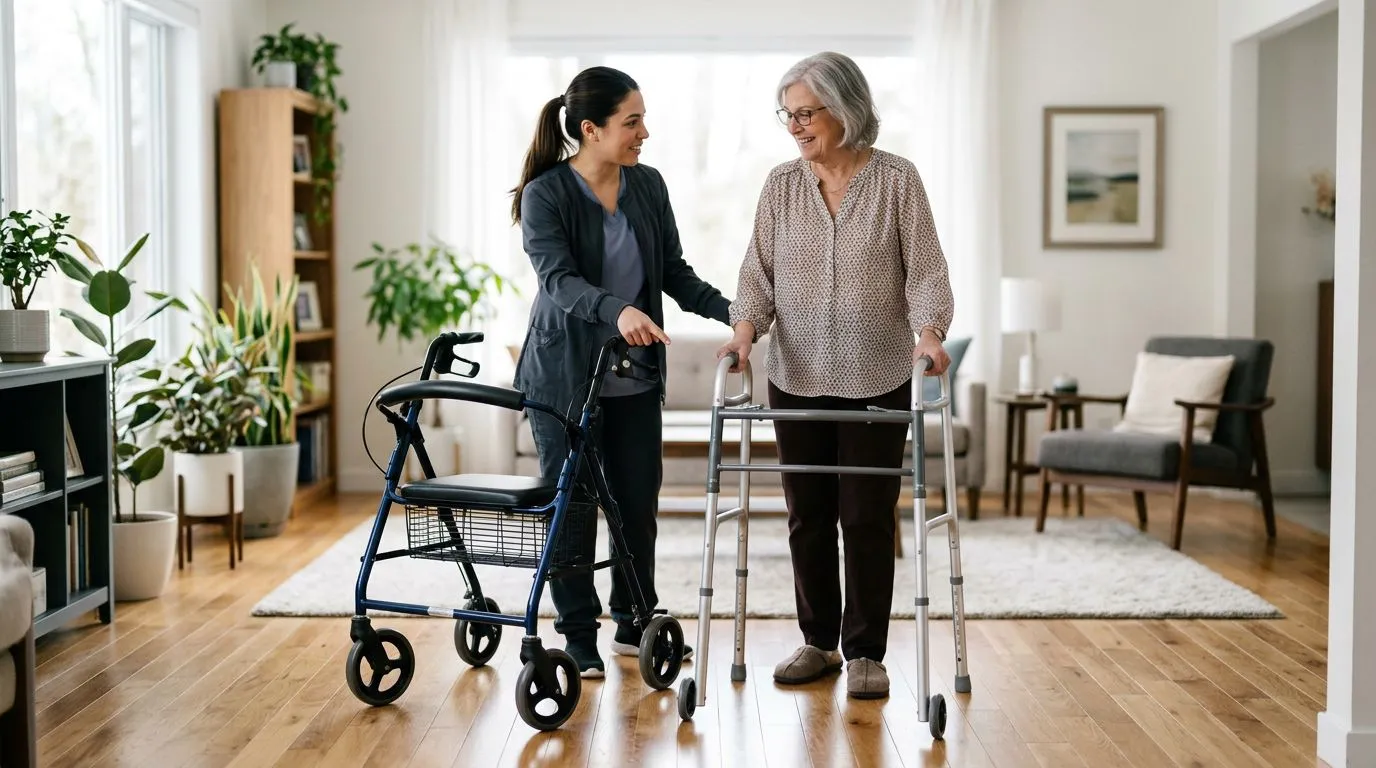
When a Rollator May Not Be the Safest Choice: Balance, Fall Risk, and Caregiver Considerations
11 min read
How to Use a Mobility Walker Safely: Step Pattern, Posture, Turning, and Trip Prevention
13 min read