Disclosure: We may earn a commission when you buy through links on this page, at no extra cost to you. We buy nothing, sell nothing and accept no payment for coverage — commissions never decide what we recommend. How we make money.

To use a mobility walker safely, place it a short step ahead, keep all legs or wheels steady on the floor, then step into the frame without leaning too far forward. A good fit, upright posture, slow turns, and clear walking paths reduce the chance of trips and help you build confidence with daily movement.
This guide focuses on standard walkers, folding walkers, and two-wheel walkers. Rollators are different: they have 3 or 4 wheels, hand brakes, and often a seat, so they require different braking habits and are not the main technique covered here.
Walker safety basics for the first 10 feet
The first 10 feet of walking often reveal the biggest safety problems: the walker is too low, the user steps too far forward, or clutter is in the way. Before you walk across a room, pause for a quick setup check.
- Stand tall inside the walker, not behind it.
- Keep both hands on the grips unless a clinician has taught you a different method.
- Move the walker only as far as a comfortable step, usually about 6 to 12 inches.
- Look ahead at the walking path, not straight down at your feet.
- Wear shoes or nonskid slippers that stay on your feet.
A walker gives support, but it is not meant to catch a fast fall or hold your full body weight during a sudden lunge. Think of it as a stable frame that helps you shift weight, balance, and move in a controlled rhythm.
If a physical therapist, occupational therapist, nurse, or physician has given you specific instructions after surgery, injury, stroke, or a balance diagnosis, follow that plan first. Weight-bearing limits can be very specific, such as partial weight bearing or toe-touch weight bearing, and those instructions change the step pattern.
Who standard, folding, and two-wheel walkers are best for
Most walkers used at home are 25 to 30 inches wide and have 4 contact points on the floor. The right style depends on strength, balance, walking speed, and the surfaces you use most often.
| Walker type | How it moves | Who it is often best for | Key caution |
|---|---|---|---|
| Standard walker | Lift, place, step | Someone who needs maximum stability and can lift the frame each step | Requires enough arm and shoulder strength to pick it up repeatedly |
| Folding walker | Usually used like a standard walker; folds for storage | Someone who needs stable support and wants easier car or closet storage | Make sure both folding locks click fully before walking |
| Two-wheel walker | Front wheels roll; back tips glide or lift slightly | Someone who cannot comfortably lift a full walker but still needs more stability than a cane | Can roll away if pushed too far forward |
| Rollator | Rolls on 3 or 4 wheels with hand brakes and usually a seat | Someone who walks more continuously and can manage brakes safely | Not the same as a walker; brakes must be used before sitting or stopping |
For new users, the safest choice is not always the fastest device. A standard walker may feel slow, but it provides a wide, steady base. A two-wheel walker can feel smoother, yet it requires you to control forward motion. A rollator may help some people, especially outdoors, but it is not a substitute for a walker when maximum stability is needed.
How to measure walker height in 3 checks
Walker height is usually adjusted in 1-inch button increments. A small change matters: a walker set 2 inches too low can encourage hunching, while one set too high can make your shoulders tense and reduce control.
Use these 3 checks while standing in your usual walking shoes:
- Wrist crease check: Stand upright with arms relaxed at your sides. The top of the hand grip should line up near the crease of your wrist.
- Elbow bend check: Place your hands on the grips. Your elbows should bend slightly, often around 15 to 20 degrees.
- Shoulder check: Your shoulders should stay relaxed, not lifted toward your ears.
After adjusting the legs, confirm that all 4 legs are set to the same height. On a two-wheel walker, the wheel side and rear leg side may look different, so check the numbered holes or button positions carefully. Push down lightly on both handles before walking to make sure the frame does not wobble.
If you use walker skis, glide caps, or rear tips, inspect them regularly. Worn rubber tips can reduce grip, and uneven accessories can make the walker rock. Replace damaged tips before they become smooth or cracked.
Step pattern for a standard or folding walker: 1 walker move, then 2 steps
With a standard or folding walker, the basic pattern is simple: move the walker first, step with the weaker or more affected leg, then step with the stronger leg. Many clinicians teach it as a 3-part rhythm.
- Lift the walker and place it about 6 to 12 inches ahead.
- Set all 4 legs firmly on the floor before stepping.
- Step forward with the weaker, painful, or surgical leg, if you have one.
- Press through your hands as needed, then step forward with the stronger leg.
- Stop with both feet inside the walker frame, not past the front bar.
Keep steps short at first. Your toes should not land beyond the front legs of the walker. If your body moves too far into or past the frame, you lose the walker’s best support position.
Do not slide a standard walker forward unless it has been fitted with appropriate glides and you have been taught to do so. Dragging rubber tips can catch on flooring, thresholds, or rug edges. Lift, place, then step.
For folding walkers, add one safety habit before each use: check that the folding mechanism is locked. A partially opened walker can collapse or twist under pressure, and the check takes only a few seconds.
Step pattern for a two-wheel walker: roll 6 to 12 inches, then step
A two-wheel walker follows the same general sequence, but the front legs roll instead of being lifted completely. Move it only a short distance at a time, often 6 to 12 inches, then step into the frame.
- Stand close enough that your hands rest comfortably on the grips.
- Roll the walker forward a short step length.
- Keep the rear tips on or close to the floor for control.
- Step with the weaker or less steady leg first, if applicable.
- Bring the other foot forward until both feet are under you.
A common mistake is pushing a two-wheel walker too far ahead. When the frame is more than about 1 step away, you may lean forward and chase it. That increases the risk of a trip, especially on tile, wood, or low-pile carpet.
Two-wheel walkers can be useful in tight indoor spaces because they move more smoothly than standard walkers. Still, they are not rollators. Most two-wheel walkers do not have hand brakes or seats, so you should not rely on them for sudden stopping or resting the way you might with a properly used rollator.
Posture and hand position: aim for a 15 to 20 degree elbow bend
Safe walker posture starts with your head and chest. Stand tall, look about 6 to 10 feet ahead, and let your arms support you without locking your elbows straight.
Your hands should wrap around the grips, with weight shared through both arms as needed. Avoid leaning your forearms on the walker frame unless the device is specifically designed for forearm support. A standard walker frame is not built to be used like an upright rollator or platform walker.
Watch for these posture clues:
- Too much forward lean: The walker may be too low, too far ahead, or you may be taking steps that are too long.
- Raised shoulders: The walker may be too high, or you may be gripping too tightly.
- Bent back and downward gaze: Pause, reset your feet inside the frame, and look ahead before continuing.
- Uneven pressure: If one side of the walker feels heavier, check height settings and tip wear.
Short walking sessions are often better than one tiring session. For example, 3 to 5 minutes of careful walking several times a day may be safer than pushing through fatigue. Stop before your legs feel shaky.
Turning safely in 4 small steps
Turning is where many walker trips happen. A safe turn is not a pivot on one foot; it is a series of small steps, often 4 or more, with the walker moved a little at a time.
To turn with a standard or folding walker, lift and place the walker slightly in the direction you want to go. Step your feet to follow. Repeat until you face the new direction. Keep your feet inside the walker’s width instead of twisting your hips while the walker stays still.
With a two-wheel walker, roll the front wheels in a small arc and step with control. Do not swing the walker around quickly. The rear tips can catch if you twist too sharply, especially on carpet or at a doorway threshold.
Use this rule: walker first, feet second, body follows. If you feel rushed, stop and stand still for 2 breaths. A slow turn is still a successful turn.
Sitting down and standing up: keep the walker close, but do not pull on it
Chair transfers may happen 10 or more times a day, so they deserve careful technique. The walker should help you line up and steady yourself, but it should not be the main object you pull on to stand.
To sit down
- Back up until you feel the chair touch the back of both legs.
- Keep one hand on the walker only if needed for balance.
- Reach back for the chair armrest with one hand, then the other if safe.
- Lower yourself slowly, bending at the hips and knees.
To stand up
- Scoot toward the front half of the chair.
- Place both feet under your knees, about hip-width apart.
- Push from the chair arms or seat, not from the walker.
- Once balanced, place one hand at a time on the walker grips.
If a chair has no arms, is very low, or slides on the floor, transfers can be harder. A firm chair with armrests and a seat height near 18 to 20 inches is often easier for many adults, though body size and leg strength matter.
Trip prevention at home: clear 36-inch paths where possible
A walker needs more space than a cane. Many interior doorways are about 28 to 32 inches wide, and some walkers are close to that width. When possible, create walking paths around 36 inches wide in main areas such as the bedroom, bathroom route, and kitchen.
Start with the floor. Remove loose throw rugs, curled mats, cords, shoes, pet toys, and low baskets. Tape down necessary cords along the wall rather than across a walkway. Keep frequently used items between waist and shoulder height so you do not need to bend deeply or reach overhead while holding the walker.
| Hazard | Why it matters | Safer fix |
|---|---|---|
| Throw rugs | Walker tips or wheels can catch an edge | Remove them or use secured, low-profile mats only where necessary |
| Wet bathroom floors | Rubber tips can slide when water or soap is present | Dry the floor and use properly secured nonslip surfaces |
| Pets underfoot | A small pet can move into a step path in under 1 second | Use gates, closed doors, or a verbal routine before walking |
| Dim hallways | Edges and thresholds are harder to see | Add night lights, especially between bed and bathroom |
| Cluttered furniture paths | Walker legs need clearance on both sides | Move small tables, baskets, and plant stands out of the route |
Thresholds need extra attention. Approach them straight on, not at a diagonal. With a standard walker, lift the walker over the threshold, set all legs down, then step. With a two-wheel walker, roll the front wheels over first, confirm the rear tips are clear, then step through.
Stairs, curbs, and outdoor surfaces: ask for training before the first attempt
Many basic walkers are not designed for independent stair use. A single curb can be 4 to 8 inches high, enough to throw off balance if you try to lift the walker and step at the same time without training.
If stairs or curbs are part of your daily routine, ask a physical therapist or trained clinician to practice with you. The safest method depends on your strength, which leg is weaker, whether there is a handrail, and what type of walker you use.
Outdoor surfaces add more variables: gravel, grass, cracked sidewalks, wet leaves, and sloped driveways. A standard walker can sink or catch on uneven ground. A two-wheel walker may roll too quickly on a slope. Move slower outside, shorten your step length, and avoid carrying bags that change your balance.
For longer outdoor walking, some people discuss a rollator with a clinician because rollators have larger wheels, hand brakes, and a seat. That does not make them safer for everyone. A rollator requires brake control, judgment, and enough balance to manage a device that rolls continuously.
Common mistakes to correct in the first 7 days
The first week is a good time to build habits. Correcting small errors early can keep them from becoming automatic.
- Walking too far behind the frame: Stay inside the walker, with the frame surrounding your step area.
- Taking oversized steps: Use shorter steps until your rhythm feels steady.
- Carrying items in one hand: Use a walker pouch, basket, or have someone help, rather than walking one-handed.
- Skipping tip checks: Look at rubber tips weekly, or sooner if the walker feels uneven.
- Rushing to answer the door or phone: Let it wait. Speed is not worth a fall.
- Using the walker on escalators: Avoid escalators with walkers; use an elevator when available.
If you feel dizzy, unusually weak, short of breath, or notice new pain while walking, stop and sit safely. Contact a healthcare professional if symptoms are new, worsening, or concerning. Walker safety is partly technique, but it also means listening to your body.
A simple 5-minute practice routine
Practice works best when it is short and specific. A 5-minute routine in a clear room can help a new walker user learn the movement pattern without fatigue.
- Minute 1: Stand inside the walker and check posture, grip height, and relaxed shoulders.
- Minute 2: Practice 5 slow walker placements without stepping, making sure all legs or wheels are steady.
- Minute 3: Walk 10 to 15 feet using the correct step pattern.
- Minute 4: Practice one slow turn to the left and one to the right.
- Minute 5: Practice lining up with a firm chair and sitting down safely.
Have another adult nearby the first few times if you are unsteady. The goal is not to walk farther each time. The goal is to move with control, keep the walker close, and make safe habits feel familiar.
A mobility walker can support independence when it fits well, matches your needs, and is used with a steady pattern. Start slow, keep paths clear, and ask for professional instruction when your medical condition, weight-bearing status, home layout, or confidence level calls for extra guidance.
FAQ
Frequently asked questions
How far ahead should I place a walker before stepping? +
For most new users, place the walker about 6 to 12 inches ahead, then step into the frame. If you have to lean forward to reach it, it is too far away.
Should my weaker leg or stronger leg move first with a walker? +
Many people are taught to move the walker first, then the weaker or more painful leg, then the stronger leg. Follow your clinician’s instructions if you have surgery precautions or weight-bearing limits.
Can I use a walker if I feel dizzy? +
Do not keep walking if you feel dizzy, faint, unusually weak, or short of breath. Sit safely if you can and contact a healthcare professional if symptoms are new, severe, or do not improve.
Is a two-wheel walker safer than a standard walker? +
Not always. A standard walker usually offers more stability because all 4 legs contact the floor, while a two-wheel walker is easier to move but can roll too far ahead if not controlled.
Can I sit on my walker like a rollator? +
No. Standard, folding, and two-wheel walkers are not designed as seats. Rollators are the wheeled devices that may include a built-in seat and hand brakes, and even those must be used according to safety instructions.
How often should I check walker tips and wheels? +
Check rubber tips, wheels, and adjustment buttons at least weekly, and sooner if the walker feels uneven, slips, squeaks, or catches on the floor.
Keep reading
Related guides

How to Use a Walker or Rollator Safely: Basic Training for Seniors and Caregivers
14 min read
Caregiver Training for Walker and Rollator Users: Assist Without Raising Fall Risk
12 min read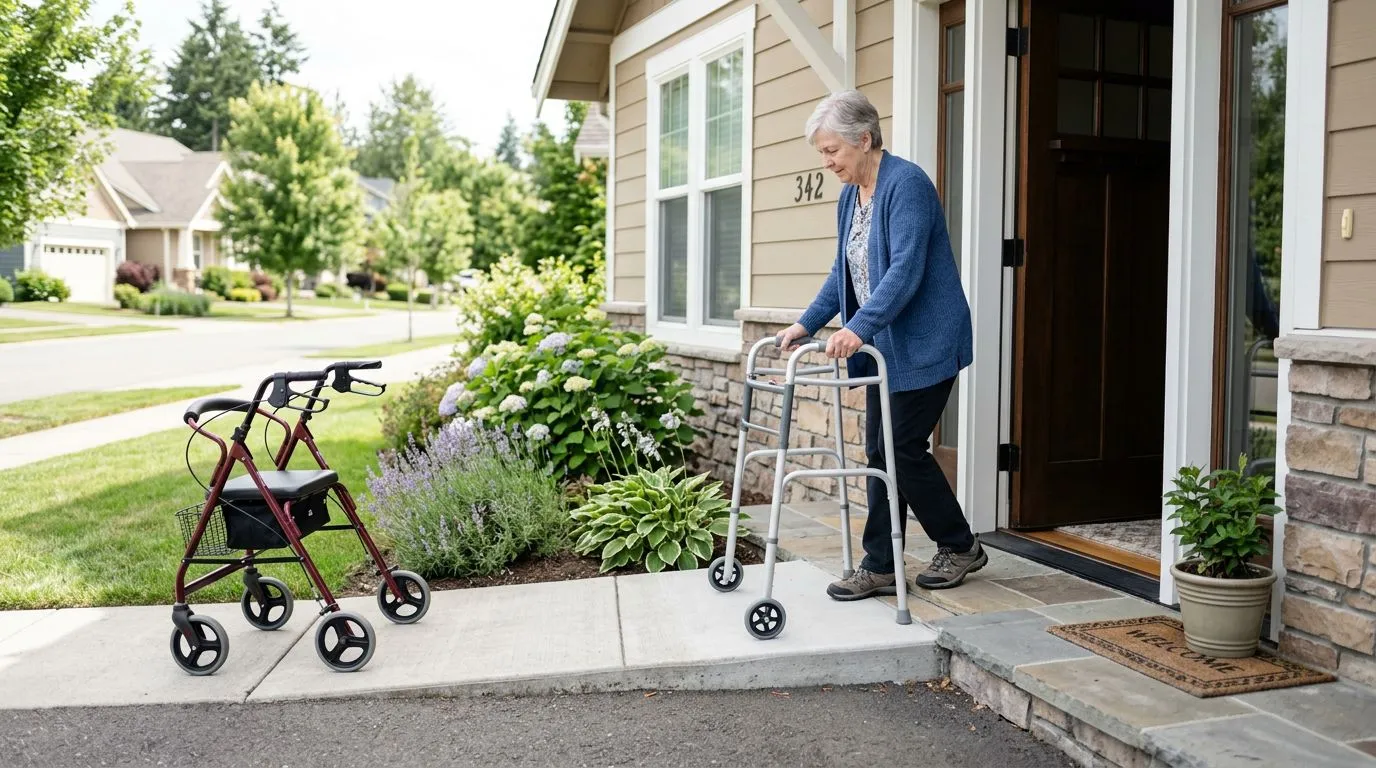
Walker and Rollator Safety on Curbs, Ramps, and Thresholds
13 min read