Disclosure: We may earn a commission when you buy through links on this page, at no extra cost to you. We buy nothing, sell nothing and accept no payment for coverage — commissions never decide what we recommend. How we make money.

The safest way to sit or stand with a walker or rollator is to put your hands on the chair, bed, or toilet support first, not on the mobility device. Back up until you feel the surface behind your legs, reach back for stable armrests or the seat, and move your hands to the walker or rollator only after you are fully standing. A rollator seat can help with short rests when the brakes are locked, but a standard walker should never be used as a chair because it has no built-in seat or parking brakes.
This guide is for people comparing walkers and rollators, caregivers helping with transfers, and anyone who feels unsure during the sit-to-stand moment. It explains the hand placement that matters most, when a rollator seat is useful, and why different devices call for different habits.
The 3-step rule for sitting with any walker or rollator
Sitting safely follows a 3-step sequence: turn, back up, then reach. The order matters because many falls happen in the last few inches before someone reaches the chair, especially when they try to sit while still turned slightly sideways.
First, turn slowly until your back is lined up with the chair, bed, toilet, or rollator seat. Keep the walker or rollator close enough that you do not have to lean forward, but not so close that it blocks your knees. With a standard walker or two-wheel walker, pick it up or roll it forward in small movements until you are square with the sitting surface. With a 4-wheel rollator, stay inside the frame as you turn and keep both hands near the brake handles until you are in position.
Second, back up until you feel the chair or seat against the back of both legs. Do not guess. Feeling the surface behind both legs confirms you are close enough to sit without dropping down or reaching backward from too far away.
Third, reach back one hand at a time for the chair arms, bed, toilet safety frame, or the rollator seat handles if the design has stable supports meant for that purpose. Then lower yourself slowly. If one side is weaker, a clinician or physical therapist may teach a specific hand sequence, but the general rule is simple: sit to the surface, not to the walker.
| Device type | Before sitting | Where your hands go | Key caution |
|---|---|---|---|
| Standard or folding walker, no wheels | Back up until both legs touch the chair | Chair arms or seat surface | Do not pull on the walker; it can tip |
| Two-wheel walker | Stop with rear tips stable on the floor | Chair arms, bed, or toilet rails | Wheels can move if you lean forward |
| 4-wheel rollator | Lock both brakes before sitting on its seat | Seat edges or stable supports, as appropriate | Never sit unless brakes are fully locked |
| Upright rollator | Return to normal handles before sitting | Chair arms or rollator seat supports | Forearm supports are not chair arms |
The 4-step rule for standing up safely
Standing is a 4-step process: scoot forward, set your feet, push up from the sitting surface, then take the walker or rollator. If you rush, you may pull the device toward you and shift your balance before your legs are ready.
Start by scooting to the front third of the chair. Keep your feet flat on the floor, about hip-width apart, with one foot slightly behind the other if that feels steadier. Many adults stand more easily from a chair that is about 18 to 20 inches high than from a very low sofa, so practice from a firm, level seat while learning.
Place both hands on the chair arms if available. If there are no arms, put your hands on the stable seat surface beside your hips, not on the walker crossbar. Lean forward from the hips so your nose moves over your toes, then push through your legs and hands to stand. Once upright, pause for 2 or 3 seconds. Only then place one hand, then the other, on the walker or rollator handles.
If you use a rollator, keep the brakes locked while standing up from its seat or from a nearby chair if the rollator is in front of you. After you are fully upright and balanced, release the brakes when you are ready to walk. With a standard walker, make sure all 4 legs are on the floor before you step.
Why a rollator seat helps for 2- to 5-minute rests
A rollator seat can be very helpful when someone needs brief seated rests during errands, hallway walks, or outdoor paths. Many 4-wheel rollators include a padded or sling-style seat, hand brakes, and a backrest or back strap. Seat heights often fall around 20 to 23 inches, though sizes vary, so the fit must match the user.
The rollator seat is for stopping, locking the brakes, turning carefully, and sitting for a short rest. It is not meant for being pushed while seated unless the device is specifically designed and labeled for transport use. A standard rollator is a walking aid, not a wheelchair.
For people who fatigue after 100 to 300 feet, a seat can make outings more realistic because rest is available without having to find a bench. That can support independence in a practical way. It does not replace safe technique, clear judgment, or a device that fits the person and the environment.
Before sitting on a rollator, park it on firm, level ground. Lock both hand brakes. Test that the frame does not roll by gently trying to move it. Turn slowly until the backs of your legs touch the seat. Reach for stable supports and sit under control. On slopes, gravel, thick grass, soft carpet, or crowded spaces, look for a regular chair instead.
Why a standard walker is not a chair: 0 brakes, 0 seat
A standard walker, folding walker, no-wheel walker frame, or two-wheel walker should not be used like a chair because it has 0 built-in seats and 0 parking brakes. Even when it feels sturdy for walking, it is not designed to hold body weight during a backward sit or sideways lean.
The most common problem is pulling backward on the handles while sitting down. A walker is stable when weight is directed downward through all legs, especially when the user is standing and stepping in a controlled pattern. It is much less stable when someone pulls it toward the body, twists it, or uses the front crossbar as a grab bar.
No-wheel walkers are often chosen because they provide a broad, steady base. They can be excellent for slower, deliberate walking on indoor floors. But that stable base is not a seat. Two-wheel walkers reduce the need to lift the frame, yet the front wheels can still move if the user leans or pulls at the wrong time.
If you need frequent seated rests, that is a decision point. A rollator with a seat may be more appropriate than a standard walker for some people, while others may need a transport chair, wheelchair, or a plan with chairs placed every 25 to 50 feet at home. The safest choice depends on balance, strength, endurance, cognition, hand function, and the walking surface.
Walkers vs. rollators: 6 decision points before you choose
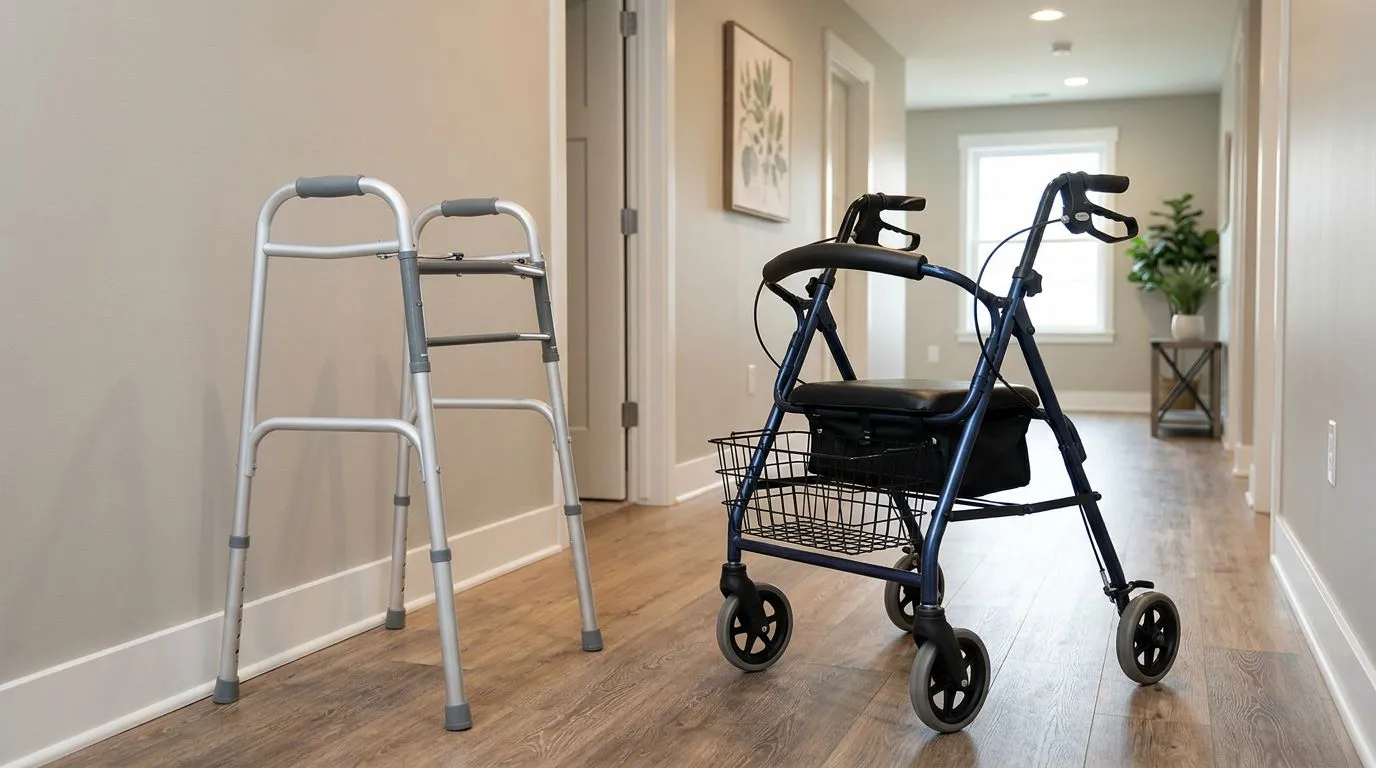
The difference between a walker and a rollator is more than wheels. A walker is usually a simpler frame used for stability, often with 0 or 2 wheels and no seat. A rollator has wheels, hand brakes, and usually a built-in seat for resting. Choosing between them means considering at least 6 practical factors: balance, endurance, hand strength, walking speed, environment, and need for seated rest.
| Decision point | Walker may fit better | Rollator may fit better |
|---|---|---|
| Balance | You need a slower, more stable frame | You can control a rolling device without it getting ahead |
| Endurance | You walk short indoor distances with chairs nearby | You need a seat for brief rests during longer walks |
| Hand control | You may not manage brake squeezing or locking well | You can use hand brakes reliably every time |
| Walking surface | Indoor, level floors and tight rooms | Longer hallways, sidewalks, or community spaces |
| Speed | You walk slowly and benefit from pause-step movement | You walk at a steadier pace and need less lifting |
| Body size and capacity | A basic frame with the correct height and width is enough | You may need a wider, bariatric, or upright design with rated capacity |
Standard and folding walkers are often preferred after a new mobility change because they encourage a slower rhythm. Two-wheel walkers can reduce lifting effort while still keeping rear tips in contact with the floor. Rollators are often better for people who can walk more continuously but tire and need a seat. Three-wheel rollators are usually more maneuverable in tight spaces, while 4-wheel rollators tend to offer a broader base and a more usable seat.
Upright or stand-up rollators place the handles and forearm supports higher, which may help some users maintain a more upright posture. They also require careful fitting and enough control to manage a taller wheeled frame. Bariatric rollators and walkers are built with higher weight capacities and wider frames, but the wider turning radius can matter in bathrooms and narrow hallways.
How to measure handle height in 1 minute
You can do a basic handle-height check in about 1 minute. Stand in your usual shoes with your arms relaxed at your sides. The walker or rollator handle should line up near the crease of your wrist. When you place your hands on the grips, your elbows should bend slightly, often around 15 to 30 degrees.
Handles that are too low can encourage stooping and extra pressure through the shoulders. Handles that are too high can make it harder to press down safely and may raise the shoulders. Neither issue is just about comfort; poor fit can affect control during sitting, standing, turning, and braking.
Seat height matters too. On a rollator, the seat should allow you to sit with control and stand without a deep squat. If the seat is several inches lower than your usual chair, standing may be difficult. If it is too high, your feet may not rest flat, which can feel insecure during a break.
- Check width: The frame must pass through key doorways, often 28 to 32 inches in many homes.
- Check weight capacity: Use a device rated above the user’s body weight, including clothing and carried items.
- Check grip comfort: Hands should wrap the handles without wrist strain.
- Check brake reach: Rollator brakes should be easy to squeeze and easy to lock without pain.
- Check folded size: If it travels in a car, confirm one person can fold and lift it safely.
A physical therapist, occupational therapist, or trained clinician can give the most specific fit advice, especially after surgery, illness, a fall, or a major change in strength.
Common mistakes to correct in the first 7 days
The first 7 days with a walker or rollator are when habits form. Small corrections early can make daily movement calmer and safer.
Mistake 1: Pulling on the walker to stand. This is one of the most important habits to stop. Push from the chair, bed, or toilet supports, then move your hands to the walker after standing.
Mistake 2: Sitting before both legs touch the chair. If only one leg feels the seat, you may be angled or too far away. Keep backing up in small steps until both legs make contact.
Mistake 3: Forgetting rollator brakes. Lock both brakes before sitting on a rollator seat and before standing up from it. If the brakes do not hold, do not use the seat until the device is checked.
Mistake 4: Parking a rollator on a slope. Even locked brakes may not feel secure on an incline. Choose level ground whenever possible.
Mistake 5: Carrying items in one hand. Holding a mug, phone, or bag can reduce grip and attention. Use an attached basket, pouch, tray, or caregiver help when appropriate, and keep both hands available for transfers.
Mistake 6: Letting the rollator get too far ahead. Your feet should stay within a comfortable distance of the rear wheels or frame. If your elbows straighten fully and you are reaching, slow down and bring the device closer.
Mistake 7: Using furniture that moves. Lightweight dining chairs, rolling office chairs, and towel bars are not safe hand supports. Choose stable armchairs, grab bars installed into the wall, or proper toilet safety rails.
Who it is best for: 3 user profiles
Thinking in 3 user profiles can make the walker-versus-rollator decision clearer. These are not medical categories, but they are practical starting points for discussion with a clinician or caregiver.
Best fit for a standard or folding walker
This user needs maximum pause-and-place stability, walks mainly indoors, and does not need to sit on the device. They may be recovering strength, learning a slower gait pattern, or using the walker for short distances between a bed, bathroom, and chair. A no-wheel frame can feel very steady, while a two-wheel walker may help if lifting the frame is tiring.
Best fit for a rollator with a seat
This user can manage hand brakes, control a wheeled frame, and benefits from a built-in seat for short rests. They may walk in apartment corridors, stores, community centers, or on smooth sidewalks. The seat supports planned pauses; it is not a substitute for a wheelchair.
Best fit for an upright or bariatric rollator
This user may need a higher handle position, a wider frame, or a higher stated weight capacity. The tradeoff is size: a wider or taller rollator can be harder to turn in a 5-foot bathroom or load into a vehicle. Fit, brake access, and home layout should be checked before relying on it daily.
Practice plan: 10 minutes a day with supervision
A short, focused practice session can build confidence without wearing someone out. Try 10 minutes a day for several days, with a caregiver nearby if balance is uncertain. Use a firm chair with arms, supportive shoes, good lighting, and a clear floor.
Start with 3 slow sit-to-stand repetitions. Say the steps out loud: scoot forward, feet under knees, push from the chair, stand tall, hands to the device. Then reverse it: turn, back up, feel the chair, reach back, sit slowly. Speaking the sequence may feel awkward at first, but it helps prevent rushing.
Next, practice a short walk of 10 to 20 feet, a turn, and a return to the chair. If using a rollator, include brake locking and unlocking every time. If using a standard walker, focus on placing all legs down before stepping and keeping the frame close.
Stop practice if the person becomes dizzy, unusually short of breath, confused, or unable to follow the steps. Those signs call for medical or clinical guidance. The goal is steady technique, not pushing through fatigue.
Safer daily use starts with 2 habits
Two habits make the biggest difference: use the sitting surface for your hands, and respect what the device is designed to do. A walker is for supported walking, not sitting. A rollator is for supported walking plus short seated rests only when the brakes are locked and the surface is safe.
If you are deciding between a walker and a rollator, let the sitting and standing moments guide you. A person who needs the most stable frame and does not need an onboard seat may do better with a standard or two-wheel walker. A person who walks longer distances, controls brakes well, and needs rest breaks may benefit from a rollator seat. In either case, proper height, clear practice, and consistent hand placement matter more than any single feature.
FAQ
Frequently asked questions
Can I pull on my walker or rollator to stand up? +
No. Push up from the chair arms, bed, or toilet supports first, then move your hands to the walker or rollator after you are fully standing and balanced. Pulling on the device can make it tip or roll.
Is it safe to sit on a rollator seat? +
It can be safe when the rollator is designed with a seat, both brakes are locked, the surface is level and firm, and you sit down slowly with control. Do not use a rollator seat on slopes or if the brakes do not hold.
Can someone push me while I sit on a rollator? +
Usually no. A standard rollator is a walking aid with a rest seat, not a wheelchair. Unless the device is specifically designed for transport use, being pushed while seated can be unsafe.
Why should I not sit on a standard walker? +
A standard walker has no seat and no parking brakes. It is built to support walking, not to hold body weight during sitting. Use a stable chair, bed, toilet safety frame, or a properly locked rollator seat instead.
Which is better for standing up: a walker or a rollator? +
Neither should be used as the main support to rise. For both walkers and rollators, the safest method is to push from the sitting surface first. A walker may offer more stable walking support afterward, while a rollator may help users who can manage brakes and need seated rests.
How do I know if my walker or rollator handles are the right height? +
Stand in your usual shoes with arms relaxed. The handles should be near your wrist crease, and your elbows should bend slightly when your hands are on the grips. If the fit feels awkward, ask a clinician or therapist to check it.
Keep reading
Related guides
Mobility Walker With Seat vs Standard Walker: Which One Is Right for You?
14 min read
When a Rollator May Not Be the Safest Choice: Balance, Fall Risk, and Caregiver Considerations
11 min read
How to Sit and Stand Safely With a Walker or Rollator
14 min read