Disclosure: We may earn a commission when you buy through links on this page, at no extra cost to you. We buy nothing, sell nothing and accept no payment for coverage — commissions never decide what we recommend. How we make money.
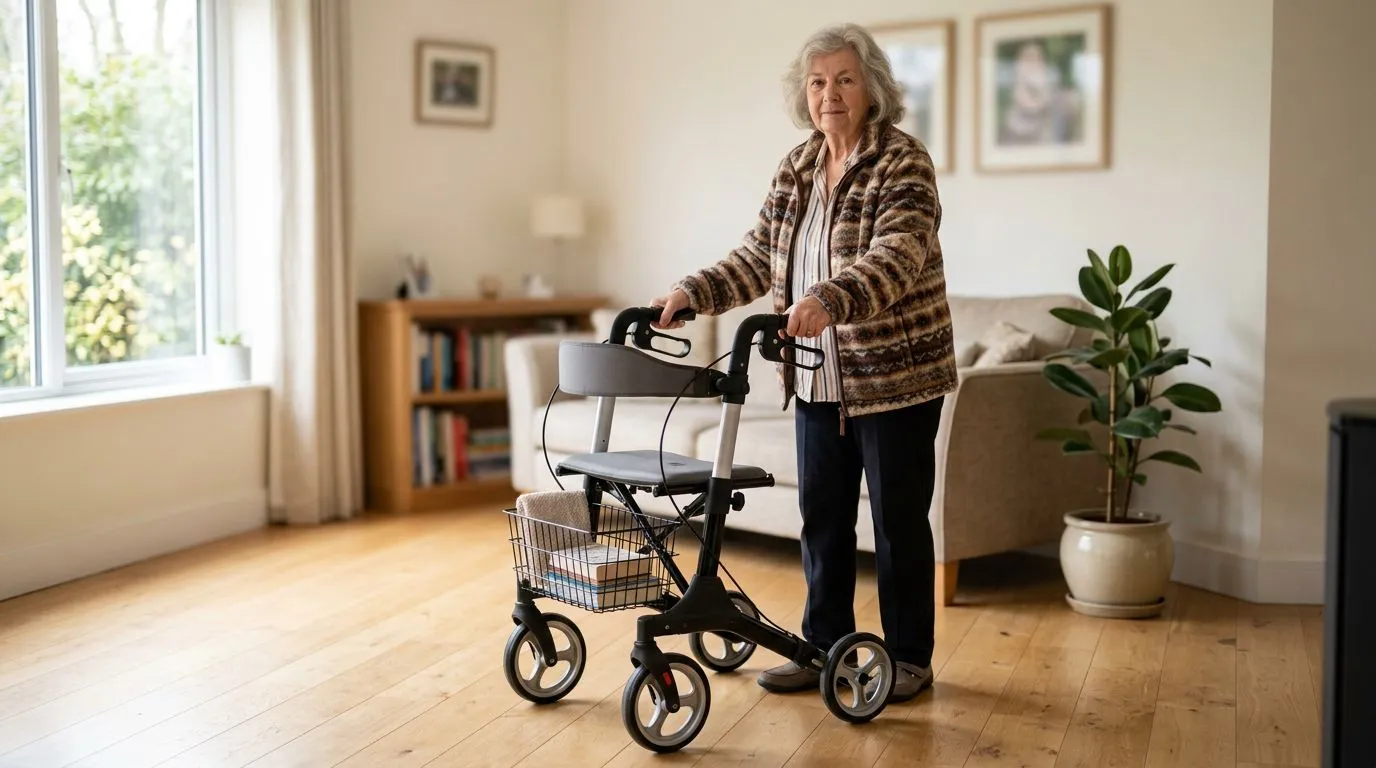
To sit safely on a rollator, stop on a flat surface, lock both parking brakes, turn until the seat is directly behind you, and lower yourself slowly without dropping your weight. To stand, keep the brakes locked, place both feet under you, push up with control, and unlock the brakes only after you feel steady. A rollator seat is meant for short rests, not for being pushed like a wheelchair.
This guide explains the proper sequence for sitting, standing, and using rollator brakes so you can reduce tip-over and fall risks. It also covers when a rollator with a seat is appropriate, when a standard walker may be safer, and which measurements matter before you buy or use one.
Rollator seat basics: the 3 parts that affect safety
A rollator is a wheeled mobility walker with hand brakes and, on seated models, a built-in seat. Most 4-wheel rollators have two hand brake levers, four wheels, a seat, and a backrest or back strap; many have wheel sizes from about 6 to 10 inches. The seat is convenient, but it also changes how the device needs to be used.
The three safety parts to know are the brakes, the wheels, and the seat frame. The brakes control movement while you walk and hold the rollator still while you sit or stand. The wheels make the rollator easier to move than a standard walker, but they also mean it can roll away if the brakes are not fully locked. The seat frame must support your body weight within the stated weight capacity, which commonly ranges from about 250 to 300 pounds on standard rollators and about 350 to 500 pounds on many bariatric rollators.
A rollator is different from a standard walker. A standard walker or no-wheel walker frame is lifted and placed forward step by step; it usually has no seat and no hand brakes. A two-wheel walker has front wheels and rear tips or glides, so it rolls less freely than a rollator. These walkers can be more stable for people who need firm support with each step, while rollators are often better for people who can walk but need help with balance, pacing, and rest breaks.
| Mobility aid | Wheels | Seat | Brakes | Best safety use |
|---|---|---|---|---|
| Standard walker | 0 | No | No hand brakes | Maximum steady support when lifted and placed |
| Two-wheel walker | 2 front wheels | No | Usually none | Slower walking with less lifting than a standard walker |
| 3-wheel rollator | 3 | Varies by design | Hand brakes | Tight spaces, short trips, users who do not need a wide seat |
| 4-wheel rollator | 4 | Yes on most seated models | Hand brakes plus parking locks | Walking with planned rest breaks on level surfaces |
| Upright rollator | 4 | Often yes | Hand brakes | Users who fit the forearm support style and can control it safely |
Who a rollator seat is best for: 5 common user profiles
A rollator with a seat is best for someone who can walk independently or with light support but needs a place to rest after a short distance, such as after 100 to 300 feet in a hallway, store, or park path. It is also useful for people who can operate hand brakes with both hands and remember to lock them every time before sitting.
Good candidates often include people who fatigue during errands, want to pause safely while waiting in line, or need a portable rest seat during outdoor walks. A 4-wheel rollator can be especially helpful when the user can maintain upright posture, steer with control, and stop before sitting.
A rollator may not be the safest choice if you need to put heavy body weight through the handles with every step, have trouble squeezing or locking hand brakes, or feel unsteady when turning. In those cases, a standard walker, folding walker, or two-wheel walker may provide a more controlled base. If you have had recent falls, sudden dizziness, a new surgery, or major weakness on one side, ask a clinician or physical therapist to fit and train you before relying on any mobility aid.
- Best fit: You can walk, steer, brake, and turn without someone holding you up.
- Use caution: You need to sit often but forget to lock brakes.
- Consider a walker instead: You need firm, non-rolling support for each step.
- Get professional fitting: You are recovering from surgery, stroke, or a new injury.
How to lock rollator brakes: a 2-step check before sitting
Most seated rollators have loop-style hand brakes. To slow down while walking, squeeze both brake levers toward the handles. To park the rollator before sitting, you usually push both brake levers down until they click or stay in the locked position. Some designs vary, so read the owner instructions for your specific brake style.
Before you sit, use a simple 2-step check. First, lock the left and right parking brakes. Second, while standing close to the rollator, gently nudge it forward and backward with your hands. If it moves more than a small amount, do not sit; reset the brakes or move to a flatter surface.
Both brakes matter. Locking only 1 brake can let the rollator pivot, especially on smooth flooring, a sloped driveway, or a store aisle. A rollator can turn sideways faster than expected when one wheel is held and the other is free.
Brake maintenance is part of seat safety. If the brake lever touches the handgrip before the wheel stops, if one brake feels weaker than the other, or if the parking lock will not stay engaged, stop using the seat until the brakes are adjusted or repaired. Check brake function at least weekly if you use the rollator every day, and check it before any longer outing.
How to sit on a rollator safely in 7 steps
Sitting safely is mostly about position and timing. Do not try to sit while the rollator is moving, angled, or partly on a rug edge. Choose a level surface, ideally with all 4 wheels flat on the floor or ground.
- Stop completely. Bring the rollator to a full stop before turning your body.
- Choose the surface. Sit only on level, firm ground; avoid slopes, gravel, wet grass, curb ramps, and thick carpet edges.
- Turn carefully. Turn your body so your back faces the seat and the rollator is close behind you.
- Back up until you feel the seat. The back of both legs should touch the front edge of the seat before you lower yourself.
- Lock both brakes. Push both parking brake levers into the locked position and do the nudge test.
- Reach back with control. Use the frame or stable hand support as directed by the rollator design; do not pull hard on flexible parts, a basket, or a back strap.
- Lower slowly. Bend at your hips and knees and sit down under control rather than dropping the last few inches.
Keep your feet on the floor after sitting. A rollator seat is narrow compared with a dining chair; many seats are about 13 to 18 inches wide. Avoid leaning far to one side to pick something up. If an item is on the floor, stand first or ask for help.
Do not sit backward on the seat unless the rollator instructions specifically allow that position. Do not sit on the storage bag, basket, or closed folding frame. The seat is the load-rated surface, not the accessories.
How to stand up from a rollator seat in 6 steps
Standing is when many rollator tip-overs happen because the user pulls on the handles before their feet are ready. Take 6 slow steps instead of one big push.
- Keep both brakes locked. The rollator should not move while you shift forward.
- Scoot toward the front of the seat. Move until your feet can be placed flat on the floor.
- Place feet under knees. A good target is knees bent near 90 degrees, with feet about hip-width apart.
- Lean forward slightly. Bring your nose over your toes to move your weight over your feet.
- Push up with control. Use stable contact points as instructed for your rollator; avoid yanking backward on the brake handles.
- Pause before walking. Stand still for 3 to 5 seconds, make sure you are not dizzy, then unlock both brakes and start walking.
If you feel lightheaded when standing, sit back down if you can do so safely and wait. Dizziness, new weakness, or repeated near-falls should be discussed with a healthcare professional.
When someone is assisting, they should stand close enough to help your balance but should not push the rollator while you are seated. A rollator is not designed to transport a seated person like a wheelchair. Pushing someone seated on a rollator can overload the frame, defeat the brakes, and increase tip-over risk.
Tip-over risks to avoid: 9 situations that deserve extra caution
Most rollator seat accidents are preventable. The risk rises when the rollator rolls, twists, or tips while body weight is shifting. These 9 situations are common trouble spots.
- Sitting on a slope. Even a small driveway incline can let the rollator roll or pivot.
- Only 1 brake locked. The rollator can swing around the locked wheel.
- Soft or uneven ground. Grass, gravel, mulch, and cracked pavement can stop one wheel and tip the frame.
- Reaching more than 6 to 8 inches. Leaning far outside the seat base can pull the rollator sideways.
- Hanging heavy bags on handles. A bag weighing 10 pounds can change the balance, especially when you sit or stand.
- Using the rollator on stairs or escalators. A rollator is not meant to roll on steps while you support weight through it.
- Sitting with the frame partly folded. The rollator must be fully opened and locked into its walking position.
- Ignoring loose brakes. Parking brakes must hold before the seat is used.
- Being pushed while seated. This is wheelchair use, and a rollator is not built for that job.
Curbs require extra care. If you must navigate a curb, do it while standing and walking, not while seated. Many rollators have larger front wheels, but a 6-inch curb can still be enough to stop the front wheels abruptly.
How to choose and measure a safer seated rollator: 4 key measurements
A safer rollator seat starts with fit. Four measurements matter most: handle height, seat height, seat width, and weight capacity. If one is wrong, sitting and standing can become harder.
Handle height: Stand in your regular walking shoes with your arms relaxed at your sides. The handgrips should line up near the crease of your wrist. When holding the grips, your elbows should be slightly bent, often around 15 to 20 degrees. Handles that are too low can make you stoop; handles that are too high can make braking and steering harder.
Seat height: Sit-to-stand is usually easier when your feet rest flat and your knees are near a right angle. Common rollator seat heights range from about 18 to 25 inches. A seat that is too low may require too much leg strength to stand; a seat that is too high can leave your feet dangling, which is unsafe.
Seat width and depth: Choose a seat that supports you without squeezing your hips. A practical rule is to allow about 1 inch of clearance on each side while still keeping the rollator narrow enough for your home. Many US interior doorways are about 30 to 32 inches wide, and bathroom doors may be narrower.
Weight capacity: Check the stated user weight capacity and stay within it. Do not count storage capacity as user capacity. Bariatric rollators often have wider frames, reinforced seats, and higher capacities, but the wider footprint can be harder to maneuver in tight hallways.
| Feature | Typical range | Safety reason |
|---|---|---|
| Seat height | About 18 to 25 inches | Affects whether feet rest flat and standing is controlled |
| Seat width | About 13 to 18 inches on many models | Affects comfort and side-to-side stability |
| Wheel size | About 6 to 10 inches | Larger wheels may handle outdoor cracks better, but still require level sitting |
| Standard capacity | Often about 250 to 300 pounds | User must stay within the rated limit |
| Bariatric capacity | Often about 350 to 500 pounds | Higher-rated frame for larger users, with wider turning needs |
3-wheel, 4-wheel, upright, and bariatric rollators: seat safety differences
Not every rollator seat feels the same. A 4-wheel rollator usually offers the most familiar seated-rest setup because the seat is centered over a wider base. A 3-wheel rollator is often narrower and easier to turn, but if it has a seat, that seat may be smaller or less supportive than a full 4-wheel design. If a built-in seat is a major reason for buying, confirm that the seat is intended and rated for sitting.
Upright rollators place the forearms higher, which can help some users maintain a more upright walking posture. Seat safety still depends on the same basics: lock both brakes, sit only on level ground, and stand before moving. The higher frame can feel different during turning, so practice in a clear 6-foot by 6-foot area before using the seat in public.
Bariatric rollators are built with higher weight capacities and wider frames. The seat may feel more stable for a larger user when properly fitted, but the device may need more turning room. Measure your tightest home spaces, including bathroom entrances, bedroom walkways, and the space beside your favorite chair.
Folding rollators add one more safety check. Before sitting, make sure the frame is fully opened and the seat is locked or properly supported. Never sit on a rollator that is partly folded, even for a quick rest.
Practice routine: 10 minutes to build safer habits
Practice turns seat safety into muscle memory. Spend 10 minutes in a clear, well-lit room with a firm floor. Wear the shoes you normally use outside, not slippers.
Start with 5 brake checks. Roll forward a few inches, squeeze the hand brakes to stop, then push the levers down to park. Do the nudge test each time. Next, practice 5 sit-to-stand repetitions with the brakes locked, resting between attempts. Move slowly and stop if you feel tired or dizzy.
Then practice approaching the seat from a short walk. Walk 10 to 15 feet, stop, turn, back up until your legs touch the seat, lock brakes, and sit. Repeat only as many times as you can do with good control. Quality matters more than speed.
If possible, have a family member or caregiver watch from the side. They can remind you if you forget one brake, sit before the rollator is still, or reach too far while seated. A written note on the seat, such as brakes first, can help build the habit during the first week.
FAQ: 5 common rollator seat safety questions
Can I use a rollator seat like a wheelchair?
No. A rollator seat is for short stationary rests, not transportation. Do not have someone push you while seated on a rollator, because the frame, wheels, and brakes are not designed for wheelchair-style use.
Should I lock the brakes before turning around to sit?
The safest rule is that both brakes must be locked before you lower your body onto the seat. Many users turn first, back up until the backs of their legs touch the seat, then lock both brakes and check that the rollator does not move.
Is a standard walker safer than a rollator with a seat?
It depends on the person. A standard walker can be safer for someone who needs firm support and slower movement. A rollator may be better for someone who can steer and brake safely but needs rest breaks while walking.
Can I sit on a rollator outdoors?
Yes, but only on firm, level ground with both brakes locked. Avoid slopes, gravel, wet grass, curb ramps, and uneven pavement. If any wheel is not flat and stable, choose another place to rest.
What should I do if my rollator moves with the brakes locked?
Do not sit on it. Check that both parking brakes are fully engaged. If it still moves, the brakes may need adjustment or repair before the seat is used again.
FAQ
Frequently asked questions
Do both rollator brakes need to be locked before sitting? +
Yes. Lock both parking brakes every time before sitting or standing. Locking only one brake can let the rollator pivot or roll.
Where is it safe to sit on a rollator? +
Use the seat only on firm, level ground with all wheels flat and both brakes locked. Avoid slopes, gravel, wet grass, curb ramps, and uneven pavement.
Is a walker safer than a rollator with a seat? +
A standard walker may be safer for someone who needs firm support with each step. A rollator with a seat is better suited to users who can steer, brake, and turn safely but need rest breaks.
What if my rollator moves when the brakes are locked? +
Do not sit on it. Recheck both brake locks, and if the rollator still moves, have the brakes adjusted or repaired before using the seat again.
Keep reading
Related guides
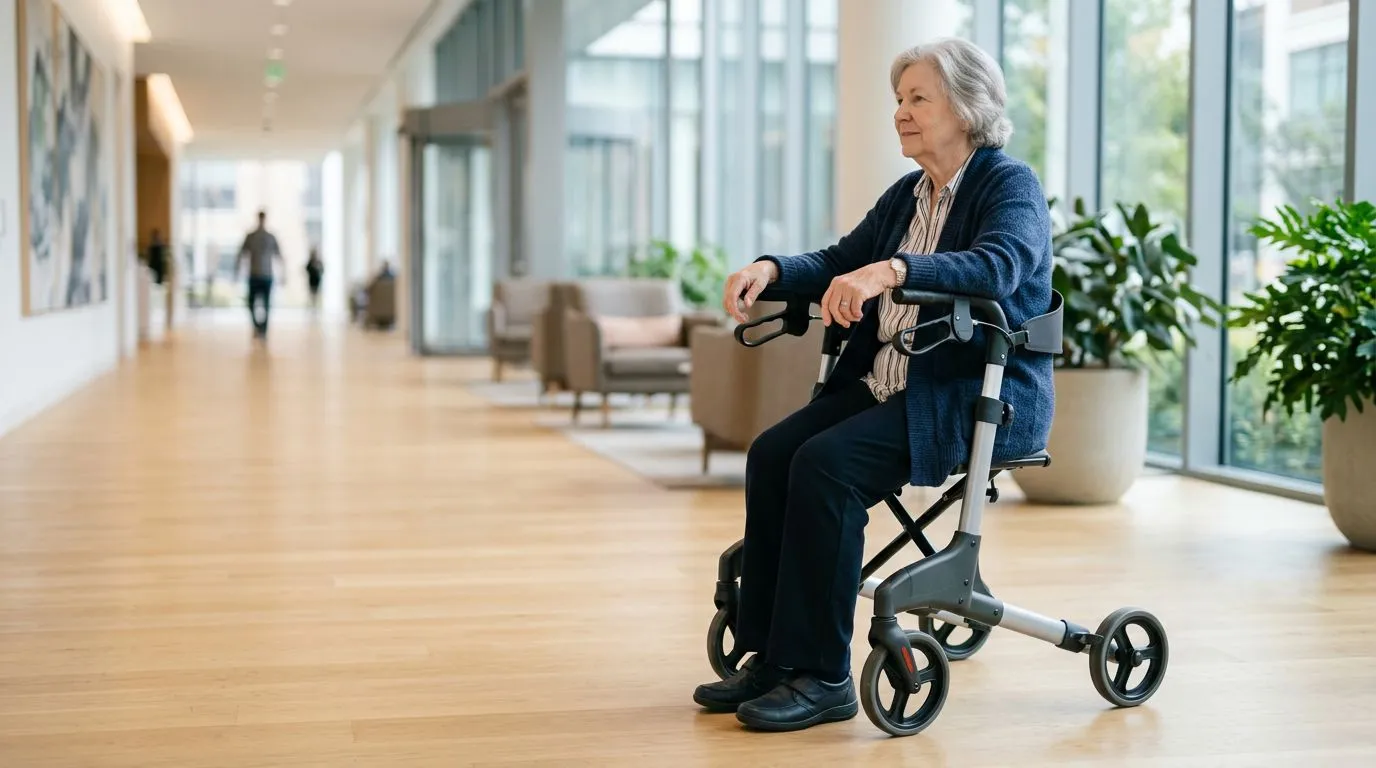
Rollator Seat Safety: When to Rest, Where to Park, and Why the Brakes Must Be Locked First
11 min read
When a Rollator May Not Be the Safest Choice: Balance, Fall Risk, and Caregiver Considerations
11 min read
Rollator Brake Safety Checklist: How to Stop, Lock, Test, and Avoid Brake-Related Falls
11 min read