Disclosure: We may earn a commission when you buy through links on this page, at no extra cost to you. We buy nothing, sell nothing and accept no payment for coverage — commissions never decide what we recommend. How we make money.
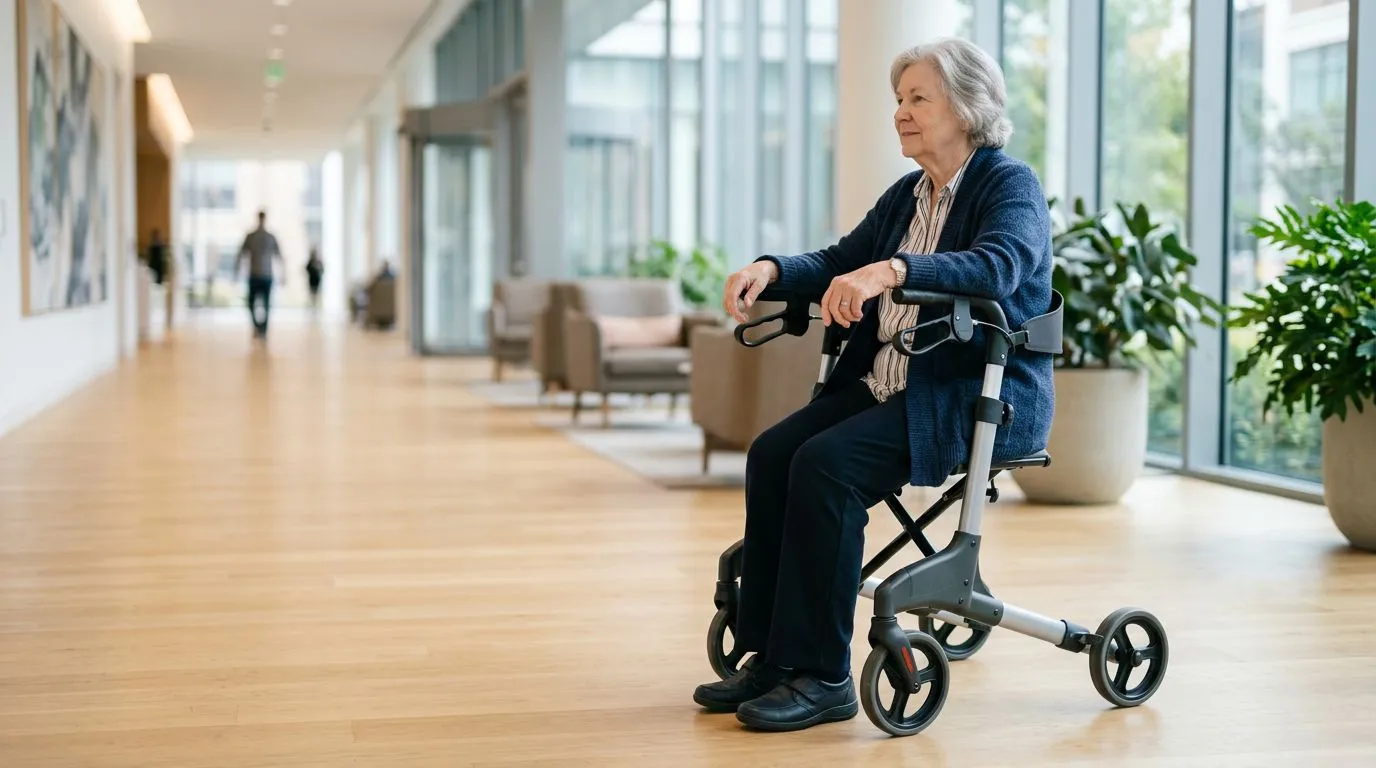
A rollator seat is intended for short, planned rests on a flat, stable surface—not for coasting, transfers, or sitting on a slope. Before you sit, park the rollator, turn it so the seat is safely positioned, lock both hand brakes, and check that the frame does not move.
This matters because a rollator is not the same as a standard walker. A walker frame is lifted or partly lifted for support, while a rollator moves on wheels and can roll away if the brakes are not fully engaged. Safe seat use begins with treating the seat as a temporary resting place, not a chair replacement.
1. A rollator seat is for short rests, not all-day sitting
Most rollator seats are made for brief breaks during walking—often a few minutes at a time—not for extended sitting. The seat, wheels, brakes, and folding frame are designed around mobility first. Safe use depends on where you park, whether the brakes are locked, and whether the rollator fits the user’s size and weight capacity.
A standard walker or folding walker usually has no seat and no hand brakes. A two-wheel walker has front wheels, rear tips, and no built-in chair. A rollator, by contrast, usually has 3 or 4 wheels, hand brakes, and often a seat on 4-wheel, upright, and bariatric designs. That convenience comes with one key responsibility: the user must stop the wheels before resting.
Use the seat when you feel tired, need to catch your breath, or want to pause before continuing. Do not use it as a dining chair, shower seat, step stool, or wheelchair. Those uses put forces on the frame that it may not be designed to handle.
| Mobility aid type | Seat? | Brakes? | Best resting approach |
|---|---|---|---|
| Standard or folding walker | No | No hand brakes | Rest in a nearby chair or bench |
| Two-wheel walker | No | Usually no hand brakes | Do not sit on the frame or crossbar |
| 3-wheel rollator | Usually no built-in seat | Hand brakes | Use a real chair; do not sit on a pouch, tray, or basket |
| 4-wheel rollator | Common | Hand brakes | Park flat, lock both brakes, then sit |
| Upright rollator | Often | Hand brakes | Lower forearm supports if required and lock brakes first |
| Bariatric rollator | Common, wider | Hand brakes | Confirm weight rating and seat width before use |
2. When to rest: use the seat before fatigue changes your balance
The safest time to sit is before you are exhausted. A practical rule is to plan a rest every 50 to 100 feet if longer walks tend to tire you, then adjust based on your endurance and your clinician’s guidance. Waiting until your legs feel shaky can make turning, braking, and sitting harder.
Good reasons to stop include leg fatigue, shortness of breath, lightheadedness, pain that changes your walking pattern, or the need to review your route. If any symptom is sudden, severe, or unusual for you, the right response is not simply to sit and continue. Stop in a safe place and contact a healthcare professional or caregiver as appropriate.
Build rest points into common routes. For example, if the walk from the parking lot to a clinic entrance is about 200 feet, look for a flat spot halfway along the route instead of pushing through to the door. Indoors, choose a hallway wall area or lobby corner away from swinging doors and crowds.
A rollator seat can support independence when it is used early and deliberately. It is much safer to pause for 2 minutes on level flooring than to hurry toward a bench after balance and stamina have already dropped.
3. Where to park: choose a flat, firm spot at least 3 feet out of traffic
Before using the seat, look for a level surface that is firm, dry, and wide enough for the rollator’s full footprint. Try to stay at least 3 feet away from moving foot traffic, shopping carts, automatic doors, curb edges, and parking lot lanes. A quiet corner is usually safer than the middle of a walkway.
Flat matters. Even a gentle slope can let a wheeled frame shift, especially if the user sits down quickly or leans backward. If a pen, water bottle, or shopping cart would roll on that surface, it is not a good place to sit on a rollator. Side slopes are especially risky because the rollator can tip or twist rather than simply roll straight.
Firm ground matters too. Grass, gravel, thick carpet, soft dirt, and uneven brick can interfere with wheel contact and brake grip. A brake that holds well on smooth indoor flooring may not hold the same way on a damp ramp or loose gravel path. When in doubt, use a bench or regular chair instead.
Safer parking spots
- Level indoor flooring, such as a lobby or hallway corner
- A dry concrete sidewalk away from curb cuts
- A flat waiting area with enough room to turn around
- A wide aisle end where other people can pass easily
Riskier parking spots
- Ramps, driveways, curb cuts, and sloped sidewalks
- Wet tile, loose gravel, grass, or thick carpet
- Bus stops close to the curb or street
- Doorways, elevator thresholds, and crowded checkout lanes
4. Lock both brakes first: a 5-step sitting sequence
The brakes must be locked before you sit because the sitting motion pushes force into the frame. If the wheels move at that moment, the seat can slide away from you. Locking one brake is not enough; both sides should be fully engaged so the rollator resists rolling and pivoting.
Most rollators use loop-style hand brakes. Squeezing the handles slows the wheels while walking. Pushing the brake handles down typically locks them for parking, though designs can vary. Practice the lock and release motion with someone nearby until it feels familiar.
- Stop completely. Do not try to sit while the rollator is still moving.
- Turn the rollator into position. The seat should be on a flat surface with enough space behind it.
- Lock the left and right brakes. Push both parking brakes into the locked position.
- Test the frame. Gently nudge the rollator forward and backward. It should not roll.
- Back up until you feel the seat behind your legs. Reach back only if you can do so safely, then sit slowly.
Standing up is just as important. Keep the brakes locked while you rise. Push from the seat or another stable surface if your care team has taught you to do so; avoid pulling hard on the handles because that can tip or shift the rollator. Once you are fully upright and balanced, release the brakes and begin walking.
If the brake handles feel loose, the wheels turn while the brakes are locked, or one side locks differently than the other, do not use the seat until the rollator has been adjusted or repaired. Brake performance is not a minor detail. It is the main safety system when resting.
5. Seat limits: check weight capacity, width, and height before the first use
Every rollator has a stated weight capacity, often in the range of about 250 to 300 pounds for many standard models, with bariatric rollators commonly rated higher. The exact number depends on the product design, so treat the user manual or frame label as the authority. Never assume a wider seat automatically means a higher weight rating.
Seat height also affects safety. Many rollator seats are roughly 18 to 24 inches from the floor. A seat that is too low can make standing difficult, while a seat that is too high may leave the user’s feet poorly supported. Ideally, when seated, both feet should rest flat on the floor or ground, with knees bent comfortably.
Seat width matters for comfort and stability. If the user has to perch on the front edge or squeeze between side supports, the rollator may not be an appropriate resting option. Bariatric rollators often have a wider seat and stronger frame, but they can also be heavier and wider through doorways, sometimes measuring 25 inches or more across.
| Fit factor | What to check | Why it matters |
|---|---|---|
| Weight capacity | User weight plus clothing and carried items | Protects frame, seat, axles, and brakes from overload |
| Seat height | Feet flat, knees comfortable | Helps with controlled sitting and standing |
| Seat width | No squeezing or perching | Improves centered seating and reduces side leaning |
| Handle height | Wrists near handle level when standing tall | Supports better posture while walking, not sitting |
| Brake reach | Hands can lock brakes without strain | Makes safe parking realistic every time |
Carried items count too. A storage pouch with 10 pounds of groceries can change balance and stress the frame. Keep heavy items low and centered if the rollator is designed for storage, and remove bags before sitting if they make the frame feel unstable.
6. Type-specific mistakes: 3-wheel, 4-wheel, upright, and bariatric rollators
Different rollator styles call for different seat-safety habits. The most important distinction is that many 3-wheel rollators do not have a true seat. They are often chosen for tight spaces and easier maneuvering, but a basket, pouch, or tray is not a sitting surface. Sitting on anything not designed as a seat can collapse fabric, damage hardware, or cause a fall.
A 4-wheel rollator is the most common style with a built-in seat. Its main risk is overconfidence: sitting quickly without locking both brakes, resting on a slope, or letting the rollator drift as the user turns. The frame may feel chair-like, but it is still a wheeled mobility aid.
Upright or stand-up rollators place the handles and forearm supports higher so the user can walk in a more upright posture. When resting, make sure any forearm platforms, cables, or accessories do not block the user’s ability to turn and sit. Some users need extra practice because the higher supports can make the rollator feel different during parking.
Bariatric rollators are built for higher capacities and often have wider seats, stronger frames, and larger tubing. Their size can improve fit for the right user, but it may also require more room to turn. A wider frame parked partly in a hallway or aisle can become a trip hazard for other people.
| Rollator type | Common seat-safety mistake | Safer habit |
|---|---|---|
| 3-wheel rollator | Sitting on a pouch, tray, or basket | Use a real chair or bench instead |
| 4-wheel rollator | Locking only 1 brake before sitting | Lock both brakes and test for movement |
| Upright rollator | Turning awkwardly around tall supports | Practice the parking and sitting motion in a clear space |
| Bariatric rollator | Assuming any wide seat fits any user | Check the stated weight capacity, seat width, and doorway clearance |
7. How to measure and choose: 4 checks before relying on the seat
Seat safety starts before the rollator is ever used outside the home. A rollator that is too narrow, too tall, too low, or too hard to brake invites unsafe shortcuts. Take measurements with the shoes the user normally wears, because even a 1-inch heel difference can affect posture and sitting control.
Check 1: standing handle height
Stand upright with arms relaxed at the sides. The handles should generally line up near the wrist crease so the elbows can bend slightly during walking. Handles set too low can encourage leaning; handles set too high can reduce control.
Check 2: seat height
Sit on the rollator with brakes locked and supervision if needed. The feet should reach the floor. If the user must slide forward to touch the ground, standing up may be less controlled.
Check 3: brake access and grip
The user should be able to squeeze and lock the brakes with both hands. Weak grip, arthritis, numbness, or hand pain can make some brake styles harder to use. If locking the brakes takes several tries, ask a qualified professional whether adjustment or a different style is needed.
Check 4: home clearance
Measure narrow doorways, bathroom entries, and hall turns. Many interior doorways are about 28 to 32 inches wide, and a rollator that barely fits can be harder to park safely. The user should have enough room to turn, lock, and sit without twisting around furniture.
8. Daily safety habits: a 10-second scan before every rest
A simple routine prevents many rollator seat problems. Before each rest, take 10 seconds to scan the surface, brakes, surroundings, and your body position. Short routines are easier to remember than long lists, especially in public places.
- Surface: Is it flat, dry, firm, and free of loose rugs or gravel?
- Space: Are you out of doorways, curb edges, ramps, and traffic?
- Brakes: Are both parking brakes fully locked?
- Stability: Did the rollator stay still when gently tested?
- Body position: Are you centered in front of the seat before lowering down?
Caregivers can help without rushing the user. Stand close enough to assist if needed, but avoid pulling the rollator backward while the person sits. If help is needed, support should follow the care plan provided by a clinician or therapist.
Maintenance is part of seat safety too. Check brake cables, tire wear, loose bolts, bent frames, worn tips on hybrid designs, and torn seat fabric. A quick weekly inspection takes less than 5 minutes and can catch problems before they affect balance. If a rollator has been dropped, left in the rain, or transported roughly in a car trunk, inspect it before using the seat again.
The safest rollator seat habit is consistent: rest early, park flat, lock both brakes, test the frame, and sit slowly. Those steps may seem small, but they are the difference between a helpful walking aid and a rolling seat used in the wrong place.
FAQ
Frequently asked questions
Can I sit on my rollator if only one brake is locked? +
No. Both brakes should be fully locked before sitting. Locking only one side can allow the rollator to pivot or roll, especially when you lower your weight onto the seat.
Is it safe to sit on a rollator on a ramp or driveway? +
It is not recommended. Ramps, driveways, curb cuts, and sloped sidewalks increase the chance that the wheels will move or the frame will tip. Find a flat, firm surface or use a regular chair or bench.
Do 3-wheel rollators have seats? +
Most 3-wheel rollators do not have a true built-in seat. Do not sit on a pouch, basket, or tray. If you need a seat for regular rest breaks, compare 4-wheel, upright, or bariatric rollators that are designed with seating.
How long should I sit on a rollator seat? +
A rollator seat is best for short rest breaks, not extended sitting. If you need to sit for a long period, use a stable chair or bench with appropriate back support.
What should I check if my rollator moves while the brakes are locked? +
Stop using the seat until the brakes are inspected. The brake cables may need adjustment, the wheels may be worn, or the brake mechanism may be damaged. A mobility equipment provider, repair technician, or qualified professional can help.
Can a rollator be used like a wheelchair? +
No. A rollator is a walking aid with a temporary seat, not a wheelchair. Sitting on it while someone pushes you can overload the frame, reduce steering control, and create a fall risk unless the device is specifically designed and labeled for that use.
Keep reading
Related guides
Rollator Seat Safety: How to Sit, Stand, and Lock the Brakes the Right Way
13 min read
Sitting and Standing Safely With a Walker or Rollator
13 min read
Rollator Brake Safety Checklist: How to Stop, Lock, Test, and Avoid Brake-Related Falls
11 min read