Disclosure: We may earn a commission when you buy through links on this page, at no extra cost to you. We buy nothing, sell nothing and accept no payment for coverage — commissions never decide what we recommend. How we make money.
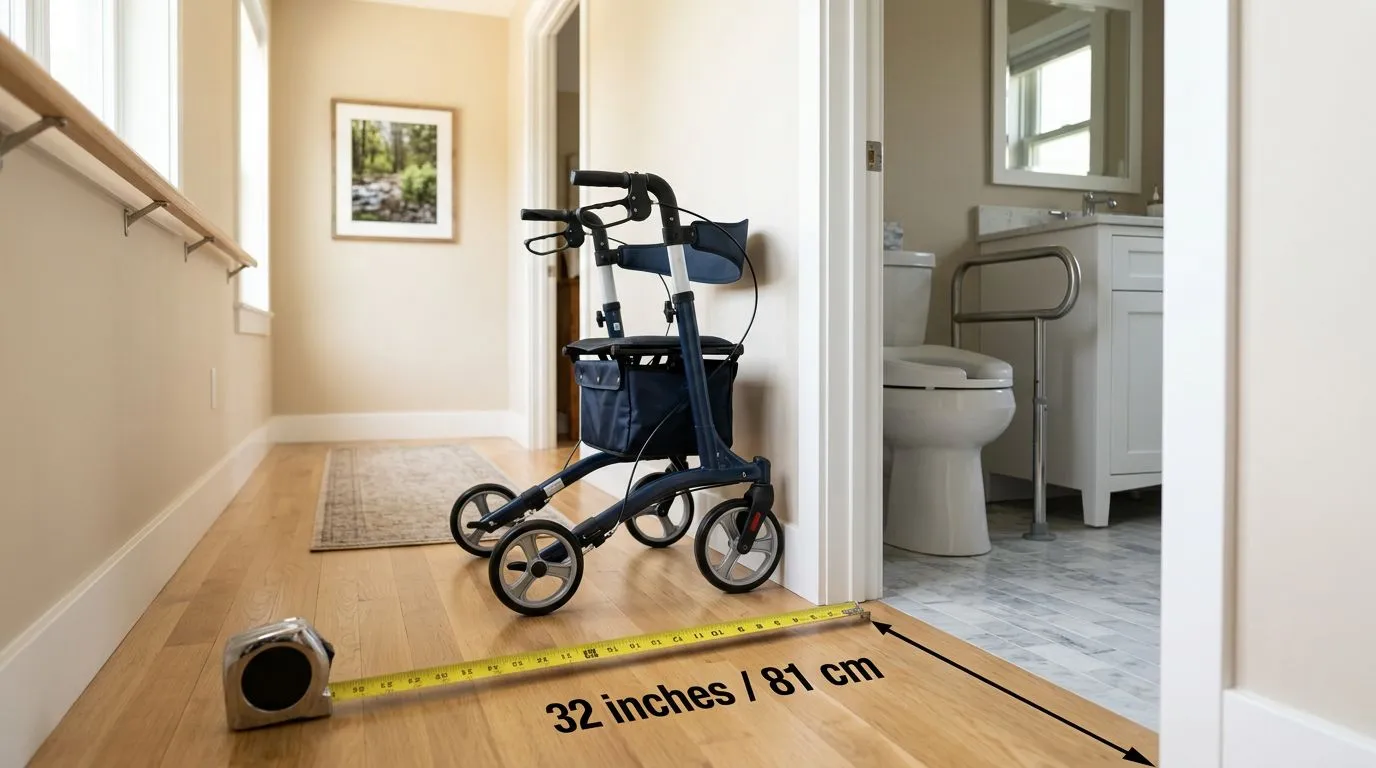
A narrow rollator walker is worth considering if your tightest doorway, bathroom path, or hallway turn leaves only a few inches of clearance. Before you buy, check 3 measurements: overall width at the widest point, wheelbase length and width, and how much floor space the rollator needs to turn. Compare those numbers with your home measurements, and think about whether a standard walker frame may be safer in very small rooms.
Compact mobility equipment is not just about being “small.” A rollator also needs enough stability, brake control, and handle height range for real daily use. The best choice depends on your walking pattern, your space, and whether you need a seat, hand brakes, or the slower, more controlled feel of a standard walker.
Start with 3 measurements: width, wheelbase, and turning space
When shoppers compare narrow rollator walkers, the first number they usually check is overall width. That matters, but it is only one part of the fit. A rollator that is 23 inches wide may pass through a 28-inch doorway, yet still feel awkward if the wheelbase is long or the front wheels swing wide during a turn.
Use these 3 measurements together:
- Overall width: the widest outside-to-outside measurement, often at the rear wheels or hand grips. Many compact rollators fall around 22 to 25 inches wide, while many full-size 4-wheel rollators are closer to 24 to 28 inches.
- Wheelbase: the footprint formed by the wheels, measured side to side and front to back. A longer wheelbase can feel steadier but may be harder to pivot in a small bathroom.
- Turning radius or turning space: the floor area needed to make a 90-degree turn, a U-turn, or to line up with a toilet, bed, or sink. In real homes, this often matters more than the listed width.
For a quick first check, measure the narrowest place you use every day and subtract at least 2 inches for hand clearance and uneven steering. If a bathroom doorway is 24 inches wide, a 23-inch rollator may technically fit, but it may not feel comfortable or safe. Depending on your strength and balance, a 21- or 22-inch walker frame may be easier.
Walker vs. rollator in tight spaces: a 2-inch clearance can change the answer
A walker and a rollator are related mobility aids, but they behave differently indoors. A standard walker or folding walker frame usually has no seat and may have no wheels or 2 front wheels. A rollator is a wheeled walker with hand brakes; most 4-wheel rollators have a built-in seat, while many 3-wheel compact rollators skip the seat to stay lighter and narrower.
In a tight room, a standard walker can be easier to “place” because you lift or partly lift it, set it down, and step into it. That stop-and-go pattern can help people who need firm support with every step. A rollator keeps moving unless you control it with your hands and brakes, which is convenient in open areas but less forgiving in a cramped bathroom.
| Type | Typical indoor fit | Best use case | Key caution |
|---|---|---|---|
| Standard no-wheel walker | Often narrow, commonly around 21 to 24 inches wide | Maximum step-by-step control in small rooms | Requires lifting the frame with each step |
| 2-wheel walker | Good for hallways and doorways; rear legs add braking friction | People who want easier forward movement than a no-wheel walker | Not designed as a seated rest device |
| 3-wheel rollator | Usually compact and easier to steer around corners | Shopping, narrow halls, and crowded spaces when a seat is not required | May have less lateral stability and often no built-in seat |
| 4-wheel narrow rollator | Can fit many doorways if width is about 22 to 25 inches | Users who need hand brakes, wheels, and a resting seat | Needs enough space to turn and brake safely |
| Upright rollator | Often taller and sometimes wider than compact rollators | People who have been advised to walk in a more upright posture | Forearm platforms and wider frames may reduce tight-space clearance |
The practical question is not “Which one is smallest?” It is “Which one can I control in the exact spaces where I will use it?” If you have a 30-inch hallway and a 90-degree turn into a 26-inch bathroom doorway, test both the straight width and the turn into the opening.
How to measure doorways, bathroom turns, and hallways in 10 minutes
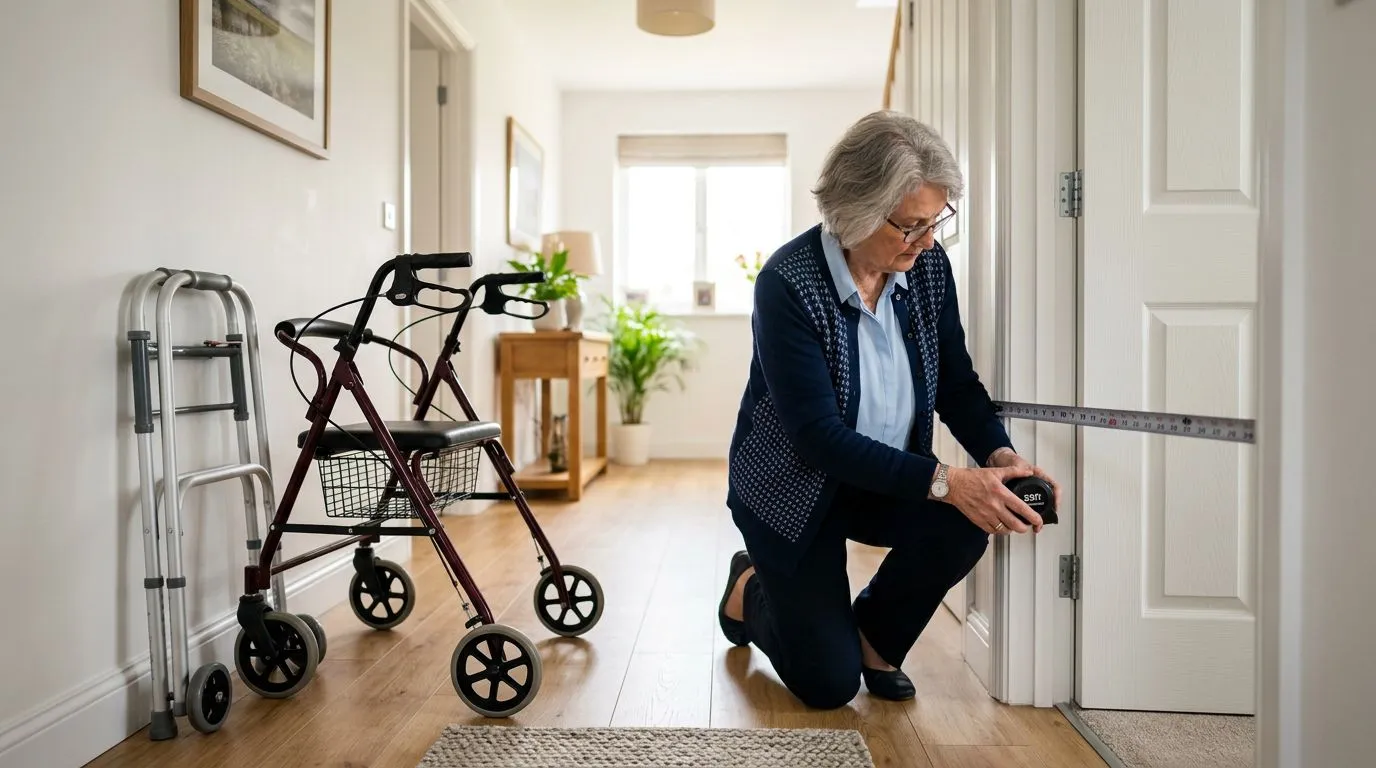
You do not need special tools. A tape measure, painter’s tape, and 10 minutes can prevent a poor fit. Measure the real usable opening, not the size printed on a building plan.
- Doorway opening: open the door fully and measure from the inside edge of the door to the opposite door stop. Hinges and trim can reduce usable space by 1 inch or more.
- Hallway width: measure at the narrowest point, especially near furniture, floor vents, laundry baskets, and hallway tables.
- Bathroom approach: measure the path from doorway to toilet, sink, or shower. Many older bathroom doors are about 24 to 28 inches wide, and the clear space inside may be even tighter.
- Turning area: mark a rectangle on the floor with tape that matches the rollator’s listed footprint, then practice walking the route without the device. This helps you see whether the front wheels would need to swing around a vanity, tub, or bed.
As a rule of thumb, aim for at least 1 inch of clearance on each side of the widest part of the mobility aid. Two inches total is a bare minimum; 4 inches total feels much easier for many users. If your doorway is 27 inches wide, a 24-inch rollator is more realistic than a 26-inch rollator, especially if your hands rest near the outside edges of the grips.
Overall width: check the widest point, not just the seat width
Rollator listings may show several width measurements, including seat width, inside handle width, or overall frame width. For doorways, the number that matters is outside-to-outside width at the widest point. This may be the rear wheels, brake cables, hand grips, or frame tubes.
A seat that is 18 inches wide does not mean the rollator is 18 inches wide. Many seated 4-wheel rollators have an overall width of 24 to 28 inches because the wheels and frame sit outside the seat. Bariatric rollators may be wider still, sometimes over 28 inches, because they are built for higher weight capacities and a larger seat.
| Measurement to check | Why it matters | Practical target |
|---|---|---|
| Overall width | Determines whether the rollator clears doors and furniture | At least 2 inches narrower than the tightest doorway |
| Inside width between handles | Affects shoulder comfort and walking posture | Wide enough that arms hang naturally without rubbing |
| Seat width | Affects resting comfort, not doorway clearance | Comfortable for short rests without forcing hips against frame |
| Folded width | Important for car trunks, closets, and apartment storage | Small enough for the storage spot you actually use |
Standard walkers can be narrower in the places that matter. A folding walker with no seat may slip through a tight doorway more easily because it has fewer protruding parts. If your main problem is a very narrow bathroom, compare a compact rollator with a standard or 2-wheel walker before assuming the rollator is the better indoor tool.
Wheelbase length and wheel size: 6-inch wheels turn differently than 8-inch wheels
Wheelbase is the rectangle created by the 4 wheels on a rollator, or by the front wheels and rear contact points on a 2-wheel walker. A short wheelbase can feel more maneuverable in a kitchen or bathroom. A longer wheelbase can feel steadier when walking in a straight line, especially outdoors.
Wheel size also changes the feel. Many indoor-focused rollators use wheels around 6 inches, while all-purpose rollators often use 8-inch wheels. Larger wheels roll more easily over sidewalk cracks, thresholds, and low-pile outdoor surfaces, but they can add bulk and may widen the turning path.
For indoor shoppers, pay attention to these tradeoffs:
- Shorter wheelbase: easier to turn near a bed, toilet, or kitchen island, but may feel less planted for some users.
- Longer wheelbase: can improve straight-line tracking and stability, but needs more room for turns.
- Smaller wheels: often suit smooth indoor floors and tighter frames.
- Larger wheels: better for thresholds and outdoor surfaces, but may increase the rollator’s footprint.
Do not judge stability by width alone. A rollator that is 23 inches wide with a very short base may feel different from a 23-inch model with a longer base. If you have balance concerns, ask a physical therapist, occupational therapist, or qualified clinician to watch you walk and turn with the device before relying on measurements only.
Turning radius: test the 90-degree turn before the U-turn
Turning radius is rarely as easy to compare as overall width because listings may not provide a true turning-radius number. In daily life, 2 movements matter most: turning 90 degrees through a doorway and making a U-turn in a hallway, bathroom, or beside a bed.
A 3-wheel rollator often turns more sharply than a 4-wheel rollator because the single front wheel pivots through tight spaces. That can help in crowded stores or narrow apartment hallways. A 4-wheel rollator with a seat may feel more stable for resting and straight walking, but it usually needs more floor space to rotate.
Here is a simple way to estimate turning fit before buying:
- Measure the listed overall width and overall length of the rollator.
- Use painter’s tape to mark that rectangle on the floor.
- Move the rectangle through your tightest 90-degree turn on paper or with tape.
- Add 2 to 4 inches for hand movement, brake cable clearance, and imperfect steering.
If the taped footprint bumps into a vanity, bed frame, or door trim, the real device probably will too. In that case, a narrower walker frame, a 2-wheel walker, or a compact 3-wheel rollator may be more practical than a seated 4-wheel rollator.
Who a narrow rollator is best for, and who may need a standard walker instead
A narrow rollator can be a smart fit for someone who walks at a steady pace, can use hand brakes reliably, and needs to move through spaces around 24 to 30 inches wide. It is especially useful in apartments, older homes, senior living rooms, small kitchens, and crowded public places.
A compact rollator may be best for:
- People who need a wheeled aid for longer indoor walks or errands.
- Users who can squeeze and lock hand brakes consistently.
- Homes where the tightest doorway still leaves about 2 inches of total clearance.
- Shoppers who want a seat for brief rests, if choosing a seated 4-wheel rollator.
- People who need a folding frame for car travel or closet storage.
A standard walker or 2-wheel walker may be better for:
- People who need firm support with each step rather than continuous rolling motion.
- Very tight bathrooms where a rollator seat and rear wheels get in the way.
- Users who have trouble remembering, reaching, or operating hand brakes.
- Short transfers between bed, chair, toilet, and sink.
- Situations where a clinician has recommended a more controlled gait aid.
Rollators are not a replacement for all walkers. They support mobility and independence for many people, but they require safe brake use and enough balance to manage a wheeled device. If falls, dizziness, weakness, or recent surgery are part of the picture, get individualized guidance before choosing based on size alone.
Handle height, seat height, and weight capacity: do not trade fit for narrowness
A narrow frame only helps if the rollator also fits your body. Handle height is one of the most important comfort and safety measurements. Many walkers and rollators adjust through a range of several inches, often roughly from the low 30s to the high 30s, but the exact range varies by type.
To estimate handle height, stand in your usual walking shoes with your arms relaxed at your sides. The hand grips should generally line up near the crease of your wrist, with a slight bend in the elbow when your hands are on the grips. If the handles are too low, you may lean forward. If they are too high, your shoulders may rise and tire quickly.
Seat height matters on a seated rollator. Common seat heights are often around 18 to 23 inches. A lower seat can be easier for shorter users to sit on, while a taller seat can be easier to stand from for some people. Your feet should rest securely when seated, and the brakes should be locked before you sit.
Check weight capacity without guessing. Many standard rollators list capacities around 250 to 300 pounds, while bariatric rollators are designed for higher capacities and wider seating. Higher-capacity frames may be wider and heavier, so measure doorways carefully if you need a bariatric option. Never choose a lower-capacity device just to gain an inch of clearance.
Foldability and storage: measure the car trunk and the 12-inch closet gap
Folded size matters if the rollator will travel in a car, sit beside a restaurant table, or store in a narrow apartment entry. Some rollators fold side to side; others fold front to back. A standard folding walker may become very flat, while a rollator with a seat, basket, and brakes usually remains bulkier.
Before buying, measure the actual storage spot. A closet gap that looks generous may only be 12 inches deep once coats and shoes are inside. A car trunk opening can be narrower than the trunk interior. If a caregiver will lift the device, check the total weight too. Compact rollators may weigh in the mid-teens of pounds, while larger or bariatric rollators can weigh noticeably more.
Look for practical details rather than fancy extras:
- Can it stay folded without popping open?
- Is there a simple strap, latch, or one-hand folding motion?
- Do bags or baskets need to be removed before folding?
- Will brake cables catch on furniture or car seats?
- Can the user or caregiver lift it without strain?
A rollator that fits through the bathroom door but is too heavy to load into the car may not solve the real problem. Match the folded dimensions to the routines you already have.
Pre-buy checklist: 8 numbers to write down before comparing options
Before comparing narrow rollator walkers or compact walker frames, write down 8 numbers. This keeps the decision practical and reduces the chance of choosing a device that looks right online but fails at home.
| Number | What to measure | Why it helps |
|---|---|---|
| 1 | Narrowest doorway width | Sets the maximum overall device width |
| 2 | Hallway width at the tightest point | Shows whether turns and passing furniture are realistic |
| 3 | Bathroom clear floor space | Reveals whether a seated rollator can turn inside |
| 4 | Needed overall rollator or walker width | Allows 2 to 4 inches of total clearance |
| 5 | Overall length or wheelbase length | Predicts 90-degree turn difficulty |
| 6 | Handle height range | Matches the device to your arm and posture |
| 7 | Seat height and seat width, if needed | Checks resting comfort and safe standing |
| 8 | User weight and device capacity | Confirms the frame is appropriate for safe use |
If the numbers are close, favor control over convenience. A rollator that barely fits can scrape door frames, catch on rugs, and encourage awkward twisting. A slightly less feature-rich walker that turns safely may be the better everyday choice.
Bottom line: choose the narrowest device that still fits your body and walking needs
The right narrow rollator walker is not simply the smallest one available. It is the one that clears your tightest doorway by at least 2 inches, turns where you need it to turn, adjusts to your handle height, and supports your weight capacity without compromise.
If you need wheels, hand brakes, and a place to rest, compare compact 4-wheel rollators carefully and test the turning footprint. If your main challenge is a small bathroom or a short transfer path, a standard walker or 2-wheel walker may be safer and easier to control. Measurements make the choice clearer, but comfort, braking ability, and professional guidance matter too.
FAQ
Frequently asked questions
What width rollator fits through a standard doorway? +
Many interior doorways are about 28 to 32 inches wide, but older bathrooms may be closer to 24 to 28 inches. For comfortable use, choose a rollator with an overall width at least 2 inches narrower than the actual clear opening, and allow more clearance if possible.
Is a 3-wheel rollator better for narrow spaces than a 4-wheel rollator? +
A 3-wheel rollator often turns more sharply and can be easier to steer in tight hallways or crowded areas. A 4-wheel rollator usually offers a seat and may feel more stable for resting, but it needs more room to turn.
How do I measure a rollator's turning radius at home? +
If a turning-radius number is not listed, use the rollator's overall width and length to tape a footprint on the floor. Move that footprint through your tightest doorway turn or bathroom path, then add 2 to 4 inches for hand movement and steering clearance.
Are standard walkers narrower than rollators? +
Many standard walkers and 2-wheel walkers are narrower or less bulky than seated rollators because they do not have a seat, rear wheel assembly, or brake cables. They may be easier to control in small bathrooms, though they do not provide the same rolling motion or seated rest.
Should I choose a narrow rollator if I have balance problems? +
Not automatically. Rollators require brake control and enough balance to manage a wheeled device. If you have a history of falls, dizziness, weakness, or a recent surgery, ask a physical therapist, occupational therapist, or clinician which type of walker is safest for you.
Keep reading
Related guides
Will a Walker or Rollator Fit in Your Home? Doorways, Hallways, Turning Space, and Storage
14 min read
Indoor Mobility Walkers: Choosing a Walker or Rollator for Tight Spaces at Home
13 min read
Inside Width vs Overall Width: How Much Room You Need in a Walker or Rollator
13 min read