Disclosure: We may earn a commission when you buy through links on this page, at no extra cost to you. We buy nothing, sell nothing and accept no payment for coverage — commissions never decide what we recommend. How we make money.
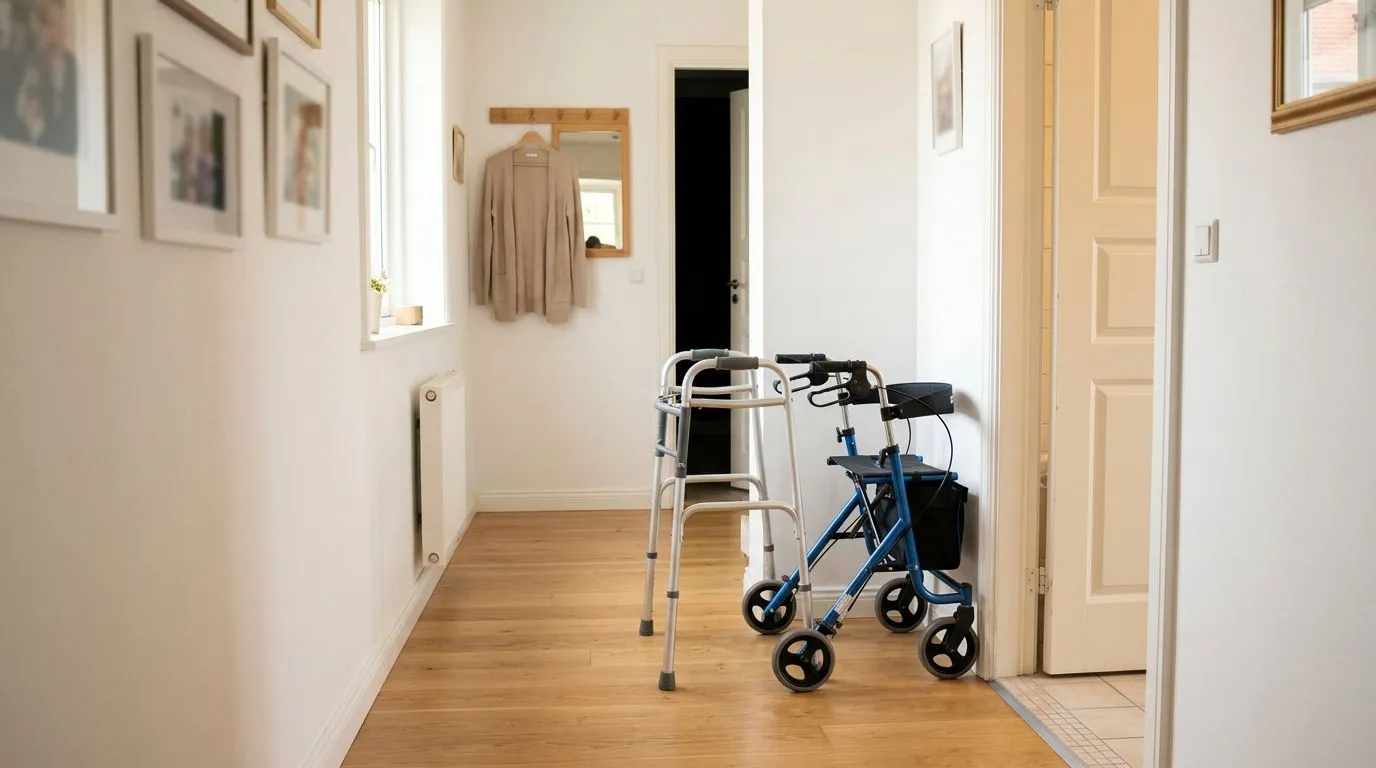
The best indoor mobility aid for tight spaces is usually a narrow folding walker or two-wheel walker when you need maximum stability, and a compact 3-wheel or small 4-wheel rollator when you need smoother movement and brakes. In many homes, the most important numbers are doorway width, hallway clearance, turning space, and the overall width of the walker or rollator. Measure first, then choose the smallest device that still supports your balance, weight capacity, posture, and daily routine.
Indoor use is different from outdoor use. A walker that feels fine in a parking lot may be awkward beside a 30-inch bathroom door, in a galley kitchen, or in a hallway with a laundry basket in the way. This guide explains how walkers and rollators compare indoors, what to measure, and which features matter most in small homes and apartments.
Start with your home measurements: 28-inch doors, 36-inch halls, and real turning space
Before comparing walker types, measure the home itself. Many interior doorways in older US homes are about 28 to 30 inches wide, while newer accessible doorways are often closer to 32 to 36 inches. Hallways may be 36 inches wide on paper, but furniture, door trim, baseboards, rugs, and storage bins can reduce usable space by several inches.
Use a tape measure and write down the tightest spots, not the average ones. A walker or rollator only needs one narrow point to become frustrating.
- Doorway clear opening: measure the space inside the door frame with the door open at least 90 degrees.
- Hallway width: measure the narrowest section, including handrails, furniture corners, and wall-mounted items.
- Bathroom path: measure from the doorway to the toilet, sink, tub, or shower entrance.
- Kitchen aisles: measure between counters, the refrigerator, the stove, and the table.
- Turning area: check whether there is at least 30 to 36 inches of open floor where you need to turn around.
Do not rely only on the listed frame width. A rollator with hand brakes, rear wheels, a basket, or a tray can feel wider in daily use than it appears on a spec sheet. A standard walker may have a simple frame, but its rear legs can still catch on rugs or the sides of a doorway if the user turns at an angle.
Walker vs rollator indoors: 4 key differences in tight spaces
A walker and a rollator are related, but they are not the same tool. A walker is usually a frame that you lift or partially roll forward, then step into for support. A rollator is a wheeled walker with hand brakes and, in most 4-wheel designs, a built-in seat. Indoors, the choice often comes down to stability, turning, braking, and how much room you have.
| Feature | Walker | Rollator |
|---|---|---|
| Wheels | No wheels or 2 front wheels are common | 3 or 4 wheels are common |
| Seat | Usually no built-in seat | Most 4-wheel rollators include a seat |
| Brakes | Usually none; stability comes from the frame | Hand brakes are standard |
| Indoor control | Often better for slow, careful steps | Often easier for continuous walking on open floors |
| Tight-space concern | May require lifting or repositioning | May roll too freely if brakes are not used well |
Walkers tend to win when controlled weight-bearing and balance support are the priority. A no-wheel walker can be very steady because all four tips contact the floor. A two-wheel walker reduces lifting effort but still resists rolling away. In a narrow apartment, a compact folding walker can be a practical everyday choice because it has fewer protruding parts than many rollators.
Rollators tend to work better when the person can walk more continuously but needs support, a place to sit, or less effort pushing the device. A 3-wheel rollator can maneuver well around kitchen islands and furniture because it has a narrower front profile and a tighter turning feel. A 4-wheel rollator is usually more stable than a 3-wheel rollator and commonly includes a seat, though it may be wider and longer.
The caution matters: a rollator is not designed to support heavy leaning unless the brakes are properly locked and the user is positioned safely. If someone needs to push down hard through the handles for each step, a walker is often the safer category to discuss with a clinician.
Compact walker options: widths around 17 to 24 inches
Indoor walkers come in several styles, and even a small difference in frame design can matter in a narrow bathroom. Compact or junior-size walkers may be around 17 to 22 inches wide, while many standard adult walkers are closer to 22 to 24 inches wide. Bariatric walkers are usually wider and stronger, with some frames exceeding 25 inches in outside width.
No-wheel standard walker
A no-wheel standard walker has four legs with rubber tips. It is often the most stable walker style because the frame does not roll unless the user lifts and places it. Indoors, that can help near a toilet, bed, or chair where slow transfers happen.
The tradeoff is effort. The user must lift, or at least unweight, the frame for each step. In a tight hallway, that repeated lifting can be tiring, especially during a 20-foot walk from bedroom to bathroom at night.
Folding walker
A folding walker collapses for storage or travel, often with a push-button or two-button mechanism. For small homes, foldability matters even if the walker rarely leaves the house. Being able to fold the frame and store it beside a recliner, in a closet, or near a bed can help keep walkways clear.
Check both the open width and folded width. A walker that folds to 4 to 6 inches deep may fit behind a door or next to a dresser, but only if the handles, wheels, or glide tips do not stick out into the path.
Two-wheel walker
A two-wheel walker has wheels in front and rubber tips or glides in back. It is a common compromise for indoor use because the user does not have to fully lift the frame, yet the rear legs help slow the device. This style can work well on hard floors and low-pile carpet.
Wheel size matters. Small 3- to 5-inch front wheels are common on indoor walkers and can fit better in tight spaces than large outdoor-style wheels, but they may catch more easily on thick thresholds or uneven flooring.
Compact rollator options: 3 wheels, 4 wheels, upright frames, and 250- to 400-lb capacities
Rollators vary more than many buyers expect. A compact 3-wheel rollator may be noticeably easier to steer in a narrow kitchen than a large 4-wheel rollator, while a bariatric or upright rollator may offer needed support but require more turning room. Common weight capacities often range from about 250 to 300 pounds for standard designs, with heavy-duty or bariatric rollators commonly rated higher, sometimes around 350 to 400 pounds or more depending on construction.
3-wheel rollator
A 3-wheel rollator is often the most compact rollator style. It has one front wheel and two rear wheels, usually with hand brakes. Many 3-wheel designs do not include a seat, though some include a pouch or basket.
For tight indoor spaces, the advantage is maneuverability. A 3-wheel rollator can turn more easily around a table leg, bathroom vanity, or apartment entryway. The downside is that it usually provides less side-to-side stability than a 4-wheel rollator, and the lack of a seat may matter for someone who needs rest breaks every few minutes.
4-wheel rollator
A 4-wheel rollator usually includes a seat, backrest, hand brakes, and storage. Seat heights often fall around 18 to 24 inches, depending on the frame size. This can help someone rest safely during longer indoor tasks, such as preparing a meal or folding laundry.
Indoors, measure carefully. A 4-wheel rollator with an overall width near 24 to 28 inches may fit through many doorways, but it can still be awkward in a 30-inch bathroom doorway once the user, door swing, and turning angle are included.
Upright or stand-up rollator
An upright rollator has taller forearm supports or elevated handles to encourage a more upright posture. These can be helpful for some users, but they are often larger than compact rollators. The higher frame and arm platforms may also make it harder to tuck close to counters or bathroom fixtures.
For indoor-only use, test whether the upright frame can pass through the narrowest doorway and turn in the smallest room. If the home has several 28- to 30-inch doorways, a bulky upright rollator may feel limiting.
Bariatric rollator
A bariatric rollator is built for a higher weight capacity and typically has a wider seat and reinforced frame. That strength is valuable when needed, but width is the indoor challenge. A wider seat and frame may not clear older bathroom doors or tight bedroom pathways.
Never choose a lower weight capacity just to fit a doorway. Instead, compare bariatric walkers and bariatric rollators by exact outside width, turning space, seat width, and brake design.
Who it is best for: matching 6 common home situations
The right indoor mobility aid depends on the person and the room. A walker may be best in one area of the home, while a rollator may be easier in another. Some households use a walker indoors and a rollator outdoors, but that decision should be based on ability, safety, and available space.
| Home situation | Often better fit | Why it helps |
|---|---|---|
| Bathroom doorway under 30 inches | Compact folding walker or narrow two-wheel walker | Less width and fewer protruding parts |
| Long hallway around 20 to 40 feet | Two-wheel walker or compact rollator | Less lifting effort than a no-wheel walker |
| Kitchen with tight turns | 3-wheel rollator or narrow walker | Better maneuvering around counters and chairs |
| Needs to sit during chores | 4-wheel rollator with seat | Built-in rest option when brakes are locked |
| Needs strong downward support | Standard or two-wheel walker | More controlled frame support |
| Very small apartment storage | Folding walker or folding compact rollator | Can be stored out of the walking path |
If the person is recovering from surgery, has frequent falls, or has been told to limit weight bearing on one leg, get guidance from a physical therapist, occupational therapist, or prescribing clinician. Device choice can affect gait, posture, and fall risk.
How to choose and measure: a 10-minute indoor fit check
A simple fit check can prevent buying a mobility aid that technically fits through a door but does not work in real life. Set aside about 10 minutes, use a tape measure, and walk the usual routes from bed to bathroom, chair to kitchen, and entry door to living area.
- Measure the person first. Walker or rollator handles should generally line up near the wrist crease when the user stands upright with arms relaxed. Elbows should bend slightly, often around 15 degrees, when holding the grips.
- Measure outside width. Compare the device width with the narrowest doorway. Leave at least 2 inches of practical clearance if possible, especially for nighttime use.
- Check handle height range. A device that is too low can encourage stooping; one that is too high can reduce control.
- Confirm weight capacity. Choose a walker or rollator rated for the user, including clothing and any items commonly carried.
- Look at floor surfaces. Thick rugs, curled mats, raised thresholds, and power cords can create hazards for wheels and walker tips.
- Test the turning path. Make sure the user can turn 180 degrees in the bathroom, bedroom, and kitchen without backing into obstacles.
For rollators, add a brake check. The user should be able to squeeze the hand brakes comfortably and lock them without pain or confusion. If hand strength is limited, brake style and adjustment become critical. A rollator with brakes that are hard to operate is not a good indoor solution, no matter how compact it is.
For walkers, check how much lifting is required. If the user drags a no-wheel walker across the floor because lifting is too hard, a two-wheel walker may be more practical. Dragging can damage floors and increase the chance of catching on rug edges.
Bathroom and kitchen safety: 2 rooms where inches matter most
Bathrooms and kitchens are often the hardest indoor spaces for walkers and rollators because they combine narrow clearances with hard surfaces. A bathroom may have a 28-inch doorway, a toilet only 15 to 18 inches from a side wall, and a bath mat exactly where wheels or rubber tips need to land. A kitchen may have only 30 to 36 inches between counters and an island.
In bathrooms, a compact walker often has an advantage near the toilet or sink because it can be positioned squarely and kept still. A rollator can work if there is enough room, but the brakes should be locked before the user reaches, turns, or sits. A rollator seat should not replace a properly placed shower chair, toilet safety frame, or grab bar when those are needed.
In kitchens, rollators can help with longer standing tasks if the user needs breaks, but they can also block appliance doors. Check whether the refrigerator, oven, dishwasher, and cabinet doors can open while the mobility aid is nearby. A walker with a tray may help carry light items, but carrying hot liquids or heavy cookware while using any mobility aid can be risky.
Remove loose throw rugs whenever possible. Low thresholds and non-slip flooring are easier for both walkers and rollators. Keep at least one clear path wide enough for the device plus the user’s feet, especially for nighttime bathroom trips.
Small-apartment storage and folding: plan for 4 to 8 inches of parked space
A mobility aid that blocks the path becomes a hazard. In a small apartment, storage can matter as much as walking performance. Many folding walkers store nearly flat, sometimes around 4 to 6 inches deep when folded. Folding rollators vary more because the wheels, seat, brake cables, and storage pouch take up space; some may still need 8 inches or more of depth when parked.
Pick a parking spot before choosing a device. Good locations include beside a favorite chair, near the bed, in an entry nook, or against a wall where it does not block the bathroom route. Avoid leaving a walker or rollator behind a swinging door, in front of a heater, or where someone else may trip over it.
If the user lives alone, the device must also be manageable without assistance. Ask whether they can fold it, unfold it, lift it over a threshold if needed, and position it beside a chair. A compact walker that is easy to fold with one hand may be more useful than a feature-rich rollator that is hard to manage in a 500-square-foot apartment.
Final indoor buying checklist: 12 details to compare before deciding
Use the numbers and daily routines together. A narrow walker that does not provide enough support is not a good choice, and a comfortable rollator that cannot turn in the bathroom will not solve the indoor problem. Compare at least these 12 details before making a final decision.
- Overall outside width in inches
- Open and folded dimensions
- Weight capacity in pounds
- Device weight for lifting and storage
- Handle height range
- Wheel size and floor compatibility
- Brake ease and lock function for rollators
- Seat height and seat width for rollators
- Turning room in the smallest bathroom
- Clearance beside the bed and favorite chair
- Rug, threshold, and cord hazards
- Ability to fold, park, and retrieve the device independently
For tight indoor spaces, start with the smallest safe category, not the largest feature list. Many people do well with a compact folding walker or two-wheel walker inside the home. Others prefer a compact rollator because it rolls smoothly, turns easily, and offers a seat when the home layout allows it. The best choice is the one that fits the person, fits the rooms, and supports safer movement through the places used every day.
FAQ
Frequently asked questions
Is a walker or rollator better for a small apartment? +
A compact folding walker or two-wheel walker is often better when space is very tight or the user needs strong, steady support. A compact rollator may be easier if the person walks more continuously, can use hand brakes safely, and has enough turning room.
What width should I look for in an indoor walker? +
Compare the walker’s outside width with your narrowest doorway. Many indoor-friendly walkers are roughly 17 to 24 inches wide, but you should leave about 2 inches of practical clearance when possible.
Can a rollator fit through a bathroom door? +
Some compact rollators can fit through many bathroom doors, but the listed width is only part of the issue. You also need room for the user to turn, lock the brakes, and approach the toilet or sink safely.
Are 3-wheel rollators good for indoor use? +
A 3-wheel rollator can be useful indoors because it often turns well in kitchens, hallways, and apartments. It may not provide as much stability as a 4-wheel rollator, and many 3-wheel designs do not include a seat.
Should I remove rugs when using a walker or rollator at home? +
Loose throw rugs, curled mats, and thick rugs can catch walker tips or wheels and increase fall risk. Low, secured flooring transitions are safer for most walker and rollator users.
How high should walker or rollator handles be? +
A common fit check is to stand upright with arms relaxed and set the handles near the wrist crease. When holding the grips, the elbows should bend slightly, often around 15 degrees.
Keep reading
Related guides
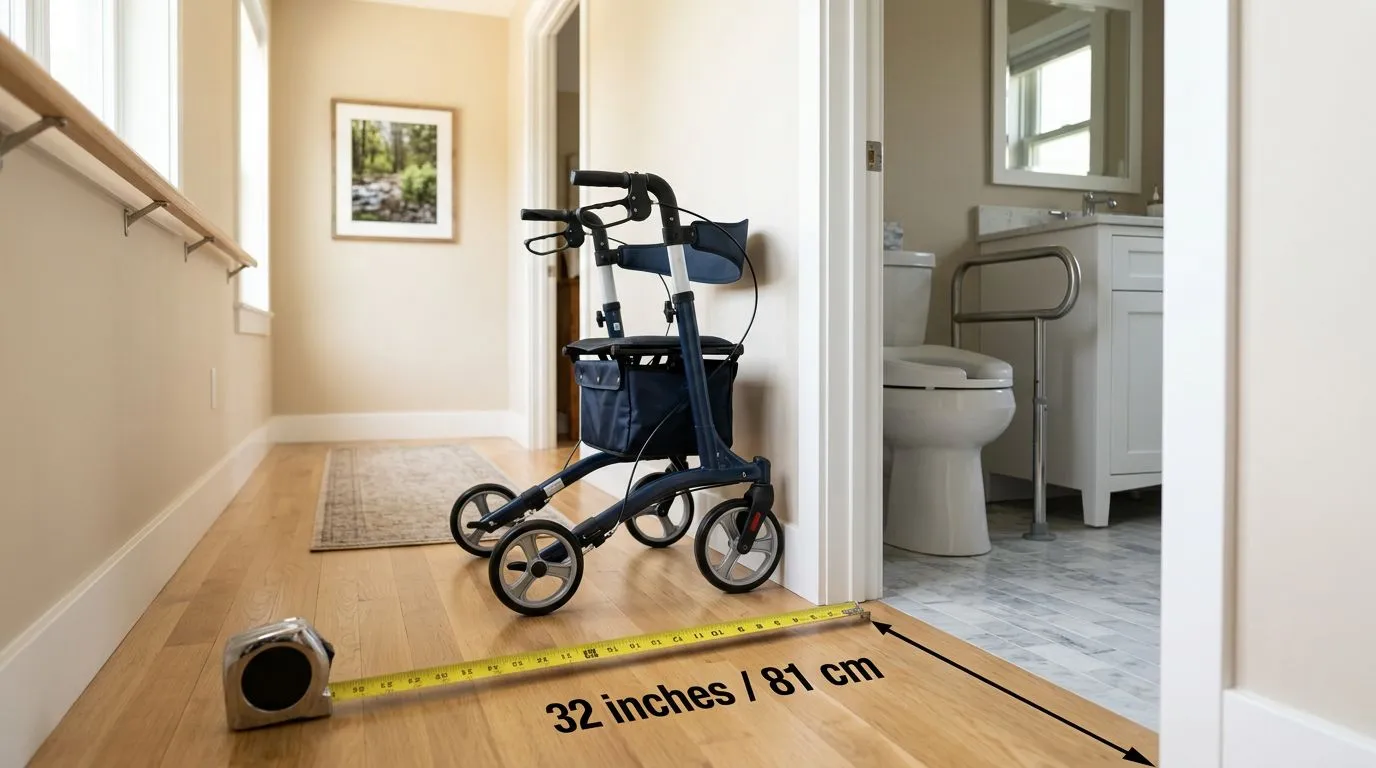
Narrow Rollator Walkers: How to Check Width, Wheelbase, and Turning Radius Before You Buy
14 min read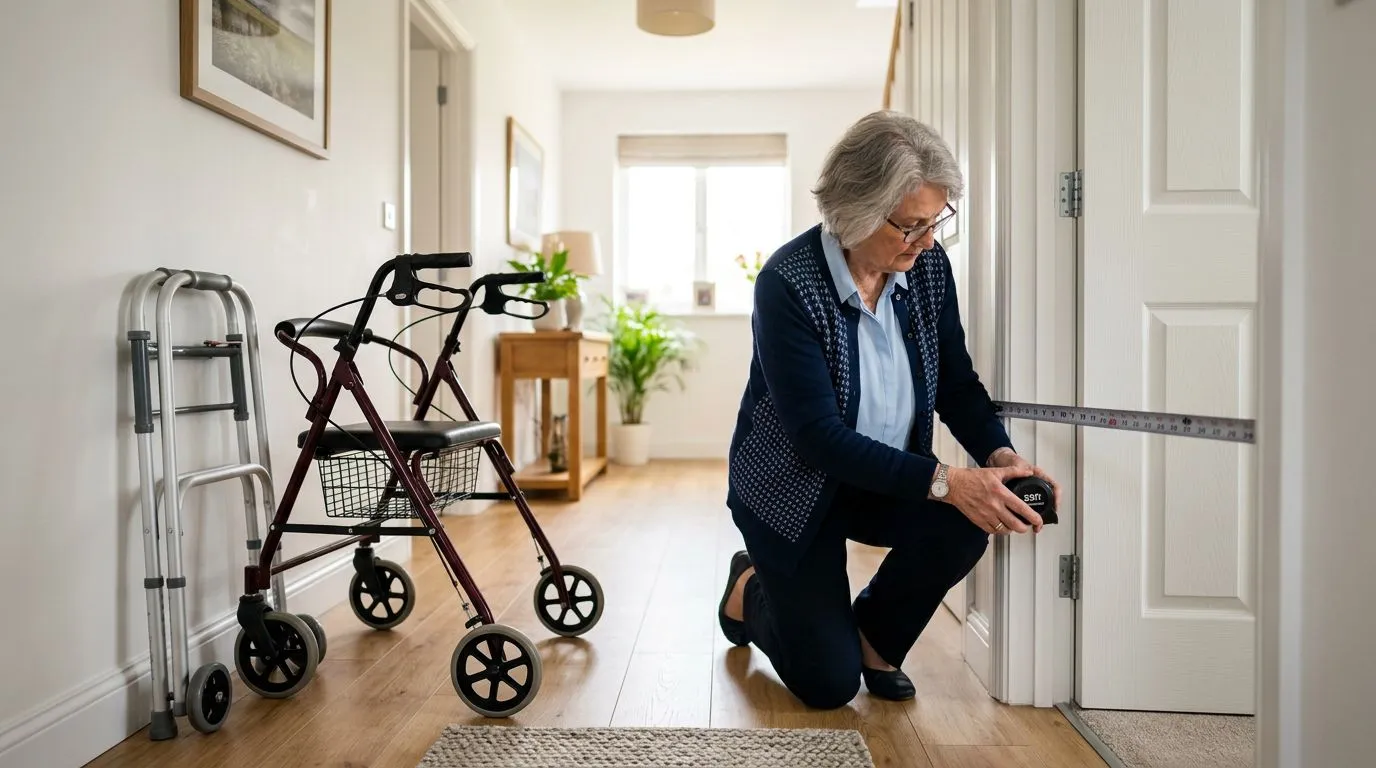
Will a Walker or Rollator Fit in Your Home? Doorways, Hallways, Turning Space, and Storage
14 min read
One Mobility Walker for Home and Outdoors? Standard Walkers vs Rollators for Daily U.S. Use
13 min read