Disclosure: We may earn a commission when you buy through links on this page, at no extra cost to you. We buy nothing, sell nothing and accept no payment for coverage — commissions never decide what we recommend. How we make money.
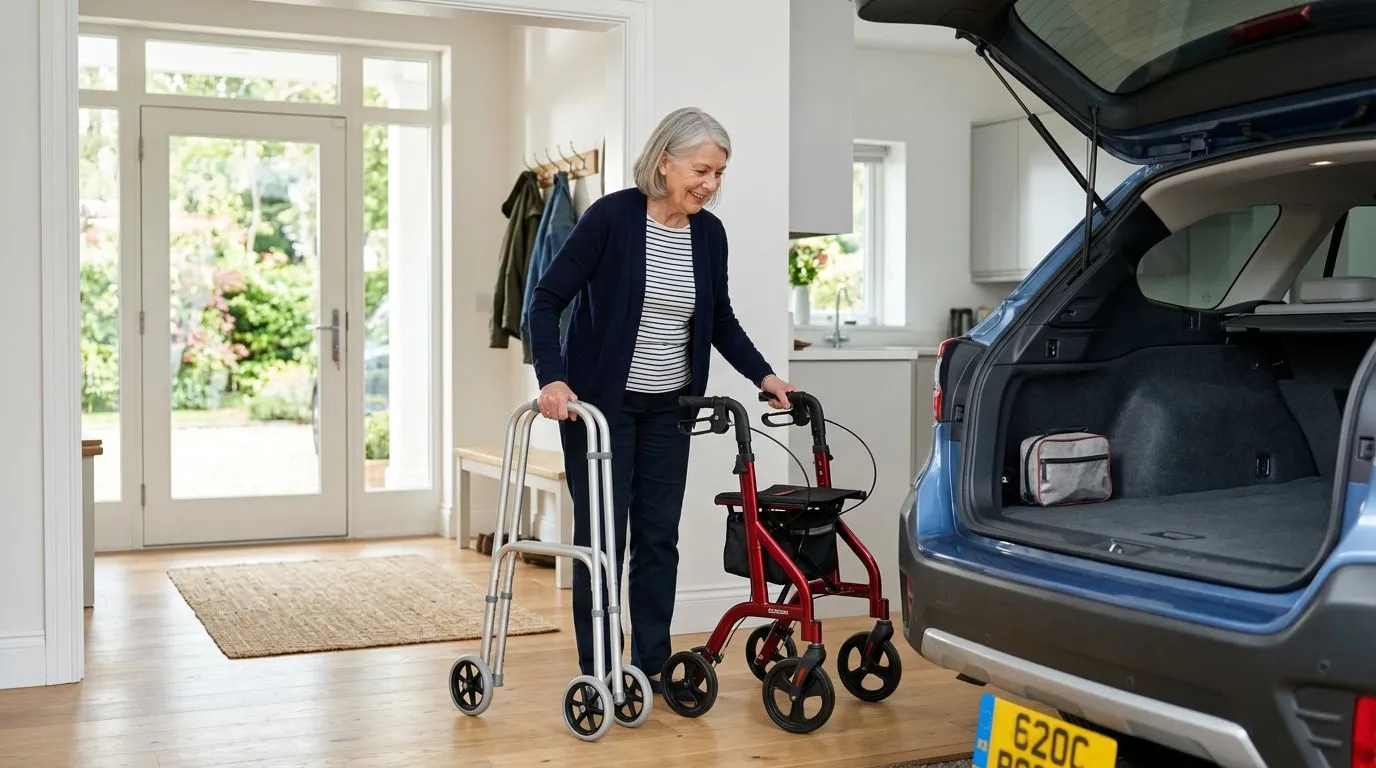
A folding mobility walker or compact rollator works best when it fits your body, supports the way you walk, and folds small enough for your home, car, or errands. Choose a folding standard walker or two-wheel walker if you need maximum stability and a light lift weight; choose a compact rollator if you need wheels, hand brakes, and a built-in seat for rest breaks.
Portability matters before you buy because the device has to work in real places: beside a bed, in a hallway, near a restaurant table, or in the back seat of a car. A walker that is safe but too awkward to store may sit unused, while a rollator that folds easily but does not give enough support can create risk.
Start with the main difference: walkers vs. rollators in 30 seconds
A walker is a mobility frame you lift or partially roll forward, then step into. A rollator is a wheeled walker, usually with 3 or 4 wheels, hand brakes, and often a built-in seat. Both can fold, but they handle very differently in tight spaces and during errands.
Standard folding walkers and no-wheel walker frames are usually the most stable because all 4 legs contact the floor when used correctly. Two-wheel walkers add small front wheels, often around 5 inches, so the user does not have to lift the entire frame with every step. Rollators have larger wheels, commonly about 6 to 10 inches, and are made to roll continuously while the user controls speed with hand brakes.
The tradeoff is straightforward. Walkers favor stability, lighter weight, and a smaller folded profile. Rollators favor smoother movement, outdoor usability, a seat, and a storage pouch or basket. If you are comparing both, decide first whether you need a device to steady each step or one that helps you keep moving longer with planned rest stops.
| Type | Typical best use | Portability notes |
|---|---|---|
| Folding standard walker | High stability indoors, post-surgery support, short distances | Often light, commonly around 5 to 8 lb, folds flat |
| Two-wheel folding walker | Indoor walking with less lifting effort | Front wheels add convenience but still fold compactly |
| Compact 3-wheel rollator | Narrow spaces, errands, users who do not need a seat | Folds slim, turns tightly, usually no built-in seat |
| Compact 4-wheel rollator | Errands, longer walks, rest breaks | Seat and brakes add usefulness but increase folded bulk |
| Upright rollator | Users who benefit from forearm support and a taller posture | Often heavier and larger, so check trunk and closet space |
| Bariatric rollator or walker | Higher weight capacity and wider frame needs | Stronger frames may weigh 20 lb or more and fold wider |
Folded size matters: measure 3 storage spots before buying
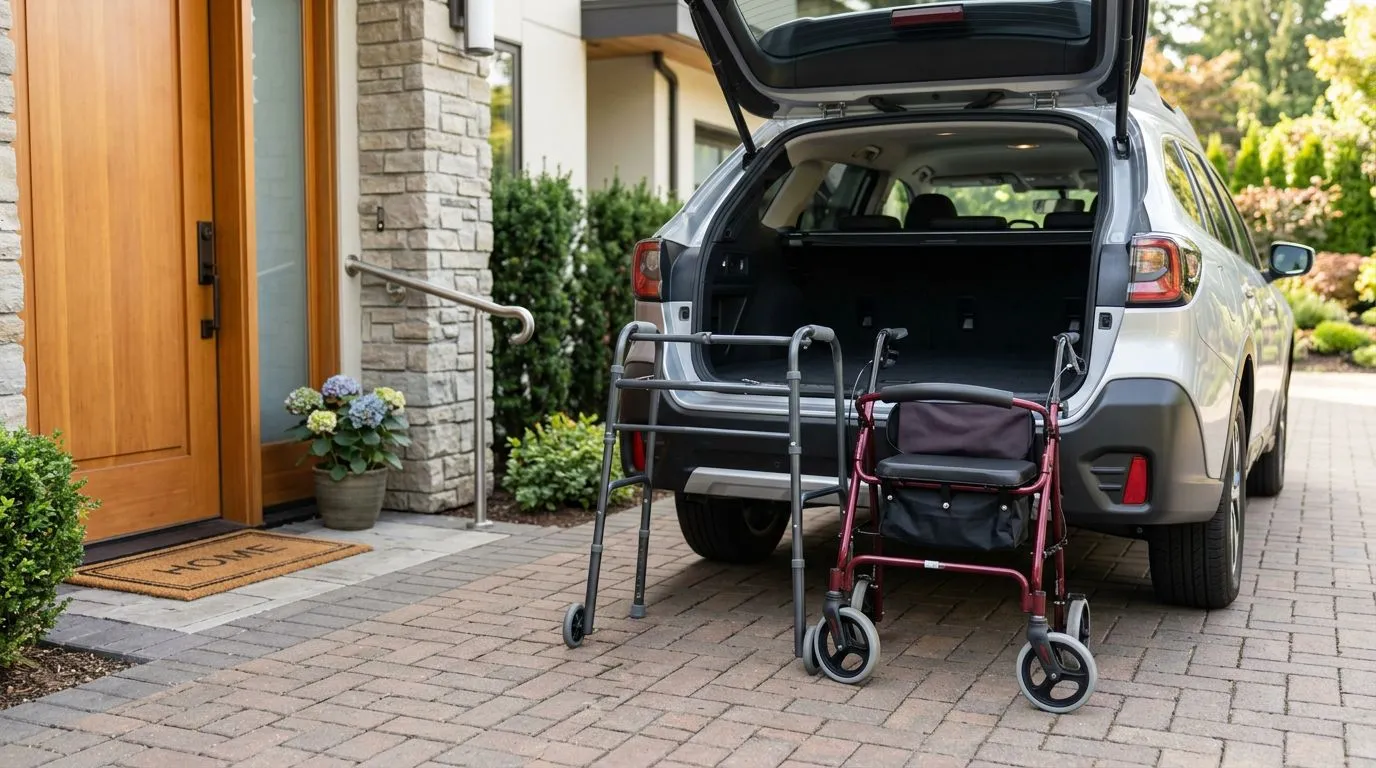
Before choosing any folding walker or rollator, measure at least 3 places: where it will be stored at home, where it will ride in the car, and where it will sit during meals or appointments. A device that looks compact in a product photo may still be too tall for a trunk or too wide for a hallway closet.
Use a tape measure and write down the height, width, and depth of each space. Common trouble spots include a 30-inch bathroom doorway, a crowded entryway, a bedroom corner, the gap between a passenger seat and dashboard, and the trunk opening rather than the trunk floor itself. The opening is often the limiting dimension.
Folding walkers usually collapse front-to-back into a flatter shape. Many can stand against a wall or slide behind a chair. Rollators fold in different ways. Some fold side-to-side like an umbrella, while others fold by pulling up on the seat. A side-folding rollator may be narrow but tall; a seat-folding rollator may be shorter but thicker.
Do not judge compactness by one number. Folded width matters for closets. Folded height matters for car trunks. Folded depth matters behind doors and beside beds. If the device will be loaded into a sedan, SUV, or ride-share vehicle, check whether it can be lifted through the opening without forcing your wrists into an awkward position.
Lift weight: a 7 lb walker feels different from a 19 lb rollator
Lift weight is one of the most overlooked buying factors. A folding standard walker may weigh around 5 to 8 pounds, while a compact 4-wheel rollator often weighs more, sometimes in the mid-teens. Upright and bariatric rollators can be heavier still because they use larger frames, bigger wheels, reinforced parts, and braking hardware.
The listed product weight is not the whole story. What matters is whether the user or caregiver can lift it safely into a vehicle, up 2 porch steps, or around a tight bathroom corner. A rollator with a seat may be comfortable on a walk but frustrating if it has to be loaded in and out of a car 4 times during one errand trip.
Match lift weight to the person who will actually do the lifting. If an adult child or caregiver handles the car, a heavier rollator may be fine. If the user lives alone and drives, a lighter folding walker or lightweight compact rollator may be more realistic. Also consider grip points. A 12-pound device with a balanced frame and clear grab bar can be easier to manage than a 10-pound device that flops open while being lifted.
- For frequent car use, look for a manageable one-person lift.
- For apartment storage, check whether it can stand folded without blocking a walkway.
- For errands, consider how often it will be folded and unfolded in a single day.
- For caregivers, test whether the folding latch is easy to operate with one hand.
Who compact folding walkers are best for: stability first, often under 8 lb
A compact folding walker is often the better choice for someone who needs steady support with each step rather than continuous rolling movement. This includes many people recovering from surgery, living with balance changes, or walking short indoor distances where stability is the priority. A no-wheel walker frame gives the most deliberate movement because it must be placed before stepping.
Folding standard walkers are especially useful in homes with tight rooms because they are usually narrow enough to move through common interior doorways and simple enough to fold for storage. They have no hand brakes to adjust, no seat hardware, and fewer parts to maintain. That simplicity can feel reassuring.
A two-wheel folding walker can be a good middle ground. The front wheels roll while the rear tips or glides help slow the frame. This reduces lifting effort, which can help people with limited upper-body strength. It is still not a rollator. A two-wheel walker does not roll as freely, typically has no built-in seat, and does not use hand brakes the same way a rollator does.
For portability, folding walkers often win. They can fit behind a recliner, next to a bed, or in a car more easily than many rollators. The main drawback is pace and terrain. Walkers are slower outdoors, less comfortable on uneven sidewalks, and not intended as a place to sit.
Who compact rollators are best for: brakes, wheels, and a seat for 5-minute rests
A compact rollator is usually better for a person who can control a wheeled device, needs help with endurance, and wants a place to rest during errands or longer walks. The built-in seat is a major advantage when a store has no bench or a waiting area is crowded. Many users value being able to pause for 5 minutes without searching for a chair.
Rollators require safe brake use. The user should be able to squeeze the hand brakes to slow down, lock them before sitting, and avoid leaning too far forward while walking. This differs from a standard walker, which provides a more fixed frame of support. If hand strength, reaction time, or judgment is limited, a clinician or mobility professional should help assess whether a rollator is appropriate.
Compact 3-wheel rollators are nimble and can turn in tight aisles, but most do not include a full seat. Compact 4-wheel rollators are more common for people who want a seat and storage pouch. Upright rollators place the hands or forearms higher, which may help some users maintain a more open posture, but they are often less compact when folded.
For errands, a rollator can be more practical than a walker if the user needs to cover a parking lot, a pharmacy aisle, and a clinic hallway in one trip. The tradeoff is bulk. Brakes, wheels, a seat, and a storage bag make the device more useful, but also more complex to fold, lift, and store.
How to choose and measure: use 5 body and home checks
The right folding walker or rollator should fit both the person and the routine. Start with 5 checks: handle height, user weight capacity, doorway width, folded storage size, and lift weight. Skipping any one of these can lead to a device that feels safe in one setting but difficult everywhere else.
For handle height, stand in supportive shoes with arms relaxed at the sides. The handgrips should generally line up near the crease of the wrist when standing upright. When holding the grips, the elbows should have a slight bend, often around 15 to 20 degrees. If the handles are too low, the user may hunch. If too high, shoulders and wrists may feel strained.
Check weight capacity carefully. Many standard devices are designed around common adult weight ranges, while bariatric walkers and rollators are built for higher capacities and often wider seating or frames. Capacity is not only about body weight; it is also about frame strength, seat rating, and stability. Never assume a seat is safe unless the device is designed and rated for sitting.
Measure the home environment. A walker or rollator may be listed as compact, but a 24-inch wide frame can still feel large in a narrow bathroom. If the device will be used around a bed, measure the walking path with dresser drawers closed and laundry baskets in their usual spots. Real homes are not empty showrooms.
Finally, practice the fold. A folding mechanism should be understandable, repeatable, and secure. If the latch is hard to find or requires painful hand force, portability will suffer. The best compact choice is not always the smallest one; it is the one that can be folded, lifted, stored, and reopened without creating a new hazard.
| What to measure | Why it matters | Practical target |
|---|---|---|
| Handle height | Comfort, posture, control | Grip near wrist crease with slight elbow bend |
| Doorways and hallways | Indoor access | Check narrow spots such as 28 to 32 inch doors |
| Folded dimensions | Storage and car fit | Measure height, width, and depth, not just one number |
| Lift weight | Car loading and daily handling | Choose a weight the actual lifter can manage |
| Seat height on rollators | Safe sitting and standing | Feet should reach the floor when seated |
| Weight capacity | Frame and seat safety | Use the rated capacity; do not estimate |
Compare folding mechanisms: 1 hand, 2 hands, and seat-pull designs
Folding systems vary more than many buyers expect. Some folding walkers use 2 push buttons, one on each side of the frame. Others use a central paddle or trigger that can be operated with one hand. Rollators may fold by lifting a strap at the seat, pulling side frames together, or releasing a hinge.
One-hand folding is convenient when the other hand is holding a car door, purse, or railing. Two-hand folding can feel more secure but may be harder for someone with arthritis, tremor, or limited grip strength. Seat-pull rollators are often intuitive: lift the seat strap and the frame collapses inward. Still, they may not stay tightly closed unless they include a locking clip or strap.
Watch for pinch points near hinges. A good folding design should keep fingers away from closing metal parts. The device should also lock open firmly. A walker or rollator that partially folds during use is unsafe and should be inspected before use.
For storage, consider whether the device stays folded. A walker that springs open in a closet can block the door. A rollator that unfolds while being lifted into a trunk can strike the bumper or twist the user’s wrist. Small details such as a folding lock, carry handle, or frame strap can make daily use easier.
Wheels, brakes, and surfaces: 6-inch wheels are different from 10-inch wheels
Wheel size changes how a compact rollator or two-wheel walker handles real surfaces. Small front wheels on a two-wheel walker are usually intended for smooth indoor floors. Rollator wheels are larger and designed to roll over more varied surfaces, though larger wheels may increase folded bulk.
A compact rollator with 6-inch wheels may work well in stores, clinics, and apartment hallways. An 8-inch wheel often handles sidewalk seams and parking lots more comfortably. A 10-inch wheel may improve outdoor rolling but can make the frame taller or less compact when folded. These are general patterns, not guarantees; frame design matters too.
Brakes are a key rollator feature. Loop hand brakes should slow the wheels when squeezed and lock when pushed down or otherwise engaged, depending on the design. Brake cables should not snag when folded or stored. If the rollator will travel in a crowded car trunk with groceries or medical equipment, exposed cables deserve extra attention.
Walkers without wheels have no brake system because the frame itself is placed and stabilized by the user. Two-wheel walkers also do not function like rollators; the rear contact points help prevent free rolling. For someone who feels unsafe with a rolling frame, a walker may provide more confidence even if it moves more slowly.
Storage for errands: baskets, pouches, and a 10 lb grocery mistake
Storage can be helpful, but it should not turn a mobility aid into a shopping cart. Many rollators include a pouch, bag, or basket for small personal items. Some walkers can accept simple accessory pouches. The key is to keep weight balanced and within the device’s intended use.
A 10-pound bag of groceries hanging from the handles can change how a walker or rollator moves. It may tip the frame, interfere with brakes, or make steering harder. Storage is best for light items such as keys, a phone, a wallet, medication list, water bottle, or folded sweater. Heavier purchases are safer in a cart, carried by another person, or divided into smaller loads.
For errands, think through the full sequence. Can the user fold the walker or rollator, place it in the car, drive to the store, unload it, walk through automatic doors, navigate a checkout lane, and reload it afterward? A compact rollator with storage may be ideal for this routine, but only if the lift weight and folded size are manageable.
At home, storage matters too. A folding walker that rests beside the bed should not create a nighttime trip hazard. A rollator parked near the kitchen should have locked brakes and enough clearance for cabinet doors. Compact does not only mean small; it means easy to live with every day.
Everyday fit examples: apartments, cars, clinics, and 30-inch doorways
Different daily routines point toward different choices. In a small apartment with 30-inch doorways and short walking distances, a folding standard walker or two-wheel walker may be the most practical. It folds flat, stores easily, and provides steady support from room to room.
For a person who drives to appointments twice a week, lift weight and trunk fit may matter as much as walking feel. A lightweight folding walker is usually easier to load. A compact rollator may still be the better choice if the person needs a seat while waiting, but it should be tested for car handling before purchase when possible.
For grocery stores, pharmacies, and community events, compact 4-wheel rollators can be useful because they roll smoothly and offer a seat. A 3-wheel rollator may be easier in tight aisles, though the lack of a full seat can be a drawback. Upright rollators may help some users feel more supported through the forearms, but their folded size can be less convenient for small cars.
For larger users or anyone needing a higher weight rating, bariatric walkers and rollators deserve careful measurement. They may offer stronger frames and wider seats, but they also take up more space. Check both the user fit and the home fit; a wider frame that cannot pass comfortably through key doorways will create daily frustration.
Safety and comfort checklist: 12 points before you decide
Use a final checklist before committing to a folding mobility walker or compact rollator. A few minutes of review can prevent months of inconvenience. If there is any uncertainty related to surgery recovery, falls, neurological conditions, or complex balance problems, ask a physical therapist, occupational therapist, or qualified clinician for individualized guidance.
- Handles adjust to a comfortable height with a slight elbow bend.
- The frame feels stable on the surfaces used most often.
- The device fits through important doorways and hallways.
- Folded size works for the car, closet, or bedside storage area.
- The actual lifter can raise it without strain.
- Folding and unfolding can be done consistently.
- Locks or latches hold the frame open during use.
- Rollator brakes are easy to squeeze and lock.
- Rollator seat height allows safe sitting and standing.
- Wheels match the main surfaces, such as tile, carpet, sidewalks, or parking lots.
- Storage pouches do not interfere with walking, brakes, or folding.
- The rated weight capacity fits the user and intended use.
The best portable choice is the device that supports safe movement in the places the user actually goes. For some people, that is a simple folding walker under the arm of a caregiver. For others, it is a compact rollator with brakes, a seat, and enough wheel size for errands. Start with support needs, then confirm folded size, lift weight, and storage fit. That order keeps the decision practical.
FAQ
Frequently asked questions
Is a folding walker or a rollator easier to store? +
A folding standard walker is usually easier to store because it often folds flatter and weighs less. A rollator can still be compact, but the wheels, brakes, seat, and storage pouch usually make it bulkier.
Which is better for errands, a walker or a rollator? +
A rollator is often better for errands if the user can safely control hand brakes and benefits from a seat for rest breaks. A folding walker may be better for shorter trips or when stability and light lifting matter more than speed.
How do I know if a walker or rollator will fit in my car? +
Measure the trunk or back-seat opening, not just the open storage area. Compare those measurements with the folded height, width, and depth of the walker or rollator, and consider whether the actual lifter can manage the weight.
Are two-wheel walkers the same as rollators? +
No. A two-wheel walker has front wheels but is still used more like a walker, usually without a seat or hand brakes. A rollator has 3 or 4 wheels, hand brakes, and often a built-in seat.
What is the most important measurement when choosing a compact mobility aid? +
Handle height is critical for body fit, while folded dimensions are critical for portability. For daily convenience, measure both the user and the storage spaces before buying.
Can I sit on any rolling walker? +
No. Only sit on a rollator that has a built-in seat and is rated for seated use. Always lock the brakes before sitting, and do not sit on a standard walker or two-wheel walker unless it is specifically designed for that purpose.
Keep reading
Related guides

Buying Your First Walker or Rollator: Questions to Ask Before You Order
15 min read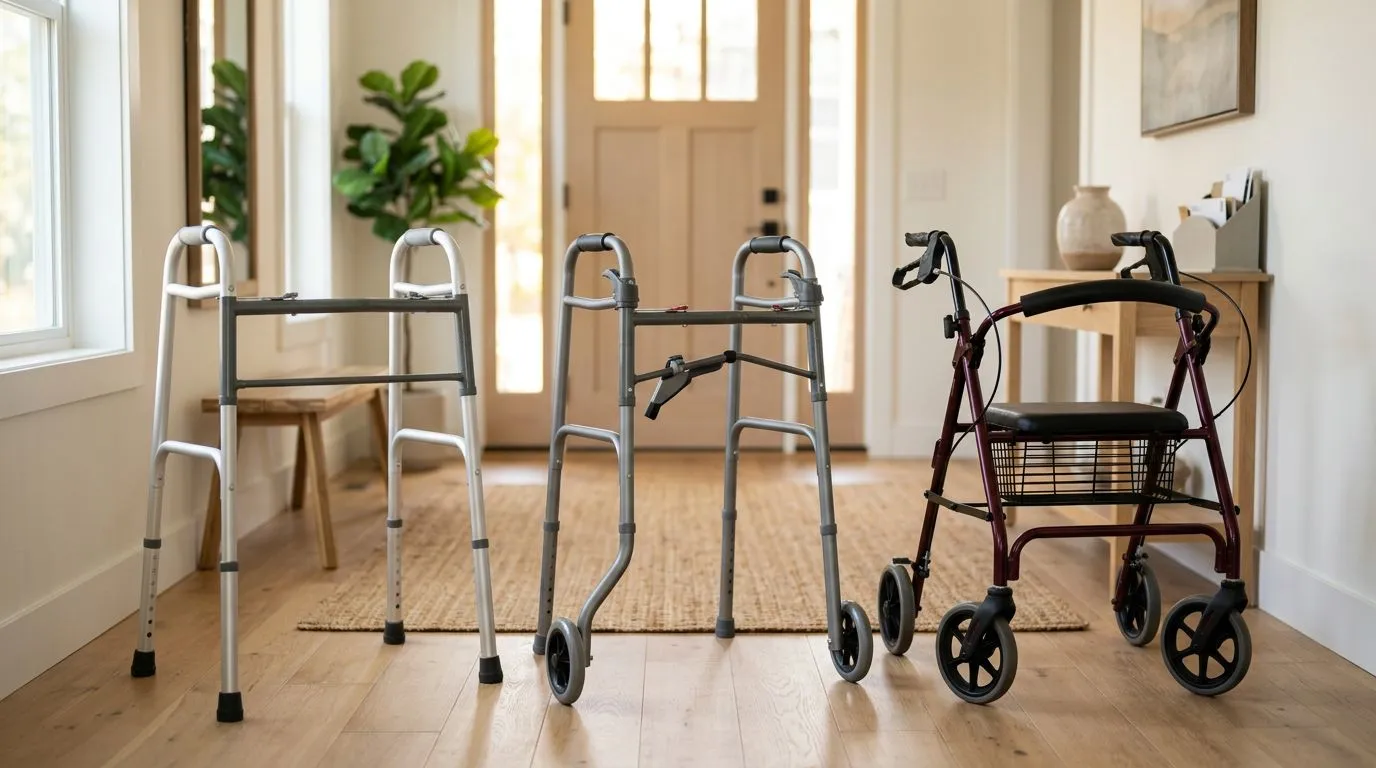
No-Wheel Walker vs Two-Wheel Walker vs Rollator: How Wheels Change Stability, Effort, and Control
13 min read
Indoor Mobility Walkers: Choosing a Walker or Rollator for Tight Spaces at Home
13 min read