Disclosure: We may earn a commission when you buy through links on this page, at no extra cost to you. We buy nothing, sell nothing and accept no payment for coverage — commissions never decide what we recommend. How we make money.
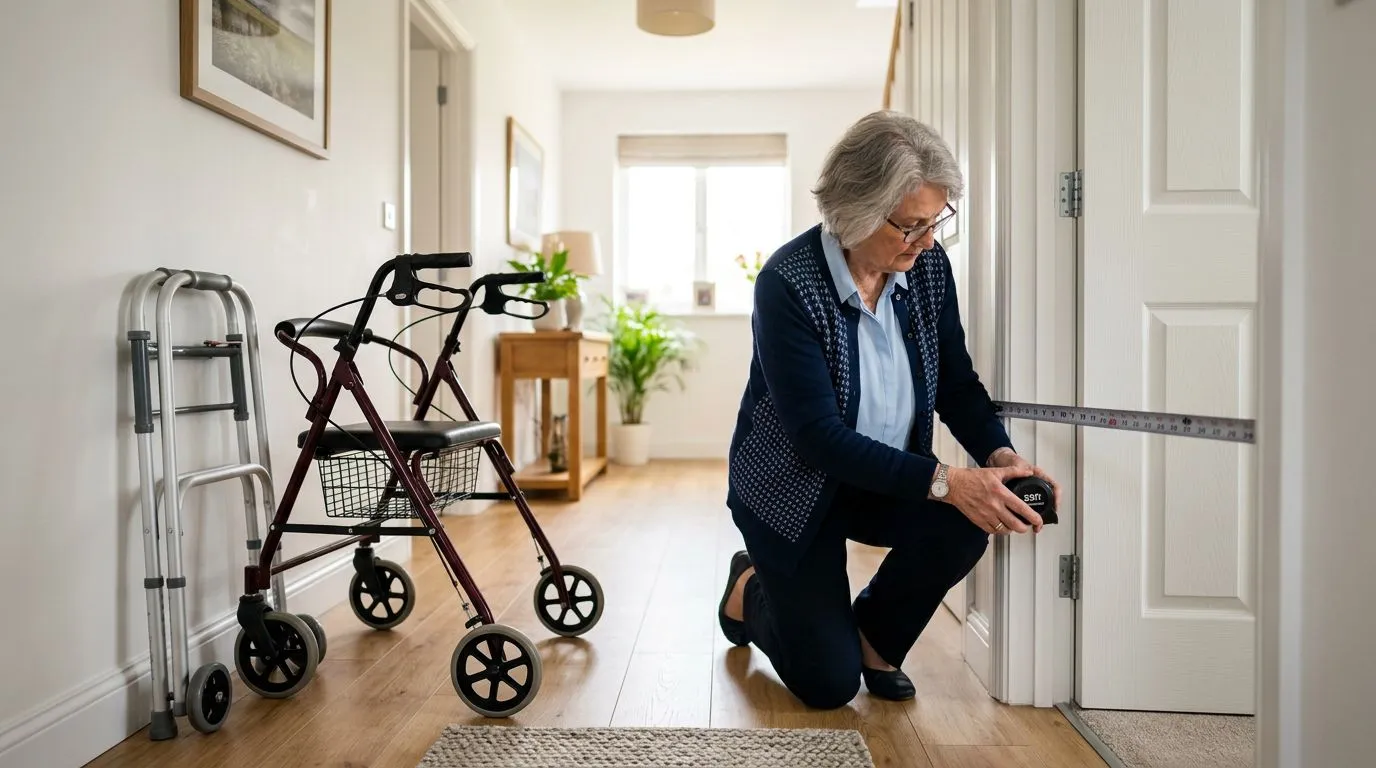
A walker or rollator will fit in many homes, but the real answer comes down to 4 measurements: doorway width, hallway width, turning space, and folded storage size. Most standard walkers are about 24 to 27 inches wide, while many 4-wheel rollators are about 24 to 30 inches wide, so a narrow bathroom door or tight hallway can make a big difference.
If your home has 30-inch doorways, clear 36-inch hallways, and a place to fold or park the device, you will have more options. If you have 24- to 28-inch doorways, sharp turns, thick rugs, or very small bathrooms, a narrower walker or compact rollator may be safer and easier to manage than a larger seated rollator.
Start With 4 Measurements: Doorways, Hallways, Turns, and Storage
Before comparing walker or rollator features, measure your home with a tape measure. A device that seems reasonable in a store can feel too wide when it reaches a 28-inch bedroom doorway, a 32-inch hallway, or a tight turn into a bathroom.
Write down these 4 numbers:
- Narrowest doorway: Measure the clear opening from the inside edge of the door frame to the opposite inside edge. Do not include trim. Common interior doors are often 28, 30, or 32 inches wide, but older homes may have 24- or 26-inch bathroom doors.
- Narrowest hallway: Measure wall to wall, then subtract anything that sticks out, such as a radiator, shoe rack, side table, or laundry basket.
- Turning space: Measure the open area where you must turn, such as outside a bathroom, beside the bed, or in a kitchen. Even 36 inches can feel tight with a larger rollator.
- Storage space: Measure the closet, corner, car trunk, or wall space where the walker or rollator will be parked. Folded size matters if the home is small.
Do not measure only the front door. The hardest spots are often the bathroom, bedroom, laundry area, and the path around furniture.
Walker and Rollator Widths: Typical Sizes From 23 to 32 Inches
Walkers and rollators are related mobility aids, but they do not use space in the same way. A standard walker or two-wheel walker is usually a simple frame, often without a seat, and may be easier to control in very tight indoor spaces. A rollator is a wheeled walker with hand brakes and usually a built-in seat; it rolls more continuously but often has a larger frame, wheels, and brake handles.
These are general size ranges, not exact measurements for every device. Always check the listed overall width, not just the seat width or wheel size.
| Type | Typical overall width | Indoor fit notes | Best home situations |
|---|---|---|---|
| Standard no-wheel walker | About 24 to 27 inches | Lift-and-place movement; can be steady but slower | Tight rooms, short indoor routes, narrow bathrooms |
| Folding walker | About 24 to 27 inches | Similar width to standard walkers; folds flatter for storage | Homes where closet or car storage matters |
| Two-wheel walker | About 24 to 27 inches | Front wheels roll while rear legs help control speed | Indoor use where full rolling is not needed |
| 3-wheel rollator | About 23 to 27 inches | Narrower and turns well, but usually no full built-in seat | Apartments, narrow halls, errands, compact storage |
| 4-wheel rollator | About 24 to 30 inches | Has hand brakes and a seat; needs more turning room | Homes with wider halls and a place to park it |
| Upright rollator | About 25 to 30 inches | Forearm supports and taller frame may need more clearance | Users who need a more upright walking posture and open pathways |
| Bariatric rollator | Often 28 to 32+ inches | Wider frame and seat; may not fit narrow doors | Homes with wide doorways and clear routes |
The smallest number is not always the best choice. A narrow device still needs to match the user's height, weight capacity, balance needs, hand strength, and daily routine.
Doorways: Allow at Least 2 Inches of Clearance
A practical rule is to leave at least 2 inches of total clearance between the device and the doorway. For example, a 26-inch-wide walker through a 28-inch clear doorway gives only 1 inch on each side. That may work, but it leaves very little room for angled entry, door hinges, fingers, and uneven movement.
Doorway fit depends on more than the number on paper. The door itself may not open fully. A towel hook, doorstop, raised threshold, or thick bathmat can reduce usable space. Bathroom doors are especially important because people often need the device when they are tired, moving slowly, or turning in a confined area.
Use this quick guide:
- 24-inch doorway: Very restrictive. Many walkers and rollators will not pass comfortably. A narrow walker may still be difficult.
- 26-inch doorway: Possible for some compact walkers or narrow 3-wheel rollators, but clearance is tight.
- 28-inch doorway: Often workable for many standard walkers and some compact rollators, but measure carefully.
- 30-inch doorway: Better for standard walkers, two-wheel walkers, and many 4-wheel rollators.
- 32-inch doorway: More forgiving, including for many seated rollators, though bariatric frames may still be close.
If the device barely fits straight through, test whether it also fits when approached from the hallway at an angle. Many real-life door entries are not straight.
Hallways and Turning Space: 36 Inches Feels Different Than 30 Inches
Hallway width affects how easily a walker or rollator can be used without scraping walls or catching wheels. A 36-inch hallway is much easier than a 30-inch hallway, especially with a 4-wheel rollator, upright rollator, or bariatric frame.
Turning space matters even more. A rollator with 8-inch wheels and a seat can be easy to push forward but awkward in a small U-turn near a bathroom or bed. A standard walker may be easier to reposition in small increments because it can be lifted and set down, but that requires enough strength and coordination to lift the frame safely.
Common tight spots to check
- Bedroom to bathroom route: Measure the full path, not just the doorway.
- Beside the bed: Leave enough room to turn and back up. A 24-inch gap may be too tight for many users.
- Kitchen work triangle: Check the distance between counters, island, refrigerator, and stove. A rollator seat or basket can catch on cabinet handles.
- Laundry area: Doors that swing outward, baskets, and machines can reduce usable width by several inches.
- Entryway: Shoes, mats, umbrella stands, and thresholds can make a wide doorway feel narrow.
For many homes, a clear path of about 30 inches is a minimum target for basic passage, while 36 inches or more gives better maneuvering. Extra space helps if the user turns slowly, uses oxygen tubing, has limited vision, or needs a caregiver nearby.
Storage and Folding Size: Walkers May Fold to 4 Inches, Rollators Often Need More
Storage is part of fit. A walker or rollator that blocks a hallway can become a trip hazard. Many folding walkers fold relatively flat, often around 4 to 8 inches deep depending on the frame. Rollators fold too, but the wheels, seat, brake cables, and backrest can make the folded shape bulkier, often closer to 10 to 18 inches deep.
| Device type | Typical folded profile | Storage considerations |
|---|---|---|
| Folding standard walker | Often about 4 to 8 inches deep | Good for closets, behind doors, and car trunks |
| Two-wheel folding walker | Often about 5 to 9 inches deep | Front wheels add bulk but still usually stores flat |
| 3-wheel rollator | Often about 8 to 12 inches deep | Triangular frame may stand in a corner; usually compact |
| 4-wheel rollator | Often about 10 to 18 inches deep | Seat, basket, and wheels need a larger parking spot |
| Upright rollator | Often about 12 to 20 inches deep | Taller handles and forearm supports need vertical clearance |
| Bariatric rollator | Often 14 inches or more deep | Wider frame may not fit small closets or tight car trunks |
Also think about daily parking, not just long-term storage. Where will the device go while the user sits at a dining table? Can it be reached from the bed? Will it block a bathroom door? A rollator with a seat can be convenient, but it still needs a safe place when not in motion.
How to Measure Your Home in 15 Minutes
You can do a useful home fit check in about 15 minutes with a tape measure, painter's tape, and a notepad. If possible, have another person help measure and observe the route the user takes most often.
Step-by-step fit check
- 1. Measure the device width you are considering. Use overall outside width, usually wheel-to-wheel or frame-to-frame. Do not rely on seat width.
- 2. Measure the narrowest doorways. Check front door, bedroom, bathroom, and any doorway used at night.
- 3. Measure hallways at the narrowest point. Include furniture, wall-mounted items, and doors that swing into the path.
- 4. Mark the footprint on the floor. Use painter's tape to mark a rectangle about 26 inches wide for many walkers or 30 inches wide for a larger rollator. Walk the route and see what it hits.
- 5. Check turns. Stand at the bathroom entrance, beside the bed, and at the kitchen corner. Ask: can the device turn without backing up repeatedly?
- 6. Measure storage. Confirm folded width, depth, and height against the closet, wall space, or car trunk.
- 7. Check floor transitions. Thresholds higher than about 1/2 inch, loose rugs, and thick carpet can affect wheels and walker legs.
Handle height matters too. Many walkers and rollators adjust across several inches, but the correct setting should be based on the user's body, not the doorway. A common starting point is handle height near the wrist crease when the person stands upright with arms relaxed at the sides, but a clinician or mobility professional can help if posture, pain, or balance is complicated.
Who a Compact Walker Is Best For in a Small Home Under 800 Square Feet
In a small apartment, older home, or home under about 800 square feet, a standard walker, folding walker, or two-wheel walker may fit better than a large seated rollator. These walker types are often narrower, simpler, and easier to park beside a bed or toilet.
A walker may be the better indoor choice if:
- The bathroom doorway is 24 to 28 inches wide.
- The user moves short distances and does not need a built-in seat every few minutes.
- The home has tight turns where a rollator's wheels and seat frame catch.
- The user benefits from a slower, more controlled step-by-step pattern.
- Storage space is limited to a narrow closet or behind a door.
A no-wheel walker can feel very stable because it does not roll unless lifted, but it also requires the user to pick it up and place it forward. A two-wheel walker reduces lifting because the front wheels roll while the rear legs provide drag and control. For many indoor layouts, that middle ground works well.
The tradeoff is speed and convenience. Walkers usually do not include a built-in seat, hand brakes, or large storage bags. If the user needs frequent seated rests, a rollator may still be the better choice if the home can accommodate it.
Who a Rollator Is Best For When You Have 30- to 36-Inch Pathways
A rollator can fit well indoors when doorways are closer to 30 or 32 inches and hallways or main paths are about 36 inches or wider. Rollators are designed to roll smoothly, include hand brakes, and commonly provide a built-in seat for rest breaks.
A rollator may be the better choice if:
- The user can safely operate hand brakes every time they stop or sit.
- The home has open pathways without many sharp, narrow turns.
- The user needs a seat for rest breaks during daily routines.
- The main surfaces are smooth enough for wheeled movement.
- The device will also be used outdoors, in stores, or on longer indoor routes.
Three-wheel rollators are often easier to maneuver in tight apartments because they have a smaller turning profile. Many do not have a full seat, so they are not the same as a 4-wheel rollator for resting. Four-wheel rollators offer more seating convenience but usually take more space. Upright rollators can support a more elevated arm position, yet their taller frame and forearm platforms can be awkward in compact rooms. Bariatric rollators provide higher weight capacities and wider seats, but their extra width can be a poor match for narrow doors.
The brakes are not optional. If a person forgets to lock the brakes before sitting, or lacks the hand strength to control them, a rollator may increase risk rather than reduce it. That is a good reason to ask a physical therapist, occupational therapist, or medical equipment professional for an in-person fit check.
Feature Tradeoffs: 6 Details That Affect Indoor Fit
Two devices with the same 26-inch width may behave very differently at home. Look at these 6 fit-related features before deciding.
| Feature | Why it matters indoors | What to check |
|---|---|---|
| Overall width | Determines doorway clearance | Compare to narrowest door, leaving about 2 inches total clearance |
| Wheel size | Larger wheels roll over thresholds but add bulk | Common rollator wheels are often 6 to 10 inches |
| Seat and backrest | Add convenience but increase storage and turning space | Confirm the seat does not block bathroom or kitchen turns |
| Brake handles and cables | Can catch on furniture or door trim | Check the widest point, including handles |
| Weight capacity | Must match the user safely | Many standard devices are rated around 250 to 300 pounds; bariatric options may be 350 pounds or higher |
| Device weight | Affects lifting into cars or moving aside | Walkers are often lighter than seated rollators |
Weight capacity deserves special attention. Never choose a narrower frame if it does not meet the user's weight rating. Fit in the home matters, but structural safety comes first.
5 Home Adjustments That Can Add 2 to 6 Inches of Usable Space
Sometimes the right answer is not a different walker or rollator. Small home changes can add 2 to 6 inches of usable clearance and make daily movement safer.
- Remove loose rugs and thick mats. They can catch walker legs, wheels, and toes. Use low-profile, secured flooring solutions if a mat is necessary.
- Reposition furniture. Moving a side table 4 inches can create a better turning path beside a bed or sofa.
- Use offset hinges where appropriate. In some doorways, swing-clear hinges can add usable width by moving the door farther out of the opening.
- Clear wall clutter. Hooks, baskets, plant stands, and decorative items can steal several inches from a hallway.
- Create a parking zone. Mark a safe place near the bed, favorite chair, or dining area so the device does not block walking paths.
Bathroom changes may take more planning. Grab bars, raised toilet seats, shower chairs, and doorway modifications can help some homes, but they should be selected for the person's needs and installed correctly. An occupational therapist can often spot layout problems that are easy to miss.
Final Fit Checklist: Use the Narrowest 1 Inch to Decide
The best walker or rollator for your home is the one that fits the user and the floor plan at the same time. If a device is only 1 inch narrower than the doorway, expect daily frustration; if it has 2 to 4 inches of clearance and a workable turning path, it is much more likely to be used consistently.
- Measure the narrowest doorway, not the widest.
- Compare clear door width to overall device width.
- Leave at least 2 inches of total clearance when possible.
- Check 30- to 36-inch paths through halls and rooms.
- Test turns at the bathroom, bed, kitchen, and entry.
- Confirm folded storage size, not just open size.
- Choose a walker for tighter, shorter indoor routes when appropriate.
- Choose a rollator when the user needs wheels, brakes, and a seat and the home has room.
A good fit should feel boring in the best way: no scraping, no forced turns, no blocked doors, and no unsafe parking spots. Measure first, then choose the device type that supports safe daily movement in the real home.
FAQ: Home Fit for Walkers and Rollators
What is the narrowest doorway a walker can fit through?
Some compact walkers may fit through a 26-inch doorway, but many standard walkers are about 24 to 27 inches wide, leaving little clearance. A 28- to 30-inch doorway is usually more practical, depending on the walker and the approach angle.
Do rollators fit through bathroom doors?
Some rollators fit through 28- to 32-inch bathroom doors, but larger 4-wheel, upright, and bariatric rollators may not. Measure the rollator's overall width, including wheels and brake handles, then compare it with the clear doorway opening.
Is a 3-wheel rollator better for small apartments?
A 3-wheel rollator can be a good choice for small apartments because it is often narrower and turns more easily than a 4-wheel rollator. The tradeoff is that many 3-wheel rollators do not have a full built-in seat.
How much hallway space do I need for a walker or rollator?
A clear path of about 30 inches may allow basic passage for many walkers, while 36 inches or more is easier for rollators and turning. Furniture, rugs, baskets, and open doors can reduce usable space.
Can a walker or rollator be stored behind a door?
Many folding walkers can be stored behind a door because they often fold relatively flat. Rollators are bulkier when folded due to wheels, seats, and brakes, so measure the folded depth before relying on behind-the-door storage.
Should I choose the narrowest mobility aid available?
Not automatically. The device must also match the user's height, weight capacity, balance needs, hand strength, and walking pattern. A narrow frame that feels unstable or is rated below the user's weight is not a safe choice.
FAQ
Frequently asked questions
Should I choose the narrowest walker or rollator available? +
Not automatically. The device also needs to fit the user's height, weight capacity, balance needs, hand strength, and daily routine. Home fit matters, but safety and proper support come first.
Keep reading
Related guides
Preparing Your Home for a Walker or Rollator: Room-by-Room Space and Storage Checklist
13 min read
Narrow Rollator Walkers: How to Check Width, Wheelbase, and Turning Radius Before You Buy
14 min read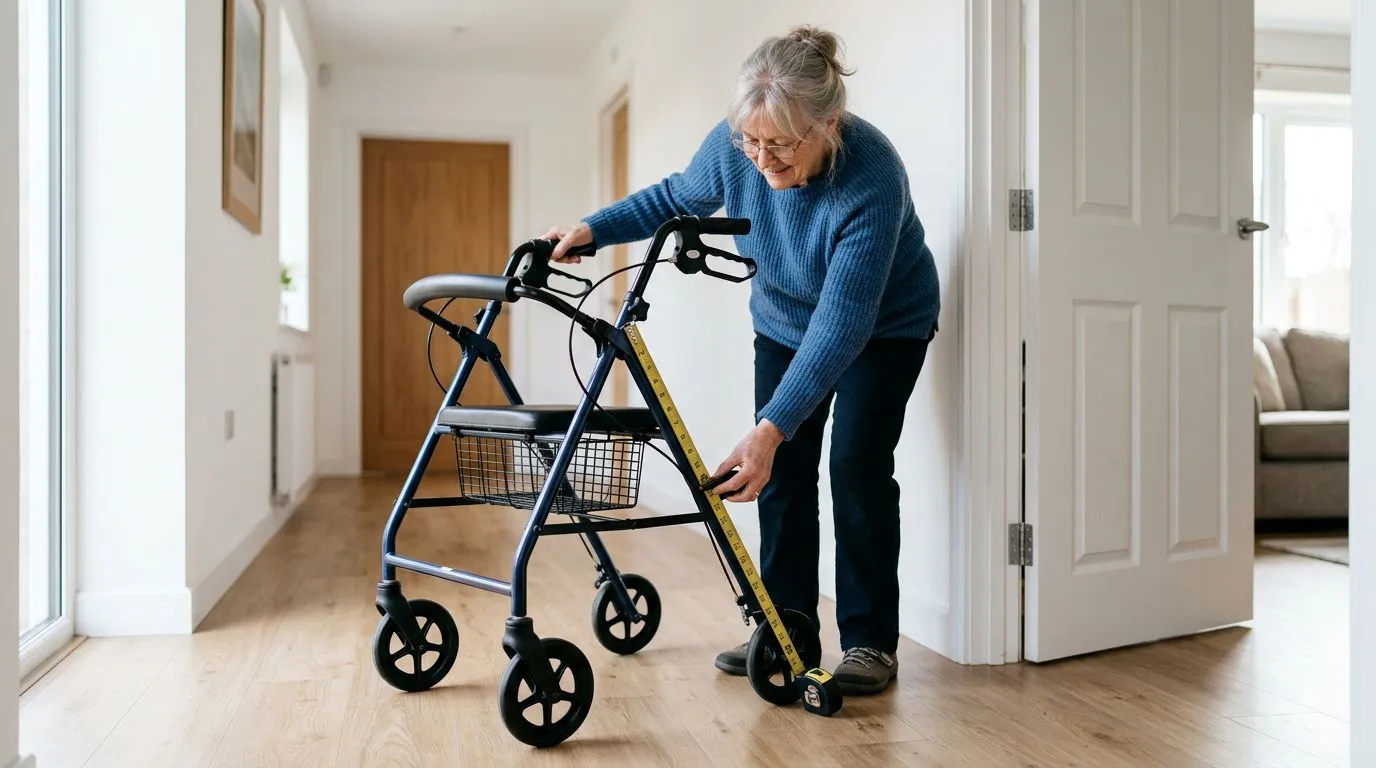
Inside Width vs Overall Width: How Much Room You Need in a Walker or Rollator
13 min read