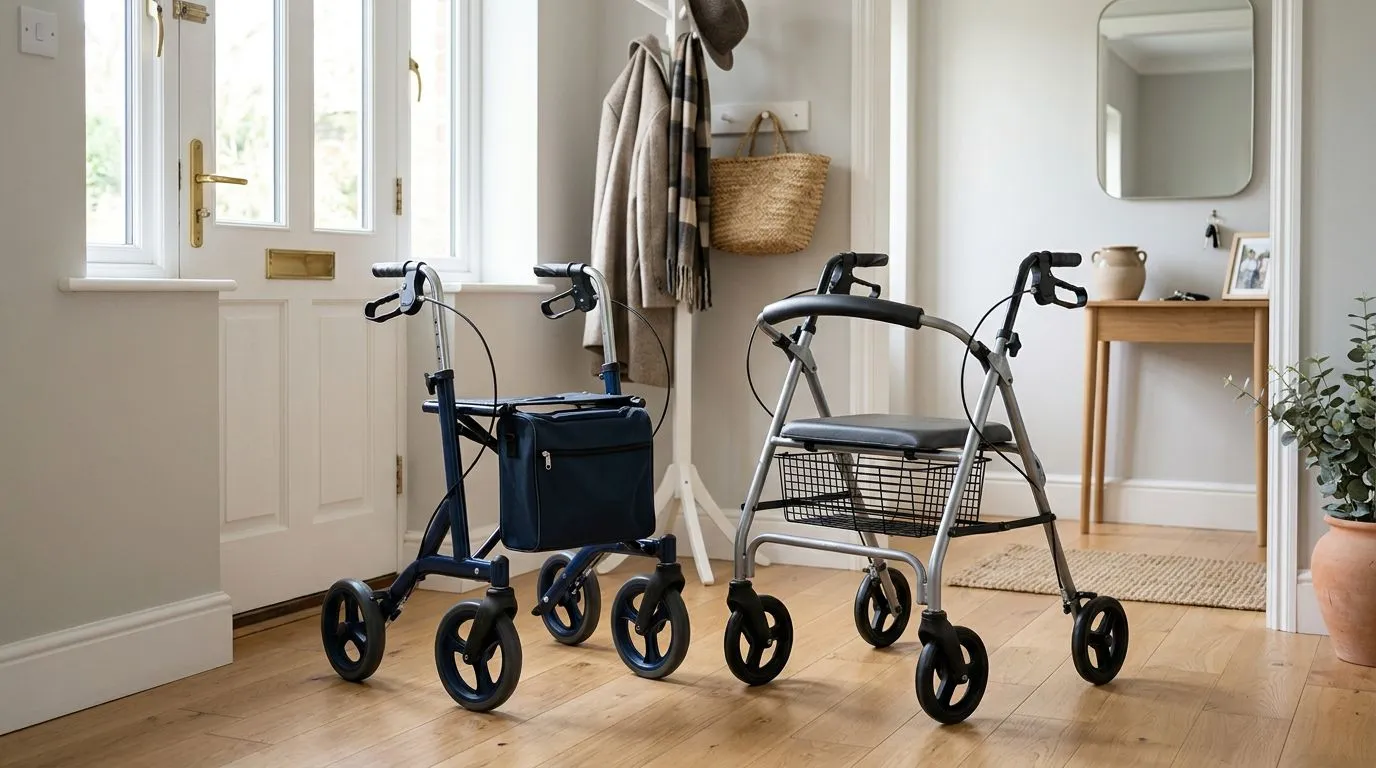
Disclosure: We may earn a commission when you buy through links on this page, at no extra cost to you. We buy nothing, sell nothing and accept no payment for coverage — commissions never decide what we recommend. How we make money.
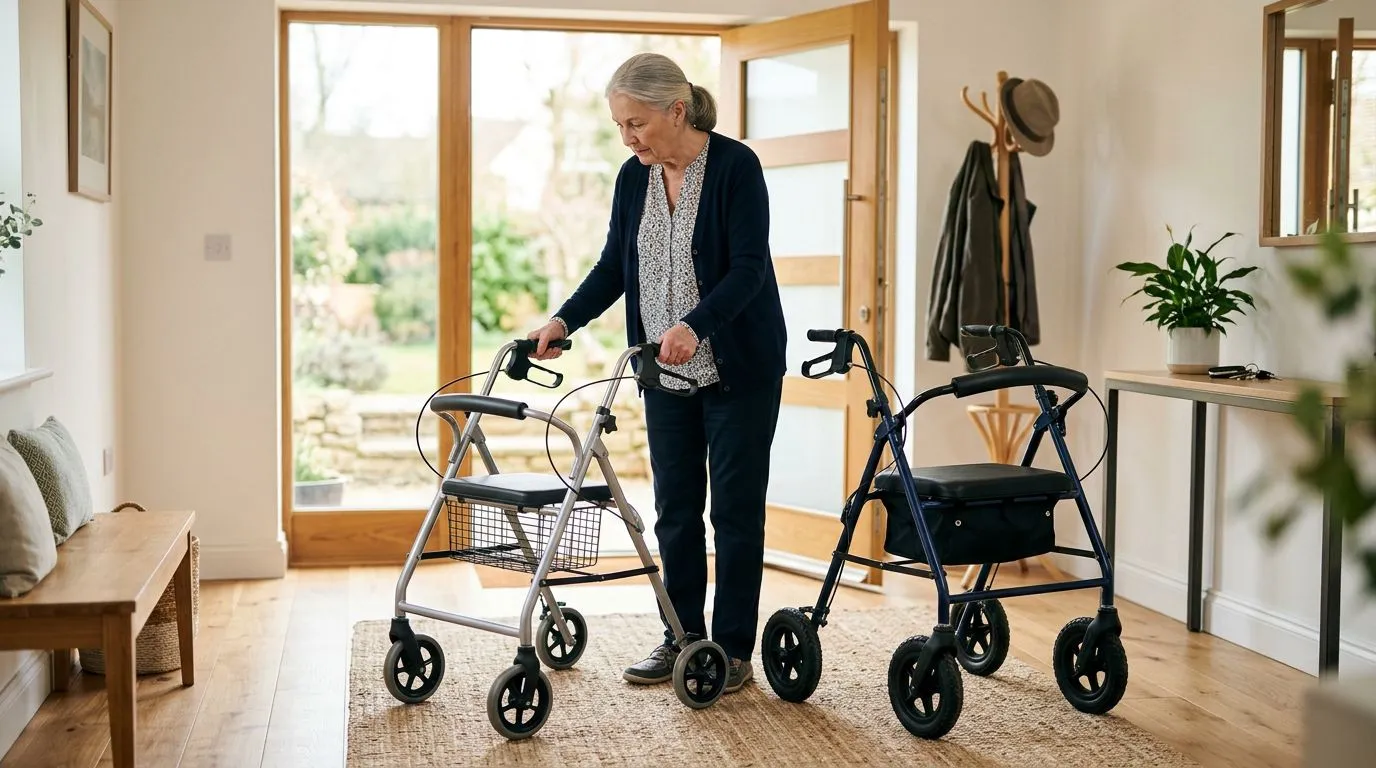
A premium rollator walker is worth paying more for when it gives you a safer fit, easier braking, better wheels for your surfaces, a more comfortable seat, or a frame that stands up to daily use. If you only need light support for short indoor trips, a basic rollator may be enough. The right choice depends less on price and more on your height, strength, walking environment, balance needs, and how often you use it.
Rollator walkers are not all designed for the same job. A 3-wheel rollator in a narrow apartment is a different tool from a 4-wheel rollator with a padded seat, an upright rollator for posture support, or a bariatric rollator built for a higher weight capacity. This guide explains which features usually justify the higher cost and which upgrades may not affect your day-to-day life.
Budget vs premium rollators: the 6 features that usually matter most
The features most worth paying more for are brakes, wheels, seat comfort, frame strength, adjustability, and foldability. These are the parts you touch and depend on every time you walk, sit, turn, or load the rollator into a car.
Most rollators have 3 or 4 wheels, 2 hand brakes, and a stated weight capacity that commonly starts around 250 to 300 pounds, with bariatric designs often rated higher. Premium does not automatically mean safer, but a better-matched rollator can feel more stable, roll more smoothly, and make daily use less frustrating.
| Feature | Budget rollator may be enough if... | Pay more when... |
|---|---|---|
| Brakes | You walk slowly indoors on level floors. | You need easy-to-squeeze brakes, reliable parking locks, or walk on slopes. |
| Wheels | You use it mainly on smooth indoor surfaces. | You cross thresholds, sidewalks, carpet, gravel paths, or uneven pavement. |
| Seat | You rarely sit on the rollator. | You rest often or need a wider, padded, more supportive seat. |
| Frame weight | You will not lift it often. | You load it into a car, carry it up 1 or 2 steps, or travel frequently. |
| Adjustability | Your height fits the standard handle range well. | You are petite, tall, or need more precise handle and seat height options. |
| Durability | You use it occasionally. | You use it daily, outdoors, or at a higher body weight. |
One practical rule: do not pay extra for features you will not use, but do not underbuy on brakes, fit, or weight capacity. Those are core safety and usability issues, not cosmetic extras.
Rollator walker vs standard walker: 2 wheels, 4 wheels, brakes, and seats
A rollator walker is a wheeled mobility aid with hand brakes. Most 4-wheel rollators also include a built-in seat and backrest, while many 3-wheel rollators are narrower and do not include a full seat. A standard walker, in contrast, may have no wheels or 2 front wheels, and it typically does not have hand brakes or a seat.
That difference matters when comparing budget and premium options. With a standard walker, you are mostly paying for frame weight, foldability, height adjustment, and grip comfort. With a rollator, you are also paying for brake quality, wheel size, wheel material, seat design, bearings, hinges, and locking mechanisms.
| Type | Typical design | Best for | Limitations |
|---|---|---|---|
| Standard walker | No wheels; lifted with each step | Maximum stability at slow speed | No seat; slower; requires lifting |
| Two-wheel walker | 2 front wheels, rear legs or glides | Indoor use with more stability than a rollator | No hand brakes; limited outdoor comfort |
| 3-wheel rollator | 3 wheels, hand brakes, narrow turning | Tight indoor spaces and light errands | Often no seat; less resting support |
| 4-wheel rollator | 4 wheels, hand brakes, seat and backrest | Walking plus seated rest breaks | Needs brake control and enough space to turn |
| Upright rollator | Forearm supports and taller frame | People who need a more upright walking position | Often heavier and bulkier |
| Bariatric rollator | Reinforced frame and wider seat | Higher weight capacity and broader seating needs | Heavier, wider, and harder to store |
If you need to lean heavily on your mobility aid for balance, ask a clinician whether a standard walker or 2-wheel walker is more appropriate. Rollators roll easily, which helps with endurance but is not ideal for every balance condition.
Seat comfort: when 2 extra inches and padding are worth paying for
A rollator seat is not just a convenience. For many users, it is what makes longer outings possible, whether that means waiting 10 minutes in a pharmacy line or resting halfway through a park path. Seat width, depth, height, padding, and backrest design all affect comfort.
Budget 4-wheel rollators often have a simple hard seat or a lightly padded seat. That can be fine for brief rests of 2 to 5 minutes. A premium seat may be wider, deeper, more padded, or paired with a better backrest. You will notice the difference most if you rest often, have a larger body frame, or dislike pressure on the backs of your thighs.
- Seat width: Many rollator seats fall roughly in the 12- to 18-inch range, with bariatric seats often wider.
- Seat height: Common seat heights are often around 18 to 23 inches, but fit varies by design.
- Padding: Worth it if you sit for more than a few minutes at a time.
- Backrest: A flexible strap may be enough for short rests; a firmer or shaped backrest may feel better for frequent sitting.
Pay more for seat comfort if the rollator will take the place of benches and chairs during daily errands. If you almost never sit, a simpler seat or even a 3-wheel rollator without a seat may be the smarter buy.
Brakes and wheels: why 6- to 10-inch wheels can change control
Brakes are one of the clearest places where quality matters. A rollator usually has loop-style hand brakes that slow the wheels when squeezed and lock for parking when pushed down. The parking brake should hold the rollator still before you sit, every single time.
Budget brakes may work well on smooth floors, while premium brake systems may feel easier to control, especially for people with hand weakness, arthritis, or reduced grip strength. The key test is simple: can you squeeze both brakes comfortably 10 times in a row, and can you lock and unlock them without strain?
Wheel size matters too. Smaller 6-inch wheels are common on compact rollators and can be easy to maneuver indoors. Larger 8- or 10-inch wheels often handle sidewalk cracks, door thresholds, rugs, and uneven surfaces more smoothly. If your home has thick carpet or you regularly walk outside, bigger wheels may be worth the added bulk.
- 6-inch wheels: Good for smooth indoor floors and tighter spaces.
- 8-inch wheels: A balanced choice for mixed indoor and outdoor use.
- 10-inch wheels: Better for rougher sidewalks, but may add weight and size.
Do not judge wheels by size alone. Tire material, tread, axle quality, and how the rollator turns all affect the ride. Still, if you will use the rollator outdoors 3 or more days per week, wheels and brakes are usually worth prioritizing over cosmetic upgrades.
Frame weight, folding, and durability: the 15- to 25-pound tradeoff
A lighter rollator is easier to lift, but a stronger rollator may feel more solid. Many everyday rollators weigh somewhere around 15 to 25 pounds, depending on frame material, wheel size, seat design, and weight capacity. Bariatric and upright rollators may weigh more because they use larger or reinforced components.
Paying more for a lighter frame can be worthwhile if you lift the rollator into a car trunk several times a week. Even a 5-pound difference can matter when you are tired or dealing with shoulder, wrist, or back discomfort. A compact fold also helps if you store the rollator in a hallway, small apartment, closet, or back seat.
Durability is the other side of the tradeoff. A rollator used twice a month indoors does not need the same construction as one used every day on sidewalks. Look closely at hinge points, brake cables, wheel mounts, seat supports, and folding locks. These are the parts that take repeated stress.
- Choose lighter weight if you travel, drive, or lift the rollator often.
- Choose stronger construction if you use it daily or need a higher weight capacity.
- Choose easy folding if you have limited hand strength or tight storage.
There is no single best frame. Aluminum is commonly used because it balances strength and manageable weight. Steel may feel sturdy but can be heavier. What matters most is whether the frame supports the stated capacity, fits your body, and folds in a way you can manage without help.
Fit and adjustability: measure handle height in 3 minutes
A rollator that is too tall can make your shoulders rise and your elbows lock. One that is too low can make you stoop and push the frame too far ahead. Handle height is one of the most important measurements, and you can check it in about 3 minutes.
How to measure for rollator handle height
- Stand in your usual walking shoes.
- Let your arms hang naturally at your sides.
- Have someone measure from the floor to the crease of your wrist.
- Look for a rollator handle range that includes that number.
- When holding the grips, your elbows should have a slight bend, often around 15 degrees.
Seat height needs attention as well. When seated, your feet should rest on the floor with your knees bent comfortably. If the seat is too high, you may feel perched. If it is too low, standing back up can be harder.
Premium rollators may offer a wider adjustment range, more handle positions, adjustable forearm supports on upright rollators, or a better fit for very short or very tall users. This is worth paying for when the standard height range does not match your body. A poor fit can turn a good rollator into an uncomfortable one.
Who it is best for: budget, midrange, and premium rollators in 3 use cases
The best rollator category depends on how and where you use it. A person walking 30 feet from bedroom to kitchen has different needs than someone walking 3 blocks to the grocery store.
| User situation | Likely best choice | Features to prioritize |
|---|---|---|
| Short indoor use a few times per week | Budget 3-wheel or 4-wheel rollator | Correct height, basic brakes, manageable width |
| Daily errands and mixed surfaces | Midrange or premium 4-wheel rollator | 8-inch or larger wheels, comfortable seat, dependable brakes |
| Frequent outdoor walking | Premium 4-wheel rollator or upright rollator | Larger wheels, stronger frame, better hand brakes, good folding design |
| Need frequent seated rests | 4-wheel rollator with upgraded seat | Seat width, seat height, padding, backrest comfort |
| Higher weight capacity needed | Bariatric rollator | Rated capacity, wider seat, reinforced frame, doorway width |
| Narrow hallways or small apartment | Compact 3-wheel rollator | Turning radius, overall width, fold size |
For many shoppers, the sweet spot is not the most expensive rollator. It is the least complicated rollator that fits correctly, brakes confidently, supports the user’s weight, and handles the surfaces they actually walk on.
What not to pay extra for: 5 upgrades that may be optional
Some premium features are genuinely helpful. Others are nice but not necessary. Before paying more, ask whether the upgrade solves a daily problem or simply looks appealing.
- Extra storage you will not use: A small under-seat pouch may be enough for keys, a phone, and a wallet.
- Oversized wheels for indoor-only use: Large wheels can add bulk in tight spaces.
- Heavy frames marketed as sturdier: More weight is not always better if you cannot lift or fold it.
- Complex folding systems: A clever fold is only useful if you can operate it safely.
- Style-only upgrades: Color and trim are personal preferences, not safety features.
There is also a point where a rollator may not be the right mobility aid. If you need substantial weight-bearing support, have frequent falls, or cannot reliably use hand brakes, a standard walker, 2-wheel walker, or another device may be safer. A physical therapist or occupational therapist can help match the device to your mobility needs.
Before you buy: a 10-point rollator checklist
Use this checklist before choosing between a budget and premium rollator. Ten minutes of measuring and testing can prevent an uncomfortable purchase.
- Check that the stated weight capacity is above the user’s current weight, with appropriate margin.
- Measure handle height from floor to wrist crease while wearing normal shoes.
- Confirm the seat height lets both feet rest on the floor.
- Measure doorways and tight hallways; many interior doorways are about 28 to 32 inches wide.
- Test both hand brakes for squeeze comfort and parking lock security.
- Match wheel size to surfaces: smooth floors, carpet, thresholds, sidewalks, or outdoor paths.
- Lift the rollator if it will go into a car; note whether 15, 20, or 25 pounds feels manageable.
- Fold and unfold it at least 3 times to check effort and pinch points.
- Sit on the seat and stand back up to confirm comfort and stability.
- Consider maintenance, including brake adjustment, wheel wear, and keeping moving parts clean.
If you are choosing for an older parent or spouse, include that person in the testing whenever possible. A rollator that looks excellent on paper can still be wrong if the user dislikes the grips, cannot manage the brakes, or feels unsteady turning it.
FAQ: 5 common questions about paying more for a rollator walker
Is a premium rollator always safer than a budget rollator?
No. Safety depends on fit, weight capacity, brake function, user ability, and the walking environment. A correctly fitted budget rollator can be safer than a premium rollator that is too tall, too wide, too heavy, or hard to brake.
Are bigger wheels worth it on a rollator?
Bigger wheels are often worth it if you walk outdoors, cross thresholds, or use the rollator on uneven sidewalks. For indoor-only use on smooth floors, smaller wheels may be easier to maneuver and store.
Should I choose a 3-wheel or 4-wheel rollator?
A 3-wheel rollator is usually better for tight spaces and quick turning, but it often lacks a full seat. A 4-wheel rollator is usually better if you need a built-in seat, more storage, and a more traditional walking-and-resting setup.
When is an upright rollator worth paying more for?
An upright rollator may be worth considering if standard handles encourage uncomfortable stooping and a clinician agrees that forearm support is appropriate. They can be heavier and larger, so test turning, braking, and folding before buying.
What feature should I not compromise on?
Do not compromise on fit, brakes, and weight capacity. A comfortable seat or lighter frame is valuable, but a rollator that does not fit your height or stop securely is the wrong choice.
FAQ
Frequently asked questions
Are bigger wheels worth it on a rollator walker? +
Bigger wheels are often worth it for outdoor use, thresholds, carpet, and uneven sidewalks. For smooth indoor floors, smaller wheels may be easier to turn and store.
Which rollator features should I not compromise on? +
Do not compromise on fit, brakes, or weight capacity. Seat comfort, frame weight, and wheel size are also important, but the rollator must fit your body and stop securely first.
Keep reading
Related guides

How Much Does a Rollator Walker Cost? US Price Ranges, Features, and Value
11 min read
Cheap Rollator Walkers: Safety and Comfort Trade-Offs to Check Before You Buy
14 min read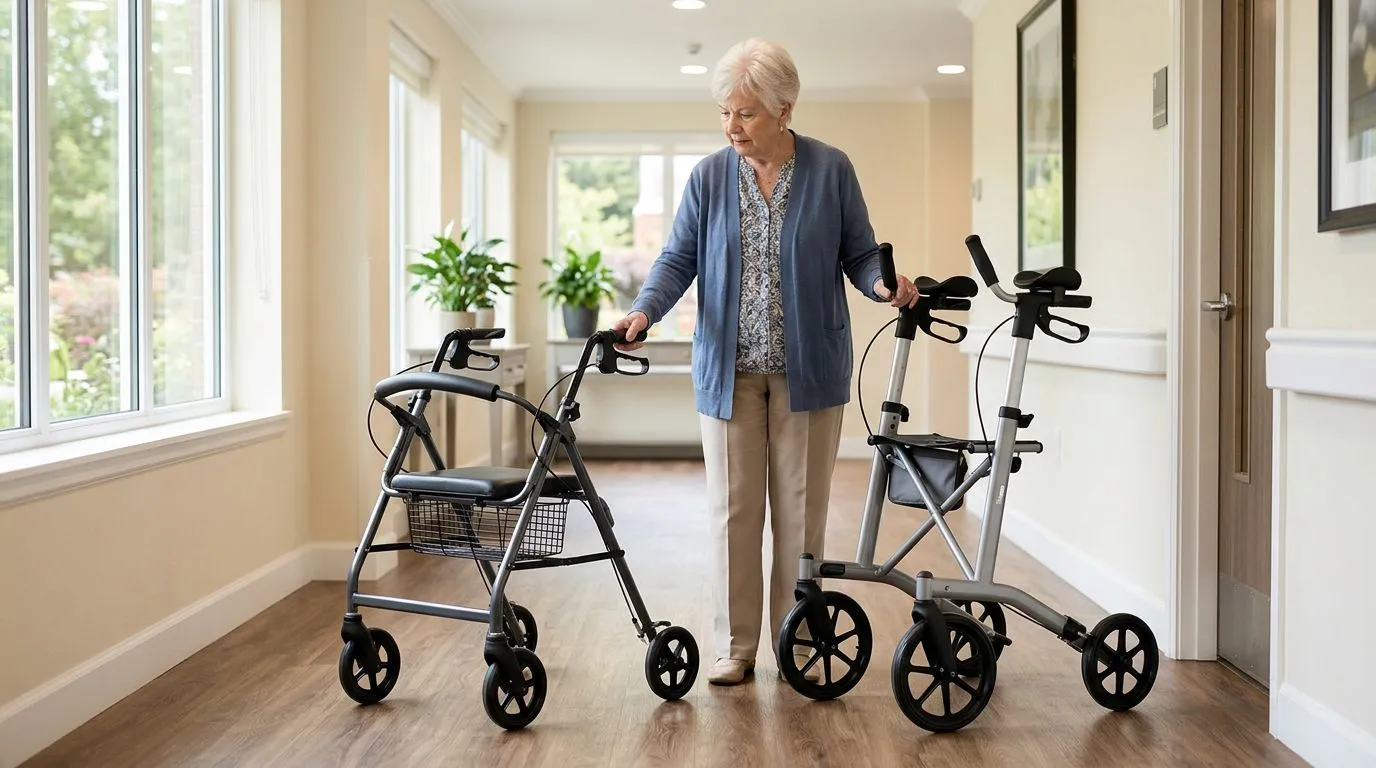
Upright Rollator Cost vs Standard Rollator Cost: Are Stand-Up Features Worth Paying More For?
13 min read