Disclosure: We may earn a commission when you buy through links on this page, at no extra cost to you. We buy nothing, sell nothing and accept no payment for coverage — commissions never decide what we recommend. How we make money.

A cheap rollator walker can be a good buy if it fits the user, rolls smoothly, brakes reliably, and supports the right weight capacity. The main trade-offs to check are stability, brake quality, seat comfort, wheel size, frame strength, and how easy it is to find replacement parts. If the person needs firm support with every step, a standard walker may be safer than a rollator, even if the rollator seems more convenient.
Price matters. Safety matters just as much. Low-cost rollators can help people move around the home, shop, and rest on a built-in seat, but not every inexpensive option suits the same body size, walking pattern, or surface. Use the checks below to compare generic rollator walkers and standard walkers without depending on brand names or marketing claims.
Cheap rollator walkers in 60 seconds: what you are really buying
A rollator is a wheeled walker with hand brakes, usually 3 or 4 wheels, and often a seat. Most 4-wheel rollators include a seat and storage pouch or basket, while many 3-wheel rollators are narrower and lighter but do not offer a full sitting surface. Common rollator wheel sizes include 6-inch and 8-inch wheels, and many standard user weight capacities are around 250 to 300 pounds.
When shoppers say cheap rollator walker, they usually mean a basic, no-frills wheeled mobility aid rather than a premium model with extra-wide seats, large outdoor wheels, heavy-duty frames, or upright forearm supports. A lower-cost rollator may still work well for light daily use. The issue is not the low price alone. It is whether cost-cutting appears in the parts that affect safety: brakes, frame rigidity, wheel quality, seat support, and adjustability.
A rollator is not just a shopping cart with a seat. The user puts body weight through the handles, turns with the frame, and may sit on the seat when tired. Fit has to be right. A rollator that is too tall can strain the shoulders, while one that is too low can pull the user into a stooped posture. A seat that is too high may leave the feet dangling; a seat that is too narrow may feel insecure.
Rollator vs walker: 4 differences that affect a budget purchase
Rollators and walkers are related, but they are not the same product. A standard walker, folding walker, or no-wheel walker frame is lifted and placed forward with each step. A two-wheel walker has wheels on the front legs and glides more easily, but the rear legs still provide friction and stability. A rollator has 3 or 4 wheels and hand brakes, so it moves continuously and requires more brake control.
| Type | Typical features | Best fit | Budget caution |
|---|---|---|---|
| Standard or folding walker | No wheels, often adjustable handles | People who need maximum stability with every step | Slower to use; no built-in seat |
| Two-wheel walker | Front wheels, rear glide tips or legs | People who need stability but cannot lift a full walker easily | Check rear tips often for wear |
| 3-wheel rollator | Triangular frame, hand brakes, tight turning | Narrow hallways and lighter support needs | Usually no full seat; less stable than 4-wheel designs |
| 4-wheel rollator | Four wheels, hand brakes, seat, storage | People who walk longer distances and need rest breaks | Brake quality and seat strength matter |
| Upright rollator | Forearm supports, taller frame, hand brakes | People advised to walk more upright | Fit is more complex; heavier frame may be harder to load |
The biggest safety difference is simple: a walker can be more stable for someone who leans heavily through the device, while a rollator is better for someone who can control a wheeled frame and use brakes. A person with poor grip strength, delayed reaction time, or balance loss during turns should not choose a rollator just because it has a seat.
In tight spaces, measure the home. Many interior doorways are about 30 to 32 inches wide, though older homes can be narrower. A rollator that is wide, has outward-angled wheels, or needs extra turning space may be frustrating indoors. A basic folding walker can sometimes fit where a bulky rollator cannot.
Who a low-cost rollator is best for: 3 common situations
A budget rollator can make sense for a person who walks independently but tires after several minutes and needs a convenient place to sit. It can also work well for errands, apartment hallways, community rooms, or smooth sidewalks where the surface is predictable. The user should be able to squeeze hand brakes, lock the brakes before sitting, and turn without the frame getting away from them.
- Light indoor and neighborhood use: A basic 4-wheel rollator with 6-inch or 8-inch wheels may be enough for flat floors, elevators, and short paved walks.
- Occasional rest breaks: A seat can help during longer outings, but only if the seat height and width match the user.
- Easy storage needs: A folding rollator is useful for car trunks, closets, or senior apartment storage spaces.
A cheap rollator is less ideal for someone who needs to put a large amount of body weight through the handles, walks on gravel or uneven grass, or needs a frame rated well above standard weight capacity. It may also be the wrong choice for someone who forgets to lock brakes before sitting. In those cases, a therapist, clinician, or durable medical equipment professional can help decide whether a standard walker, two-wheel walker, bariatric rollator, or another aid is more appropriate.
Safety trade-offs: check these 5 parts before choosing
Low-cost rollators can look similar in photos, but the important differences show up in the hardware. Take a few minutes to check the frame, brakes, wheels, seat, and stated weight capacity. If you cannot inspect in person before buying, review the specifications carefully and keep return rules in mind.
1. Frame strength and wobble
Open the rollator fully and press down on both handles. The frame should feel solid, not loose or twisty. A little flex is common in lightweight aluminum frames, but sharp wobbling at the hinge or cross brace is a warning sign. If the rollator folds, the latch should engage clearly and should not collapse when the user shifts weight.
2. Hand brakes and parking locks
Brake levers should be easy to reach and should stop both rear wheels evenly. On many rollators, squeezing the handles slows the rollator, and pushing the brake handles down locks the parking brakes. The parking brakes must hold before the user sits. Test on a flat surface first, then on a very slight slope if safe. If one wheel turns while locked, the brake needs adjustment or the rollator should not be used until fixed.
3. Wheels for the surfaces you use
Small 6-inch wheels can work indoors but may catch more easily on sidewalk cracks, thresholds, or rough pavement. Larger 8-inch wheels usually roll over minor outdoor changes more comfortably. No rollator wheel size makes curbs, ice, loose rugs, or uneven ground automatically safe.
4. Seat and backrest support
A basic rollator seat may be narrow, lightly padded, or made from a simple plastic or fabric panel. The seat should not sag deeply or tilt. The backrest should feel secure enough for light support while resting, not for pushing backward with force. Always lock the brakes before sitting, and sit straight down rather than dropping into the seat.
5. Weight capacity with a safety margin
Many standard rollators list capacities around 250 to 300 pounds, while bariatric rollators may be rated for 350, 400, or 500 pounds depending on design. Choose by the listed capacity, not appearance. For comfort and durability, it is wise to avoid buying a rollator that barely meets the user weight, especially if it will be used daily or outdoors.
Comfort and fit: measure 3 things in inches
Fit is where many low-cost rollators disappoint. A rollator can have decent brakes and still be uncomfortable if the handle height, seat height, or overall width is wrong. Use a tape measure before buying.
Handle height
Stand in the shoes normally worn for walking, with arms relaxed at the sides. The top of the rollator handles should line up near the wrist crease. Many adult rollators adjust somewhere around 31 to 38 inches, but ranges vary. When hands rest on the grips, elbows should be slightly bent, often around 15 to 20 degrees, not locked straight and not sharply bent.
Seat height and depth
Common rollator seat heights are roughly 20 to 23 inches from the floor. Petite users may need lower seats, while taller users may need higher ones. When seated, the user should be able to place both feet on the floor. If the feet do not reach, standing back up becomes harder and less safe.
Overall width
Measure the narrowest doorway, bathroom entry, and hallway turn the rollator must pass through. Then compare that with the rollator width. A 26-inch wide rollator may pass through many standard doors, but turning around in a small bathroom can still be difficult. Do not forget that the user needs space for hands and elbows, too.
| Fit point | What to measure | Why it matters |
|---|---|---|
| Handle height | Floor to wrist crease while standing | Helps reduce stooping and shoulder strain |
| Seat height | Floor to back of knee, then compare with seat | Helps feet stay flat while resting |
| Seat width | Hip width while seated, plus comfort space | Prevents feeling squeezed or unstable |
| Door clearance | Narrowest doorway or hall turn | Prevents buying a frame too wide for home use |
How to inspect a cheap rollator in 10 minutes
If you can test the rollator before purchase, use a simple 10-minute inspection. Bring the intended user if possible, because a rollator that feels fine to one person may feel awkward to another.
- Minute 1: Confirm the listed weight capacity and handle height range.
- Minute 2: Open and fold the frame. Check that the latch or folding mechanism is secure.
- Minute 3: Push down on the handles. Look for twisting, rattling, or uneven legs.
- Minute 4: Squeeze both brake handles. Both wheels should respond smoothly.
- Minute 5: Lock the parking brakes. Try to roll the frame gently; it should resist movement.
- Minute 6: Walk 20 to 30 feet on a flat surface. Listen for scraping or wheel wobble.
- Minute 7: Make a slow turn. The rollator should not feel like it is tipping outward.
- Minute 8: Sit only after locking brakes. Check seat height and backrest position.
- Minute 9: Lift it slightly or fold it as you would for a car trunk. Weight matters.
- Minute 10: Look for replaceable parts, including brake cables, grips, wheels, and seat hardware.
If buying used, be stricter. Worn brake tips, frayed cables, cracked wheels, bent frames, and missing bolts are not cosmetic details. They can change how the rollator performs under load. A used rollator that needs several parts may not be a bargain.
Low-cost rollator types: 3-wheel, 4-wheel, upright, and bariatric
Different rollator types solve different problems. The cheapest style is not always the lowest-cost choice over time if it is uncomfortable or wears out quickly.
3-wheel rollators
A 3-wheel rollator is often easier to steer in tight spaces and may fold into a slimmer shape. It can be a good option for users who mainly need balance guidance rather than a seat. The trade-off is stability. A triangular frame can turn sharply, but it usually does not feel as planted as a 4-wheel rollator, and many designs do not include a full resting seat.
4-wheel rollators
A 4-wheel rollator is the most common choice for people who want a seat, hand brakes, and storage. It works well for errands and longer indoor walks. On budget models, pay close attention to brake adjustment and seat support because those parts carry much of the safety responsibility.
Upright rollators
Upright or stand-up rollators use forearm supports to encourage a more upright position. They can help some users avoid bending over, but they are not automatically better. They are often taller, bulkier, and more complex to fit. Handle and forearm platform height must match the user closely, usually within a small adjustment range of a few inches.
Bariatric rollators
Bariatric rollators are built for higher weight capacities and often have wider seats and stronger frames. They may weigh more and require more turning space. If the user needs a 400-pound capacity, do not substitute a standard rollator rated for 300 pounds to save money. The rating is a safety specification.
Replacement parts and long-term cost: check 4 items
A cheap rollator can become expensive if common wear parts are hard to replace. Before buying, check whether generic or compatible parts are available for the brakes, wheels, grips, and seat hardware. You do not need a brand recommendation to ask the right questions.
- Brake cables: Cables can stretch or wear. Look for adjustability at the brake handle or wheel end.
- Wheels: Indoor wheels may last a long time on smooth floors, but outdoor use can wear tread faster.
- Hand grips: Foam or rubber grips should feel secure and not rotate on the handlebar.
- Seat and backrest hardware: Bolts, brackets, and folding hinges should be standard enough to service.
Also think about maintenance. A rollator should be checked every few weeks if used daily: squeeze the brakes, inspect wheels, tighten loose knobs, and look for cracks. This takes about 5 minutes, and it can catch problems before they become dangerous.
When a cheaper walker may be safer than a rollator by 2 key signs
Sometimes the safer budget choice is not a rollator at all. A standard walker or two-wheel walker may cost less, weigh less, and provide more controlled support for someone who has trouble managing wheels and brakes.
Consider a walker instead of a rollator if either of these 2 signs apply. First, the user needs to lean heavily on the device with nearly every step. Second, the user cannot reliably lock and unlock hand brakes or forgets to lock them before sitting. In both cases, the continuous rolling motion of a rollator can increase risk rather than improve independence.
A no-wheel walker frame is slow but very stable. A folding walker can be stored easily and transported in a car. A two-wheel walker reduces lifting effort while keeping rear contact with the floor. None of these options provide a built-in seat, but they may be better for controlled walking inside the home.
Smart buying checklist: 12 questions before you pay
Use this checklist to compare low-cost rollator walkers without getting distracted by colors, cup holders, or oversized claims.
- Is the weight capacity clearly listed, and does it leave a reasonable margin?
- Does the handle height adjust to the user’s wrist crease?
- Can the user squeeze and lock both hand brakes?
- Do the parking brakes hold before sitting?
- Are the wheels the right size for indoor floors, sidewalks, or both?
- Does the seat height allow both feet to rest on the floor?
- Is the seat wide enough for comfort without forcing the user to perch?
- Will the frame pass through the narrowest doorway at home?
- Can the user fold, lift, or store it as needed?
- Are brake cables, grips, and wheels replaceable?
- Does the frame feel stable during a slow 180-degree turn?
- Is a standard walker or two-wheel walker safer for this person’s support needs?
The right low-cost rollator should feel boring in the best way: steady, predictable, easy to brake, and comfortable enough for real daily use. If it feels tippy, too tall, too narrow, or hard to stop, keep looking or consider a different type of walker.
FAQ: 5 questions about cheap rollator walkers
Are cheap rollator walkers safe?
They can be safe when they fit the user, meet the correct weight capacity, and have reliable brakes and a stable frame. Do not assume every low-cost rollator is safe for every person. Test the brakes, seat, folding latch, and wheel stability before relying on it.
Is a rollator better than a standard walker?
Not always. A rollator is better for someone who can control wheels and brakes and wants a seat for rest breaks. A standard walker or two-wheel walker is often better for someone who needs more stable support with each step.
What wheel size is best on a budget rollator?
For mostly indoor use, 6-inch wheels may be adequate. For sidewalks, thresholds, and mixed indoor-outdoor use, 8-inch wheels often feel smoother. Larger wheels do not make rough ground automatically safe, so match the wheel size to the real walking surface.
How do I know if the rollator seat is the right height?
When seated, both feet should rest flat on the floor and the user should be able to stand without rocking or pushing awkwardly. Many seats are around 20 to 23 inches high, but petite and tall users may need a different range.
Should I buy a used rollator to save money?
A used rollator can be reasonable if the frame is not bent, brakes work evenly, wheels are not cracked, and replacement parts are available. Avoid used rollators with frayed brake cables, missing bolts, deep seat sagging, or any folding latch that does not lock securely.
FAQ
Frequently asked questions
What is the biggest risk with a low-cost rollator? +
The biggest risks are weak or poorly adjusted brakes, poor fit, frame wobble, and buying a weight capacity that is too close to the user’s actual weight. These issues can affect stopping, turning, and sitting safety.
Is a rollator better than a walker? +
A rollator is better for users who can control a wheeled frame and need rest breaks. A standard walker or two-wheel walker may be safer for someone who needs firm support with every step or cannot manage hand brakes reliably.
What size wheels should a budget rollator have? +
Six-inch wheels may be fine for smooth indoor floors. Eight-inch wheels usually handle sidewalks, thresholds, and mixed indoor-outdoor use more comfortably, though no wheel size makes uneven ground risk-free.
Can I buy a used rollator walker? +
Yes, but inspect it carefully. Avoid used rollators with bent frames, cracked wheels, frayed brake cables, missing bolts, loose folding latches, or brakes that do not hold when locked.
Keep reading
Related guides
Budget vs Premium Rollator Walkers: Which Features Are Worth Paying More For?
12 min read
How to Save Money on a Walker or Rollator Without Sacrificing Safety
14 min read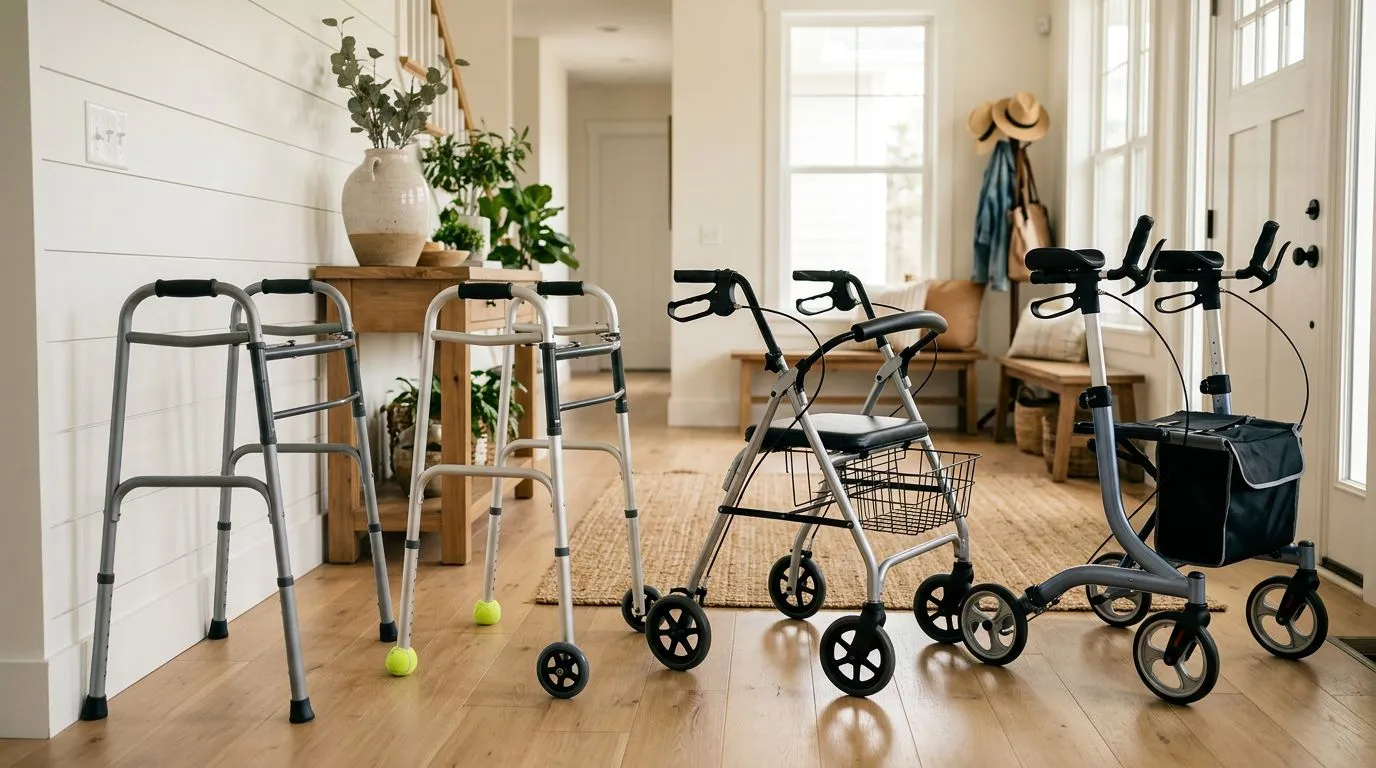
How Much Does a Mobility Walker Cost? Price Ranges for Walkers, Rollators, and Upright Models
13 min read