Disclosure: We may earn a commission when you buy through links on this page, at no extra cost to you. We buy nothing, sell nothing and accept no payment for coverage — commissions never decide what we recommend. How we make money.

An upright rollator is worth paying more for when its stand-up supports help you walk more comfortably, keep your eyes forward, and lessen the need to lean heavily on your hands. A standard rollator is usually the better value if you only need light balance support, a seat for rest breaks, and dependable hand brakes on mostly smooth surfaces. The right choice depends less on the price tag than on fit, posture, braking control, storage space, and how many minutes you can walk safely before you need to sit.
Shoppers often compare these two devices because they look similar at first glance: both are wheeled mobility aids with hand brakes, a frame, and usually a built-in seat. The difference is where your upper body is supported. A standard rollator supports you through hand grips at about wrist height, while an upright or stand-up rollator adds higher forearm platforms or armrests that encourage a more upright walking position.
Rollator vs Walker Basics: 4 Wheels, Brakes, and a Seat Change the Cost
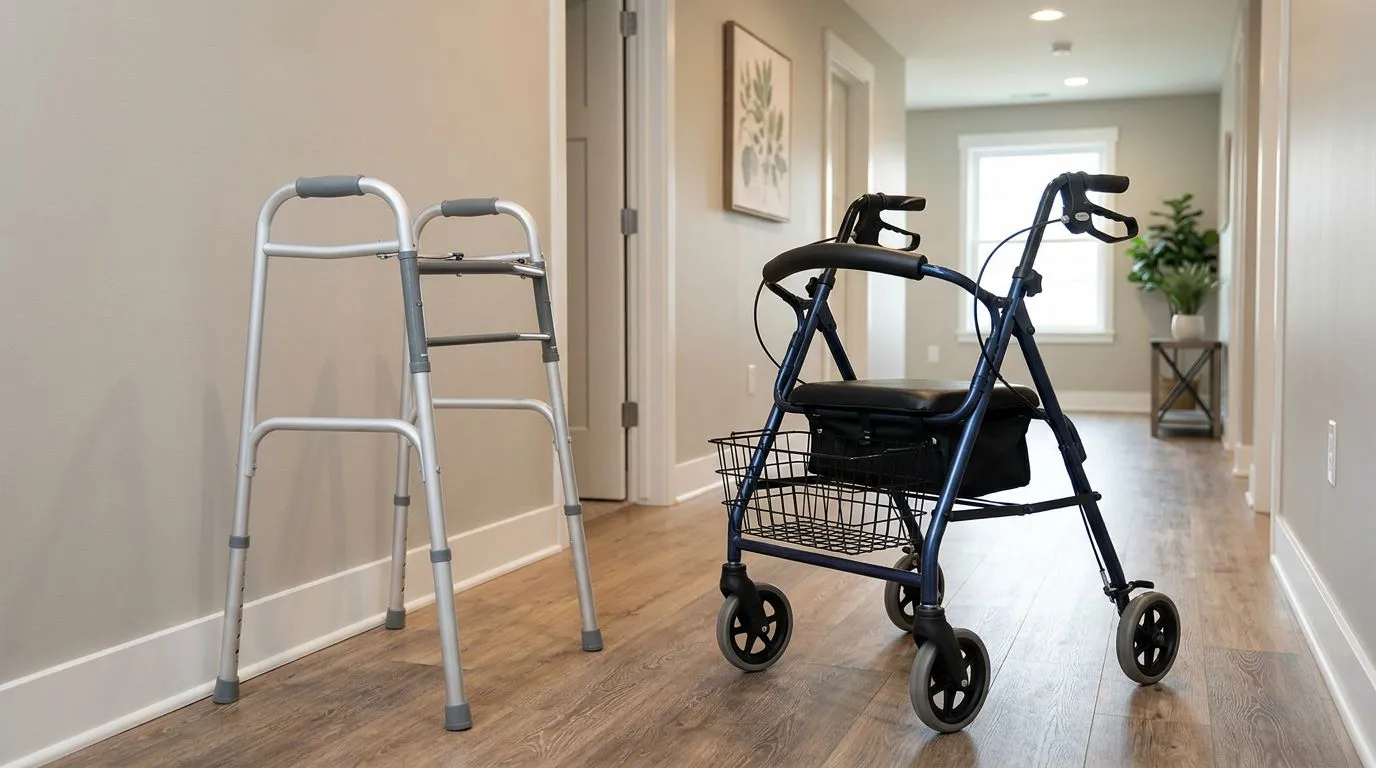
A rollator is a wheeled walker designed to roll continuously as you walk. Most standard rollators have 4 wheels, loop-style hand brakes, a padded or sling-style seat, and a storage pouch or basket. Three-wheel rollators also exist; they turn well in tight spaces but typically do not provide the same full seat support as many 4-wheel designs.
A walker is different. A standard walker or folding walker usually has no wheels, while a two-wheel walker has wheels on the front legs and rubber tips on the back legs. Walkers are picked up or moved forward in small steps, which can provide more stability for some users but requires more upper-body effort and a slower gait.
That distinction matters when comparing cost and value. Rollators include more parts than standard walkers: wheels, brake cables, brake handles, a seat frame, and often a backrest. Upright rollators add more hardware, including 2 forearm supports, height-adjustment hardware, and a taller frame. More parts do not automatically make a device better, but they do affect weight, maintenance, foldability, and the final price tier.
| Mobility aid type | Typical setup | Best general use | Key cost driver |
|---|---|---|---|
| Standard walker | No wheels, 4 legs, no seat | Maximum steadiness at slower speeds | Simpler frame with fewer moving parts |
| Two-wheel walker | 2 front wheels, rear tips, no seat | Short indoor walks with controlled support | Basic wheels plus folding frame |
| Standard rollator | 3 or 4 wheels, hand brakes, often a seat | Walking with rest breaks on smooth surfaces | Brakes, wheels, seat, and foldability |
| Upright rollator | 4 wheels, hand brakes, seat, forearm supports | More upright posture and forearm weight support | Taller adjustable frame and arm platforms |
What You Pay Extra For: 6 Upright Rollator Features
The added cost of an upright rollator usually comes from the stand-up support system, not just a taller handlebar. A true upright rollator is built so your forearms can rest on padded supports while your hands reach the brake handles. This setup is meant to reduce forward hunching compared with standard hand-grip-only designs.
The first feature is adjustable forearm height. Many upright designs offer several inches of vertical adjustment so the armrests can meet your elbows when you are standing tall. If the supports are too low, you still bend forward. If they are too high, your shoulders may shrug upward and tire faster.
The second feature is forearm pad size and angle. Larger pads spread pressure over more surface area than a narrow hand grip. Some upright rollators allow the pads to rotate or angle inward, which can help users with shoulder width differences or wrist discomfort.
The third feature is a longer or taller frame. A stand-up rollator must stay stable while supporting weight higher above the ground. That can mean a wider base, larger tubing, or added bracing. A wider frame may feel steadier outdoors, but it can be harder to maneuver through a 24-inch bathroom doorway or beside a tight dining table.
The fourth feature is brake positioning. On a standard rollator, your hands sit directly on the grips. On an upright rollator, the brakes must be reachable while your forearms remain supported. Test reach carefully, especially if you have limited grip strength or finger stiffness.
The fifth feature is wheel size. Many rollators use wheels around 6 to 10 inches in diameter. Larger wheels may roll more easily over sidewalk seams, carpet transitions, and small thresholds, though they can add size and weight.
The sixth feature is foldability. Upright rollators can fold, but some remain bulkier than standard rollators after folding because the arm supports extend upward. If you load the device into a car trunk 2 or 3 times a week, folded size and lifting weight deserve as much attention as posture.
Standard Rollator Value: Why 4-Wheel Designs Still Make Sense
A standard 4-wheel rollator remains the value choice for many people because it provides the core benefits most shoppers need: rolling support, hand brakes, a seat, and a compact frame. If you can stand reasonably upright while holding regular handles, paying extra for forearm platforms may not improve your daily routine enough to justify the higher cost.
Standard rollators also tend to be easier to compare. Seat height, handle height, wheel size, overall width, and weight capacity are usually straightforward specifications. Common seat heights often fall somewhere around 18 to 23 inches, though exact sizing varies by design. A seat that is too low can be difficult to rise from; a seat that is too high may leave your feet dangling or reduce confidence when resting.
Another advantage is maneuverability. Standard rollators often have a lower profile, and many fold more tightly than upright designs. That helps in apartments, medical offices, narrow hallways, and restaurant aisles. If most of your walking is indoors, a standard model with appropriately sized wheels may offer the most practical balance of support and convenience.
There are limits. A standard rollator can encourage leaning if the handles are set too low or if the user pushes it too far ahead. It is not meant to be used like a shopping cart with heavy downward body weight. If you find yourself bending at the waist, staring at the floor, or developing hand soreness after 10 minutes, the lower price may not be the best value.
Upright Rollator Value: When 2 Forearm Supports Can Be Worth It
An upright rollator can be worth paying more for when the stand-up features solve a real daily problem. The most common example is posture. If standard rollator handles leave you walking bent forward, an upright frame may help you keep your head and chest higher while still using a wheeled support.
Forearm support can also help people who experience wrist or hand discomfort with regular handles. Instead of placing most pressure through the palms, the pads distribute some support along the forearms. This does not remove the need for hand control, because braking still requires safe grip and coordination, but it can make longer walks feel more manageable for some users.
Outdoor walking is another reason shoppers consider paying more. An upright rollator with larger wheels and a stable frame may feel more comfortable on sidewalks, paved paths, and long hallways. A person who walks 20 minutes to a community room, mailbox area, or nearby park may place a higher value on posture and stride comfort than someone who mainly moves between bedroom, bathroom, and kitchen.
The tradeoff is size. Upright rollators are commonly taller and may be heavier than basic standard rollators. That matters if the user or caregiver must lift it into a vehicle, store it behind a chair, or move it through tight spaces. Added posture support is valuable only if the device still fits your home, transportation, and strength level.
Cost vs Feature Comparison: 7 Buying Factors That Affect Real Value
Price alone does not tell you which rollator is the better buy. A lower-cost standard rollator that fits correctly may be safer and more useful than a premium upright device that is too wide, too tall, or too heavy. At the same time, a higher-cost upright rollator can be a smart purchase if it meaningfully improves walking tolerance and reduces strain during everyday use.
| Buying factor | Standard rollator | Upright rollator | Value question to ask |
|---|---|---|---|
| Walking posture | Hands rest on lower grips | Forearms rest on higher supports | Do you bend forward with regular handles? |
| Hand and wrist pressure | More pressure through palms | Some pressure spread through forearms | Do your hands ache after walking? |
| Brake control | Brake levers are close to hand grips | Brake reach depends on armrest setup | Can you squeeze and lock brakes easily? |
| Seat access | Usually simple to turn and sit | May require more awareness around arm supports | Can you park, lock, turn, and sit safely? |
| Folded size | Often more compact | Often taller or bulkier when folded | Will it fit in your car or closet? |
| Device weight | Often lighter, depending on frame | May be heavier due to added supports | Who will lift it, and how often? |
| Indoor clearance | Usually easier in tight spaces | May need more turning room | Can it pass through your narrowest doorway? |
The best value is the device you will use correctly every day. If an upright rollator stays in the garage because it is hard to load into the car, its added features have little practical worth. If a standard rollator causes you to lean and stop after a few minutes, its lower cost may be false economy.
Who It’s Best For: 3 Shopper Profiles
1. Choose a standard rollator if you need basic support and rest breaks
A standard rollator is often best for someone who walks with fair posture, can use hand brakes confidently, and wants a seat for rest stops. It is also a sensible option for indoor use, errands, clinic visits, and smooth sidewalks. If your main priorities are compact folding, lighter lifting, and straightforward storage, standard rollators usually offer strong practical value.
2. Consider an upright rollator if posture is the main problem
An upright rollator is more compelling if you repeatedly lean over a standard rollator or feel pressure in your wrists and hands. It may also suit someone who wants to look forward more naturally while walking instead of down toward the floor. The important test is whether the forearm supports meet your body at the right height without raising your shoulders.
3. Look beyond both if you need maximum stability or close physical support
Neither type of rollator is ideal for every mobility situation. Some people are better served by a standard walker, two-wheel walker, or another device recommended by a clinician, especially if balance is highly unpredictable or braking is difficult. A rollator moves freely on wheels, so it requires judgment, grip control, and the ability to lock the brakes before sitting.
Bariatric rollators are another category for shoppers who need a higher weight capacity or a wider seat. Always check the stated weight rating and seat width rather than assuming a larger-looking frame is appropriate. A higher-capacity device can be more supportive for the right user, but it may also be wider and heavier.
How to Measure Fit in 10 Minutes Before You Pay More
Good fit is the difference between a helpful rollator and an expensive frustration. You can do a basic sizing check in about 10 minutes with a tape measure, your usual walking shoes, and a clear hallway. If possible, involve a physical therapist, occupational therapist, or trained mobility professional for personalized guidance.
For a standard rollator, stand upright with your arms relaxed at your sides. The hand grips should generally align near the crease of your wrist when you are standing tall. Your elbows should have a slight bend when your hands rest on the grips, not a locked or shrugged position.
For an upright rollator, measure from the floor to your forearm position when your elbows are bent comfortably, often around a 90-degree angle. The pads should let your shoulders relax and your head face forward. If you must rise onto your toes, hike your shoulders, or bend at the waist to use the pads, the fit is wrong.
Check seat height next. Sit with both feet flat if the rollator includes a seat. Your knees should feel comfortable, and you should be able to stand up without pulling dangerously on the frame. Always lock both brakes before sitting; a rollator seat is for stationary rest, not for being pushed while seated.
Measure your narrowest doorway or hallway. Many interior doorways are around 28 to 32 inches wide, but bathrooms and older homes can be tighter. Compare that measurement with the rollator’s overall width, not just the seat width. Leave extra clearance for hands, door trim, and turning space.
Finally, test lifting and transport. If the rollator must go into a vehicle, confirm who will lift it and how high. A difference of just 3 to 5 pounds can feel significant when loading the device repeatedly, especially after a medical appointment or grocery trip.
Safety and Maintenance Costs: Brakes Need Attention Every 1 to 3 Months
Rollator value includes upkeep. Hand brakes, wheels, folding joints, and seat hardware should be checked regularly. A quick inspection every 1 to 3 months is reasonable for many users, and more often if the rollator is used outdoors daily.
Brake performance is the biggest safety item. Squeeze the hand brakes to slow the rollator, then push them down or engage the parking lock before sitting, depending on the brake style. If the device rolls when the parking brakes are locked, stop using the seat until the brakes are adjusted or repaired.
Wheel condition also matters. Hair, string, grit, and small stones can collect around axles. Worn tires may reduce traction, especially on wet entryways or smooth tile. Larger wheels can handle small surface changes better, but no rollator is meant for loose gravel, steep slopes, or unsafe terrain.
Upright rollators may require extra checks at the forearm supports. Make sure height-adjustment knobs or pins are fully engaged and that pads are not loose. If an arm platform shifts while walking, posture support can quickly become a hazard.
Do not overlook training. A 15-minute instruction session with a clinician or knowledgeable professional can clarify how to turn, brake, sit, stand, and approach curbs. Safe technique often delivers more value than another premium feature.
Bottom Line: Use a 5-Question Value Test
Before paying more for an upright rollator, run through 5 questions. Do you lean forward or feel hand strain with a standard rollator? Can the upright supports be adjusted to your forearm height? Can you reach and lock the brakes without awkward wrist or finger position? Will the frame fit through your home and into your vehicle? Will you use the added posture support often enough to justify the higher cost tier?
If you answer yes to most of those questions, a stand-up rollator may be worth the extra money. The added forearm support can be a meaningful feature, not just an upgrade, when it solves a daily walking problem. Choose carefully, though, because poor fit can cancel out the benefit.
If your answers are mostly no, a standard rollator is likely the better value. It provides the essential rollator functions: wheels, brakes, a seat, and support for walking breaks. For some users, a standard or two-wheel walker may be safer than either rollator, especially when maximum stability is more important than speed or distance.
The smartest purchase is not the most advanced device. It is the one that matches your body, your home, your walking routes, and your ability to brake and sit safely every time.
FAQ
Frequently asked questions
Is an upright rollator always better than a standard rollator? +
No. An upright rollator is better only when the forearm supports improve posture, comfort, or walking tolerance without making the device too bulky or hard to control. A standard rollator may be the better value for users who walk upright with regular handles and need a compact seat and brakes.
Why do upright rollators usually cost more? +
They usually cost more because they add forearm platforms, taller adjustable supports, extra frame structure, and brake placement designed for a stand-up walking position. These added parts can also affect weight, folded size, and maintenance.
Can I sit on an upright rollator the same way as a standard rollator? +
Many upright rollators include a seat, but you should always lock both brakes before sitting and follow the device instructions. Because arm supports and frame shapes vary, practice turning, backing up, and sitting safely before using the seat in public places.
Who should consider a standard walker instead of a rollator? +
A standard walker or two-wheel walker may be more appropriate for someone who needs slower, more stable support or has difficulty controlling hand brakes. A rollator moves on wheels, so it requires safe braking, steering, and balance judgment.
How do I know if an upright rollator fits me? +
The forearm supports should meet your arms while you stand tall with relaxed shoulders and your eyes forward. You should be able to reach the brakes easily, walk without leaning, and move through your narrowest doorway with clearance.
Are upright rollators harder to transport? +
They can be. Upright rollators are often taller or bulkier when folded because of the forearm supports. Before buying, check the folded dimensions and lifting weight, especially if it will be loaded into a car several times a week.
Keep reading
Related guides

How Much Does a Rollator Walker Cost? US Price Ranges, Features, and Value
11 min read
Budget vs Premium Rollator Walkers: Which Features Are Worth Paying More For?
12 min read
Upright Rollator vs Regular Rollator: When a Stand-Up Walker Makes Sense
13 min read