Disclosure: We may earn a commission when you buy through links on this page, at no extra cost to you. We buy nothing, sell nothing and accept no payment for coverage — commissions never decide what we recommend. How we make money.
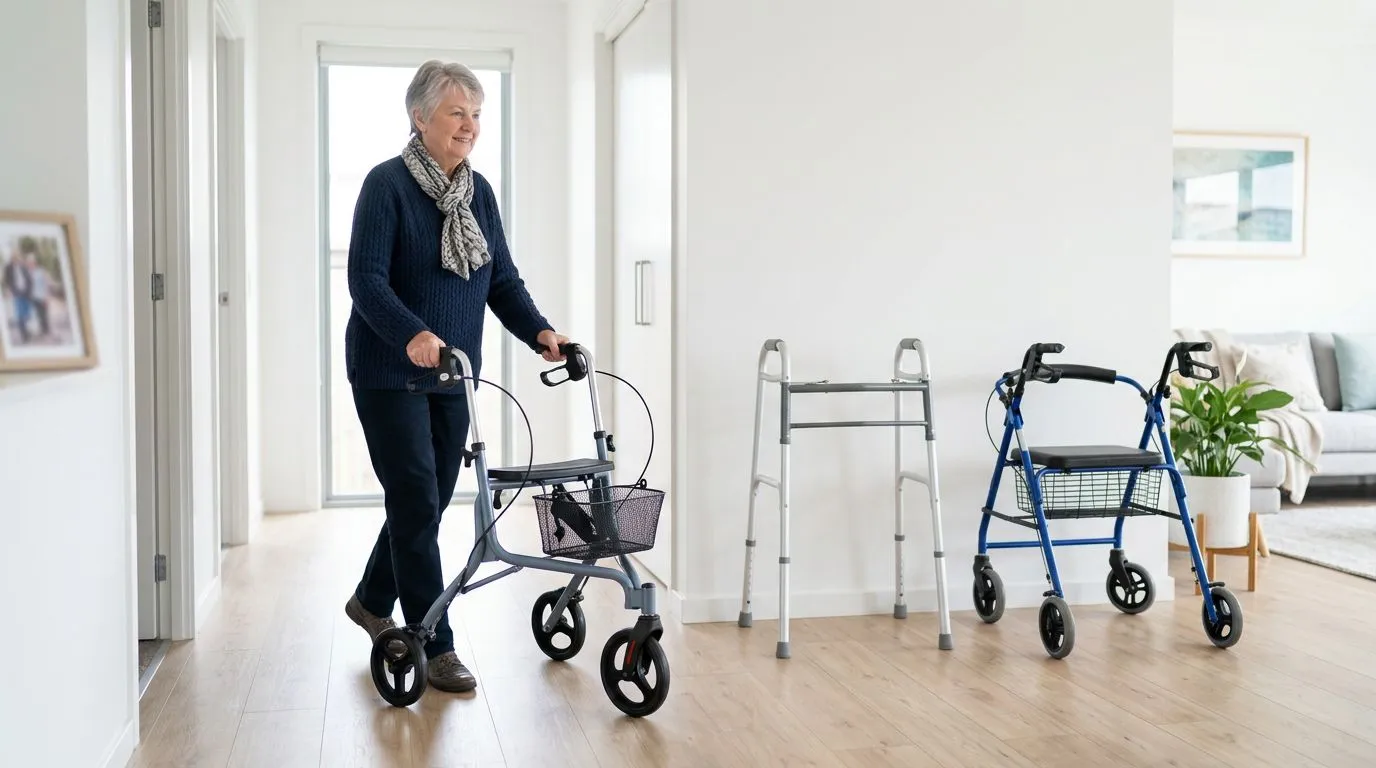
A 3-wheel rollator is safest for people who already walk with fairly steady balance but need light support, hand brakes, and easier turning in tight indoor spaces. Its tight turning radius can help in narrow kitchens, small bathrooms, and crowded rooms. However, the triangular 3-wheel frame is generally less stable than a 4-wheel rollator or a standard walker. If you need heavy weight-bearing support, a secure seat, or maximum side-to-side stability, a 4-wheel rollator or traditional walker is often the safer choice.
Three-wheel mobility walkers are popular because they feel nimble. They fold narrow, steer quickly, and take less effort to guide around furniture than many larger rollators. That easy steering is also the trade-off: a 3-wheel rollator can tip or veer more readily if the user leans sideways, turns too sharply, moves too fast, or hits uneven ground. The goal is not to call one mobility aid good or bad. It is to match the device to the person, the home, and the way it will be used every day.
3-wheel rollator safety in 30 seconds
A 3-wheel rollator has one front wheel and two rear wheels, forming a triangle. Most have hand brakes, a folding frame, and a pouch or basket; many do not offer the full sitting seat found on most 4-wheel rollators. Compared with a standard walker, it rolls continuously instead of being lifted or slid, so it usually requires less upper-body effort but more brake control and balance.
Its main safety advantage is maneuverability. A 3-wheel rollator can pivot through tight spaces where a wider 4-wheel rollator may feel awkward. The main safety concern is stability. With 3 contact points instead of 4, the base of support is smaller and more sensitive to side loading, fast turns, and uneven surfaces.
Use this simple rule: choose a 3-wheel rollator when steering space is the problem and balance is reasonably reliable. Choose a 4-wheel rollator or standard walker when stability, weight-bearing support, or safe resting is the bigger need.
How 3 contact points change stability
Stability starts with the base of support. A standard walker has 4 legs on the floor when properly placed. A 4-wheel rollator has 4 wheels spread across a rectangular footprint. A 3-wheel rollator has 3 wheels arranged in a triangle, with the front wheel acting as the steering point.
That triangular shape is why a 3-wheel rollator turns so easily. It is also why it can feel less planted when weight shifts off-center. If a user leans to one side to reach a counter, pulls hard on one handle, or turns the rollator while the body is still catching up, the device has less width and fewer ground contact points to resist that movement.
This difference matters most for people who press down heavily through the handles. Rollators are not designed to be full weight-bearing devices in the same way a properly used standard walker can be. A person who needs to unload a painful leg, recover from certain injuries, or rely on both arms for major support may be safer with a standard walker, two-wheel walker, or another device recommended by a clinician.
| Device type | Typical floor contact | Best safety strength | Main caution |
|---|---|---|---|
| Standard walker | 4 legs, no wheels | Maximum steadiness when placed correctly | Must be lifted or advanced step by step |
| Two-wheel walker | 2 front wheels, 2 rear tips | More stable than many rolling devices, easier to advance than no-wheel walkers | Less nimble than 3-wheel rollators |
| 3-wheel rollator | 3 wheels | Tight steering and narrow folding | Less side-to-side stability than 4 wheels |
| 4-wheel rollator | 4 wheels | Better stability, often includes a seat | Wider turning space and more frame bulk |
Where a tight turn helps: 28- to 36-inch spaces
Many older homes were not built with mobility equipment in mind. Interior doorways may be around 28 to 32 inches wide, hallways can feel crowded once furniture is added, and bathroom clearances may be tight. In these spaces, the tight turning radius of a 3-wheel rollator can reduce awkward backing up and repeated repositioning.
Common places where a 3-wheel rollator can help include galley kitchens, small bedrooms, narrow apartment halls, laundry areas, and dining rooms with chairs close to the table. The front wheel can guide the frame around corners without needing a wide arc. For a person who walks steadily but gets fatigued, that can make everyday routes feel smoother.
A narrow frame can also be easier to fold and store. Some 3-wheel rollators fold to a slim profile that fits beside a chair, in a closet, or in a car trunk more easily than a bulky 4-wheel rollator. That matters if the device is used for errands, senior center visits, or short indoor trips where convenience affects whether it gets used consistently.
The safety benefit is practical: fewer awkward maneuvers can mean fewer moments of twisting, reaching, or stepping around the device. Still, easy turning is only safer when the user slows down, keeps both hands on the handles, and stays inside the frame rather than walking behind it at arm’s length.
Where the same tight turn adds risk: 1-inch thresholds and uneven ground
The risk with a 3-wheel rollator rises when the surface is not smooth or the user’s balance is challenged. A small threshold, raised rug edge, sidewalk crack, or transition from carpet to tile can affect the front wheel first. If the front wheel catches or swivels suddenly, the rollator may turn faster than expected.
Outdoor use calls for extra caution. Grass, gravel, sloped driveways, curb cuts, and broken sidewalks can all reduce control. A 4-wheel rollator with larger wheels and a wider base may feel more predictable outdoors, though any rollator can become unsafe on steep slopes or loose surfaces. A standard walker may offer more stability on level indoor floors, but it is not automatically safer on uneven outdoor terrain because it must be lifted and placed carefully.
Sideways leaning is another common risk. A 3-wheel rollator is not a grab bar. If you park it beside a bed, chair, or car and pull sideways on one handle, the frame can shift or tip. Brakes help control rolling, but they do not turn a lightweight frame into a fixed support.
- Higher-risk situations: rushing to answer the door, turning sharply in socks, carrying a bag on one handle, reaching outside the frame, or using the rollator on a ramp without good brake control.
- Safer habits: slow before turning, keep your feet between the rear wheels as much as possible, use both hands, and avoid hanging heavy items from one side.
Who a 3-wheel rollator is best for, and who may need 4 wheels
A 3-wheel rollator is usually best for someone who needs light balance support, can steer with both hands, understands brake use, and walks on mostly level surfaces. It may be a good fit for a person who moves around a small apartment, wants help with mild fatigue, and does not need to sit on the device during outings.
It is often less appropriate for someone with frequent falls, major balance loss, significant weakness on one side, dizziness, poor hand strength, or a need to put substantial body weight through the handles. In those cases, a 4-wheel rollator, two-wheel walker, standard walker, or different mobility plan may provide a better safety margin.
| User need | 3-wheel rollator fit | Safer alternative to consider |
|---|---|---|
| Small indoor spaces | Often strong fit | Narrow two-wheel walker if more stability is needed |
| Full resting seat for outings | Often limited | 4-wheel rollator with seat and locking brakes |
| Heavy weight-bearing through arms | Usually poor fit | Standard walker or clinician-recommended device |
| Uneven outdoor routes | Use caution | 4-wheel rollator with appropriate wheels, if balance allows |
| Frequent quick turns in tight rooms | Often helpful | Confirm stability during a supervised trial |
Bariatric users should pay close attention to rated weight capacity and frame width. A rollator’s published capacity is not just a comfort number; it relates to frame strength, brake performance, wheel durability, and overall fit. Never assume a compact 3-wheel frame is appropriate simply because it feels easy to steer.
How to choose and measure: 15- to 30-degree elbow bend
Handle height affects posture and control. With shoes on, stand upright with arms relaxed at your sides. The handgrips should usually line up near the crease of the wrist. When holding the grips, many people have a slight elbow bend of about 15 to 30 degrees. Handles set too low can encourage stooping; handles set too high can reduce leverage and make braking awkward.
Measure the home, not just the person. Check the narrowest doorway, the bathroom entry, the space beside the bed, and the turn into the kitchen. A rollator that fits through a doorway but cannot turn safely inside the room may still be frustrating. Leave extra space for hands on the grips, rear wheels, and foot placement.
Brake fit is just as important as frame fit. Hand brakes should be easy to squeeze without pain, and parking brakes should lock securely. People with arthritis, limited grip strength, numbness, or slower reaction time may need extra help choosing and adjusting brakes. If the rollator has a seat or perch, confirm the brakes lock before sitting, and use the seat only as the manufacturer intends.
- Width: confirm the overall width fits your tightest indoor route with at least a little clearance on both sides.
- Wheel size: smaller wheels may work indoors; larger wheels may roll more smoothly over minor outdoor irregularities.
- Weight capacity: choose a frame rated for the user, including any expected clothing or carried items.
- Device weight: a lighter frame is easier to lift into a car but may feel less planted.
- Folding method: practice folding and unfolding before relying on it for transportation.
Safe use habits: 6 checks before you walk
Even a well-chosen rollator can become unsafe if it is used casually. A 30-second check before walking can prevent many problems, especially after the device has been folded, loaded into a car, or used outside.
- Check both brakes. Squeeze the handles and confirm the wheels slow or stop evenly.
- Lock before transfers. Use parking brakes before standing from a chair, pausing, or sitting if the device has an approved seat.
- Look at the wheels. Remove hair, string, grit, or debris that can affect rolling.
- Keep the path clear. Move throw rugs, cords, pet toys, and low stools from regular walking routes.
- Stay close to the frame. Walking too far behind the rollator reduces control and encourages forward leaning.
- Turn in small steps. Do not twist your body while the rollator pivots sharply.
Carrying items takes planning. Use the built-in pouch, basket, or bag if provided, and keep weight centered. Hanging a purse, grocery bag, or oxygen bag from one handle can pull the rollator off balance, especially during a turn. If an accessory changes how the device handles, reassess it before using it on stairs, ramps, or sidewalks.
Maintenance matters too. Brake cables can stretch, tires can wear, and folding locks can loosen. A monthly inspection is reasonable for many users, and more often if the rollator is used daily outdoors. Replace worn tips, damaged wheels, or loose parts according to the manufacturer’s instructions rather than trying to improvise repairs.
Walker and rollator comparison: 0, 2, 3, or 4 wheels
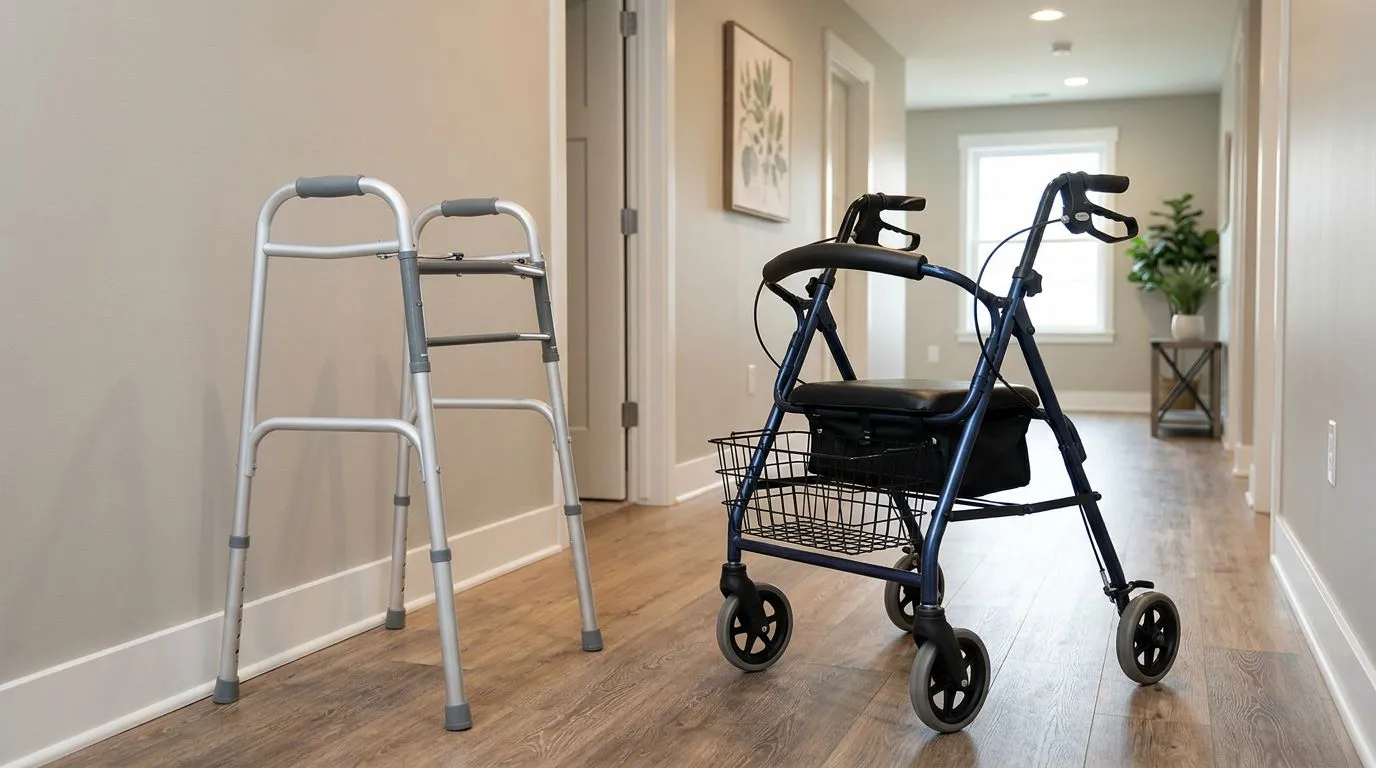
The word walker is often used broadly, but the options behave differently. A standard walker is a non-wheeled frame that is lifted and placed. A folding walker may be standard or may include front wheels. A two-wheel walker rolls at the front and has rear tips or glides. A rollator is a wheeled walker with hand brakes, and many 4-wheel rollators include a built-in seat. Three-wheel rollators sit between a walker and a full-size rollator in feel: quick and compact, but not the most stable option.
| Feature | Standard walker | Two-wheel walker | 3-wheel rollator | 4-wheel rollator |
|---|---|---|---|---|
| Turning in tight rooms | Moderate | Moderate | Excellent | Good to fair, depending on size |
| Side-to-side stability | High | High to moderate | Moderate | Moderate to high |
| Brakes | Usually none | Usually none | Hand brakes | Hand brakes |
| Seat | No | No | Often no full seat; verify design | Common |
| Best indoor role | Maximum support on level floors | Support with easier forward movement | Narrow routes and quick pivots | Balance support plus rest breaks |
| Learning curve | Step-place pattern | Moderate | Brake and speed control | Brake, seat, and speed control |
If the main issue is needing something sturdy to lean on, start the conversation with walkers. If the main issue is fatigue and needing a rolling aid with brakes, compare rollators. If the main issue is fitting through tight indoor spaces, a 3-wheel rollator may be worth a careful trial.
When to get professional fitting within 1 visit
A physical therapist, occupational therapist, or qualified mobility professional can often spot problems in a single fitting session that are easy to miss at home. They can watch gait, turning, braking, posture, and transfers. They can also compare a standard walker, two-wheel walker, 3-wheel rollator, and 4-wheel rollator under similar conditions.
Professional guidance is especially important after a fall, surgery, stroke, new dizziness, medication changes, or a noticeable decline in strength. It is also helpful when the user has low vision, Parkinsonian symptoms, neuropathy, severe arthritis, or cognitive changes that may affect safe brake use. The best device is not simply the one that moves most easily in a showroom. It is the one the person can control safely at 7 a.m., at night, on the way to the bathroom, and when tired.
A 3-wheel rollator can be a smart, confidence-supporting tool for the right person in the right setting. Its tight turning radius is a real advantage in cramped homes and busy indoor spaces. Respect the trade-off, though: less frame width and 3 contact points mean less forgiveness when balance, speed, surface, or braking is not ideal. Choose based on stability first, convenience second, and personal fit every time.
FAQ
Frequently asked questions
Is a 3-wheel rollator less stable than a 4-wheel rollator? +
In general, yes. A 3-wheel rollator has a triangular base with 3 ground contact points, so it usually offers less side-to-side stability than a 4-wheel rollator. It may still be safe for users with good balance who need a compact, easy-turning mobility aid.
Can you sit on a 3-wheel rollator? +
Many 3-wheel rollators do not have a full seat, and any sitting feature should only be used if the design specifically allows it. If resting during walks is important, a 4-wheel rollator with a proper seat and locking brakes is often a better option.
Who should avoid using a 3-wheel rollator? +
People with frequent falls, poor balance, dizziness, significant one-sided weakness, or a need to put heavy weight through the handles may need a more stable device. A standard walker, two-wheel walker, or 4-wheel rollator may be safer depending on the situation.
Are 3-wheel rollators good for outdoor use? +
They can work on smooth, level outdoor surfaces, but they require caution on slopes, gravel, grass, curb cuts, and cracked sidewalks. A wider 4-wheel rollator with suitable wheels may feel more stable outdoors for many users.
How high should the handles be on a 3-wheel rollator? +
A common starting point is to set the handles near the crease of the wrist while the user stands upright in regular shoes. When holding the grips, the elbows should usually have a slight bend, often around 15 to 30 degrees.
Keep reading
Related guides
3-Wheel vs 4-Wheel Rollator Walkers: Which Design Fits Your Needs?
11 min read
Walker and Rollator Wheel Size Explained: Small Wheels, Large Wheels, Swivel Wheels, and Rougher Surfaces
14 min read
No-Wheel Walker vs Two-Wheel Walker vs Rollator: How Wheels Change Stability, Effort, and Control
13 min read