Disclosure: We may earn a commission when you buy through links on this page, at no extra cost to you. We buy nothing, sell nothing and accept no payment for coverage — commissions never decide what we recommend. How we make money.
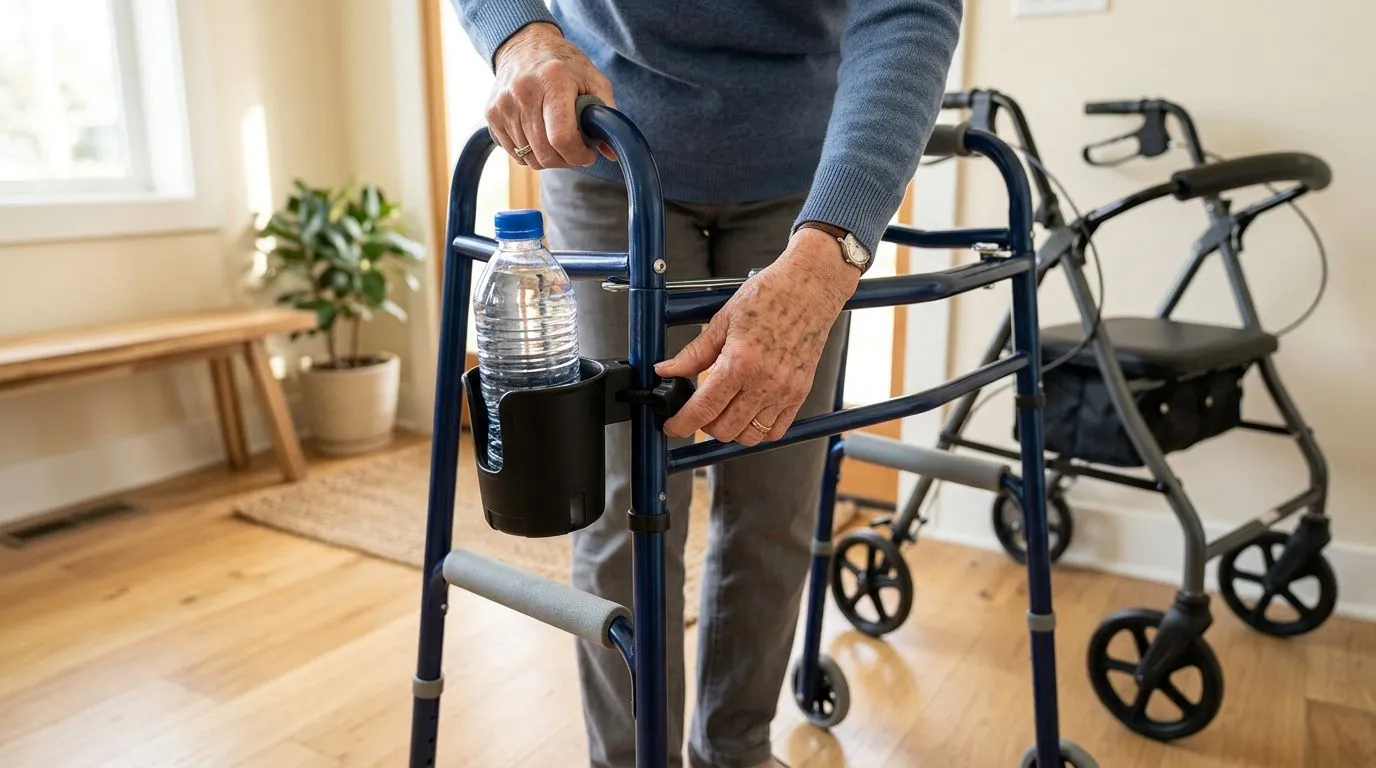
The best cup holder for a walker or rollator clamps securely to the frame, keeps the drink low and close to the center, and does not block hand grips, brakes, folding joints, or walking space. Walkers usually need lighter, simpler holders because many have no wheels and less built-in storage. Rollators can often handle a drink carrier better, as long as the brakes, seat, and steering stay clear.
A drink holder may seem like a small accessory, but it changes how weight sits on a mobility aid. An 8- to 16-ounce drink can spill, swing, or pull the frame off balance if it is mounted too high, too far forward, or on a loose clamp.
Quick answer: what usually fits, and what can tip with an 8- to 16-ounce drink
Most walkers and rollators use round or oval tubing, often around 7/8 inch to 1 1/8 inches in diameter, though some frames are smaller or larger. A universal clamp-style cup holder is the most common fit, but universal does not mean guaranteed. It still needs the right clamp range, a flat enough mounting area, and enough clearance for your hand, knee, brake cable, or folding latch.
For a standard walker, folding walker, two-wheel walker, or no-wheel frame, the safest spot is usually on a side tube below the hand grip, not high on the front crossbar. For a rollator, the safest spot is often on the side frame near the seat support or lower handle area, provided it does not interfere with hand brakes or brake cables.
The biggest tipping risks come from oversized bottles, rigid holders mounted outside the frame, and hot drinks without secure lids. A full 16-ounce bottle weighs about 1 pound; a larger 24- or 32-ounce bottle can add 1.5 to 2 pounds before you count the holder. That may not sound like much, but when the weight hangs several inches outside the frame, it can make a lightweight walker or narrow 3-wheel rollator feel less steady.
Walkers vs. rollators: why the frame changes the fit by 1 inch or more
Walkers and rollators support movement in different ways, so the same drink carrier can behave differently on each one. A standard walker or folding walker is lifted and placed with each step. A two-wheel walker rolls at the front but still depends on the rear legs for stability. A rollator has 3 or 4 wheels, hand brakes, and usually a seat, so it stays on the ground and rolls continuously.
That difference matters. On a no-wheel walker, a drink holder may bounce every time the frame is lifted. On a two-wheel walker, the front wheels can smooth the motion, but the rear legs still rise and set down. On a 4-wheel rollator, the cup holder has less vertical bouncing, but it may get more vibration outdoors on sidewalks, thresholds, and curb cuts.
Frame shape matters too. Many walkers have exposed side tubing and front crossbars that look easy to clamp to, but folding release buttons and height-adjustment holes may reduce usable space to only 2 or 3 inches. Rollators may offer more tubing, yet cables, brake handles, seat hinges, baskets, and backrest supports compete for the same space.
| Mobility aid type | Best drink carrier approach | Main caution |
|---|---|---|
| Standard or folding walker | Light clamp or soft drink pouch on side tube | Added weight can swing when the walker is lifted |
| Two-wheel walker | Clamp holder mounted low and inward | Do not mount where knees or rear legs hit it |
| 3-wheel rollator | Compact holder close to center frame | Narrower base can feel tippier with side weight |
| 4-wheel rollator | Clamp holder, basket insert, or seat-area carrier | Keep brake handles and cables fully clear |
| Upright rollator | Lower side mount, not near forearm pads | High mounting can interfere with posture supports |
| Bariatric rollator | Heavy-duty clamp within frame width | Higher capacity does not make off-center loads harmless |
Cup holder types compared: clamps, straps, pouches, trays, and baskets for 12- to 24-ounce containers
Drink carriers for walkers and rollators generally fall into 5 types: clamp-on holders, strap-on holders, soft pouches, tray holders, and basket or bag carriers. Each can work well in the right setting, but each comes with trade-offs.
Clamp-on holders are the most common because they attach directly to the frame. They may use a screw knob, hinged clamp, rubber insert, or adjustable jaws. A good clamp feels firm after tightening and does not rotate when you place a 12-ounce can or 16-ounce bottle inside.
Strap-on holders are more forgiving on unusual frame shapes. They often use hook-and-loop straps that wrap around tubing, a handle, or a side support. They can be useful on walkers with oval tubing, though they may shift if the strap is not tightened evenly.
Soft pouches are friendly for walkers because they add little hard plastic or metal to the frame. Many work best with a capped bottle rather than an open cup. Tray holders can be convenient indoors, but they raise the drink and can make spills more likely if the walker is bumped. Basket and under-seat carriers are common on rollators and may be safer for sealed bottles, although they are less convenient for quick sipping.
| Holder type | Good for | Watch for |
|---|---|---|
| Clamp-on cup holder | Rollators and walkers with round tubing | Clamp range, rotation, brake clearance |
| Strap-on drink holder | Oval frames or mixed tube shapes | Strap slip after repeated use |
| Soft bottle pouch | Sealed water bottles on walkers | Less support for open cups |
| Tray with cup recess | Indoor use on compatible walkers | Higher spill risk and reduced visibility of feet |
| Basket or under-seat carrier | Rollators carrying capped drinks | Not ideal for hot open beverages |
How to measure before you buy or install: 5 checks that prevent poor fit
Before choosing a drink holder, measure 5 things: tube diameter, straight mounting length, distance to the hand grip, distance to the brake handle or cable, and folded width if the walker or rollator folds. A flexible tape measure and a 60-second test can prevent most fit problems.
First, measure the tube where you want to attach the holder. Many clamps list a minimum and maximum tube diameter, and even a difference of 1/8 inch can affect how securely the clamp grips. If the tubing is oval, measure both the narrow and wide direction.
Second, look for at least 2 inches of straight, unobstructed tubing. Avoid height-adjustment holes, spring buttons, folding hinges, welds, curved sections, and textured grips. A clamp placed half on a curve and half on a straight tube is more likely to twist.
Third, sit or stand as you normally use the device. Your hand should reach the grip naturally without brushing the cup. On a rollator, squeeze both brake handles fully. The cup holder should not touch the handle, cable, or parking brake mechanism at any point.
Fourth, walk a short indoor route of about 10 to 15 feet with an empty holder attached. If your knee, thigh, wrist, sleeve, or door frame catches it, move it. Finally, fold the walker or rollator. Some holders must be removed before folding; that may be acceptable at home but frustrating for car trips or clinic visits.
Spill prevention: mount low, use lids, and test on a 1-inch threshold
Spill prevention starts with container choice. A sealed water bottle is safer than an open mug, especially on a walker that is lifted or a rollator used outdoors. If you carry coffee or tea, use a secure travel lid and avoid filling it to the brim. Leaving even 1 inch of space at the top reduces sloshing.
Mounting height affects spills. A holder near shoulder or hand height may seem convenient, but it also amplifies wobble. A lower mount, close to the frame and within the width of the walker or rollator, usually keeps the drink steadier.
Surface changes are the real test. A smooth kitchen floor is easy. A doorway threshold, thick rug edge, driveway crack, or sidewalk joint can shake the drink enough to splash. After installation, test the holder with water over a 1-inch threshold or a similar small bump before trusting it with hot liquids.
Treat open cups as short-distance, indoor-only items. For example, moving a half-full cup of water from the kitchen counter to a nearby table may be reasonable for some users with a stable rollator and steady hands. Carrying an uncovered hot drink across a parking lot is a different risk.
- Use capped bottles for outdoor trips.
- Choose a holder with a deep cup well when possible.
- Avoid tall, narrow bottles that wobble above the rim.
- Remove empty disposable cups before folding the device.
- Do not hang a drink from the brake cable, grip, or seat strap.
Weight balance and tipping risk: a 1-pound drink can matter
A pint of water weighs about 1 pound. Add a rigid holder and a large bottle, and the total side load may approach 2 pounds. On a wide, heavier 4-wheel rollator, that may be manageable when mounted correctly. On a lightweight folding walker or narrow 3-wheel rollator, the same load may be more noticeable.
The danger is not only the weight. It is the lever effect. A drink mounted 4 or 5 inches outside the frame pulls differently than a bottle carried inside a basket. The farther the load sits from the centerline, the more it can affect turning, lifting, and moving over uneven ground.
Walkers deserve extra caution because the user may lift the frame dozens of times in a single room-to-room trip. A side-mounted drink can swing slightly with every lift, especially if the holder is loose or the container is tall. If the walker starts to twist in your hands, the holder is in the wrong place or the drink is too heavy for that setup.
Rollators have their own issue: speed and steering. A rollator can pick up momentum on a slope. If a drink holder encourages one-handed steering while the other hand reaches for a bottle, brake control can suffer. Stop the rollator, lock the brakes if appropriate, and then take the drink.
| Load situation | Lower-risk choice | Higher-risk choice |
|---|---|---|
| Daily water bottle | 16-ounce capped bottle mounted low | 32-ounce bottle mounted outside the frame |
| Hot drink | Travel mug with tight lid, short indoor route | Open mug on sidewalk or ramp |
| Walker use | Soft pouch with sealed bottle | Rigid side holder with heavy cup |
| Rollator use | Holder clear of brakes and within frame width | Holder attached near brake handle or cable |
Brake, grip, seat, and folding clearance: leave at least 1 inch where movement happens
Any accessory on a walker or rollator must stay out of the way of the parts that keep you safe. A practical rule is to leave at least 1 inch of clearance around moving parts, including brake levers, brake cables, folding hinges, seat supports, wheel forks, and height-adjustment buttons.
For standard walkers and folding walkers, check the hand grips first. Your fingers should wrap fully around each grip without hitting the holder. If the drink holder makes you change your wrist angle, it is too close.
For rollators, brakes come first. Squeeze the hand brakes while standing in your normal posture. Then engage the parking brake if your rollator has one. The holder should not rub the brake lever, pinch the cable, or block your knuckles. Brake cable interference is easy to miss because the holder may look clear when the rollator is still but touch the cable when the handle is squeezed.
Seat access matters as well. A 4-wheel rollator seat should open, close, and support sitting without the drink holder pressing into the seat edge or backrest area. On an upright rollator, do not mount a cup where it changes how the forearm pads, arm rests, or vertical handles are used.
Folding is the final clearance test. Fold the device completely, not halfway. If the holder prevents the walker from locking closed or makes the rollator too wide for the car trunk, you may need a quick-release style, a different mounting spot, or a soft carrier that compresses.
Who it is best for: matching the carrier to 4 common mobility situations
The best drink carrier depends on how the person uses the walker or rollator for real tasks, not just on frame size. A person who walks 20 feet from bedroom to kitchen has different needs than someone who takes a rollator to appointments, shops for 45 minutes, or navigates outdoor sidewalks.
For standard and folding walker users
A light, low-profile holder or soft bottle pouch is usually best. Choose sealed bottles over open cups, and avoid mounting anything that changes how the walker is lifted. If the user has limited grip strength or balance changes, an occupational or physical therapist can help judge whether carrying drinks on the walker is appropriate.
For two-wheel walker users
A clamp holder may work well because the front wheels reduce some bouncing. Mount it on the side, low enough to avoid elbow contact and far enough back that the knees do not strike it. Keep the container modest, such as a 12- to 16-ounce bottle.
For 3-wheel rollator users
Use compact holders and keep weight centered. Three-wheel rollators are often easy to maneuver in tight spaces, but the triangular base can feel less forgiving with a heavy side load. A capped bottle in a center bag may be safer than a large cup on the outside frame.
For 4-wheel, upright, and bariatric rollator users
A sturdy clamp-on holder or basket-based bottle carrier can work well, provided it clears the brakes and seat. Upright rollators need extra attention around forearm supports, while bariatric rollators may have larger tubing that requires a wider clamp range. Higher weight capacity does not remove the need to mount the drink close to the frame.
Installation and daily-use checklist: a 60-second routine
Once a cup holder is installed, check it regularly. A clamp can loosen after a week of vibration, and a strap can stretch after repeated folding. A simple 60-second routine before leaving home is enough for many users.
- Twist test: With the holder empty, try to rotate it by hand. It should not move easily.
- Brake test: On rollators, squeeze both brakes and set the parking brakes, if present.
- Grip test: Hold both hand grips normally and make sure your fingers are clear.
- Fold test: Fold and unfold the device if you plan to transport it.
- Walk test: Move 10 to 15 feet and turn once in each direction.
- Spill test: Start with water before carrying coffee, tea, or juice.
Think about cleaning too. Drink holders collect dust, sticky residue, and condensation. Remove the holder or wipe it down as needed, especially after spills. If a clamp has rubber padding, check that the padding is still in place; bare hard plastic or metal can slide on the frame or scratch the finish.
Replace the holder if it cracks, no longer tightens, or starts dropping bottles. Do not compensate with tape around brake cables or moving joints. A drink carrier should make daily routines easier, not create one more thing to manage.
Practical buying priorities: 6 features that matter more than style
When comparing generic cup holders and drink carriers, focus on 6 practical features: clamp range, depth, adjustability, release method, material, and profile. Color and shape matter less than whether the holder stays put and keeps the drink away from essential controls.
Clamp range should match your measured tubing, with a little room on both sides. Holder depth should support the lower part of the cup or bottle, not just pinch the middle. Adjustability can help on angled rollator frames, but too many moving joints may create wobble if they do not tighten securely.
A quick-release design can be helpful for folding walkers and rollators that go into a vehicle several times a week. For users who rarely fold the device, a more permanent clamp may be simpler. Material should feel durable but not sharp-edged. A holder that protrudes 6 inches from the frame may catch on doorways, furniture, or clothing, even if it technically fits.
The safest choice is often the least dramatic one: a modest holder, mounted low, carrying a capped 12- to 16-ounce drink, with full access to both hands and brakes. That applies whether the mobility aid is a basic walker, a folding walker, a two-wheel walker, a 3-wheel rollator, or a larger 4-wheel rollator.
FAQ
Frequently asked questions
Can I put a cup holder on any walker? +
Not always. Many walkers have round or oval tubing that can accept a clamp or strap holder, but folding hinges, height-adjustment buttons, and narrow tubing can prevent a secure fit. Measure the tube diameter and make sure the holder does not interfere with your grip or the walker’s folding mechanism.
Where is the safest place to mount a drink holder on a rollator? +
Usually on a side frame tube, low and close to the rollator’s center, while keeping the hand brakes, brake cables, seat, and folding parts clear. Avoid mounting it high near the handles or on any part that moves when the brakes are squeezed.
Are hot drinks safe to carry on a walker or rollator? +
Hot drinks require extra caution. Use a secure travel lid, do not fill the cup to the top, and avoid carrying open hot beverages outdoors, on ramps, or over uneven surfaces. If balance or grip is uncertain, a sealed bottle or separate tray carried by another person may be safer.
Will a cup holder make a walker tip over? +
A small, capped drink mounted low is less likely to cause trouble, but a heavy bottle or cup mounted far outside the frame can affect balance. This is especially important on lightweight walkers, no-wheel walker frames, and narrow 3-wheel rollators.
What size drink works best in a walker or rollator cup holder? +
A capped 12- to 16-ounce bottle is often the most manageable size. Larger 24- to 32-ounce bottles add more weight and can sit higher in the holder, which may increase wobble, spills, and tipping risk.
Should I remove the cup holder before folding my walker or rollator? +
If the holder blocks folding, keeps the frame from locking, or makes the device too wide for transport, remove it before folding. Some holders are designed for quick removal, while others are better left on only when they do not interfere with folding or storage.
Keep reading
Related guides
Walker Trays and Cup Holders: What Works Best for Standard Walkers, Two-Wheel Walkers, and Rollators
15 min read
Walker Bags, Baskets, and Carriers: Safer Ways to Carry Items on Walkers and Rollators
15 min read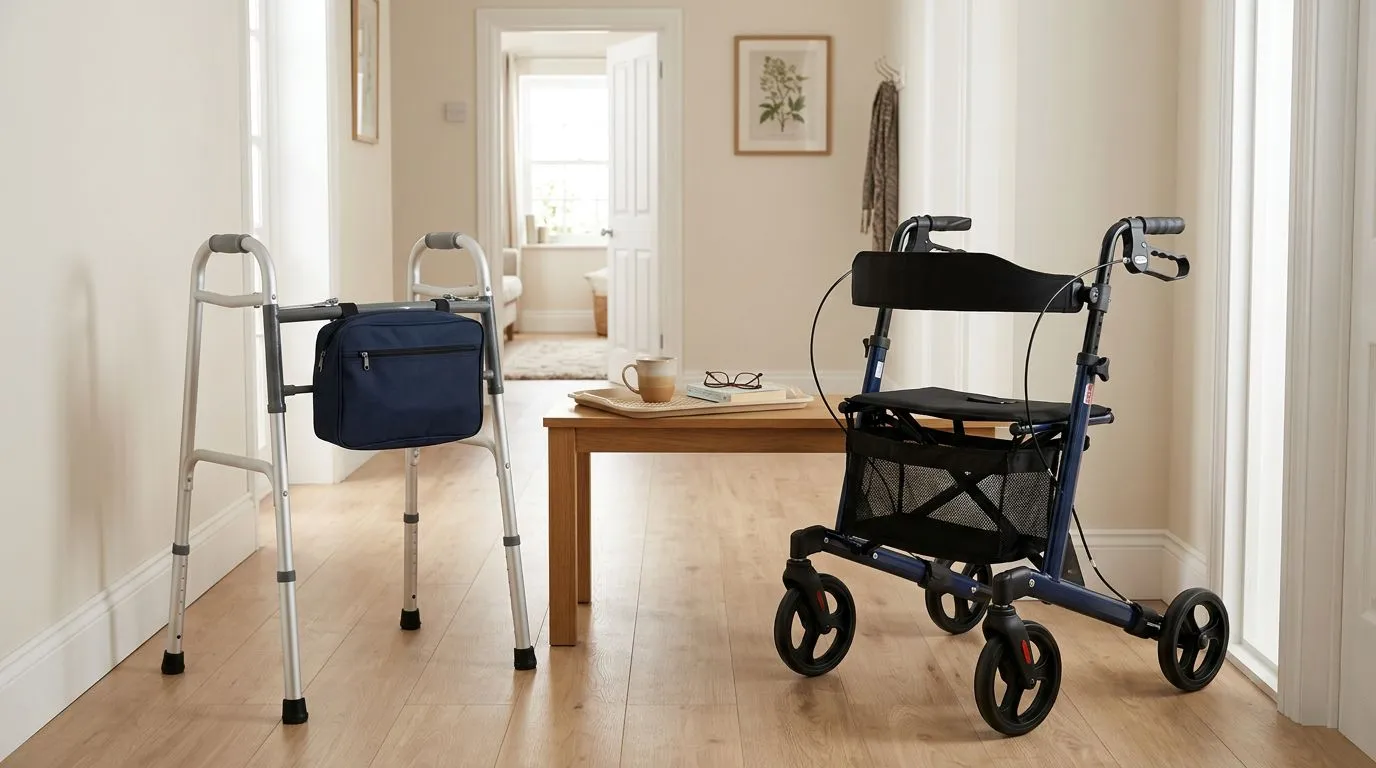
Walker Tray vs Basket vs Storage Bag: Safer Ways to Carry Items on a Walker or Rollator
14 min read