Disclosure: We may earn a commission when you buy through links on this page, at no extra cost to you. We buy nothing, sell nothing and accept no payment for coverage — commissions never decide what we recommend. How we make money.
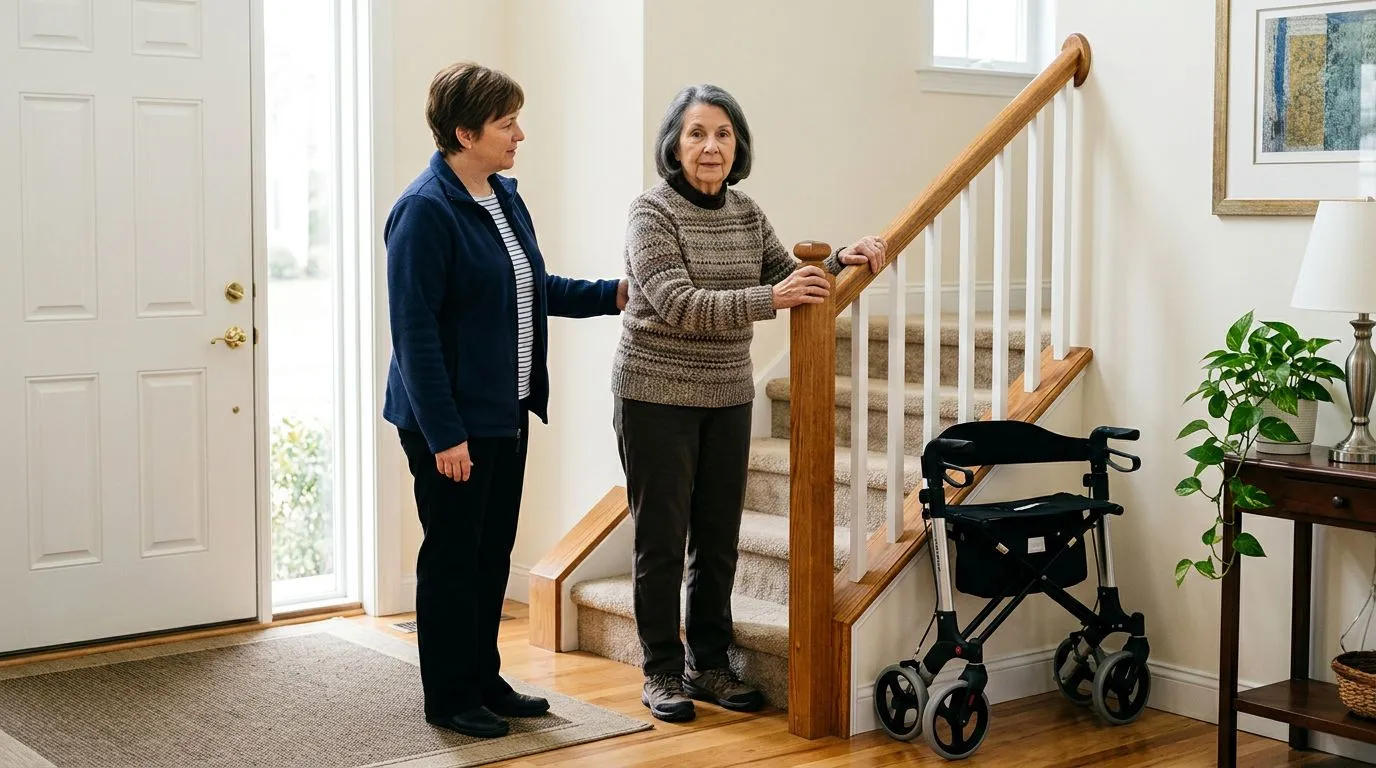
You generally should not use a rollator on stairs, and you should only manage a walker on steps with the right technique, a secure railing, and enough strength and balance to stay in control. A standard or folding walker may be carried or repositioned for 1 to 3 steps in some situations, but a rollator’s wheels, brakes, seat, and heavier frame make it unsafe for stair climbing. If you are unsure, ask a caregiver or physical therapist for help before trying stairs alone.
Stairs are where the difference between a walker and a rollator matters most. On flat ground, both can improve stability. On steps, the safest choice often depends on whether you have a railing, how many steps you need to manage, whether the device has wheels, and whether someone can assist.
The 10-second safety rule before any step
Before using any mobility aid near stairs, pause for about 10 seconds and check three things: the stairs, your body, and the device. The step should be dry and well lit, your shoes should be secure, and the walker or rollator should not wobble, be overloaded with bags, or sit halfway on and halfway off a step.
A walker can sometimes be managed around a single curb, porch step, or short set of 2 or 3 steps when the user has practiced a safe method. A rollator should generally stay off stairs. Even if the hand brakes feel firm on a hallway floor, they are not designed to turn a wheeled frame into a stable stair-climbing device.
Use this simple decision rule: if you need both hands on the device to stay upright, stairs are probably not safe without help. If you cannot stand still for 10 seconds while holding a railing, ask someone to assist or choose another route.
Walker vs. rollator on stairs: 3 key differences
A walker and a rollator can look similar from a distance, but they behave very differently at the edge of a step. Most standard walkers have 4 legs, while rollators have 3 or 4 wheels, hand brakes, and usually a built-in seat. Those differences change what is safe.
| Device type | Typical stair concern | Safer stair approach |
|---|---|---|
| Standard walker with no wheels | Must be lifted and placed evenly; all 4 legs need stable contact | May be managed on a curb or very short step sequence if trained and steady |
| Folding walker | Can be carried folded, but still awkward on narrow stairs | Often folded and carried in one hand while the user holds a railing with the other, if advised by a clinician |
| Two-wheel walker | Front wheels can roll at the wrong time; rear legs can catch on the stair edge | Treat with caution; do not rely on wheels for stair support |
| 3-wheel rollator | Narrower turning radius, but all 3 wheels can move on an uneven stair edge | Not recommended for stair climbing |
| 4-wheel rollator | Wider frame, seat, basket, and 4 wheels create tipping and rolling risks | Keep off stairs; have another person carry it if needed |
| Upright or bariatric rollator | Often taller, wider, and heavier; weight capacity may be 300 lb or more | Avoid stairs; plan an alternate route or use separate devices on each floor |
The key point is control. A no-wheel walker can be lifted. A rollator is designed to roll. That is helpful in a hallway and dangerous on a staircase.
Who it is best for: 1 step, 2 railings, and real limits
Managing stairs with a mobility aid is most realistic for someone who can hold a railing, follow a sequence, and handle a very small number of steps, such as 1 porch step or 2 indoor steps between rooms. It is not a test of toughness. It is a safety decision.
A standard walker may be a reasonable option near steps for a person who can stand without swaying, lift the walker without losing balance, and use at least one sturdy handrail. Some people keep one walker on the main level and another upstairs so they do not have to carry a device up and down a full flight.
A rollator is best for people who need rolling support on flat surfaces, places to rest, and hand brakes for controlled walking. It is not best for stairs. If the user needs a rollator because walking even 20 to 30 feet is tiring, that same fatigue can make stairs riskier.
Caregivers also need to consider their own limits. A lightweight walker may weigh around 5 to 8 lb, while some rollators can weigh 15 to 25 lb or more. Lifting a rollator up a staircase while also guarding a person is too much for many helpers to do safely.
How to choose and measure for stairs in 5 checks
Before deciding whether a walker can be used near steps, measure and inspect the area. A standard stair riser is often around 7 inches high, and many treads are around 10 to 11 inches deep, but older homes can vary. Small differences matter when a walker leg or wheel must land fully on a surface.
- Measure the step height. A single 4-inch threshold is very different from an 8-inch porch step. Higher steps require more leg strength and balance.
- Measure tread depth. If the tread is too shallow for the walker’s feet or wheels to sit fully, do not place the device on that step.
- Check stair width. Many walkers are roughly 20 to 25 inches wide. Some stairs, landings, or turns may not allow the frame to fit squarely.
- Inspect the railing. A railing should feel solid when pulled with moderate force. A loose rail is not a safety support.
- Confirm walker height. With arms relaxed, the handgrips are commonly adjusted near wrist crease height, allowing about a 15-degree bend at the elbow. Poor fit can make lifting or turning the walker harder.
For rollators, the measuring answer is simpler: do not plan to use the rollator on the stairs. Instead, measure doorways, landings, and storage space so the rollator can be parked safely away from the stair path.
Safer walker technique for 1 to 3 steps
For a curb or a short step sequence, many people are taught a basic pattern: move the walker first when going up a curb, step up with the stronger leg, then bring the weaker leg up. Going down, the walker goes down first, then the weaker leg, then the stronger leg. This is a general pattern, not a substitute for hands-on instruction.
On a staircase, the safest method often does not involve using the walker as an open frame on each step. If there is a sturdy railing, a clinician may teach the person to hold the rail, fold the walker, and carry it on the opposite side. Another person may carry the walker while the user holds the railing with full attention and at least one hand.
Keep movements slow. One step at a time is enough. The walker should never be perched diagonally with only 2 legs supported, and the user should not pull up on the walker as if it were a railing. Walkers are designed to support downward pressure on level surfaces, not to act like a fixed handrail bolted into a wall.
If there is no railing, do not treat the walker as a railing replacement. A standard walker may feel sturdy on a flat floor, but stairs add height, angle, and fall distance. The risk rises sharply when both hands are occupied and there is nothing fixed to grab.
Why rollators are generally unsafe on stairs, even with 2 hand brakes
Most rollators have 2 hand brakes, but those brakes are designed for slowing, parking, and sitting on level ground, not for bracing the device on a staircase. A brake can reduce wheel movement, but it does not remove the wheels or make the frame stable across stair edges.
A 4-wheel rollator can tip if one wheel is higher than the others. A 3-wheel rollator can pivot quickly when weight shifts. An upright rollator raises the user’s posture, but it also changes leverage; on stairs, a taller frame can be harder to control. Bariatric rollators may offer higher weight capacities, sometimes 300 lb or more, but strength ratings do not mean stair safety.
The built-in seat creates another concern. A rollator seat is meant for resting when the brakes are locked on a flat, stable surface. It should not be used on a stair, landing edge, ramp slope, or halfway through a transfer. Sitting on a rollator near stairs can put the user’s center of gravity too close to a drop-off.
Caregivers sometimes ask whether they can tip a rollator back and bump it up a few steps. That may damage the device, strain the helper, or cause a sudden roll. If the rollator must go to another floor, it is safer for a capable person to carry it separately while the user climbs with a railing or uses another mobility plan.
Railings, caregivers, and transfer points: 3 supports that matter
Three supports make stair situations safer: a secure railing, a trained or steady caregiver, and a clear transfer point at the top and bottom. Without at least one dependable railing, most seniors who use a walker or rollator should not attempt stairs alone.
Two railings are better than one because they allow symmetrical hand support, but many homes have only one. The railing should extend far enough that the person can hold it before the first step and after the last step. A short rail that stops early can create a risky final step.
A caregiver should usually stand below the person on stairs, close enough to guard but not pulling the person off balance. On the way up, that often means one step below and slightly behind. On the way down, it may mean one step below and facing the person as appropriate. The helper should not carry a heavy rollator and physically support the person at the same time unless they have been trained and can do both safely.
Transfer points matter too. At the bottom of the stairs, the walker or rollator should be positioned so the person can reach it after both feet are on level ground. At the top, there should be room to turn without backing toward the stair edge. A landing that is only a few feet deep can feel crowded when a walker, caregiver, and door swing all compete for space.
When to ask for help or avoid stairs: 6 red flags
Ask for help, use another route, or avoid stairs entirely if any of these 6 red flags apply. One red flag may be enough to change the plan for the day, especially if fatigue or medication side effects are involved.
- Dizziness, lightheadedness, or new weakness. Even a brief dizzy spell can be dangerous on steps.
- No secure railing. A walker or rollator does not replace a fixed rail.
- Wet, icy, uneven, or dark steps. Outdoor stairs can change from safe to unsafe in minutes.
- Need to carry items. Carrying laundry, groceries, or a pet while using a mobility aid increases risk.
- Recent fall, surgery, or change in walking ability. New limitations deserve professional guidance.
- Rollator is the only support available. If the person cannot climb without leaning on a rollator, the stairs are not a safe option.
Families should take near-falls seriously. Grabbing the wall, missing a step, or needing someone to catch the device are signs that the current setup is not working.
Safer home options than carrying a device up 12 steps
A full flight of stairs often has about 12 to 14 steps, which is a very different challenge from a single curb. Instead of carrying a walker or rollator up and down every time, many households can reduce risk with practical changes.
| Option | Best use | Important note |
|---|---|---|
| One walker on each level | Homes where the person can climb with a railing but needs support once on level ground | Removes the need to carry the walker on stairs |
| Extra railings or repaired railings | Stairs used daily | Installation should be secure and appropriate for the wall structure |
| Threshold or entry ramp | Small doorway rises and single exterior steps | A common accessibility guideline is 1 inch of rise for 12 inches of ramp run, so a 6-inch rise may need about 6 feet of ramp |
| Main-floor setup | Temporary recovery or worsening mobility | Moving sleeping, bathing, or laundry tasks to one level can reduce daily stair trips |
| Professional home safety visit | Repeated falls, complex layouts, or caregiver strain | An occupational or physical therapist can assess stairs, transfers, and device use |
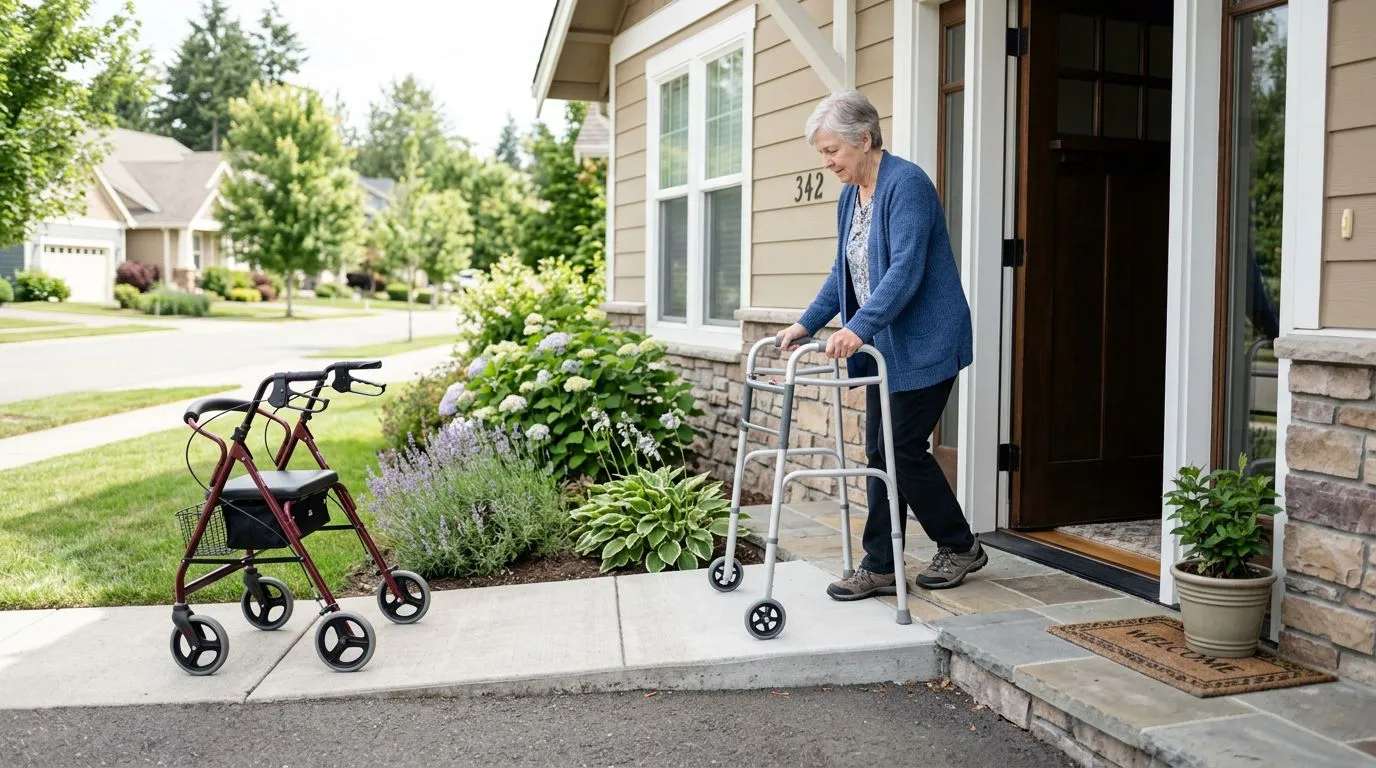
For outdoor access, a ramp can help some walker and rollator users, but it must have the right slope, width, surface, and length. A steep homemade ramp may be harder and more dangerous than the step it replaces. Rollator users also need enough space at the top and bottom to stop, turn, and lock brakes on level ground.
The practical bottom line in 4 decisions
When deciding what to do, separate the device from the person and the environment. The safest answer depends on all 4 decisions: what device is being used, how many steps are involved, whether there is a reliable railing, and whether help is available.
For a standard or folding walker, short step situations may be manageable with training, a railing, and careful pacing. For a two-wheel walker, the wheels add a rolling risk, so be more cautious and ask for instruction. For any rollator, including 3-wheel, 4-wheel, upright, and bariatric styles, stairs are generally not appropriate.
The goal is not simply getting upstairs once. The goal is getting there safely today, tomorrow, and on a tired day when balance is not at its best. If the plan only works when everything goes perfectly, it is not a reliable stair plan.
FAQ
Frequently asked questions
Is it safe to use a rollator on stairs if the brakes are locked? +
No. Rollator brakes are meant for level surfaces, not for stabilizing the device on stair edges. The wheels, frame angle, and weight shift can still create a tipping or rolling hazard.
Can a standard walker be used on a single porch step? +
Sometimes, if the person has enough balance and strength, the step is dry and stable, and the technique has been practiced. A railing or caregiver support makes the situation safer.
What should I do with my walker when climbing a full flight of stairs? +
Many people use a railing and have the walker carried separately, or keep a second walker on the other floor. A physical or occupational therapist can teach the safest method for your layout.
Are two-wheel walkers safer than rollators on stairs? +
They may be easier to manage than a rollator in some situations, but the wheels can still move unexpectedly. They should be used near steps only with caution and proper instruction.
When should a senior avoid stairs completely? +
Avoid stairs during dizziness, new weakness, poor lighting, wet or icy conditions, after a recent fall, or when there is no secure railing. If a rollator is the only support, choose another route or ask for help.
Keep reading
Related guides
Walker and Rollator Safety on Curbs, Ramps, and Thresholds
13 min read
When a Rollator May Not Be the Safest Choice: Balance, Fall Risk, and Caregiver Considerations
11 min read
Caregiver Training for Walker and Rollator Users: Assist Without Raising Fall Risk
12 min read