Disclosure: We may earn a commission when you buy through links on this page, at no extra cost to you. We buy nothing, sell nothing and accept no payment for coverage — commissions never decide what we recommend. How we make money.

Running errands with a walker or rollator is safest when you plan the route, keep both hands available for support, and avoid carrying loose items by hand. Walkers provide maximum stability for short, careful trips, while rollators are often easier for longer errands because they have wheels, hand brakes, a basket or pouch, and a seat for planned rest breaks.
The best approach depends on the errand. A quick pharmacy pickup may work well with a folding walker and a small tote attached to the frame. A grocery trip across a large parking lot may be better suited to a 4-wheel rollator if the user can operate the brakes safely.
Start with a 5-minute errand plan before leaving home
A good outing begins before the car door opens. Take 5 minutes to think through distance, surfaces, seating, and how items will be carried. Seniors and caregivers often focus on the destination, but the riskiest moments are usually the transitions: getting out of the car, crossing a parking lot, turning in a narrow aisle, reaching at a counter, and loading bags back into the vehicle.
Choose the mobility aid based on the errand, not habit alone. A standard walker or folding walker is usually slower, but it gives a very stable base because the frame is placed on the ground before each step. A two-wheel walker can help on smooth indoor floors because the front wheels glide while the rear legs provide braking friction. A no-wheel walker frame may be best when the user needs firm support and is traveling only a short distance.
A rollator works differently. Most rollators have 3 or 4 wheels, hand brakes, and a built-in seat. Many include an under-seat basket, pouch, or bag. Rollators can make longer store trips easier, especially when rest breaks are needed, but they require judgment and hand strength because the device keeps rolling unless the brakes are controlled.
- Check the weather, since wet pavement and snow can reduce traction.
- Pick stores with automatic doors, curb cuts, and nearby accessible parking when possible.
- Bring only essentials: phone, keys, payment, ID, medication list, and a short shopping list.
- Wear supportive shoes with non-slip soles, not loose slippers or backless sandals.
- Decide before you go where you can sit if you need a 2- to 5-minute rest.
Walker vs rollator for errands: a 3-type comparison
Walkers and rollators are both mobility aids, but they behave very differently in public places. The biggest difference is control. With a walker, the user places or slides the frame, steps forward, and repeats. With a rollator, the wheels move continuously, so brake use becomes part of every stop, turn, and rest break.
For errands, the question is not which device is better overall. A more useful question is which device matches the user, the terrain, and the task. A person who needs to put significant weight through the frame may feel safer with a standard walker. A person who walks farther but tires quickly may appreciate a rollator seat after 100 to 300 feet, provided they can lock the brakes and sit safely.
| Type | Best errand use | Strengths | Watch-outs |
|---|---|---|---|
| Standard or folding walker | Short pharmacy trips, clinic check-ins, small stores | Very stable, simple, no brake system to manage | Harder to carry items; slower across parking lots |
| Two-wheel walker | Smooth store floors, short grocery stops, indoor errands | Front wheels reduce lifting; rear legs help stop movement | Can catch on thresholds; still limited for carrying bags |
| 3- or 4-wheel rollator | Longer errands, sidewalks, larger stores, seated rest breaks | Rolls easily; hand brakes; basket or pouch; seat on many models | Requires brake control; not meant to be pushed like a shopping cart |
Three-wheel rollators are often narrower and easier to turn in tight aisles, but many do not have a full seat. Four-wheel rollators are more common for seated rest breaks, though they can be wider and need more room to turn. Upright rollators allow a more forward-facing posture for some users, but they are typically larger and require careful fitting. Bariatric rollators and heavy-duty walkers may offer higher weight capacities, often in the 300- to 500-lb range, but their wider frames can be harder to maneuver in older stores with tight layouts.
Parking lots: manage 20 to 40 feet at a time
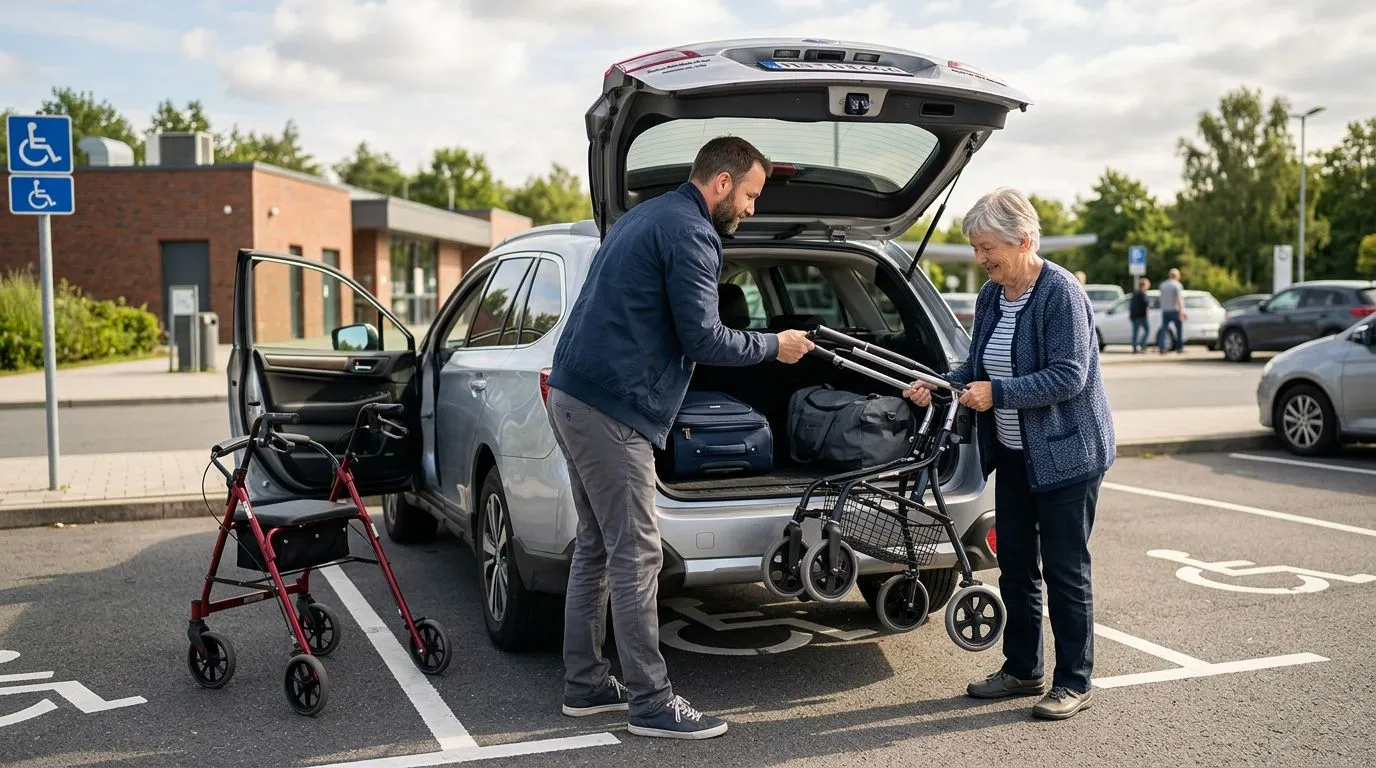
Parking lots combine moving cars, uneven pavement, painted lines, curbs, shopping carts, and distracted pedestrians. For many seniors, the walk from the car to the entrance is the most demanding part of the errand. Break the distance into short segments of about 20 to 40 feet, and pause in a safe spot when needed.
If using a walker, place all 4 legs firmly before stepping. On cracked pavement, a no-wheel walker can feel secure, but the rubber tips may catch if the walker is dragged. Lift only as high as needed. A two-wheel walker can roll over smooth asphalt more easily, but the back legs may scrape or snag on rough patches.
If using a rollator, keep both hands on the handles and move slowly. Test the hand brakes before leaving the car. Squeeze the brakes gently to slow down on a slight slope, and lock them only when stopped. Never sit on a rollator seat in a driveway lane, behind parked cars, or on a slanted surface.
- Park near the entrance, but avoid spaces where cars back out quickly on both sides.
- Use curb cuts instead of stepping off a curb whenever possible.
- Make eye contact with drivers before crossing a lane.
- Do not hang heavy bags on walker handles or rollator handles; 5 lb on one side can affect steering.
- If a caregiver is present, they should walk beside or slightly behind, not pull the device forward.
Accessible parking spaces help, but they do not remove every hazard. The striped access aisle beside the space is for deploying mobility devices and allowing room to move. Do not stand there longer than needed if vehicles are passing nearby.
Store aisles and pharmacies: allow 36 inches when possible
Many public accessibility routes are designed around a 36-inch clear width, but real stores are not always ideal. Displays, seasonal bins, stacked boxes, and other shoppers can narrow the path. A walker user may need to square up to the aisle before turning, while a rollator user needs enough room for both the frame and the turning radius.
In a pharmacy, plan for waiting. If the prescription counter line is long, ask whether there is a place to sit or whether the order can be brought to a lower counter. A rollator seat can be useful if there is a safe flat area away from foot traffic. Lock both brakes before sitting, turn slowly, back up until both legs touch the seat edge, and reach back only if balance is steady.
With a walker, avoid reaching far to the side for items on shelves. Move the walker close, stop, then reach with one hand while the other hand stays on the frame if needed. Better yet, ask for help with anything above shoulder height or below knee level. Many falls happen during reaching, not walking.
| Store area | Walker tip | Rollator tip |
|---|---|---|
| Automatic entrance | Pause after the threshold; rubber tips can catch on mats | Roll straight over mats slowly; brake if the mat bunches |
| Narrow aisle | Take short steps and avoid pivoting fast | Use a wide, slow turn instead of twisting the handles sharply |
| Checkout lane | Stand close enough to unload without leaning | Lock brakes if standing in line for more than a minute |
| Pharmacy counter | Ask staff to place bags within easy reach | Keep the rollator in front, not off to the side where it can roll |
Shopping carts, baskets, and mobility aids: avoid pushing 2 devices
One of the most common errand mistakes is trying to push a shopping cart while also using a walker or rollator. For many people, managing 2 rolling or moving devices at once is unsafe. A shopping cart is not a substitute for a walker because it can roll away, tip differently, and may not support body weight.
With a walker, consider a small walker bag, tray, or basket designed for the frame. Keep the load light and centered. A few small items may be manageable; a 10-lb grocery bag hanging from one side can change balance and make the frame harder to place evenly. If the store has small hand baskets, they are often difficult because they occupy one hand.
With a rollator, use the built-in storage area when available. Under-seat baskets and front pouches are meant for light to moderate personal items, not cases of water or overfilled grocery bags. Heavy items should go in a store cart pushed by a caregiver, delivered by store staff, or split into smaller trips.
Some stores offer motorized carts or employee assistance. There is no shame in using them. If walking the store would take 30 minutes and exceed the user’s safe endurance, a powered store cart may be the better errand tool that day. Transfer carefully, park the walker or rollator where staff allow, and keep personal items secure.
- Do not place a purse on top of a rollator seat if you plan to sit.
- Do not carry hot coffee while operating a walker or rollator.
- Choose smaller packages when possible, such as 2 lighter bags instead of 1 heavy bag.
- Ask cashiers to pack bags at 5 lb or less if carrying strength is limited.
Carrying items safely: keep loads under about 5 to 10 lb
Carrying items changes balance. Even a small load can matter if it pulls to one side or blocks a view of the floor. A practical rule for many errands is to keep any one bag under about 5 to 10 lb, and lighter if the person has shoulder, wrist, balance, or endurance limitations.
Walker users should keep both hands available whenever possible. A walker bag attached to the front or sides can hold a phone, wallet, folded list, and small purchases. A tray may help move items inside the home, but outdoors and in crowded stores it can create a tripping or bumping hazard if overloaded.
Rollator users should place items low and centered. Under-seat storage is usually more stable than hanging bags from the handles. Handle-hung bags can swing, interfere with braking, or pull the rollator backward when the user sits. If using a pouch, zip it when possible so items do not fall near the wheels.
Caregivers can help without taking over. The most useful support is often carrying purchases, opening heavy doors, reading labels, or standing in line while the walker or rollator user rests nearby. Avoid grabbing the mobility device unless the user asks or there is an immediate safety concern.
Sidewalks, curbs, and doorways: check 1 threshold at a time
Sidewalk travel requires attention to surface changes. A 1-inch raised edge, a cracked slab, wet leaves, gravel, or a thick entrance mat can be enough to stop a walker tip or jolt a rollator wheel. Slow down before each threshold instead of reacting at the last second.
For walkers, approach thresholds straight on. Place the front legs or wheels over the edge first, then step forward. If the threshold is high, use the nearest ramp or ask for help. Do not lift the walker high while stepping at the same time unless a physical therapist has trained that method.
For rollators, larger wheels generally handle outdoor surfaces better than small wheels, but no rollator makes curbs risk-free. Use curb cuts. Keep the rollator close to the body on slopes, and lightly squeeze the brakes to control speed. On a downhill path, do not let the rollator get more than a step ahead.
Doorways create another common challenge. Automatic doors are easiest, but older stores may have heavy pull doors. A caregiver can hold the door while the user moves through slowly. When alone, look for the accessible entrance, pharmacy drive-through, curbside pickup, or a call button if available.
Rest breaks and energy pacing: plan for 2 safe seats
Fatigue affects judgment, posture, and foot clearance. Before a longer errand, identify at least 2 possible rest options: a bench near the entrance, a pharmacy waiting chair, a cafe seat, a store customer service area, or the seat on a 4-wheel rollator when it is safe to use.
A rollator seat is for resting, not being pushed while seated. The brakes should be locked, the surface should be level, and the rollator should not be in a traffic lane. Sit only after backing up until the seat touches the backs of the legs. Stand by pushing from the seat or frame only as directed by the device instructions or a clinician; many people do better pushing from a stable chair with arms when available.
Walker users need to plan rest breaks differently because most walkers do not include a seat. In large stores, choose routes that pass seating areas or ask staff where to wait. For some seniors, 10 minutes of walking inside a large store after crossing a parking lot may be too much without a seated pause.
Caregivers should watch for subtle signs of fatigue: shorter steps, leaning heavily on the handles, rushing to finish, shuffling, or confusion at checkout. When these appear, it is time to pause, not push through.
How to choose and measure for errands: 3 fit checks
A walker or rollator that fits poorly can make errands harder than they need to be. Three basic checks can help, although fitting guidance from a physical therapist, occupational therapist, or medical equipment professional is best when balance, pain, or fall history is involved.
1. Handle height
When standing upright in walking shoes, handles are commonly set near wrist crease height with arms relaxed at the sides. Elbows should have a slight bend, often around 15 to 30 degrees, when hands are on the grips. Handles that are too low can encourage stooping; handles that are too high can reduce control.
2. Width and turning space
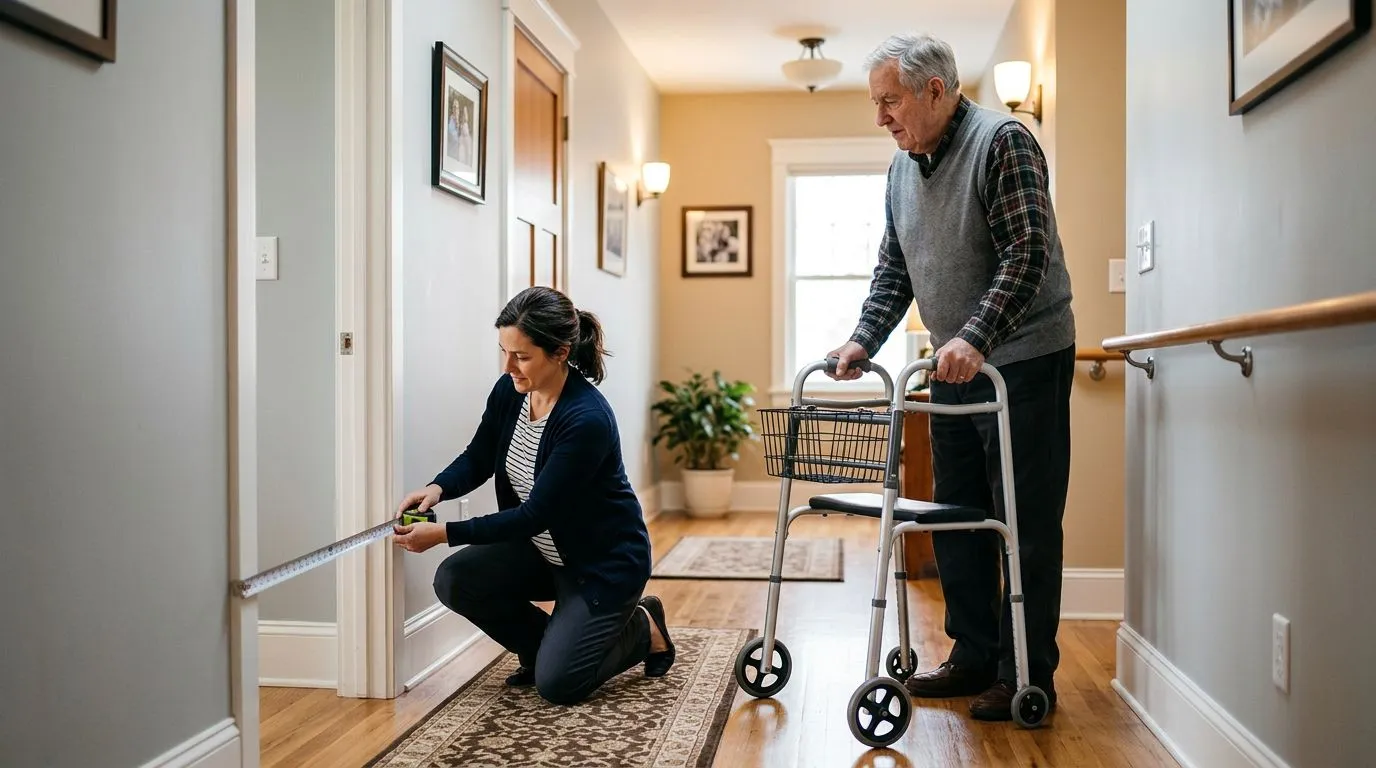
Measure the narrowest places the user visits often: bathroom doors, apartment hallways, pharmacy aisles, and the space beside the car. Many interior doorways are about 28 to 32 inches wide, while public routes are often wider. A bariatric rollator or wide walker may be appropriate for support but still difficult in tight stores.
3. Weight capacity and storage needs
Check the stated weight capacity of the frame and seat if using a rollator. Do not assume the seat capacity is the same as the storage capacity. If errands regularly involve groceries, prescriptions, and personal items, choose a setup that keeps weight low, centered, and within the device limits.
| Need | Often points toward | Reason |
|---|---|---|
| Maximum stability for short distances | Standard or folding walker | Frame stays planted between steps |
| Smoother indoor walking | Two-wheel walker | Front wheels reduce lifting on store floors |
| Frequent rest breaks | 4-wheel rollator with seat | Built-in seat supports planned pauses |
| Tight turning in small shops | Narrow walker or 3-wheel rollator | Smaller footprint may maneuver more easily |
| Higher weight capacity | Bariatric walker or bariatric rollator | Stronger frame, often wider and heavier |
Caregiver support: use a 10-second safety pause
A simple 10-second pause before each transition can prevent many problems. Stop before leaving the car, entering the store, stepping onto a curb cut, turning into a crowded aisle, or loading bags. Ask: Is the path clear? Are both hands free? Are the brakes working? Is the load balanced?
Caregivers should avoid rushing the pace. Walking slightly ahead can unintentionally pull the person forward, especially if conversation distracts them. A better position is beside the person on the weaker side if they have one, or just behind and to the side in busy spaces. Offer an arm only if that is how the person has been trained to walk safely; mixing an arm hold with a walker can sometimes throw off balance.
Errands can also be redesigned. Use pharmacy drive-through windows, curbside pickup, smaller local stores, delivery for heavy items, or one errand per trip instead of 4 stops in a row. Independence is not measured by doing everything the hardest way. It is measured by getting the task done with the least reasonable risk.
A practical errand routine for a 30-minute trip
For many seniors, a safe errand has a rhythm: park close, pause, cross carefully, enter slowly, shop from a short list, rest before fatigue peaks, pay without rushing, and return to the car with help for bags. A 30-minute outing is often more manageable than an open-ended shopping trip.
If using a walker, keep the shopping list short and prioritize essentials. Ask for help with top-shelf items and heavy purchases. If using a rollator, use the brakes deliberately at counters, checkout lines, and rest stops. Keep storage light, balanced, and away from the handles.
The best mobility aid for errands is the one the user can control well in the real places they go: parking lots, store aisles, pharmacies, sidewalks, and doorways. With planning, proper fit, and sensible carrying habits, walkers and rollators can support safer local travel while preserving choice and independence.
FAQ
Frequently asked questions
Is a walker or a rollator better for grocery shopping? +
A rollator is often easier for longer grocery trips because it rolls smoothly, may include storage, and usually has a seat. A standard or folding walker may be safer for someone who needs maximum stability or cannot reliably use hand brakes.
Can I push a shopping cart while using a walker? +
It is usually not safe to manage a shopping cart and a walker at the same time. Use a walker bag or basket for a few light items, ask a caregiver or store employee to help, or consider curbside pickup for larger orders.
Is it safe to hang grocery bags on rollator handles? +
Heavy bags should not be hung from rollator handles because they can affect steering, braking, and balance. Use the built-in basket or pouch for light items and keep weight low and centered.
How should I use a rollator seat during errands? +
Use the seat only on a flat, safe surface away from traffic. Lock both brakes, back up until the seat touches the backs of your legs, sit slowly, and never allow anyone to push the rollator while you are seated.
What should caregivers do in parking lots? +
Caregivers should slow the pace, watch for cars and uneven pavement, carry bags when possible, and avoid pulling the walker or rollator forward. Walking beside or slightly behind the person is usually safer than leading from the front.
Keep reading
Related guides
Buying a Mobility Walker for an Older Parent: Questions to Ask Before You Shop
13 min read
Taking a Walker or Rollator on Public Transportation: Buses, Trains, Subways, and Rideshares
13 min read
Walker or Rollator for Day Trips and Events: Museums, Restaurants, Stadiums, and Crowded Places
12 min read