Disclosure: We may earn a commission when you buy through links on this page, at no extra cost to you. We buy nothing, sell nothing and accept no payment for coverage — commissions never decide what we recommend. How we make money.
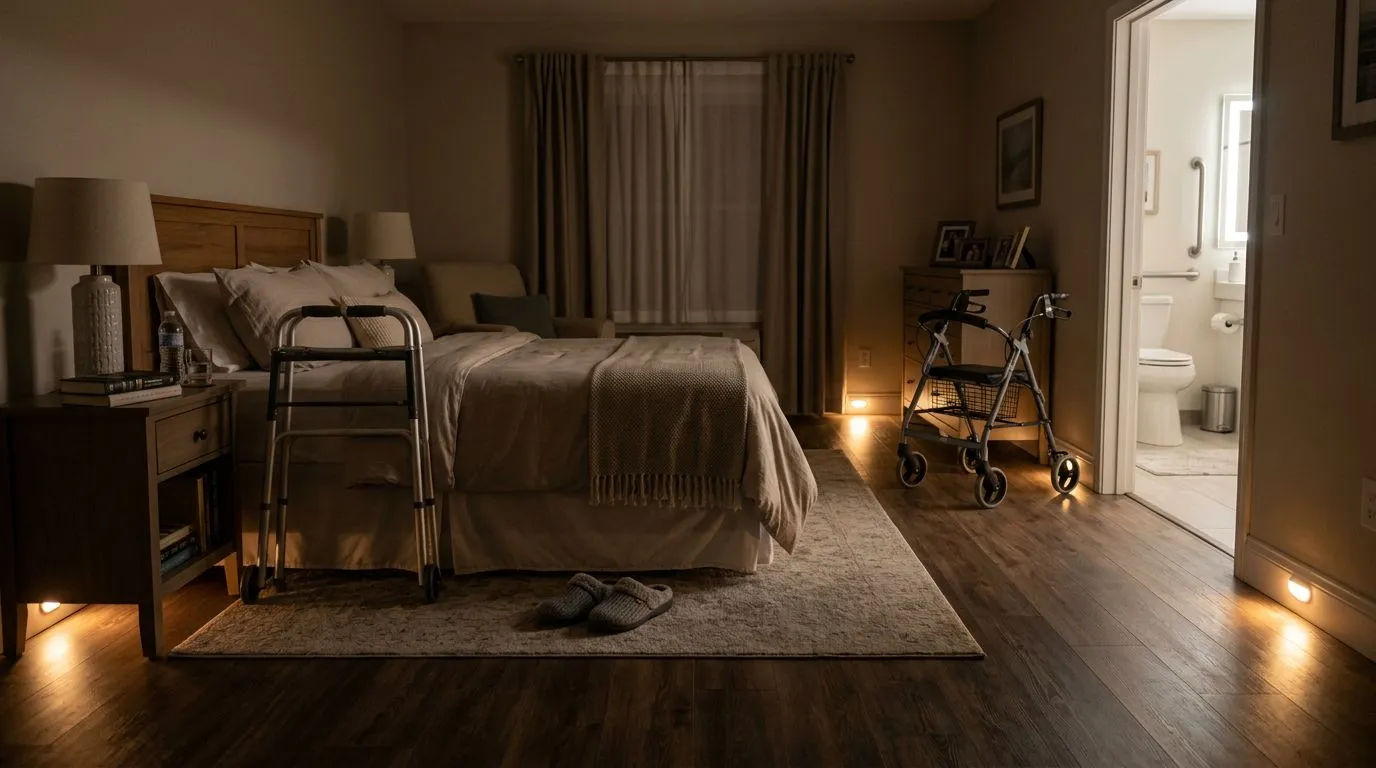
Nighttime walker and rollator safety comes down to four basics: light the path, clear the route, use the device correctly, and slow down before bathroom trips. A walker provides steady support for short, careful steps. A rollator can help with longer household distances, but it must be braked before stopping, turning, or sitting. If nighttime trips are frequent, rushed, or already leading to near-falls, the home setup and level of supervision may need to change.
Many falls happen during ordinary moments: getting out of bed, reaching for slippers, turning toward the bathroom, or backing up to sit. Darkness makes each step harder because depth, shadows, rugs, and thresholds are more difficult to judge. The goal is not to make the house look like a hospital. It is to create a simple, repeatable nighttime routine that still works at 2 a.m. when you are sleepy.
Start with a 3-minute nighttime route check
A useful safety check takes about 3 minutes and should be done after dark, not in bright afternoon light. Walk the exact route from bed to bathroom, bed to favorite chair, and bed to kitchen if nighttime water or medication is part of the routine. Use the same walker or rollator, the same slippers, and the same lighting you normally use overnight.
Watch for anything that interrupts a smooth path: a throw rug edge, a charging cord, a laundry basket, a pet bed, a narrow turn by the dresser, or a door that only opens halfway. If a walker catches once during the check, it is a hazard. If a rollator wheel bumps, twists, or drops into a gap, that spot needs attention before bedtime.
Walkers and rollators behave differently at night. A standard walker or folding walker without wheels has to be lifted and placed. A two-wheel walker rolls in front but still has rear tips that can drag or catch. A rollator has 3 or 4 wheels, hand brakes, and usually a seat, so it moves more easily but can roll away if the brakes are not used. That difference matters most when you are tired.
Light the path with at least 2 hands-free light sources
Hands-free lighting is safer than carrying a flashlight because both hands stay available for the walker grips or rollator handles. A good setup often includes at least 2 light sources: one near the bed and one along the route, such as a plug-in night light, motion-sensor light, or low lamp that can be turned on before standing.
Place light where it removes shadows, not where it shines into the eyes. A bright light at floor level can help reveal rug edges and thresholds, while a lamp aimed directly at the bed may cause glare. If the bedroom-to-bathroom route is 15 to 25 feet, the middle of the route usually needs light too, especially around a hallway turn.
Small attachable lights can be useful on walkers and rollators, but they should not replace room lighting. If a light is attached to a walker frame, make sure it does not block the folding mechanism, brake cables, or hand placement. For rollators, avoid attaching anything near the hand brakes that could interfere with squeezing the levers.
Clear a 36-inch path when possible
A clear path of about 36 inches gives most walkers and rollators enough room to move without bumping furniture. Some standard walkers are about 24 to 28 inches wide, and many rollators are in a similar range, but turning space matters as much as straight-line width. Tight pathways invite side-stepping, twisting, and reaching, all common fall risks at night.
Start with the floor. Remove throw rugs if they slide, curl, or bunch under walker tips or rollator wheels. Tape is not always enough, especially on older rugs with raised edges. Keep shoes, books, oxygen tubing, pet toys, and phone chargers out of the route. A laundry basket can wait until morning; a clear floor cannot.
Check thresholds and doorway lips. Even a raised edge of 1/2 inch can catch a walker tip or slow a small rollator wheel. If a threshold cannot be removed, it should be visible and approached straight on. Turning while crossing a threshold is harder, particularly with a 3-wheel rollator or a two-wheel walker.
| Night hazard | Why it matters | Safer fix |
|---|---|---|
| Loose throw rug | Walker tips and rollator wheels can catch or slide | Remove it from the route |
| Power cord across floor | Creates a trip line in low light | Route it along the wall |
| Narrow furniture gap | Forces twisting or side-stepping | Move furniture to allow about 36 inches |
| Pet bed near hallway | Soft obstacle is hard to see at night | Relocate it before bedtime |
Choose the right device for nighttime use: walkers vs. rollators in 4 common situations
A walker is not the same as a rollator. A walker is typically a frame with no wheels or 2 front wheels, used for stable, step-by-step support. A rollator is a wheeled walker, usually with 3 or 4 wheels, hand brakes, and a built-in seat. Rollators are easier to move across longer distances, but they require good brake habits and enough control to prevent unwanted rolling.
At night, the safest device is the one the person can manage consistently while sleepy. Someone who needs firm support for every step may do better with a standard walker or two-wheel walker. Someone who walks steadily but tires easily on the way to the bathroom may benefit from a 4-wheel rollator with brakes and a seat, as long as they can use the brakes correctly.
| Device type | Who it is best for at night | Watch-outs |
|---|---|---|
| Standard walker or no-wheel frame | People who need maximum stability for short distances | Must be lifted and placed; can be tiring |
| Two-wheel walker | People who need support but have trouble lifting a full frame | Rear tips can catch on rugs or thresholds |
| 3-wheel rollator | People who need maneuverability in tight spaces | Usually no full seat; less stable than many 4-wheel options |
| 4-wheel rollator | People who need wheels, brakes, and a place to rest | Can roll if brakes are not locked before sitting |
| Upright rollator | People who have been fitted to walk more upright with forearm support | Requires enough space and correct height adjustment |
| Bariatric rollator | People needing a higher weight capacity and wider frame | May need wider doorways and larger turning areas |
Weight capacity matters. Many mobility aids list limits such as 250, 300, 350, or more pounds, depending on frame type. The listed capacity includes the user, and for rollators, it also relates to safe use of the seat. Never assume a seat is safe just because the frame looks sturdy; check the device label or manual if available.
Measure handle height in 2 simple steps
Incorrect handle height can make nighttime walking harder. If handles are too low, the user may lean forward and look down. If they are too high, the shoulders rise and balance can feel less steady. A common starting point is to stand upright in regular walking shoes, let the arms hang naturally, and set the grips near the crease of the wrist.
The elbows should usually have a slight bend, often around 15 to 30 degrees, when holding the grips. This is a general fit check, not a medical fitting. A physical therapist, occupational therapist, or trained mobility professional can help if posture, weakness, pain, or one-sided balance problems make adjustment difficult.
Do the handle-height check at night with the same footwear used for bathroom trips. Thick slippers can add height; bare feet can reduce it. A 1-inch difference in footwear can change how the device feels, especially for a person who depends heavily on the handles for balance.
Make bathroom trips safer in the first 10 seconds
The first 10 seconds after waking are important. Sit at the edge of the bed, turn on the light, place both feet flat, and make sure the walker or rollator is directly in front before standing. Standing up while reaching sideways for the device is a common risky move.
Keep the device close enough to reach without stretching, but not so close that it blocks the feet. For a walker, the open side should face the user so they can step into the frame. For a rollator, the brakes should be engaged before standing if it is being used as support, then released only when ready to walk.
Rushing to the bathroom raises risk. If urgency is a frequent problem, consider non-device solutions too: a bedside commode, a urinal, scheduled toileting before bed, easier clothing fasteners, or a conversation with a healthcare professional about nighttime urination. These are practical fall-prevention steps, not signs of giving up independence.
Inside the bathroom, space is often tight. Many bathrooms have 24- to 30-inch doorways, limited turning space, and hard surfaces. A standard walker may fit where a wider rollator does not. A 3-wheel rollator may turn more easily than a 4-wheel model, but it still needs careful brake control. Once the person is in the bathroom, grab bars, raised toilet seats, and non-slip flooring may matter more than the mobility aid itself.
Use rollator brakes every time: stop, lock, then sit
Rollator brakes are not optional at night. Keep the routine simple: slow down, squeeze the hand brakes to stop, lock the brakes if the rollator will stay still, and only then sit or stand. Many rollator falls happen when a person starts to sit before the brakes are locked.
A 4-wheel rollator seat is meant for resting, not for being pushed while seated. The user should turn slowly, back up until both legs feel the seat, lock the brakes, reach back if able, and sit with control. Standing up follows the same rule in reverse: brakes locked first, both feet placed firmly, then stand.
For 3-wheel rollators, remember that many do not have a full seat. They are often chosen because they are lighter and easier to maneuver, but they may not provide a resting surface. At night, that matters if the bathroom route is long or fatigue comes on quickly.
Brake cables and hand levers should be checked regularly. If a brake feels loose, uneven, or hard to squeeze, stop using the rollator for high-risk trips until it is adjusted or repaired. Someone with arthritis, hand weakness, or numbness may need a different brake style or more support than a standard rollator provides.
Use walker technique that avoids 3 common mistakes
Walkers are stable when used correctly, but they still require rhythm. The basic pattern for many people is: place the walker a short distance ahead, step into it, then repeat. The walker should not be shoved far forward like a shopping cart. A distance of about one normal step is usually safer than reaching far ahead.
Three nighttime mistakes are especially common. First, lifting a standard walker too high can throw off balance. Second, stepping outside the frame reduces support. Third, turning by twisting the body while the walker stays still can lead to a sideways loss of balance. Small steps are better.
With a two-wheel walker, the front wheels roll but the rear tips still need clearance. If the rear tips are worn, sticky, or uneven, they can drag on carpet or catch on a rug edge. Replacement tips or glides may help in some homes, but changes should be matched to the flooring and used with care.
Wear footwear with a closed heel and low tread
Night footwear should stay on the foot. A closed heel or secure back strap is usually safer than a loose slipper. Soles should provide traction without being so sticky that they grab the floor and stop the foot suddenly. Bare feet and socks can be slippery on tile, wood, and some laminate floors.
Fit matters in small ways. A slipper that is even 1 size too large can slide or catch under the toes. Deep, bulky tread may feel secure outside but can snag on carpet indoors. If swelling changes foot size from morning to night, footwear should be checked when it is normally worn.
Keep shoes or slippers in the same place every night, ideally within easy reach while sitting. Do not place them under the bed where reaching causes bending. The safest footwear is not helpful if it takes a risky reach to get it.
Add accessories carefully: 5 useful options and 3 to avoid
Accessories can help, but they should never interfere with safe hand placement, brakes, or folding. Useful nighttime options may include a small hands-free light, reflective tape on the frame, a bedside caddy, a walker tray used only when fully awake, or a rollator pouch for essentials such as glasses and a phone.
Keep carried items light. A heavy bag hanging from one side of a walker or rollator can change balance. For rollators, avoid loading the handles with bags because it can affect steering and brake access. Use the basket or pouch area if the device has one, and stay within the manufacturer’s guidance.
Avoid 3 things at night: dangling cords or straps, cup holders that stick out into doorframes, and any add-on that blocks a hand brake or grip. A device that folds should still fold and lock normally after accessories are attached. If it does not, remove the accessory.
Know when 1 fall or repeated near-falls means the plan is not enough
One fall is enough reason to reassess the nighttime setup, even if there was no serious injury. Repeated near-falls, furniture-grabbing, new confusion, dizziness, or needing to rush to the bathroom several times a night are signs that lighting and clutter control may not be enough by themselves.
More support can take many forms. It may be a home safety evaluation, physical or occupational therapy, medication review, vision check, continence care, grab bars, a bedside commode, a wider pathway, or a caregiver assisting at certain times. For some people, a bed alarm or motion alert may help a caregiver respond, but it should be used respectfully and with the person’s dignity in mind.
Pay attention to changes that happen over days or weeks. A walker that worked well last month may not be enough after an illness, medication change, or new weakness. A rollator that felt easy in daylight may be too fast or too wide for nighttime bathroom trips. The right answer may be a different device, a different route, or fewer nighttime walks.
Build a 60-second bedtime safety routine
A short routine is easier to follow than a long checklist. Before bed, spend 60 seconds setting up the route: turn on night lights, move clutter, park the walker or rollator in the same position, place footwear within reach, and keep a phone or alert button accessible. If a caregiver helps, use the same order every night.
For walkers, confirm the frame is fully opened and locked if it folds. Check that rubber tips touch the floor evenly. For rollators, confirm brakes work, wheels are not blocked, and the seat is clear of loose items. If the device is parked beside the bed, position it so standing up does not require twisting.
The best nighttime plan is predictable. Light goes on first. Feet go flat. Device is brought close. Brakes are used when needed. Steps are slow. That simple pattern protects mobility while respecting independence, whether the person uses a standard walker, a two-wheel walker, a compact 3-wheel rollator, a 4-wheel rollator with seat, an upright rollator, or a bariatric rollator.
FAQ
Frequently asked questions
Is a walker or a rollator safer for nighttime bathroom trips? +
It depends on the person’s balance, strength, and brake control. A standard or two-wheel walker usually offers more steady support for short, careful trips. A rollator can be helpful for longer distances or fatigue, but only if the user reliably controls and locks the brakes.
Should I keep my walker or rollator next to the bed? +
Yes, if it can be reached without twisting or leaning. Park it in the same spot every night, with the open side of a walker facing the user or the rollator brakes locked before standing.
Are motion-sensor lights good for walker and rollator users? +
Motion-sensor lights can be very helpful because they keep both hands free. Place them so they light the floor and route without shining directly into the eyes or creating glare.
Can I sit on a rollator at night if I get tired? +
Only sit if the rollator is designed with a seat and the brakes are locked first. A rollator should not be used like a wheelchair, and no one should be pushed while seated on it.
What should I do after a nighttime fall with a walker or rollator? +
Treat even one fall as a reason to reassess the setup. Check lighting, pathway width, footwear, device fit, and brake function, and consider asking a healthcare professional or occupational therapist for a home safety review.
Keep reading
Related guides

Caregiver Training for Walker and Rollator Users: Assist Without Raising Fall Risk
12 min read
Preparing Your Home for a Walker or Rollator: Room-by-Room Space and Storage Checklist
13 min read
How to Use a Mobility Walker Safely: Step Pattern, Posture, Turning, and Trip Prevention
13 min read