Disclosure: We may earn a commission when you buy through links on this page, at no extra cost to you. We buy nothing, sell nothing and accept no payment for coverage — commissions never decide what we recommend. How we make money.
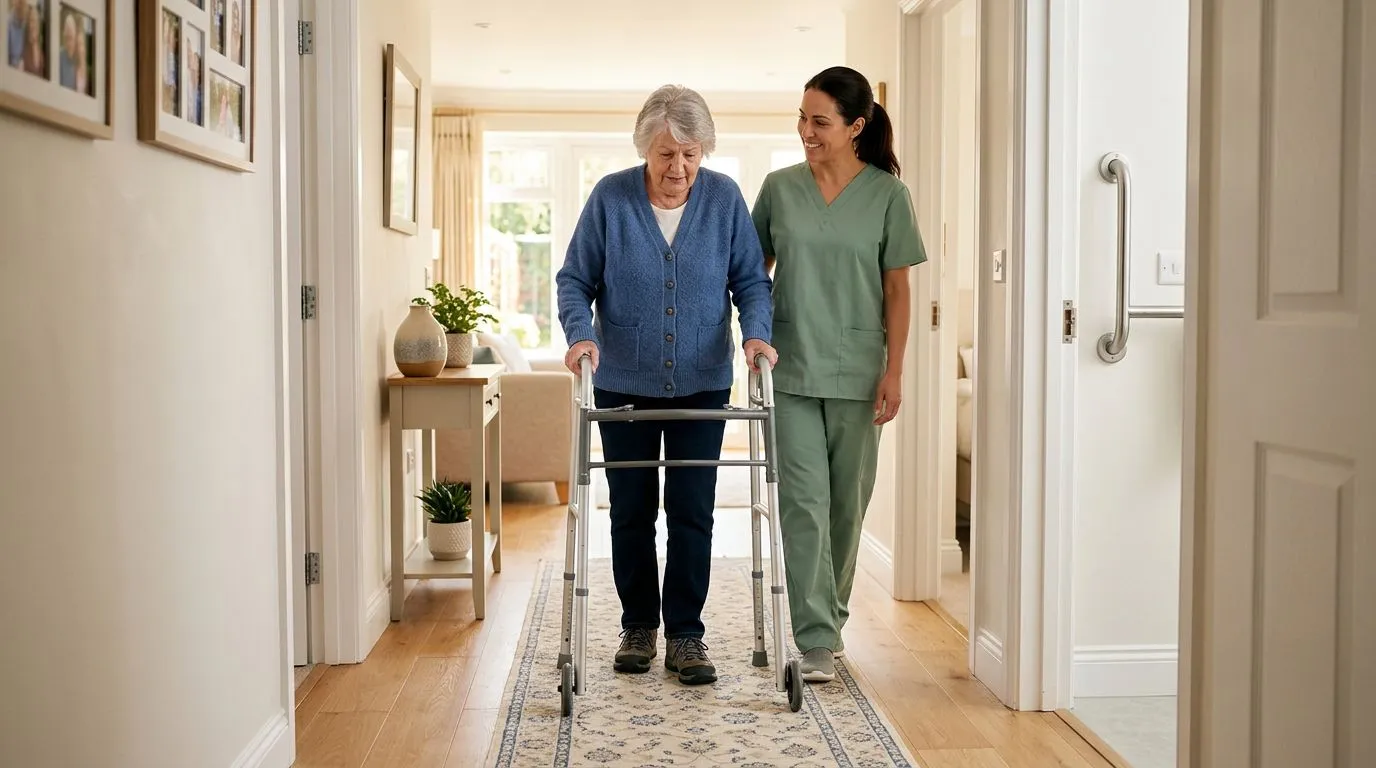
Walker safety at home begins with removing trip hazards, creating clear paths at least 30 inches wide, and matching the mobility aid to the space. Standard walkers and two-wheel walkers need stable, low-clutter floors, while rollators need enough room for wheels, hand brakes, and safe turning.
The biggest indoor risks include loose rugs, raised door thresholds, wet bathroom floors, cords, poor lighting, and tight furniture layouts. A safer home does not have to look medical; it usually requires a tape measure, smarter placement of everyday items, and a few targeted changes.
Why 1 Small Home Hazard Can Change Walker Safety
A walker or rollator adds support, but it also changes how someone moves through a home. The frame is wider than the body, the feet or wheels can catch on surfaces, and the user may need both hands on the device instead of on furniture, counters, or walls. A rug edge that seems harmless to someone walking unaided can become a fall risk when a walker leg lands on it or a rollator wheel folds it up.
Most standard and folding walkers are about 24 to 28 inches wide, and many rollators fall in a similar range, though some bariatric rollators are wider. That means a hallway, bathroom doorway, or path between a sofa and coffee table may feel very different once a mobility aid is involved. The goal is not just to fit through the space, but to move through it without twisting, backing up unnecessarily, or lifting the walker at an awkward angle.
Walkers and rollators are related, but they behave differently indoors. A standard walker has no wheels and must be lifted and placed. A two-wheel walker rolls forward but has back legs or glide tips that add friction. A rollator has 3 or 4 wheels, hand brakes, and usually a built-in seat, making continuous movement easier but requiring brake control and more room to turn.
Walker vs. Rollator at Home: 4 Key Differences for Safety
Choosing between a walker and a rollator is partly a medical and therapy decision, but the home layout matters too. A person who needs firm weight-bearing support may do better with a standard walker or two-wheel walker. Someone who walks more steadily but needs rest breaks may benefit from a rollator, especially a 4-wheel style with a seat and hand brakes.
Indoors, the safest option is the one the user can control for 10 to 20 steps at a time without rushing, dragging, tipping, or leaning too far forward. Caregivers should watch real movement in the home, not just how the device looks in a store aisle or clinic hallway.
| Mobility aid type | How it moves | Home safety strengths | Watch-outs indoors |
|---|---|---|---|
| Standard walker | Lift, place, step | Very stable; good for short, controlled movements | Can catch on rugs; requires arm strength to lift |
| Folding walker | Usually standard or two-wheel; folds for storage | Useful in small homes and for car travel | Check that folding locks are fully engaged |
| Two-wheel walker | Front wheels roll; rear legs stabilize | Easier than lifting a no-wheel frame every step | Rear tips can snag on thresholds or thick rugs |
| 3-wheel rollator | Rolls continuously; hand brakes | Turns well in tight spaces; often narrower | No full seat on many designs; can feel less stable than 4 wheels |
| 4-wheel rollator | Rolls continuously; hand brakes; seat | Seat for rest breaks; smooth movement on open floors | Needs brake use and turning room; not for heavy leaning |
| Upright rollator | Rolls with forearm supports or higher handles | May help some users maintain a more upright posture | Often taller and bulkier; measure doorways and storage space |
| Bariatric rollator | Wider, reinforced frame; hand brakes | Higher weight capacity and larger seat area | May be too wide for older bathrooms or narrow halls |
Rugs and Floor Surfaces: Fix the First 6 Feet of Every Route
Rugs are among the most common indoor walker hazards because they move, curl, bunch, and hide uneven flooring. Start with the first 6 feet inside each main route: bedroom to bathroom, chair to kitchen, entry door to living room, and favorite chair to hallway. These are the paths used most often, including at night when attention and lighting may be reduced.
For standard walkers and no-wheel frames, rug edges can catch under the front legs. For two-wheel walkers, the rear tips may drag or snag. For rollators, front wheels can push a thin rug into a fold, especially during a turn. Thick pile rugs are especially troublesome because walker tips do not land on a firm, predictable surface.
- Remove loose throw rugs whenever possible, especially in hallways, bathrooms, kitchens, and near beds.
- If a rug must stay, use a low-profile rug with a firm non-slip backing and edges that lie flat.
- Avoid placing rugs at the bottom of stairs, in front of the toilet, or directly at a doorway threshold.
- Replace curled corners or frayed edges instead of taping over a worn rug indefinitely.
- Keep floor transitions visible; a patterned rug can hide changes in level.
Hard floors can be risky too if they are slick. Smooth tile, polished wood, and laminate may reduce traction for rubber walker tips or rollator wheels. If the user wears socks indoors, consider well-fitting shoes or non-skid footwear instead. The walker is only as safe as the contact between the floor, the device, and the person using it.
Door Thresholds: Make Every 1/2-Inch Edge Easier to Cross
A raised threshold between rooms can interrupt the smooth movement of a walker or rollator. Even a 1/2-inch lip may cause a walker leg to catch or a rollator wheel to stop suddenly. Exterior thresholds, sliding door tracks, and bathroom transitions are common trouble spots.
For standard walkers, the safest approach is often to place the walker completely over the threshold before stepping. The user should avoid standing with one walker leg on one surface and another leg on a different height if it makes the frame rock. For rollators, the user should slow down before the threshold, keep both hands on the handles, and avoid coasting over the edge without control.
| Threshold problem | Walker concern | Rollator concern | Possible home fix |
|---|---|---|---|
| Raised metal strip | Leg or rear tip catches | Wheel stops or jolts | Low beveled transition strip if appropriate |
| Sliding door track | Frame may land unevenly | Small wheels may drop into track | Use alternate entrance when possible; add a safe transition solution |
| Carpet-to-tile change | Uneven landing | Speed changes suddenly | Secure carpet edge and improve contrast |
| Bathroom saddle threshold | Awkward lifting at doorway | Wheel bump near wet floor | Consider a lower transition during remodeling |
If a threshold is repeatedly difficult, do not simply tell the person to be more careful. Repeated trouble is useful information. Mark the spot, measure the height, and ask a physical therapist, occupational therapist, contractor, or home safety professional what modification is appropriate. In some homes, a small change to a transition strip can make daily movement much safer.
Bathrooms: Plan for 3 Wet Zones and 1 Tight Turn
Bathrooms combine several hazards in a small area: water, tile, narrow doorways, toilet transfers, and limited turning space. Many older bathroom doors are about 24 inches wide, which may not comfortably fit a wider walker or bariatric rollator. Even when the device fits through the doorway, there may not be enough room to turn around near the toilet or sink.
Think of the bathroom in 3 wet zones: the sink area, the toilet area, and the tub or shower area. Keep the floor dry in all 3. Bathmats should be treated like rugs; loose mats can slide under walker legs or rollator wheels. If a mat is needed outside the shower, choose a low-profile, non-slip option and keep it out of the walker’s main turning path.
- Install grab bars where transfers happen, such as beside the toilet and in the shower, using proper wall anchoring.
- Do not use a towel bar, sink edge, or shower door as a substitute for a grab bar.
- Keep soap, shampoo, toilet paper, and towels within easy reach to reduce twisting and stepping away from the walker.
- Use night lighting so the toilet route is visible at 2 a.m. or 3 a.m.
- Consider whether the bathroom door can open outward or be removed in an emergency-prone layout.
A rollator seat is not a shower chair, and hand brakes are not a substitute for bathroom grab bars. Standard walkers also should not be pulled sideways during transfers. If bathroom transfers are difficult, an occupational therapist can help plan safer equipment and placement based on the user’s strength, balance, and bathroom dimensions.
Tight Spaces: Measure 30 Inches, Then Watch the Turn
A clear path of about 30 inches is a practical minimum target for many walker users, though some devices and users need more. Measure the actual width of the walker or rollator from the outside of one side to the outside of the other. Then add several inches for hands, elbows, clothing, and natural side-to-side movement.
The narrowest spot is often not the hallway itself. It may be the laundry basket in the hall, the corner of a coffee table, a floor plant, a dining chair pushed out 6 inches, or a trash can near the kitchen island. Tight turns are usually harder than straight paths because the device must pivot while the user maintains balance.
How to measure a safe indoor route
- Measure the walker or rollator width at its widest point, including wheels or hand grips if they protrude.
- Measure doorways with the door fully open; hinges and trim can reduce usable width.
- Check turning areas at the bed, toilet, favorite chair, refrigerator, and front door.
- Walk the route at normal speed in daylight and again with nighttime lighting.
- Remove or relocate anything that forces the user to sidestep, back up, or lift the device awkwardly.
For rollators, turning radius matters. A 3-wheel rollator may maneuver better in small apartments or narrow kitchens, but it may not provide the same seated rest support as a 4-wheel rollator. A standard walker may feel safer in a tight bedroom because it does not roll away, but it still needs enough room to lift and place squarely.
Who Each Setup Is Best For: 2 Rooms, 10 Steps, and Real Life
The right home setup depends on how the person actually moves through the house. Watch a simple 10-step route, such as bed to bathroom or recliner to kitchen counter. Look for dragging, rushing, reaching for furniture, bumping thresholds, or leaving the walker behind because it is inconvenient.
A standard or folding walker may be best for someone who needs a high level of stability and moves shorter distances indoors. It can work well in a bedroom-to-bathroom routine if the path is clear, the floor is firm, and the user has enough arm strength to lift or advance the frame correctly.
A two-wheel walker may suit someone who needs stability but struggles to lift a no-wheel frame repeatedly. It is often helpful on flat indoor routes, but the rear legs or tips must move cleanly over floor surfaces. Check thresholds and rugs carefully.
A 4-wheel rollator may be best for a person who can control hand brakes, does not need to place heavy weight through the handles, and benefits from a seat during longer indoor routes. It generally works better in open floor plans than in cramped bathrooms. A 3-wheel rollator may be useful where maneuverability is the priority, but it should still match the user’s balance and support needs.
Upright and bariatric rollators require extra measurement. Upright designs may have taller frames and forearm supports, while bariatric rollators may have higher weight capacities and wider seats. Those features can be helpful, but only if the device fits through the home’s key routes.
How to Choose and Adjust a Walker or Rollator in 5 Checks
Fit and adjustment matter as much as floor safety. A walker that is too low may encourage stooping; one that is too high may reduce control. A common starting point is handle height near the wrist crease when the user stands upright with arms relaxed at the sides, but individual needs vary. A clinician can confirm the best height for posture, comfort, and safety.
| Check | What to look for | Why it matters |
|---|---|---|
| 1. Width | Fits through key doors and paths with a few inches to spare | Reduces bumping, twisting, and abandoned use |
| 2. Handle height | User can stand tall with a slight elbow bend | Supports control without excessive stooping |
| 3. Brakes | Rollator brakes stop both rear wheels and lock for sitting | Prevents rolling during pauses and transfers |
| 4. Tips or wheels | Rubber tips are not worn; wheels roll smoothly | Improves traction and predictable movement |
| 5. Weight capacity | Rated capacity meets the user’s needs, including clothing and carried items | Protects frame integrity and safe use |
Do not hang heavy bags from the front of a walker or rollator unless the device is designed to carry them in a safe location. Extra weight can change balance and steering. If items need to be carried, use an appropriate basket, tray, or pouch and keep loads light and centered.
Caregiver Home Safety Walk-Through: 15 Minutes, Room by Room
A caregiver can spot many hazards during a 15-minute home walk-through. Start at the bed, then follow the user’s normal routes to the bathroom, kitchen, favorite chair, entry door, and laundry area. Move at the user’s pace, not the caregiver’s.
- Look down: rugs, cords, shoes, pet toys, uneven flooring, and floor vents.
- Look ahead: narrow doorways, cluttered turns, low furniture, and open cabinet doors.
- Look up: lighting, reachable switches, glare, and shadows in hallways.
- Watch transfers: bed, toilet, shower, dining chair, recliner, and car entry if relevant.
- Ask what feels unsafe; users often know the exact spot where they hesitate.
Make one change at a time and test it. Removing a rug may help, but it may also reveal a slippery floor. Moving a table may create a better path, but it may remove a surface the person was using incorrectly for support. The best changes reduce risk without creating a new workaround.
Pets deserve special attention. A small dog crossing in front of a walker or a cat lying near the bathroom door can cause a sudden stop. Consider gates, feeding stations away from walking routes, and bells on collars if appropriate. The goal is predictable paths.
Maintenance and Habits: 1 Weekly Check Prevents Many Problems
A walker or rollator should be checked at least once a week, and more often if it is used outdoors and indoors. Dirt, hair, worn tips, loose screws, and weak brakes can all affect safety. The user may adapt without noticing, pushing harder or leaning differently as the device becomes less reliable.
For standard walkers and two-wheel walkers, inspect rubber tips and glide caps. If a tip is cracked, uneven, or worn smooth, traction may be reduced. For rollators, test the hand brakes before each day’s use: squeeze to slow, push or engage to lock if the design allows, and confirm the wheels do not move when the user sits.
- Keep walker legs at equal height on both sides.
- Clean wheels so they roll freely and do not track water onto smooth floors.
- Check folding mechanisms and make sure locks click fully into place.
- Do not use a damaged frame, bent leg, or unreliable brake.
- Store the device within reach, not across the room.
Habits matter too. Encourage the user to bring the walker or rollator all the way to the destination instead of parking it a few steps away. Many falls happen during the “just one step” moment near a bed, counter, or bathroom fixture.
FAQ: 5 Common Home Walker Safety Questions
Should I remove all rugs for a walker user?
Remove loose throw rugs and any rug that curls, slides, bunches, or sits in a main walking path. A low-profile rug with a secure non-slip backing may be acceptable in some areas, but bathrooms, hallways, and nighttime routes should be kept as clear as possible.
Can a rollator be used safely inside the house?
Yes, if the user can control the hand brakes, the floors are clear, and the rollator fits through doorways and turns. Rollators are not ideal for people who need to put heavy weight through the handles, and the seat should only be used with brakes locked on a stable, level surface.
What doorway width is best for a walker?
Many walkers are about 24 to 28 inches wide, so a 30-inch clear path is a useful target. Measure the actual device and the usable doorway opening, because trim, hinges, and the open door itself can reduce space.
How can I make bathroom walker use safer?
Keep the floor dry, remove loose bathmats, add properly installed grab bars, improve nighttime lighting, and place toiletries within easy reach. If the walker or rollator does not fit well near the toilet or shower, ask an occupational therapist about safer layout and transfer options.
Are thresholds dangerous for walkers and rollators?
They can be. Even a small raised edge can catch a walker leg, rear glide, or rollator wheel. Slow down, approach squarely when possible, and consider a safe beveled transition or professional modification if the threshold causes repeated trouble.
FAQ
Frequently asked questions
Are door thresholds dangerous for walkers and rollators? +
They can be. Even a 1/2-inch raised edge may catch a walker leg, rear glide, or rollator wheel. Slow down, approach carefully, and consider a safe beveled transition if the spot causes repeated trouble.
Keep reading
Related guides

How to Use a Walker or Rollator Safely: Basic Training for Seniors and Caregivers
14 min read
Walker and Rollator Fall Prevention: Common Mistakes That Make Mobility Aids Less Safe
14 min read
Indoor Mobility Walkers: Choosing a Walker or Rollator for Tight Spaces at Home
13 min read