Disclosure: We may earn a commission when you buy through links on this page, at no extra cost to you. We buy nothing, sell nothing and accept no payment for coverage — commissions never decide what we recommend. How we make money.

A walker or rollator can improve stability, but only when it matches the person’s balance needs and is used correctly. The biggest fall-prevention mistakes include leaning too far forward, pushing the device out like a shopping cart, forgetting rollator brakes, using poor hand placement during transfers, and choosing wheels when a steadier walker frame is needed.
Walkers and rollators are related, but they are not the same tool. A standard or two-wheel walker is often better when someone needs firm weight support and slower, more controlled steps. A rollator is better for people who can manage hand brakes, steering, and continuous rolling movement.
1. Walker vs. rollator safety: the 4-point difference that matters
The first fall-prevention step is understanding which device you are using and what it is designed to do. A standard walker has 4 contact points on the floor, either with no wheels or with 2 front wheels and rear tips or glides. A rollator usually has 3 or 4 wheels, hand brakes, and often a built-in seat.
That difference changes the way each device works. A walker is lifted or moved a short distance, then stepped into. A rollator keeps rolling, so it demands more steering control, brake use, and judgment on slopes or uneven surfaces. Neither one is automatically safer in every situation.
Here is a practical comparison for common fall-prevention decisions:
| Device type | Common design | Best fit | Fall-prevention concern |
|---|---|---|---|
| Standard walker | 4 legs, no wheels | People who need maximum stop-and-go stability | Can be tiring because it must be lifted each step |
| Two-wheel walker | 2 front wheels, 2 rear tips or glides | People who need support but cannot lift a walker easily | Can slide too far if pushed instead of advanced carefully |
| 3-wheel rollator | 3 wheels, hand brakes, usually no wide seat | Tighter spaces and lighter steering needs | Less side-to-side stability than many 4-wheel models |
| 4-wheel rollator | 4 wheels, hand brakes, seat | People with endurance limits who need rest breaks | Unsafe if brakes are not used before sitting or standing |
| Upright rollator | 4 wheels, forearm supports, hand brakes | People who need a taller, more upright posture | Requires proper fit and good brake control |
A rollator seat is for resting, not for being pushed like a wheelchair unless the device is specifically designed for that use. Many rollators are rated for seated rest only, and pushing someone while seated can create a tipping hazard.
2. Mistake: leaning more than 10 degrees forward while walking
Leaning forward is one of the most common unsafe habits with both walkers and rollators. A slight forward lean may happen naturally, but when the shoulders move far ahead of the hips, the person’s center of gravity shifts toward the front wheels or front legs. That can make the device harder to control and raise the chance of a stumble.
The fix is easy to describe but takes practice: keep the walker or rollator close enough that the body stays inside the frame or between the rear wheels. For many adults, the hands should rest near the sides of the body, with elbows bent about 15 to 30 degrees when standing tall.
Watch for these signs that the person is leaning too far:
- The walker or rollator is more than 1 step ahead.
- The person’s head and shoulders are reaching toward the handles.
- Steps become quick and short, as if trying to catch up.
- The back wheels of a rollator feel like they are trailing behind the body.
With a standard walker, the safe pattern is usually: move the walker a short distance, place all 4 legs or 2 wheels and rear tips securely, then step forward. With a rollator, the goal is controlled rolling at the person’s walking pace, not chasing a device that is moving faster than the body.
3. Mistake: pushing a walker like a cart for 6 or more feet
A walker is not a grocery cart. When someone pushes a standard or two-wheel walker continuously across the floor for 6, 8, or 10 feet, the device stops acting like stable support and starts acting like something to chase. This is especially risky with two-wheel walkers on smooth tile, wood, or laminate flooring.
A standard walker should be placed, not driven. A two-wheel walker may roll forward, but it still needs to be advanced in small, controlled movements. The rear tips should stay in contact with the floor unless the person has been trained otherwise by a clinician.
For many people, a safer sequence is:
- Stand tall with both hands on the walker grips.
- Move the walker forward only about 6 to 12 inches.
- Make sure the legs, tips, or wheels are steady.
- Step into the walker space without passing too far beyond it.
- Repeat slowly, especially near turns, rugs, and thresholds.
If a person naturally wants to push the walker continuously, that does not automatically mean a rollator is the answer. It may mean the walker is too low, the person is rushing, or they need training. If they have good balance, safe judgment, and the hand strength to use brakes, a rollator may be appropriate. If they need heavy support through the arms, a rollator can move too easily.
4. Mistake: forgetting rollator brakes during 3 high-risk moments
Rollator brakes matter most during 3 moments: sitting down, standing up, and stopping on any slope or uneven surface. Many falls do not happen while walking straight ahead, but during transitions when the rollator rolls away unexpectedly.
Before sitting on a rollator seat, both brakes should be locked if the device has locking brakes. The rollator should be on level ground, the person should turn fully, and the backs of the legs should feel the seat before lowering down. Sitting halfway or dropping backward from too far away is unsafe.
Standing up deserves the same attention. The person should not pull hard on the rollator handles to rise unless specifically instructed and the device is stable. In many cases, it is safer to push from the chair arms or seated surface, stand fully, then place hands on the rollator handles after balance is established.
Good brake habits include:
- Lock brakes before sitting on the rollator seat.
- Lock brakes before standing from the rollator seat.
- Use both hand brakes, not just 1, when slowing down.
- Avoid parking on ramps, wet pavement, grass, or loose gravel.
- Check brake tension if the rollator does not stop within a controlled distance.
People with arthritis, numbness, weak grip, or memory changes may have trouble using hand brakes consistently. That does not rule out a rollator in every case, but it does mean brake style, training, supervision, and device choice need extra attention.
5. Mistake: choosing wheels when balance support is the main need
A rollator can feel easier because it rolls, folds, and often includes a seat. Easier movement, however, is not the same as safer support. If a person needs to put a large amount of body weight through the handles with each step, a rolling device may move away too quickly.
A standard walker or two-wheel walker often provides more controlled support for people who are recovering from surgery, dealing with significant weakness, or learning a new gait pattern. A no-wheel walker gives a clear stop between steps. A two-wheel walker reduces lifting effort while still giving rear-floor contact.
A rollator may be a better match when the person can walk with a smoother pattern but needs help with endurance, mild balance support, or rest breaks. Many 4-wheel rollators include a seat and storage pouch, which can be helpful for longer indoor hallways, community outings, or waiting areas.
| Safety need | Walker may be better | Rollator may be better |
|---|---|---|
| Needs firm stopping support | Yes, especially no-wheel or two-wheel walker | Usually no, because wheels keep moving |
| Gets tired after 5 to 10 minutes | Possibly, but no built-in seat | Often, if brake use is safe |
| Needs to carry small items | Basket or pouch may help, but keep weight light | Often includes a pouch or basket |
| Has poor hand brake control | Often safer | Riskier unless brakes can be managed reliably |
| Walks on uneven outdoor surfaces | May catch on cracks or grass | Larger wheels may roll better, but brakes and control are critical |
When in doubt, a physical therapist or other qualified clinician can assess gait, balance, strength, cognition, and home layout. The right answer is individual. A person may even use a walker indoors and a rollator for supervised outdoor distances, if that plan is safe for their situation.
6. Mistake: setting handle height 2 inches too high or too low
Handle height is a small adjustment with a big safety impact. If handles are too low, the user may bend forward and overload the shoulders. If handles are too high, the elbows may stay stiff, and the device can feel awkward or hard to control.
A common fitting method is to have the person stand upright in supportive shoes with arms relaxed at the sides. The top of the walker or rollator handgrip should line up near the wrist crease. When the hands rest on the grips, the elbows should bend slightly, often around 15 to 30 degrees.
Height should be checked on the actual floor where the device is used. Shoes matter. A person who switches from slippers to outdoor shoes with a thicker sole may effectively change the fit by about 0.5 to 1 inch.
Follow these measuring steps:
- Put on the shoes most often worn while walking.
- Stand as tall as comfortable without shrugging the shoulders.
- Let both arms hang naturally.
- Adjust grips to wrist-crease height when possible.
- Confirm a slight elbow bend when holding the handles.
- Check that left and right sides are set to the same height.
Upright rollators are fitted differently because the forearms rest on supports. The arm platforms should encourage a tall posture without forcing the shoulders up toward the ears. If the person feels pressure in the neck, wrists, or lower back, the fit may need adjustment.
7. Mistake: unsafe transfers within 30 seconds of standing up
The first 30 seconds after standing can be a vulnerable time, especially for people who feel lightheaded, have leg weakness, or take medications that affect blood pressure. Rushing from a chair, bed, toilet, or car into walking can turn a safe mobility aid into an unstable handhold.
For walkers, the device should be placed directly in front before standing. The person usually should push up from the chair arms or bed surface rather than pulling on the walker. Once standing, they can pause, get balanced, then place both hands on the walker.
For rollators, brakes should be locked before standing if the rollator is being used for support nearby. Pulling on unlocked rollator handles is a common fall risk because the device can roll forward. Even with locked brakes, pushing from a sturdy chair is often safer than yanking upward on the handles.
A safer transfer routine is short and repeatable:
- Move to the front half of the seat.
- Place feet under the knees, about hip-width apart.
- Push from the seated surface or armrests.
- Stand fully and pause for 3 to 5 seconds.
- Take hold of the walker or rollator after balance is steady.
If dizziness, buckling knees, or repeated near-falls occur, the problem is not just technique. The person should report those symptoms to a healthcare professional promptly.
8. Mistake: ignoring thresholds, rugs, and 0.5-inch edges
Small floor changes can cause big problems. A threshold that is only 0.5 inch high can catch a rear walker tip, stop a small front wheel, or jolt a rollator enough to throw off balance. Loose rugs, curled mats, electrical cords, and cluttered hallways are just as concerning.
Walkers and rollators need clear space. Many home hallways are about 36 inches wide, but furniture, baskets, and door swings can reduce the usable path. A walker may need enough room to keep all legs flat. A 4-wheel rollator may need more turning space, especially if it has a wider frame or larger wheels.
Practical home fixes include:
- Remove loose throw rugs or secure them with low-profile, non-slip backing.
- Keep cords out of walking paths.
- Use bright lighting for nighttime bathroom trips.
- Clear at least a walker-width path through bedrooms and living areas.
- Approach thresholds straight on rather than at a sharp angle.
- Slow down before doorways, elevator gaps, and curb cuts.
Outdoor surfaces require extra judgment. Rollators with larger wheels may handle sidewalks better than small-wheeled devices, but wet leaves, gravel, grass, and steep ramps can still be unsafe. Standard walkers can sink into soft ground or catch on uneven concrete. Sometimes the safest choice is to ask for assistance or choose a different route.
9. Mistake: skipping a 60-second maintenance check
A quick check can catch problems before they become hazards. Once a week, or more often with heavy daily use, spend about 60 seconds inspecting the device. This is especially important if the walker or rollator is folded, stored in a car, or used outdoors.
For walkers, look at rubber tips, frame locks, folding mechanisms, and handgrips. Worn tips can slide on smooth floors. A folding walker that is not fully locked can shift during use. If the frame wobbles, stop using it until it is inspected or repaired.
For rollators, check brakes, wheels, seat hinges, cables, and folding latches. The brakes should slow both sides evenly. Wheels should spin without looseness or wobble. The seat should latch or rest securely according to the device design.
| Check item | Walker | Rollator | Why it matters |
|---|---|---|---|
| Tips or wheels | Inspect all 4 contact points | Inspect 3 or 4 wheels | Worn contact points can slip or snag |
| Locks and latches | Check folding lock | Check folding latch and seat area | A loose frame can shift under weight |
| Brakes | Usually not applicable | Test both hand brakes | Uneven brakes can pull the device sideways |
| Grip surfaces | Check for twisting or wear | Check for twisting or wear | Loose grips reduce control |
Weight capacity also matters. Many mobility aids list a maximum user weight, often printed on the frame label or in the manual. Bariatric walkers and bariatric rollators are built with higher capacities and wider frames, but they still need to fit through doorways and provide the right height and brake control.
10. Who it is best for: matching 5 user needs to the safer device
The safest mobility aid is the one that fits the user’s strength, balance, environment, and habits. Think in terms of 5 needs: support, endurance, hand control, home layout, and transport.
A standard walker is often best for someone who needs maximum stability and can lift the frame safely. A folding walker is useful when the device must go in a car trunk or be stored beside a chair. A two-wheel walker may be better for someone who needs support but has trouble lifting a no-wheel frame with every step.
A 4-wheel rollator is often best for a person who can walk with less weight through the arms but needs a seat for rest breaks. A 3-wheel rollator may help in tighter spaces, though it typically offers less sitting support and may feel less stable to some users. An upright rollator may help someone maintain a taller posture, but it still requires steering control, brake use, and proper fitting.
Use this decision guide as a starting point, not a diagnosis:
- Choose a standard walker when stop-and-go stability is the top priority.
- Choose a two-wheel walker when lifting a frame is hard but rolling control is still needed.
- Choose a 4-wheel rollator when endurance and seated rest breaks are major concerns.
- Choose a 3-wheel rollator when tight turns matter and the user does not need a full seat.
- Choose a bariatric walker or rollator when a higher weight capacity and wider support base are needed.
If a person repeatedly falls, freezes, rushes, forgets brakes, or cannot keep the device close, the answer may be training, a different device, home modifications, or medical evaluation. Fall prevention is not about blame. It is about matching the tool to the person and making the safest habit the easiest habit.
FAQ
Frequently asked questions
Is a walker safer than a rollator for fall prevention? +
It depends on the person’s needs. A standard or two-wheel walker is often safer for someone who needs firm, stop-and-go support. A rollator may be safer for someone with better balance who needs help with endurance and can reliably use hand brakes.
Why is pushing a walker like a shopping cart unsafe? +
Pushing a walker continuously can move the support too far ahead of the body. That forces the user to lean forward or rush to catch up, which can increase the chance of tripping or losing balance.
Should rollator brakes be locked before sitting down? +
Yes. Both brakes should be locked before sitting on a rollator seat and before standing up from it. The rollator should also be on level ground, not on a ramp, wet surface, grass, or loose gravel.
How high should walker or rollator handles be? +
A common fitting method is to set the handgrips near wrist-crease height when the user stands upright in their regular shoes with arms relaxed. When holding the grips, the elbows should have a slight bend, often about 15 to 30 degrees.
When should someone ask a professional about their walker or rollator? +
Professional guidance is wise after a fall, repeated near-falls, dizziness, new weakness, surgery, or trouble remembering brake use. A physical therapist or qualified clinician can assess gait, balance, strength, and home safety.
Keep reading
Related guides

How to Use a Walker or Rollator Safely: Basic Training for Seniors and Caregivers
14 min read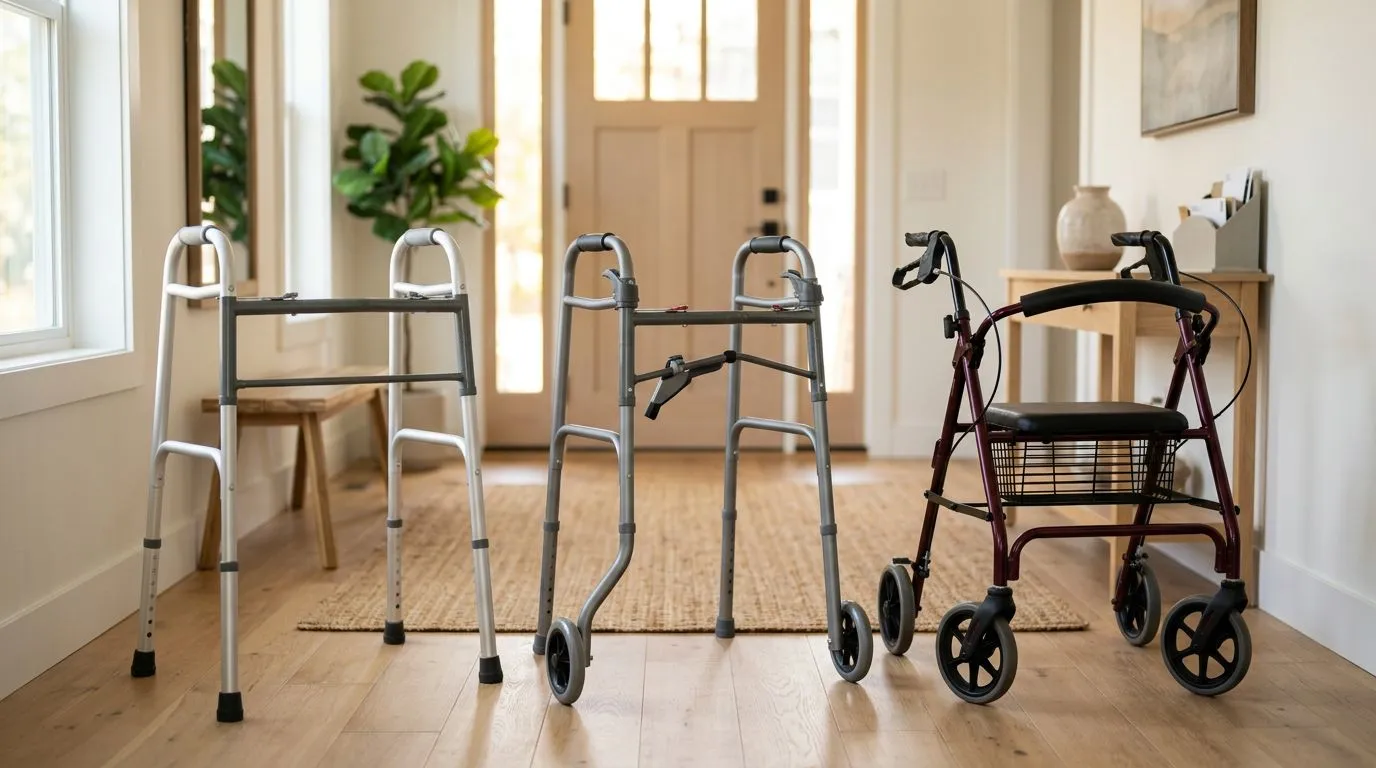
No-Wheel Walker vs Two-Wheel Walker vs Rollator: How Wheels Change Stability, Effort, and Control
13 min read
Buying Your First Walker or Rollator: Questions to Ask Before You Order
15 min read