Disclosure: We may earn a commission when you buy through links on this page, at no extra cost to you. We buy nothing, sell nothing and accept no payment for coverage — commissions never decide what we recommend. How we make money.
A lightweight mobility walker should be easy to lift and move, but it still needs the right frame strength, fit, and weight capacity for safe everyday use. For many shoppers, the best choice is not simply the lowest-weight model; it is the lightest walker or rollator that supports the user, suits the home environment, and feels steady during real walking tasks.
Standard walkers and folding walkers are usually the most stable lightweight options because they have 4 contact points on the floor. Lightweight rollators can be easier to push outdoors and often include a seat and hand brakes, but they require more brake control and may weigh more than a simple walker frame.
What lightweight means: about 6 to 20 pounds
In mobility equipment, lightweight does not have one official meaning. A basic aluminum standard walker may weigh about 6 to 8 pounds, while a folding two-wheel walker may be around 7 to 10 pounds. Lightweight rollators are often closer to 12 to 20 pounds, depending on wheel size, seat design, frame material, and weight capacity.
That range matters because lifting a 7-pound folding walker into a car is very different from lifting an 18-pound rollator with a seat, brakes, storage pouch, and 8-inch wheels. A shopper who only needs help inside the house may prefer the lighter frame. Someone who walks several blocks, stops to rest, or crosses uneven sidewalks may accept a few extra pounds for larger wheels and a built-in seat.
Frame material plays a large role. Aluminum is common because it is lighter than steel and resists rust. Steel frames are often heavier but may be used in higher-capacity or bariatric designs. Some lightweight products combine materials, using aluminum tubing with steel hardware at stress points. The key is not the material name alone. Look at the total product weight, stated weight capacity, frame rigidity, and how steady it feels under normal use.
Weight capacity is separate from product weight. A walker that weighs 7 pounds might have a stated capacity around 250 to 300 pounds, while bariatric walkers and rollators may support 350 pounds or more but usually weigh more and have wider frames. Never assume a lighter frame is safe for every user. The listed capacity should exceed the user’s body weight with a reasonable margin, especially if the person leans heavily on the device.
Walker or rollator: 0, 2, 3, or 4 wheels changes everything
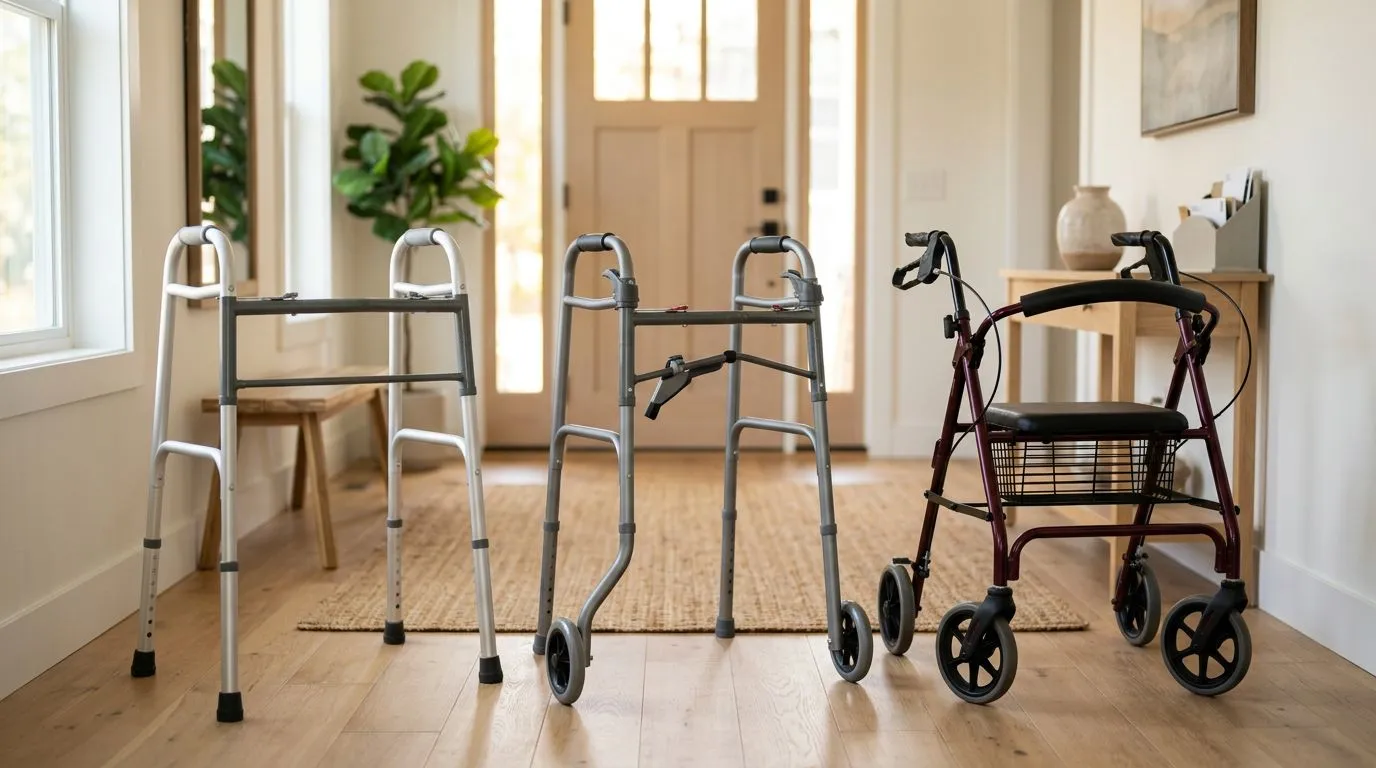
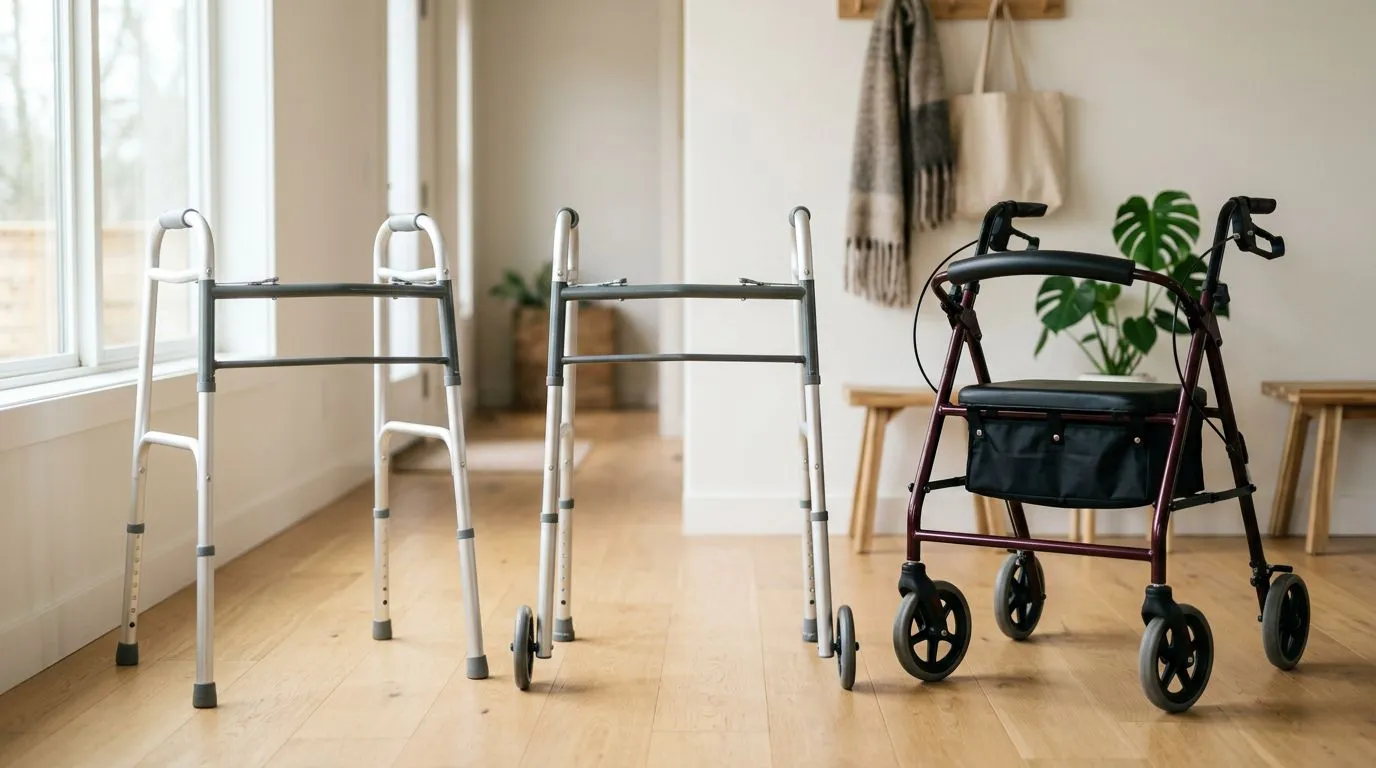
The word walker is often used broadly, but there are important differences between standard walkers, two-wheel walkers, and rollators. A standard walker has 4 legs and no wheels. The user lifts it, places it forward, then steps into it. A two-wheel walker has wheels on the front legs and rubber tips or glide caps on the back legs, so it can slide forward with less lifting. A rollator has 3 or 4 wheels, hand brakes, and usually a built-in seat.
That wheel count changes how the device behaves. A no-wheel walker is slow but very stable. A two-wheel walker reduces lifting effort while keeping rear-leg friction for control. A 3-wheel rollator turns tightly and is often lighter than many 4-wheel rollators, but it usually does not include the same full seat support. A 4-wheel rollator is smoother for longer walks and typically includes a seat, backrest, and storage area.
| Type | Common weight range | Best use | Main caution |
|---|---|---|---|
| Standard no-wheel walker | About 6 to 8 lb | Maximum stability indoors | Must be lifted with each step |
| Folding walker | About 6 to 10 lb | Car travel, storage, room-to-room use | Fold joints should lock securely |
| Two-wheel walker | About 7 to 10 lb | Less lifting on flat indoor surfaces | Rear tips can drag or wear down |
| 3-wheel rollator | About 11 to 16 lb | Tight turns, errands, narrow spaces | Usually less seated support |
| 4-wheel rollator | About 14 to 20 lb | Outdoor walks, rest breaks, smoother rolling | Requires hand-brake awareness |
When choosing between a walker and a rollator, consider how much body weight the user places through their hands. If the person needs firm support to stand upright or take short, careful steps, a standard or two-wheel walker may be safer. If the person walks with better balance, can use hand brakes reliably, and needs to rest after 5 or 10 minutes, a lightweight rollator may be more practical.
Who lightweight walkers and rollators are best for: 5 common situations
Lightweight mobility walkers are often best for people who need support but also need to lift, fold, or reposition the device many times a day. A person moving between a bedroom, bathroom, and kitchen may pick up a walker dozens of times before lunch. In that setting, shaving off even 2 or 3 pounds can reduce strain on the shoulders and wrists.
They also help caregivers. If a spouse or adult child regularly loads the device into a trunk, a folding walker around 7 pounds is easier to manage than a full-size rollator near 18 pounds. That difference becomes more noticeable when the car has a high cargo floor or the caregiver has arthritis, back pain, or limited grip strength.
- Small homes or apartments: A narrow folding walker or compact 3-wheel rollator can be easier to turn in hallways around 36 inches wide.
- Car trips: Folding walkers often collapse flatter than rollators and may fit behind a seat or in a small trunk.
- Short indoor walks: A standard walker gives steady support for bathroom trips, transfers, and kitchen tasks.
- Longer outdoor walks: A 4-wheel rollator with 6- to 8-inch wheels can reduce stop-and-start effort on sidewalks.
- Rest breaks: A rollator seat helps when the user needs to sit safely during errands, but the brakes must be locked before sitting.
Lightweight is not ideal for everyone. A very light frame may feel too lively for a user who leans hard, has strong tremors, or needs bariatric support. A taller user may also need a frame with higher handle settings, which can narrow the selection. In these cases, a slightly heavier walker or rollator can be the more stable and safer choice.
How to choose and measure: 3 numbers to check first
Before comparing features, check 3 numbers: handle height, user weight, and overall width. These measurements affect comfort and safety more than color, pouch style, or accessory options.
1. Handle height in inches
With the user wearing typical shoes, have them stand upright with arms relaxed at their sides. The walker or rollator handles should line up near the crease of the wrist. When the hands rest on the grips, the elbows should bend slightly, often around 15 degrees. Handles that are too low can encourage stooping. Handles that are too high can tense the shoulders and reduce control.
Many adult walkers adjust across a range of several inches, such as roughly 30 to 38 inches from floor to grip, but exact ranges vary by design. Upright rollators are different: their forearm supports adjust higher so the user can stand more upright. They can help some users who dislike bending over, but they are not a substitute for proper balance and brake control.
2. Weight capacity in pounds
Check the stated weight capacity before anything else if the user is near or above 250 pounds. Many standard and lightweight mobility walkers are rated around 250 to 300 pounds. Bariatric walkers and bariatric rollators may be rated higher, often 350 pounds or more, but they are usually wider and heavier.
Do not choose a device at the edge of its limit. Weight capacity is a safety rating, not a comfort rating. If a person weighs 295 pounds, a 300-pound capacity may technically match, but a higher-capacity frame may feel more solid and offer a better margin, especially during sit-to-stand movements or when the user presses down firmly through both handles.
3. Overall width and doorway clearance
Measure the narrowest doorway, hallway, or bathroom path the device must pass through. Many interior doorways are about 28 to 32 inches wide, but older homes and bathrooms can be tighter. A standard walker may be around 24 to 26 inches wide. Some bariatric rollators are wider and may not fit easily through tight doorways or between furniture.
Also measure the car trunk or storage space if travel matters. Folding width and folded height are not the same. A walker may fold flat, while a rollator may fold side-to-side or front-to-back and still take up room because of wheels and seat hardware.
Stability and safety: 6 checks before daily use
A lightweight frame should not wobble, flex dramatically, or tip easily during ordinary use. Before relying on any walker or rollator, check the parts that keep it stable. These checks take less than 5 minutes and can prevent common frustrations.
- Grip height: Both handles should be set to the same marked hole or height setting.
- Locks: Folding mechanisms should click or lock fully open before walking.
- Rubber tips: On no-wheel and two-wheel walkers, rear tips should have tread and should not be cracked or worn smooth.
- Wheels: Rollator wheels should spin freely without wobbling from side to side.
- Brakes: Hand brakes should slow the rollator when squeezed and hold it still when locked.
- Seat: On a rollator, the seat should feel level and secure, with the brakes locked before the user sits.
Stability also depends on technique. With a standard walker, the user should move the walker a short distance forward, set all 4 legs down, then step forward into the frame. Reaching too far can increase fall risk. With a rollator, the user should avoid pushing it far ahead like a shopping cart. The safest position is usually with the body close to the handles and the feet stepping between or just behind the rear wheels, depending on the design.
Floor surfaces matter, too. A no-wheel walker can catch on thick carpet if lifted poorly. A two-wheel walker may glide better, but rear tips can snag on thresholds. A rollator rolls more smoothly over outdoor cracks, especially with larger wheels, but it can move too quickly on slopes if the brakes are not used. For ramps, driveways, and uneven sidewalks, brake confidence is essential.
Features that reduce lifting: 2 wheels, folding frames, and seats
Many shoppers want lightweight mobility walkers because lifting is the hardest part. The right features can reduce lifting without jumping straight to a heavy rollator.
A two-wheel walker is often the middle ground. The front wheels stay on the ground, so the user nudges the walker forward instead of fully lifting it. The rear legs provide friction and help prevent runaway movement. This can work well on flat indoor floors, especially for users who need more control than a rollator provides but less lifting than a no-wheel walker requires.
Folding frames help with storage and transportation. Most folding walkers use a front or side release so the frame collapses inward. The release should be easy enough for the user or caregiver to operate, but not so loose that it folds accidentally. People with limited hand strength should test whether they can press the button, lever, or paddle without pain.
Rollator seats are useful, but they add weight. A seat, backrest, brake cables, wheels, and storage pouch can add 5 to 10 pounds compared with a simple walker frame. That extra weight may be worthwhile if the user needs to rest during a grocery trip or while walking outside. It may be unnecessary if the device is used only for a 20-foot trip from bed to bathroom.
| Feature | How it helps | Tradeoff to consider |
|---|---|---|
| Aluminum frame | Keeps many walkers under 10 lb | May feel less solid than heavier-duty frames for some users |
| Front wheels | Reduces repeated lifting | Less planted than a no-wheel walker |
| Foldable design | Fits cars and closets more easily | Hinges and locks need regular checking |
| Large rollator wheels | Handle sidewalks and thresholds better | Add size and sometimes weight |
| Built-in seat | Allows rest breaks during outings | Requires brake use and adds bulk |
| Bariatric frame | Higher weight capacity and wider stance | Heavier and may be harder to fit indoors |
Lightweight rollators: 3-wheel, 4-wheel, upright, and bariatric options
Lightweight rollators are worth considering when the user walks at a steadier pace, needs less downward support, and can operate hand brakes consistently. Most rollators have hand brakes similar to bicycle-style levers. Squeezing slows the wheels. Pushing the levers down usually locks the brakes for sitting or standing still.
A 3-wheel rollator is often more maneuverable in tight spaces and may weigh less than a 4-wheel model. It can be a good fit for errands, narrow hallways, and users who do not need a full seat. The tradeoff is seated support. Many 3-wheel designs have a pouch or basket rather than a true sitting surface, so they are not the best choice for someone who needs frequent seated rest breaks.
A 4-wheel rollator is the more common choice for outdoor walking and resting. It typically has 4 wheels, a padded or sling-style seat, a backrest, and storage under or near the seat. Wheel size matters: 6-inch wheels are common for indoor and smooth outdoor surfaces, while 8-inch wheels often roll more comfortably over sidewalk seams and small thresholds. Larger wheels can improve rolling comfort but may increase turning radius and storage bulk.
Upright rollators, sometimes called stand-up rollators, use higher forearm supports or taller handles to encourage a more upright posture. They are often heavier than basic lightweight rollators because the frame must support higher arm platforms. They can be helpful for certain users, but the fit must be precise. If the supports are too high, the shoulders lift. If they are too low, the user still stoops.
Bariatric rollators prioritize strength and width over minimum weight. They may have wider seats, reinforced frames, and higher capacities, but they can be harder to load into cars or maneuver in small bathrooms. For users who need higher capacity, choosing a lighter device that is under-rated is not a safe compromise. Capacity comes first.
When a slightly heavier frame is the better choice: 250 lb is not the only number
It is natural to look for the lightest walker possible, especially if lifting is painful. Still, a device that feels nervous, twists under pressure, or barely meets the weight rating is not the right bargain. A 2-pound difference is rarely worth giving up confidence with every step.
Consider a slightly heavier walker or rollator if the user leans heavily through both arms, has a wide stance, uses the device outdoors daily, or weighs close to the listed capacity. Also consider a stronger frame if the person frequently rises from chairs using the walker for balance. Walkers and rollators should not be used like grab bars unless the manufacturer instructions specifically allow that kind of load, but real life includes moments when people press down to steady themselves. A more rigid frame may feel safer under those demands.
Seat width is another example. A narrow lightweight rollator may be easier to store, but if the seat is too small, the user may perch unsafely or avoid using the seat at all. Many rollator seats are roughly 12 to 15 inches wide, while bariatric seats may be wider. The user should be able to sit with both feet on the floor, brakes locked, and hips supported without squeezing between the handles.
There is also the issue of fatigue. A very light walker may reduce lifting effort, but if it requires constant correction because it feels unstable, the user may tire faster. The best lightweight choice should make daily movement feel simpler, not more mentally demanding.
A 10-point buying checklist for lightweight mobility walkers
Use this checklist before buying any lightweight walker or rollator. If possible, test the device on the same types of surfaces the user sees every day: carpet, tile, thresholds, sidewalk, and a car trunk.
- 1. Is the weight capacity comfortably above the user’s body weight?
- 2. Do the handles adjust to wrist-crease height with shoes on?
- 3. Can the user walk inside the frame without hunching or reaching?
- 4. Will the overall width fit through the narrowest doorway at home?
- 5. Can the user or caregiver lift the folded device into a car 3 times in a row without strain?
- 6. If it is a rollator, can the user squeeze and lock both brakes confidently?
- 7. Are the wheels appropriate for the surfaces used most often?
- 8. Does the folding mechanism lock open securely and fold without pinching fingers?
- 9. Are replacement tips, wheels, or brake parts likely to be available in generic sizes?
- 10. Does the device feel steady during turns, stops, and short transfers?
For many shoppers, the final decision comes down to a simple match. Choose a lightweight standard or folding walker when maximum stability, low product weight, and indoor control matter most. Choose a two-wheel walker when lifting is the main problem but a rollator feels too mobile. Choose a lightweight rollator when the user walks more continuously, needs a seat, and can manage hand brakes safely. The right mobility aid should support independence while respecting the user’s strength, balance, home layout, and daily routine.
FAQ
Frequently asked questions
What is considered a lightweight walker? +
Many standard aluminum walkers weigh about 6 to 8 pounds, while folding and two-wheel walkers are often around 7 to 10 pounds. Lightweight rollators are usually heavier, often about 12 to 20 pounds because they include wheels, brakes, a seat, and frame hardware.
Is a lighter walker always safer for seniors? +
No. A lighter walker is easier to lift, but it still must fit the user, feel stable, and have an appropriate weight capacity. If the frame flexes, feels tippy, or is close to its maximum rating, a slightly heavier option may be safer.
Should I choose a walker or a rollator? +
Choose a standard or two-wheel walker when the user needs firm support and better control, especially indoors. Choose a rollator when the user has steadier balance, can use hand brakes, walks longer distances, and benefits from a built-in seat.
How much weight capacity should a walker have? +
The walker or rollator should be rated above the user’s body weight, with some margin for comfort and stability. Many standard models are rated around 250 to 300 pounds, while bariatric options may support 350 pounds or more.
Are lightweight rollators good for outdoor use? +
They can be, especially 4-wheel rollators with suitable wheels and reliable hand brakes. For sidewalks, thresholds, and longer walks, many users prefer larger wheels, often around 8 inches, but brake control is essential on slopes or uneven ground.
How do I know if the walker handles are the right height? +
Have the user stand upright in regular shoes with arms relaxed. The hand grips should line up near the wrist crease, and the elbows should bend slightly when the hands rest on the grips.
Keep reading
Related guides
Mobility Walker With Seat vs Standard Walker: Which One Is Right for You?
14 min read
Standard Walker vs Two-Wheel Walker: Which Basic Walker Style Should You Buy?
11 min read
When Is It Worth Upgrading to a Lightweight, Heavy-Duty, or All-Terrain Walker?
14 min read