Disclosure: We may earn a commission when you buy through links on this page, at no extra cost to you. We buy nothing, sell nothing and accept no payment for coverage — commissions never decide what we recommend. How we make money.

A carbon-fiber rollator can be worth the higher cost if lifting, travel, or hand strength are major concerns, because shaving even 3 to 6 pounds can make daily use noticeably easier. For many people, though, a well-fitted aluminum rollator is the better value: it is usually stable, durable, widely available, and easier to justify if it mainly stays indoors or only occasionally rides in the car trunk.
The right choice depends less on frame material alone and more on how often you lift it, where you walk, your weight capacity needs, and whether the rollator fits your height and stride. Carbon fiber is a premium lightweight option; aluminum is the practical standard for most 3-wheel and 4-wheel rollators.
Rollator vs walker: why the difference matters before comparing 3 to 6 pounds
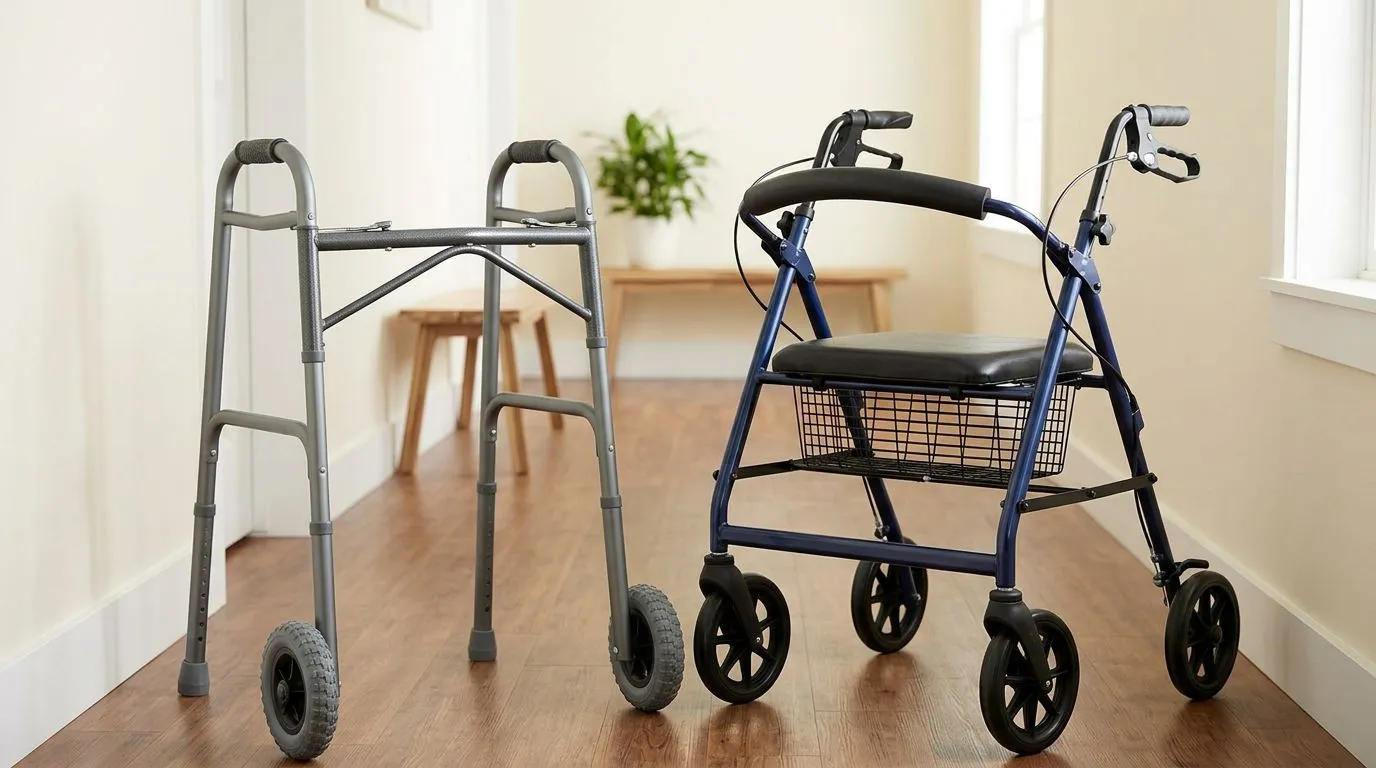
In everyday search terms, many people call any mobility aid a walker. Technically, a standard walker is a frame you lift and set down with each step, while a rollator is a wheeled walker with hand brakes; most 4-wheel rollators also include a built-in seat. This article focuses on rollators, but the distinction matters because carbon fiber is most common in premium rollators, not basic no-wheel walker frames.
A standard folding walker often has no seat, no hand brakes, and either no wheels or 2 front wheels. It is typically chosen when someone needs maximum step-by-step support and can safely lift or slide the frame. A rollator has 3 or 4 wheels, brake handles, and allows a more continuous walking motion. It is better suited to people who can steer, control speed, and operate hand brakes.
That difference changes the value equation. A lighter standard walker may be easier to lift with every step, while a lighter rollator is usually valued because it is easier to fold, load into a car, move over thresholds, or carry up 1 or 2 steps. If you need a seat for rest breaks every few minutes, you are likely shopping for rollators, not standard walkers.
| Mobility aid type | Typical setup | Best use case | Key caution |
|---|---|---|---|
| Standard walker | No wheels, 4 legs | High stability at a slow pace | Must be lifted with each step |
| 2-wheel walker | Front wheels, rear tips | Short indoor trips with added glide | No seat and limited outdoor comfort |
| 3-wheel rollator | 3 wheels, hand brakes, usually no seat | Narrow spaces and tight turns | Less seating support than 4-wheel designs |
| 4-wheel rollator | 4 wheels, hand brakes, seat | Errands, hallways, outdoor paths | Must be controlled on slopes |
How much lighter is carbon fiber than aluminum? The 3-to-6-pound reality
Carbon-fiber rollators are usually marketed around one major promise: lower frame weight. In real life, the difference is often a few pounds rather than a dramatic cut in half. Many aluminum rollators fall somewhere around the mid-teens in pounds, while premium carbon-fiber options may land closer to the low-teens, depending on wheel size, seat design, brake hardware, and accessories.
That may not sound huge on paper. It can feel huge in a parking lot.
If you lift a rollator into a trunk 4 times on a medical appointment day, a 5-pound difference can mean 20 pounds less total lifting. If you live alone and need to fold the rollator several times a week, those repeated movements matter. The benefit is less obvious when the rollator stays open in one apartment and is rarely loaded into a vehicle.
Weight also affects handling. A very light rollator may feel lively and easy to turn, especially indoors. Some users love that. Others prefer a little extra frame weight because it feels more planted. Neither reaction is wrong; it depends on strength, balance, walking pace, and the surfaces you use most.
| Factor | Carbon-fiber rollator | Aluminum rollator |
|---|---|---|
| Frame weight | Often lighter by about 3 to 6 lb | Usually light enough for many users |
| Car loading | Easier for frequent lifting | Manageable if lift height is low |
| Indoor steering | May feel quick and agile | May feel steadier to some users |
| Value | Best when weight savings are used daily | Best for budget-conscious everyday support |
Stability and safety: frame material is only 1 part of the equation
A carbon-fiber frame is not automatically safer than aluminum, and aluminum is not automatically more stable. Stability comes from the whole design: wheelbase width, handle height, brake quality, tire size, seat height, frame geometry, and whether the user fits the rollator correctly. A 24-inch-wide rollator may feel different in a narrow hallway than a 27-inch-wide one, regardless of material.
For most adults, the more important safety question is control. Can you comfortably squeeze the brakes? Can you lock the parking brakes before sitting? Does the rollator track straight without wobbling? Can you keep your feet between the rear wheels without kicking the frame?
Lightweight rollators can work very well when matched to the user, but an extremely light frame may not be ideal for someone who pushes down heavily on the handles for support. Rollators are designed for balance assistance and mobility, not for bearing the full body weight the way some people expect from a rigid standard walker. If someone needs substantial weight-bearing support, a physical therapist or clinician may recommend a standard walker, 2-wheel walker, or another device instead of a rollator.
Outdoor surfaces matter, too. Larger wheels, often 8 inches or more, tend to roll better over sidewalk seams, packed gravel, and thresholds than small wheels. If the frame is light but the wheels are too small for your route, the rollator may still feel frustrating. Material helps, but design decides.
Durability over 1,000 daily folds, bumps, and trunk lifts
Both carbon fiber and aluminum can be durable when the rollator is well designed and used within its stated weight capacity. Aluminum has a long track record in mobility equipment because it is lightweight, corrosion resistant, and practical to manufacture. Carbon fiber is known for high strength relative to weight, which is why it appears in bicycles, sporting goods, and premium mobility frames.
The key difference is how each material responds to stress and damage. Aluminum may dent, bend, or scratch after a hard impact. Carbon fiber may resist some flexing very well, but depending on construction, it can be more sensitive to sharp impacts or hidden damage. With either material, the most common long-term wear points are often not the frame tubes at all. They are brakes, cables, wheel bearings, folding hinges, handle grips, seat fabric, and locking mechanisms.
Think about use patterns. A rollator folded twice a day sees more hinge and latch wear than one parked open beside a favorite chair. A device lifted into a trunk 5 days a week experiences more bumps than one used only inside a senior apartment building. If you expect heavy daily use, inspect the warranty terms, replacement part availability, and ease of adjusting brakes. Those practical details may matter more than the frame material.
Weight capacity is also non-negotiable. Many regular rollators support common adult weight ranges, while bariatric rollators are built with higher capacities and wider seats. Carbon-fiber rollators are often designed for lightweight convenience, not necessarily maximum capacity. If you need a bariatric rollator, prioritize the listed weight limit, seat width, and frame stability before chasing the lightest possible number.
Lifting, folding, and travel: when 5 pounds changes the day
The strongest argument for carbon fiber is not walking speed. It is daily handling. If a caregiver or user needs to lift a rollator over a 6-inch curb, into an SUV cargo area, or up 3 porch steps, lighter weight can reduce strain and make the device more likely to be used consistently.
Folding style matters just as much. Some rollators fold side-to-side like an umbrella, making them slimmer for restaurant aisles or closet storage. Others fold front-to-back and may be flatter for trunks. A lightweight frame with an awkward fold can still be difficult. Before choosing carbon fiber or aluminum, check the folded dimensions and practice the folding motion if possible.
For travel, consider the whole routine. Can you lift the rollator with one hand while holding a railing with the other? Does it stay locked when folded? Will it fit behind a front seat, in a rideshare trunk, or inside a small apartment entryway? A 12-pound rollator that folds compactly may be far easier to manage than a 17-pound rollator that opens unexpectedly while being loaded.
Air travel and bus travel add another layer. Rollators are commonly handled as mobility aids, but rough handling can happen. Removable bags, canes, cup holders, and loose accessories should be secured before transport. If the frame is expensive, think carefully about how often it will be checked, gate handled, or stored in public spaces.
Price and value: when a premium rollator earns its higher cost
Carbon-fiber rollators typically cost more than aluminum rollators, sometimes several times more depending on features and retailer. Because prices change and vary widely, the practical question is not simply whether carbon fiber is better. The question is whether the weight savings will solve a real problem often enough to justify the premium.
Start with a weekly use estimate. If you lift the rollator into a car 10 times per week, the extra cost may buy meaningful independence and reduce reliance on another person. If you lift it twice a month, the same premium may be less compelling. If you have shoulder arthritis, reduced grip strength, or a small car trunk, the value of lighter weight rises quickly.
An aluminum rollator remains the value pick for many users. It can provide a seat, brakes, storage pouch, and reliable support at a more accessible cost. Many aluminum frames are light enough for routine errands, especially when paired with a compact fold and properly adjusted handles.
Carbon fiber makes the most sense when all 3 of these are true: the rollator fits well, the user can safely control it, and the lighter weight removes a frequent barrier. If only the first 2 are true, aluminum may still be the smarter buy.
Who a carbon-fiber rollator is best for: 6 common profiles
A premium lightweight mobility walker is not automatically the best choice for every senior, caregiver, or recovering adult. It works best in specific situations where low weight affects daily independence.
- People who drive often. Loading and unloading a rollator several times a day makes a 3-to-6-pound reduction more valuable.
- Users with limited upper-body strength. Lighter frames may help with lifting into trunks, closets, or apartment storage areas.
- Frequent travelers. A compact lightweight rollator can be easier in hotels, airports, and family visits.
- Caregivers doing repeated lifting. Less weight can reduce the physical workload over a week of appointments and errands.
- People in small homes. Lightweight frames are often easier to turn, fold, and reposition in tight spaces, though width still matters.
- Users who already know they like rollators. Upgrading makes more sense when the person has safely used hand brakes and a wheeled frame before.
Carbon fiber may not be the right first choice for someone who is unsure whether a rollator is appropriate. In that case, an evaluation with a physical therapist or a trial with a properly fitted aluminum rollator may be a safer starting point.
Who is usually better served by aluminum: 5 practical situations
Aluminum is popular for a reason. It offers a strong blend of weight, cost, availability, and feature variety. For many households, it is the practical answer.
- The rollator mostly stays indoors. If it is rarely lifted, the value of carbon fiber drops.
- Budget is a major factor. Aluminum usually leaves more room for other needs, such as home safety changes or therapy visits.
- A higher weight capacity is needed. Bariatric rollators are often built with heavier-duty frames, wider seats, and reinforced components.
- The user wants a wider seat. Comfort and seat dimensions may matter more than saving a few pounds.
- The rollator will take rough use. Shared facilities, public transit, and frequent storage bumps may favor a less costly frame to repair or replace.
For someone who walks around a single-level home, rests on the seat once or twice per day, and has help loading the device for appointments, aluminum may be the better value. A rollator is only worth paying more for when the added feature solves a frequent problem.
How to choose and measure: 7 checks before paying for lightweight
Before comparing frame materials, confirm the rollator fits your body and daily environment. A poorly fitted carbon-fiber rollator is still a poor choice.
- Handle height: Stand upright in supportive shoes with arms relaxed. Handles should usually align near the wrist crease, allowing a slight elbow bend of about 15 to 30 degrees.
- Seat height: When seated, feet should rest on the floor. Common rollator seat heights vary, so check the listed measurement against your leg length.
- Seat width: Make sure the seat is wide enough for comfort without forcing a frame too wide for your doorways.
- Overall width: Measure narrow doorways, bathroom entries, and hallway turns. Many interior doorways are around 28 to 32 inches wide, but older homes can be tighter.
- Wheel size: Smaller wheels may work indoors; 8-inch wheels or larger often feel better outdoors.
- Folded size: Measure the car trunk opening, not just the trunk floor. Lift height can matter as much as storage space.
- Brake feel: Test whether you can squeeze and lock both brakes without pain, numbness, or confusion.
If possible, test the rollator on the surfaces you actually use: carpet, tile, sidewalk cracks, curb cuts, and ramps. A 10-minute trial can reveal more than a specification sheet.
Feature comparison: carbon fiber vs aluminum in 8 buying categories
The best choice becomes clearer when you compare features one by one. Use this table as a decision guide, not a rulebook.
| Category | Carbon fiber | Aluminum | What to prioritize |
|---|---|---|---|
| Weight | Usually the lighter option | Still lightweight in many designs | Choose carbon fiber if lifting is frequent |
| Stability feel | Can feel nimble | Can feel more planted | Test both if balance is uncertain |
| Durability | Strong for its weight | Proven, practical, widely used | Inspect hinges, brakes, and wheels |
| Cost | Premium | Usually better value | Pay more only for a daily benefit |
| Travel | Excellent when fold is compact | Good if weight and fold are manageable | Measure the trunk and folded size |
| Outdoor use | Depends on wheel size and geometry | Depends on wheel size and geometry | Look for suitable wheels, not just material |
| Bariatric options | More limited | More common | Weight capacity comes first |
| Repairs and parts | May be more specialized | Often easier to service | Ask about brake cables and wheels |
Bottom line: a premium lightweight rollator is worth it only when weight is the daily problem
Carbon fiber is worth considering if a lighter rollator will help you leave home more often, load the device without help, or reduce strain for a caregiver. The weight savings can be meaningful, especially when the rollator is lifted many times per week.
Aluminum is still the better value for many people. It offers dependable support, a wide range of seat heights and wheel sizes, and a lower-cost path to a safe, practical wheeled walker. If the rollator will mostly stay open indoors, the premium for carbon fiber may be hard to justify.
Choose the device that fits your body, your home, your car, and your walking habits. Material matters, but fit, brakes, wheels, and safe control matter more.
FAQ
Frequently asked questions
Is a carbon-fiber rollator safer than an aluminum rollator? +
Not automatically. Safety depends on fit, brake control, wheel size, frame geometry, weight capacity, and how well the user can steer and stop the rollator. Carbon fiber mainly offers weight savings, not a guaranteed safety advantage.
How much weight can I really save with a carbon-fiber rollator? +
Many users see a difference of about 3 to 6 pounds compared with similar aluminum rollators, though the exact amount depends on the design, wheels, seat, and accessories. That can matter a lot if you lift the rollator into a car often.
Are aluminum rollators still a good choice? +
Yes. Aluminum rollators are often the best value for everyday use because they are relatively light, widely available, durable, and offered in many sizes and styles. They are especially practical when the rollator is not lifted frequently.
Who should consider paying more for a carbon-fiber rollator? +
Carbon fiber is most useful for people who travel often, load the rollator into a car several times a week, have limited upper-body strength, or rely on a caregiver who does repeated lifting. The premium makes the most sense when lighter weight solves a daily problem.
Is a rollator the same as a standard walker? +
No. A standard walker is a frame that is lifted or moved step by step, usually without a seat or hand brakes. A rollator is a wheeled walker with hand brakes, and most 4-wheel rollators include a seat for rest breaks.
Should heavier users choose carbon fiber or aluminum? +
Heavier users should start with the listed weight capacity, seat width, and frame stability rather than the material. Bariatric rollators are more commonly built with reinforced frames and higher capacities, and many are aluminum or other metal designs.
Keep reading
Related guides

Lightweight Mobility Walkers: Balancing Easy Lifting, Stability, and Weight Capacity
14 min read
Folding Walker vs Folding Rollator Value: What Portability Features Are Worth the Upgrade?
13 min read
When Is It Worth Upgrading to a Lightweight, Heavy-Duty, or All-Terrain Walker?
14 min read