Disclosure: We may earn a commission when you buy through links on this page, at no extra cost to you. We buy nothing, sell nothing and accept no payment for coverage — commissions never decide what we recommend. How we make money.
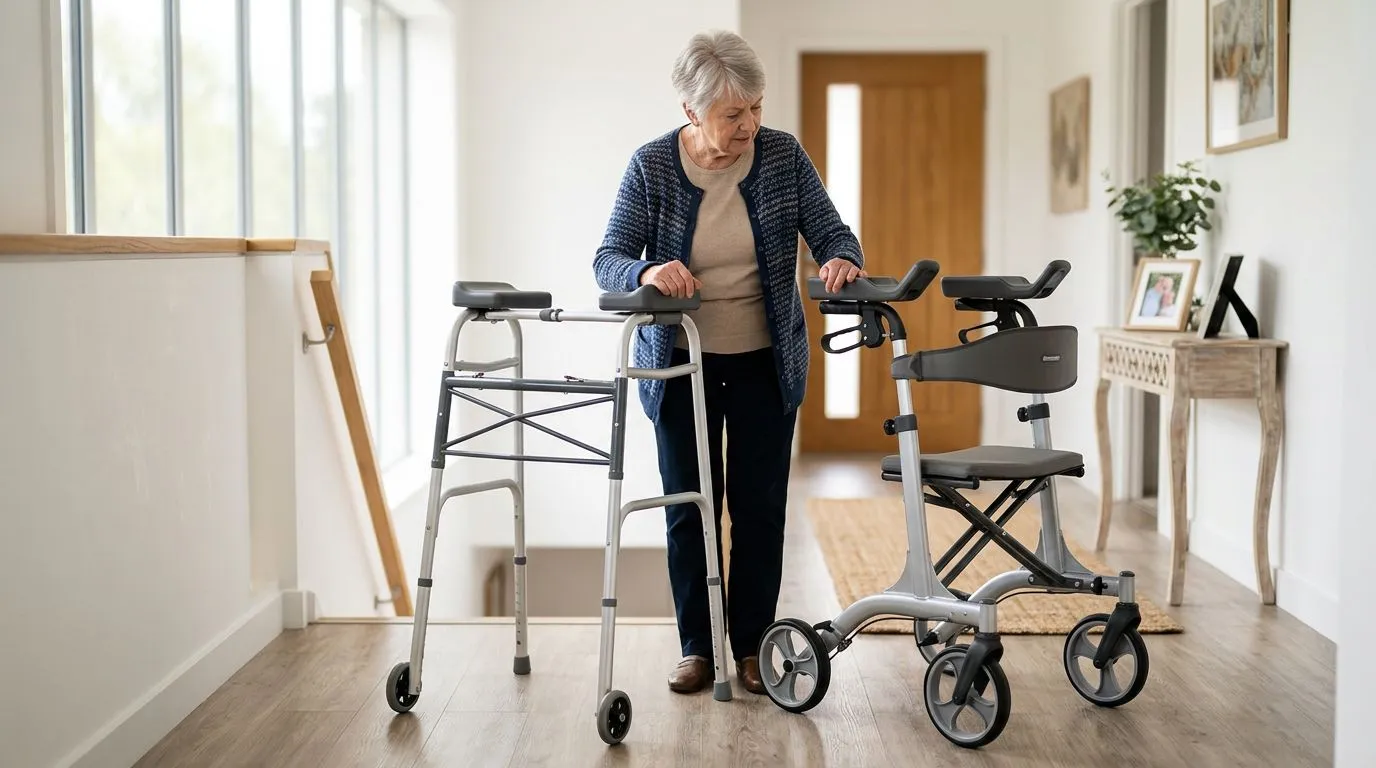
If standard walker grips hurt your wrists, strain your hands, or make you hunch forward, forearm support features may help you use a mobility aid more comfortably and safely. The main options are platform attachments for walkers, forearm-support walkers, and upright rollator-style handles. The right choice depends on how much weight you need to bear, whether you can operate brakes, and whether you need a seat.
Walkers and rollators are related, but they are not the same tool. A walker is usually a frame you lift or slide for support. A rollator is a wheeled walker with hand brakes and often a built-in seat. Forearm supports can appear on both, but they work differently in daily use.
3 Support Styles That Go Beyond Standard Walker Grips
Most standard walker handles sit near wrist height and are designed to be held with the hands, usually with the elbows bent about 15 to 30 degrees. That works well for many people, but it can be uncomfortable when arthritis, wrist pain, hand weakness, tendon irritation, or a recent injury makes gripping painful. Forearm support features shift some pressure from the hand and wrist to the forearm, which can make the device feel steadier for the right user.
There are 3 broad categories to understand. Platform walker attachments are add-on forearm platforms that mount to a standard or two-wheel walker. Forearm-support walkers are walker-style frames designed with arm platforms or troughs already built in. Upright rollators, also called stand-up rollators, use padded forearm rests or higher handles on a wheeled rollator frame with brakes and usually a seat.
These categories may look similar, but they should not be treated as interchangeable. A platform attached to a walker is often chosen for more direct support through one forearm, such as when one wrist or hand cannot grip comfortably. An upright rollator is usually chosen for people who can safely manage wheels and brakes but want a more upright walking posture than a conventional rollator provides.
| Support type | Common base | Best fit | Key caution |
|---|---|---|---|
| Platform attachment | Standard, folding, or two-wheel walker | Wrist pain, weak grip, one-sided hand limits | Must fit the walker frame securely |
| Built-in forearm-support walker | Walker frame with forearm rests | Users who need forearm weight-bearing on a walker | Can be wider or heavier than a basic walker |
| Upright rollator handles | 3-wheel or 4-wheel rollator-style frame | Posture support plus seat and brakes | Requires brake control and wheel safety |
Platform Walker Attachments: 1 or 2 Forearm Rests on a Walker Frame
A platform walker attachment is typically a padded tray, trough, or forearm rest that clamps to one side of a walker. Some people use one platform; others use 2. The user rests the forearm on the support and holds a vertical or angled handgrip if available, reducing the need to load the wrist in a palm-down position.
This setup is most often associated with standard walkers, folding walkers, and two-wheel walkers. The walker may have no wheels, 2 front wheels, or glides on the rear legs. Because the frame itself is still a walker, movement is more controlled than with a full rollator: you lift or advance the frame, step into it, and repeat. That slower rhythm can help people who need stability more than speed.
Platform attachments are especially useful when one hand cannot grip normally. A real-life example is a person with painful thumb arthritis on the right side who can grip normally with the left hand but needs the right forearm supported. Another example is someone with a wrist that should not bear full palm pressure, where a forearm platform may allow support without forcing the wrist into extension.
Fit matters. Platform attachments are not universal just because they look similar. Walker tubing diameter, frame shape, folding mechanism, and handle spacing all affect compatibility. A poorly secured platform can twist under load, creating a serious fall risk. If a walker folds, the attachment may also change how compactly it folds, adding several inches of bulk in a car trunk or closet.
Platform attachments can add noticeable weight. Even a few extra pounds can matter if the user must lift the walker over a threshold, into a vehicle, or up a single 6-inch step with assistance. For people who already struggle to lift a standard walker, a two-wheel walker with rear glides may be easier to advance than a no-wheel frame with platforms.
Upright Rollator Supports: 4 Wheels, Brakes, and a Taller Posture
An upright rollator is a rollator-style mobility aid with elevated handles or forearm supports that encourage a taller walking position. Most upright rollators use 4 wheels, hand brakes, and a built-in seat, although exact frame layouts vary. Many are designed so the forearms rest on padded supports while the hands hold brake handles positioned higher than standard rollator grips.
The biggest difference is motion. A walker stops when you stop moving it. A rollator can keep rolling unless the brakes are squeezed or locked, so brake control is essential. If limited grip strength is the main reason for considering forearm supports, the user still needs enough hand function to slow, stop, and lock the rollator, or the device may not be safe.
Upright rollators can help some people avoid leaning heavily on low handles. A conventional rollator handle is often adjusted to wrist crease height when the user stands tall; an upright model brings support closer to the forearms. This may feel better for someone with posture concerns, fatigue, or discomfort from bending over a lower frame.
They are not right for everyone. Upright rollators are usually larger and heavier than basic walkers. Many 4-wheel rollators fall in the general range of about 15 to 25 pounds, and upright or heavy-duty designs can weigh more. That may be fine for walking around a retirement community, but frustrating if the user or caregiver must load the device into a car several times a week.
Seat use also requires judgment. A rollator seat is for resting when the brakes are locked and the surface is level. It is not a transport chair unless the device is specifically designed for that use, and most rollators should not be pushed like a wheelchair with someone seated on them.
Who It Is Best For: 5 Common User Needs
Forearm supports are worth considering when standard grips create a clear barrier. The 5 common needs are wrist pain, hand arthritis, weak grip, posture discomfort, and one-sided upper-limb limitations. The best device depends on which issue matters most.
For wrist pain, a platform attachment on a walker may reduce the need to press down through the palm. This is most relevant when the person needs firm support but cannot tolerate wrist extension. It can be used on one side or both sides, depending on the problem and the clinician's guidance.
For arthritis in the fingers or thumb, forearm support may reduce gripping demand, but it does not eliminate the need to guide the device. On a rollator, the user must still operate brakes. On a walker, the user may still need to hold or steer the opposite grip, especially when turning.
For limited grip strength, a walker with platform support may be safer than a rollator if brake squeezing is unreliable. Rollator brakes typically require the hands to squeeze to slow and push down or otherwise lock to park, depending on design. If a person cannot consistently brake within a few steps, wheels can become a hazard rather than a help.
For posture concerns, upright rollator-style supports may be appealing because they can reduce the forward bend associated with low handles. Still, posture is not just about handle height. Hip, spine, balance, vision, and endurance all play a role, and setting the supports too high can create shoulder tension.
For one-sided weakness or injury, a platform on one side of a walker can sometimes provide targeted support. A rollator with symmetrical forearm rests may not solve a one-sided control problem because both sides still influence steering and braking.
How to Measure: 90 Degrees at the Elbow Is the Starting Point
Measurement should be done in the shoes normally worn for walking, on a flat surface, with the person standing as upright as comfortably possible. A common starting point for forearm platform height is the distance from the floor to the bent elbow when the elbow is at about 90 degrees. From there, small adjustments are made for comfort, posture, and control.
For a standard walker grip, the usual setup is different: the top of the handle often lines up near the wrist crease when the arm hangs at the side, creating a slight elbow bend when holding the grip. For a forearm platform, the goal is to support the forearm without shrugging the shoulder or forcing the user to bend forward.
Check 4 measurements before buying or adjusting anything. First, measure support height from floor to forearm position. Second, measure the user's elbow-to-hand distance so the forearm rests comfortably on the pad while the hand can reach the grip or brake. Third, check overall width; many interior doorways are about 30 to 32 inches wide, and bathrooms can be tighter. Fourth, confirm weight capacity, including the user's body weight and how much downward force they place on the device.
Pad angle matters too. A forearm rest that is too flat, too narrow, or too far forward can push the shoulders into an awkward position. A support that is too close to the body can make the user step on the rear legs or wheels. The best setup allows a natural step pattern without the feet striking the frame.
- Stand in regular walking shoes.
- Keep shoulders relaxed, not raised.
- Start with the elbow near 90 degrees for platform height.
- Confirm the hand can reach the grip or brake without strain.
- Walk at least 10 to 20 feet during a fit check if safe to do so.
Walker vs Rollator: 6 Features That Change the Decision
The choice between a walker and a rollator is often more important than the shape of the forearm pad. A walker generally prioritizes stability and controlled movement. A rollator prioritizes smoother travel, outdoor convenience, resting with a seat, and less lifting.
A standard walker or folding walker may be best when the user needs to stop between steps, has significant balance concerns, or cannot safely manage brakes. A two-wheel walker can be a middle ground because the front wheels reduce lifting effort while the rear legs add friction. A no-wheel walker frame is the slowest option, but it can offer strong support for short indoor distances.
A 3-wheel rollator is usually more maneuverable in tight spaces, but it often lacks a full seat. A 4-wheel rollator commonly includes a seat and storage pouch or basket. An upright rollator is a 4-wheel rollator variation that raises the support point to the forearms or higher handles. Bariatric rollators and heavy-duty walkers may offer higher weight capacities, sometimes in the 400 to 500 pound range, but they are also wider and heavier.
| Feature | Walker with platform support | Upright rollator support |
|---|---|---|
| Wheels | 0 or 2 wheels common | Usually 4 wheels |
| Brakes | Usually none on standard walker frames | Hand brakes required |
| Seat | Usually no seat | Common on 4-wheel models |
| Grip demand | Can be reduced with 1 or 2 platforms | Reduced for support, but brakes still need hand control |
| Best indoor use | Short, controlled distances | Longer smooth paths if braking is safe |
| Typical concern | Added attachment weight and fit | Rolling too fast or being hard to load |
Safety Checks Before Daily Use: 10 Minutes Can Prevent Problems
Before relying on a forearm support device every day, spend about 10 minutes checking the setup. Look for loose clamps, worn rubber tips, sticky brake cables, uneven pad height, and any wobble when downward pressure is applied. If the device folds, fold and unfold it fully to make sure the support hardware does not block the locking mechanism.
On a walker, the platform should not rotate when the user presses down through the forearm. The frame should sit evenly on the floor, and all tips or wheels should contact the ground as intended. If the platform is installed on only one side, watch whether the walker pulls or twists during use.
On a rollator, test the brakes before every walk. The wheels should slow when the brake handles are squeezed, and the parking brakes should hold on a level surface when the user sits. If the user's hands tire after 5 minutes of walking, that matters; brake control must be available at the end of the walk, not only at the beginning.
Home layout matters. Thick rugs, raised thresholds, narrow bathroom doors, and cluttered hallways can change what is safe. A device that feels excellent in a store aisle or clinic hallway may be too wide beside a bed or too long for a small bathroom turn.
Professional fitting is strongly recommended when forearm supports are being used because of surgery, fracture, neurological changes, significant arthritis, or weight-bearing restrictions. A physical therapist, occupational therapist, or qualified clinician can assess gait, upper-body strength, balance, and home needs. This is not about making the device more complicated; it is about making sure the support matches the person.
Buying Priorities: 7 Details to Compare Without Looking at Brands
You do not need a product catalog to compare support features intelligently. Focus on 7 practical details: base type, support height range, forearm pad size, grip or brake reach, frame width, folded size, and weight capacity. These specifications say more about fit than a product name does.
For walkers, start with the base. Decide whether the user needs a standard no-wheel frame, a folding walker for travel and storage, or a two-wheel walker for easier forward movement. Then confirm that the platform attachment is intended for that style of frame and can be mounted on the needed side.
For rollators, start with brake safety and wheel control. Larger wheels, such as 8 inches, may roll more smoothly over sidewalk cracks than smaller wheels, but they do not replace balance or braking ability. A wider frame may feel stable, yet it can be harder to maneuver through a 30-inch doorway.
Weight capacity should be treated as a safety specification, not a suggestion. Standard mobility aids commonly support around 250 to 300 pounds, while heavy-duty or bariatric designs may support more. The right choice must account for body weight, the amount of downward force through the arms, and any carried items.
Comfort features are important, but they come after safe fit. A soft forearm pad is helpful only if the height, width, and control points are correct. Adjustable supports can improve fit, but more adjustment points also mean more knobs, clamps, and bolts to check over time.
If possible, trial the device in the setting where it will be used most: a kitchen, hallway, apartment corridor, sidewalk, or senior living community. Walk a realistic distance, turn around, approach a chair, and simulate a bathroom doorway. A device that works for 20 feet may not work for 200 feet.
A Practical Choice Path in 4 Steps
Start with the main limitation. If the core issue is wrist or hand pain while using a walker, look first at a platform attachment or a walker with built-in forearm supports. If the core issue is stooped posture while using a rollator, compare upright rollator-style supports. If the core issue is weak grip, do not skip the brake question.
Next, match the device to the walking environment. For short indoor trips, a walker with one or two forearm platforms may provide controlled support. For longer smooth routes where the user needs to sit and rest, a 4-wheel upright rollator may be more practical if braking is reliable. For tight spaces, frame width and turning radius may outweigh every other feature.
Then check body mechanics. The shoulders should stay relaxed, the elbows should not be locked, and the user should not have to lean far forward to reach the supports. Pain that increases during a short trial is a warning sign, not something to push through.
Finally, involve a clinician when the situation is not straightforward. That includes new falls, a recent surgery, a fracture, one-sided weakness, Parkinsonian gait, dizziness, neuropathy, or any instruction to limit weight-bearing through a hand, wrist, arm, hip, or leg. The right forearm support can improve comfort and confidence, but only when it matches the user's strength, balance, and daily surroundings.
For many people, the best answer is not the most advanced-looking device. It is the one that can be adjusted correctly, controlled consistently, moved through the home, and used without adding new strain. That may be a simple folding walker with one platform attachment, a two-wheel walker with bilateral forearm supports, or an upright rollator with dependable brakes and a seat for planned rests.
FAQ
Frequently asked questions
What is the difference between a platform walker attachment and an upright rollator? +
A platform walker attachment mounts a padded forearm support onto a walker frame, often for one-sided wrist or hand limitations. An upright rollator is a wheeled rollator with higher forearm supports or handles, hand brakes, and usually a seat. The walker option is usually more controlled; the rollator option requires safe brake use.
Can forearm supports help if I have arthritis in my hands? +
They may help by reducing how much force goes through the fingers, thumb, or wrist. They do not remove all hand use, especially on rollators where brakes must be operated. A clinician can help decide whether a platform walker, forearm-support walker, or rollator is safest.
Are upright rollators safer than standard walkers? +
Not automatically. Upright rollators can be helpful for some people who need a seat and want a taller posture, but they roll continuously and require brake control. Standard walkers and two-wheel walkers may be safer for users who need slower, more stable movement.
How high should a forearm platform be? +
A common starting point is forearm support height with the elbow bent about 90 degrees while standing in normal walking shoes. The shoulders should stay relaxed, and the hand should reach the grip or brake without strain. Small adjustments are often needed after walking a short test distance.
Can I add a platform attachment to any walker? +
No. Compatibility depends on the walker frame shape, tubing size, folding mechanism, and the side where support is needed. A platform that does not clamp securely can twist or loosen, creating a fall risk.
When should I ask a physical or occupational therapist for help? +
Get professional guidance if you have recent falls, surgery, a fracture, one-sided weakness, neurological changes, major arthritis, or any weight-bearing restrictions. A therapist can check fit, gait, braking ability, and whether the device works in your home.
Keep reading
Related guides
Mobility Walkers for Arthritis or Weak Hands: Grips, Brakes, Weight, and Folding
13 min read
No-Wheel Walker vs Two-Wheel Walker vs Rollator: How Wheels Change Stability, Effort, and Control
13 min read
Buying a Mobility Walker for an Older Parent: Questions to Ask Before You Shop
13 min read