Disclosure: We may earn a commission when you buy through links on this page, at no extra cost to you. We buy nothing, sell nothing and accept no payment for coverage — commissions never decide what we recommend. How we make money.

The best walker or rollator for a short adult lets the handles align with the user’s wrist crease while they stand tall in everyday shoes, without lifting the shoulders or pulling the back forward. For rollators, the seat also needs to be low enough for safe sitting and standing, with both feet touching the floor. Shorter users should look first at handle-height range, frame width, reach to the grips and brakes, seat height, and overall control before weighing extra features.
This matters because many mobility aids are designed around average adult proportions. Someone who is 4 feet 10 inches to 5 feet 3 inches may find that a standard frame feels tall, long, or wide even when it is technically adjustable. The right fit can make walking feel steadier; the wrong fit can add strain to the wrists, shoulders, neck, and lower back.
Why shorter adults often struggle with standard walker and rollator fit
A difference of just 1 or 2 inches at the handles can change posture. If the grips sit too high, the user may walk with raised shoulders and overly bent elbows. If the grips sit too low, the user may lean forward and put too much weight through the hands. Neither position works well for daily use.
Short adults often face three fit problems at the same time: handles that do not adjust low enough, a frame that puts the grips too far forward, and a rollator seat that is too tall to use comfortably. A rollator with a 21-inch seat height, for example, may suit a taller adult but feel unstable for someone whose feet cannot rest flat when seated.
Walkers and rollators also move differently. A standard walker or folding walker is lifted or advanced in short steps, so it can work well for someone who needs firm support and walks slowly. A rollator rolls continuously on 3 or 4 wheels, so it usually demands better steering, brake use, and balance. For a shorter user, an oversized rollator can feel as if it is pulling the body forward.
Walker vs. rollator for short adults: key differences in 6 features
In US shopping and search language, many people use “walker” for any mobility aid with handles. For practical fitting, it helps to separate walkers from rollators. Walkers include standard no-wheel frames, folding walkers, and two-wheel walkers. Rollators are wheeled walkers with hand brakes and, in most cases, a built-in seat.
| Feature | Walkers | Rollators |
|---|---|---|
| Wheels | No wheels or 2 front wheels | 3 or 4 wheels, often 6 to 10 inches |
| Brakes | Usually none; stability comes from the frame | Hand brakes are standard |
| Seat | Usually no built-in seat | Common on 4-wheel rollators; less common on 3-wheel styles |
| Best pace | Slow, deliberate steps | Continuous walking with rest breaks |
| Fit concern for short adults | Handle height and frame width | Handle height, brake reach, seat height, and wheelbase length |
| Typical use | Indoor support, post-surgery use, high stability needs | Errands, longer hallways, outdoor paths, seated rests |
A no-wheel or two-wheel walker may be the better place to start when stability matters most. A rollator may feel more comfortable for a short adult who can walk at a steady pace, use hand brakes, and needs a place to sit during longer outings. Neither option is automatically safer. Fit and proper use matter more than the category name.
Handle height: the 1 measurement that matters most
The most useful starting measurement is the distance from the floor to the wrist crease while the person stands upright in their usual walking shoes. Arms should hang naturally at the sides. For many adults, the correct handle setting creates a slight elbow bend of about 15 to 20 degrees when the hands rest on the grips.
For short adults, do not assume the lowest setting is low enough. Some mobility aids adjust down only to about 31 or 32 inches at the handle, while petite-friendly options may go lower, sometimes into the upper 20-inch range. The exact number varies by product type, so the published handle-height range should be one of the first specifications checked.
A quick home check can reveal a poor fit. If the user’s shoulders rise toward the ears, the handles are probably too high. If the user has to hunch forward to keep both hands on the grips, the handles may be too low or too far away. If the wrists bend sharply instead of staying fairly neutral, the grip height or angle may be off.
With a two-wheel walker or standard folding walker, handle height affects how easily the frame advances. With a rollator, it also affects steering and braking. Handles that are too high can make it harder to squeeze the brakes firmly, especially for someone with smaller hands or limited grip strength.
Reach and frame size: when a walker feels too big by 2 inches
Shorter users often focus on height and miss reach. Reach is the distance from the body to the handles and controls while walking naturally. Even when the handles are the right height, a deep frame can make the user walk too far behind the device.
A good sign of proper reach is that the user can stand inside or close to the frame without bumping the crossbar, stretching the arms, or taking unusually short steps. With a walker, the back legs or rear glides should not push the user far behind the grips. With a rollator, the body should stay between the rear wheels enough to maintain control, not trail 6 inches behind the handles.
Width matters as well. A very wide frame may provide space between the handles, but it can be harder to turn in tight indoor areas. Many interior doorways are about 28 to 32 inches wide, and bathroom doors may be narrower in older homes. The overall width of the walker or rollator should fit the spaces the person actually uses each day.
Wheelbase length is another rollator issue. A long 4-wheel rollator can feel stable outdoors, but a petite user may find it awkward in a small kitchen or apartment hallway. A 3-wheel rollator often turns more easily in tight spaces, though it usually offers less seating support and may feel less stable for some users. The better choice depends on balance, brake control, and where the device will be used most.
Rollator seat height and depth: short adults need both feet supported
Seat fit applies to rollators, not standard walkers. A rollator seat should let the user sit with hips and knees in a comfortable position and both feet resting securely on the floor. If the seat is too high, the person may perch on the edge instead of sitting fully back, which can feel unsafe during rest breaks.
Common rollator seat heights often fall around 20 to 23 inches, but shorter adults may need a lower seat, such as roughly 17 to 19 inches, depending on leg length. The best number is not based on total height alone. A 5-foot adult with longer legs may need a different seat height than another 5-foot adult with a shorter inseam.
Seat depth and width matter too. A seat that is too deep can press behind the knees, while one that is too shallow may not feel supportive. Many rollator seats are roughly 12 to 14 inches deep, though designs vary. The user should be able to turn, lock the brakes, back up until the backs of the legs touch the seat, and sit without dropping down suddenly.
Upright or stand-up rollators require extra caution for short users. These devices support the forearms on elevated armrests and are often marketed for posture. However, the arm platforms must adjust low enough for the user’s forearms to rest comfortably without raised shoulders. If the forearm supports are too high, an upright rollator can create the same problem as handles that are too high.
Who each type is best for: 5 common short-adult situations
Different mobility aids solve different problems. A short adult who needs maximum stability at home may not need the same device as someone who walks half a mile outdoors with rest breaks. The examples below are general guideposts, not medical prescriptions.
| User situation | Often worth considering | Fit priority |
|---|---|---|
| Needs firm support after illness, injury, or surgery | Standard or folding no-wheel walker | Low enough handles and correct width |
| Can walk steadily but needs help starting and stopping | Two-wheel walker | Front wheel control and rear glide stability |
| Needs rest breaks during errands | 4-wheel rollator with seat | Seat height, brake reach, and handle range |
| Lives in a small apartment with tight turns | Compact walker or 3-wheel rollator | Overall width and turning space |
| Needs higher weight capacity | Bariatric walker or bariatric rollator | Capacity, width, and low handle setting |
Bariatric fit needs special attention. Higher weight capacity is important when needed, but some bariatric walkers and rollators are taller, wider, and heavier than standard designs. A short adult should not have to accept handles that are too high just to get an appropriate weight rating. Both the weight capacity and the height range need to match the user.
For a user with limited hand strength, a walker may feel simpler because there are no hand brakes to manage. For someone with good brake control who tires easily, a rollator seat can support independence during longer trips. If balance is changing, a physical therapist or occupational therapist can help compare options in person.
How to measure and choose in 7 practical steps
A good fitting process takes about 10 to 15 minutes and prevents many common mistakes. Measure the person, then compare those numbers with the device specifications. Do not rely only on labels like “petite,” “junior,” or “compact,” because those terms are not standardized across all mobility aids.
- Measure wrist height. Have the user stand tall in normal shoes with arms relaxed. Measure from the floor to the wrist crease.
- Compare handle range. Choose a walker or rollator with an adjustment range that includes that wrist-height number, ideally not only at the very lowest hole.
- Check elbow bend. With hands on the grips, look for a slight bend of about 15 to 20 degrees rather than locked elbows or shrugged shoulders.
- Test reach. The user should not have to lean forward or chase the frame. Hands, hips, and feet should move in a comfortable rhythm.
- Confirm width at home. Compare the overall width to doorways, bathroom access, and hallway turns. A difference of 2 inches can matter in small spaces.
- For rollators, test the brakes. The user should be able to squeeze and lock the hand brakes without pain, strain, or changing posture.
- For rollators with seats, test sitting. Lock the brakes first. The user should back up, feel the seat behind the legs, sit with control, and place both feet on the floor.
If the device will be transported in a car, foldability and weight matter too. A folding walker is often lighter and easier to lift than a rollator. Many rollators are manageable for caregivers but may still be heavy for a short adult to load alone, especially if the frame weighs more than 15 to 20 pounds.
Feature trade-offs short adults should compare before buying
Small changes can make a mobility aid easier or harder to use. A 6-inch wheel may maneuver well indoors, while an 8-inch wheel may roll more smoothly over sidewalk cracks. A wider seat may feel supportive, but the frame may become too wide for a narrow bathroom. The right answer depends on the user’s body, home, and walking routine.
| Feature | Benefit | Possible drawback for shorter users |
|---|---|---|
| Lower handle range | Better posture and control | May narrow the selection |
| Compact frame | Easier turns and indoor use | May have less storage or a smaller seat |
| Larger wheels | Smoother outdoor rolling | Can raise frame height or add weight |
| Built-in seat | Allows rest breaks | Seat may be too high or shallow |
| Upright arm supports | May reduce forward leaning for some users | Armrests may not adjust low enough |
| Higher weight capacity | Needed for safety when appropriate | Often wider, heavier, or taller |
Storage accessories should come after fit. A basket, pouch, or tray is useful only if the person can still walk close to the frame and control it. Heavy items should be carried low and centered when possible, because weight hanging from one side can affect steering.
Safety checks after 1 week of use
Even a well-fitted walker or rollator may need adjustment after real-world use. Recheck the fit after about 1 week, especially if the user reports wrist soreness, shoulder fatigue, back strain, or fear of turning. A single handle-height adjustment hole can make a noticeable difference.
Watch the user from the side while walking. The head should be upright, the shoulders relaxed, and the steps controlled. With a walker, the frame should move forward first, then the body should step into it. With a rollator, the user should stay close enough to brake and steer without reaching.
Inspect the equipment too. Rubber tips on standard walkers wear down and should be replaced when they become smooth or uneven. Wheels should roll freely, brake cables should respond promptly, and folding latches should lock fully. For rollators, the brakes should hold the device still before the user sits.
If pain, falls, dizziness, or sudden weakness occurs, equipment fit is only one part of the picture. A clinician can evaluate strength, balance, vision, medication effects, and home hazards. The goal is not just to own a mobility aid, but to use one that supports safe movement and everyday confidence.
FAQ
Frequently asked questions
How low should walker handles be for a short adult? +
Walker handles should usually line up near the crease of the wrist when the person stands upright in normal shoes with arms relaxed. This often creates a slight 15 to 20 degree bend at the elbows when holding the grips.
Is a walker or a rollator better for a petite senior? +
It depends on balance, strength, and daily use. A standard or two-wheel walker often gives firmer support for slow indoor walking, while a rollator may suit someone who walks more continuously, can use hand brakes, and needs seated rest breaks.
What rollator seat height works best for shorter users? +
Many shorter users need a lower seat than standard rollators provide. The safest fit lets the person sit with control and keep both feet flat on the floor, which may mean looking for seat heights around the high teens rather than the low 20-inch range.
Can a rollator be too big even if the handle height is adjustable? +
Yes. A rollator can have handles that adjust low enough but still feel too deep, wide, or heavy. Shorter users should also check reach to the grips and brakes, overall frame width, wheelbase length, and seat height.
Are upright rollators suitable for short adults? +
They can be, but only if the forearm supports adjust low enough. If the armrests force the shoulders upward or make the user reach forward, an upright rollator may be uncomfortable or difficult to control.
Keep reading
Related guides

Best Walker Features for Tall People, Larger Adults, and Higher Weight Capacities
13 min read
How to Measure for a Mobility Walker or Rollator: Handle Height, Elbow Bend, and Posture Checks
15 min read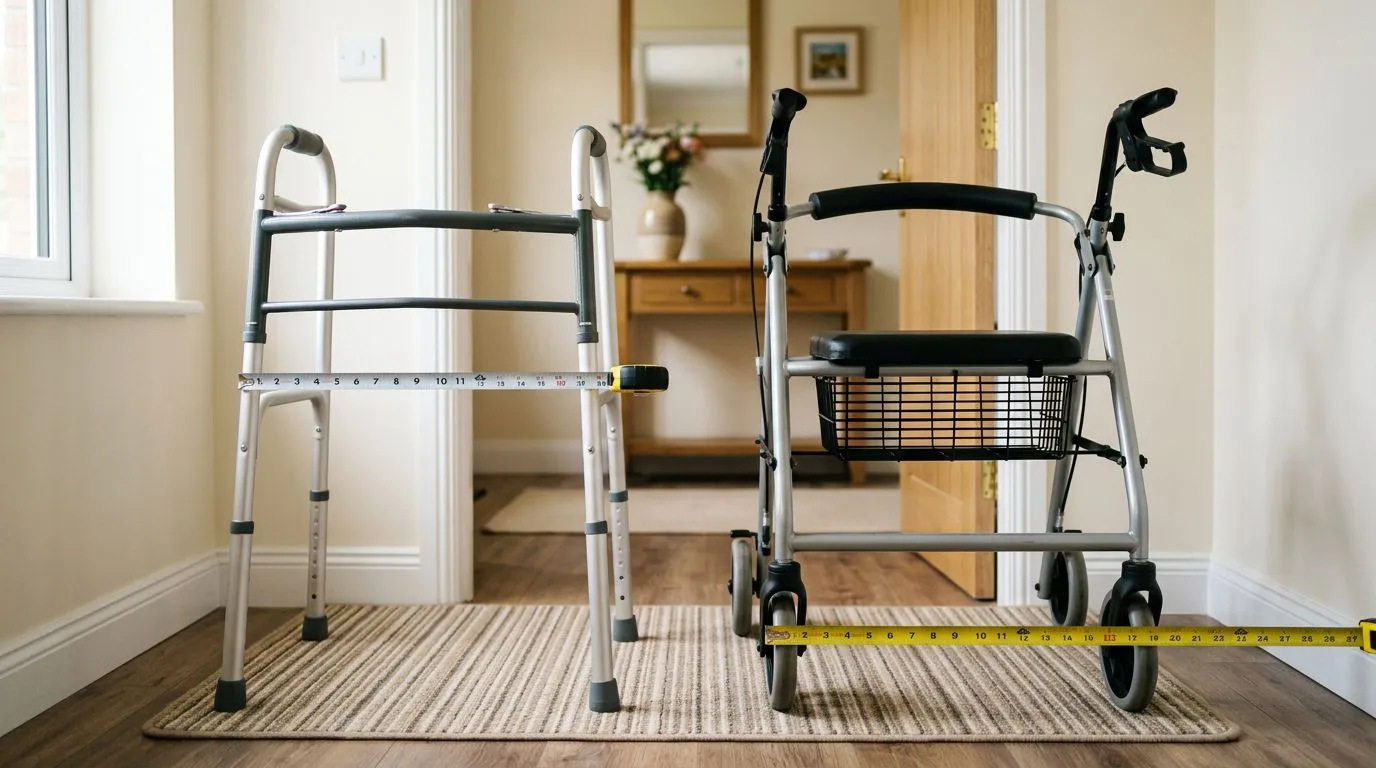
Bariatric Walker and Rollator Fit: Seat Width, Frame Width, and Weight Capacity Checklist
15 min read