Disclosure: We may earn a commission when you buy through links on this page, at no extra cost to you. We buy nothing, sell nothing and accept no payment for coverage — commissions never decide what we recommend. How we make money.
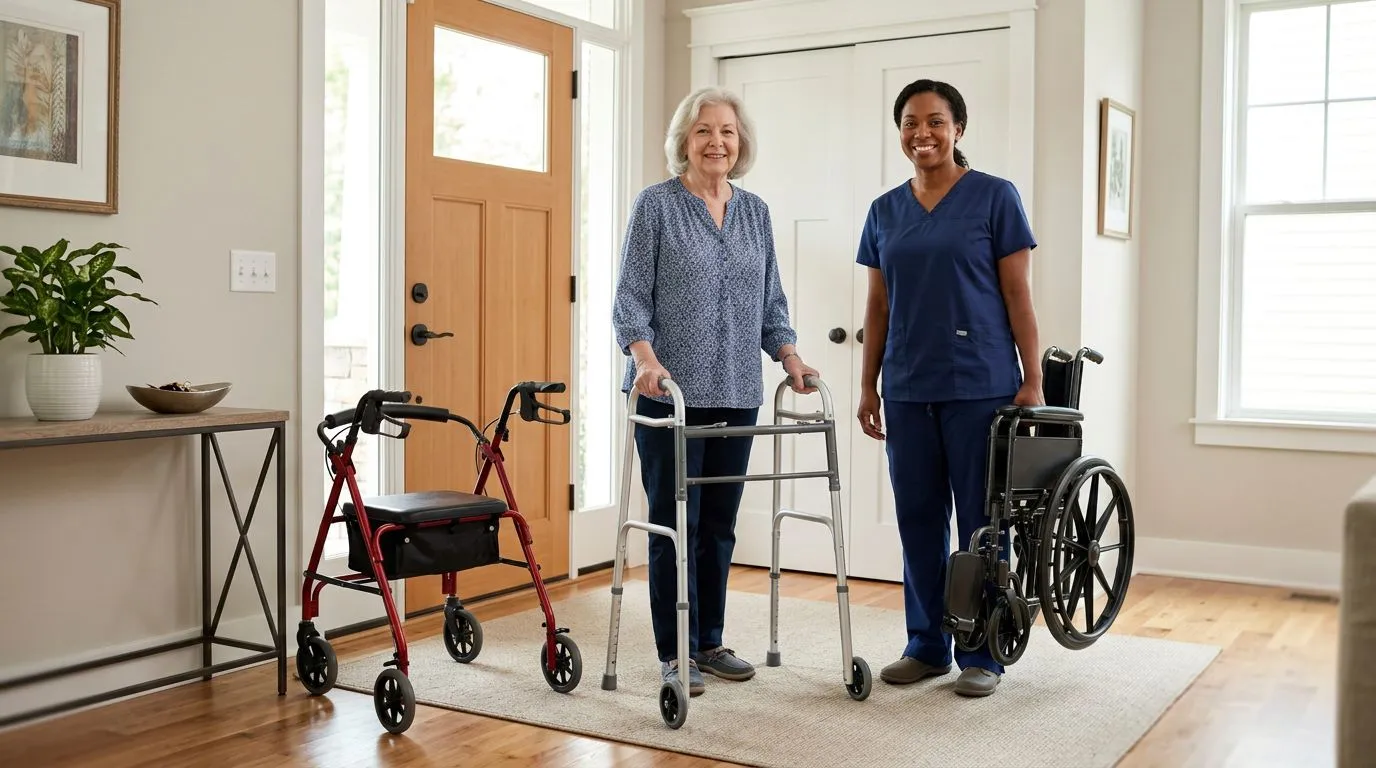
A walker or rollator is usually the better choice when a person can stand, bear weight, and walk safely with support for most daily activities. A transport chair or wheelchair is safer when walking is limited by severe fatigue, poor balance, pain, shortness of breath, or a high fall risk. Many people use both: a walker or rollator at home, and a transport chair for longer outings.
The right choice is not about giving up independence. It is about matching the device to the person, the setting, and the distance. A standard walker may add stability for a 20-foot trip to the bathroom, while a transport chair can make a 300-foot clinic hallway safer and less exhausting.
Walker, rollator, transport chair, or wheelchair: the 30-second choice
If you are comparing a walker and wheelchair, start with one practical question: can the person walk the distance they need today without becoming unsafe? If yes, a mobility walker or rollator may be enough. If no, a transport chair or wheelchair deserves serious consideration.
The distinction is simple. Walkers and rollators support walking. Wheelchairs and transport chairs replace walking for part or all of a trip. A walker requires the user to stand, step, steer, and manage balance. A wheelchair or transport chair provides seated mobility, which can be safer when legs, endurance, or balance are not reliable.
A transport chair is a lightweight chair with 4 small wheels that is pushed by a caregiver. It is not designed for independent self-propulsion because the rear wheels are usually too small to grip and push effectively. A standard manual wheelchair typically has 2 large rear wheels, so some users can propel themselves with their arms, depending on strength, coordination, and seating needs.
For many households, the decision is not either-or. It may be a walker for bedroom-to-kitchen mobility, a rollator for a level apartment hallway, and a transport chair for medical appointments, airports, museums, or shopping centers.
Mobility walker options in 2 categories: walkers and rollators
In everyday search and conversation, many people use the word walker for several different devices. It helps to separate true walkers from rollators because they behave differently.
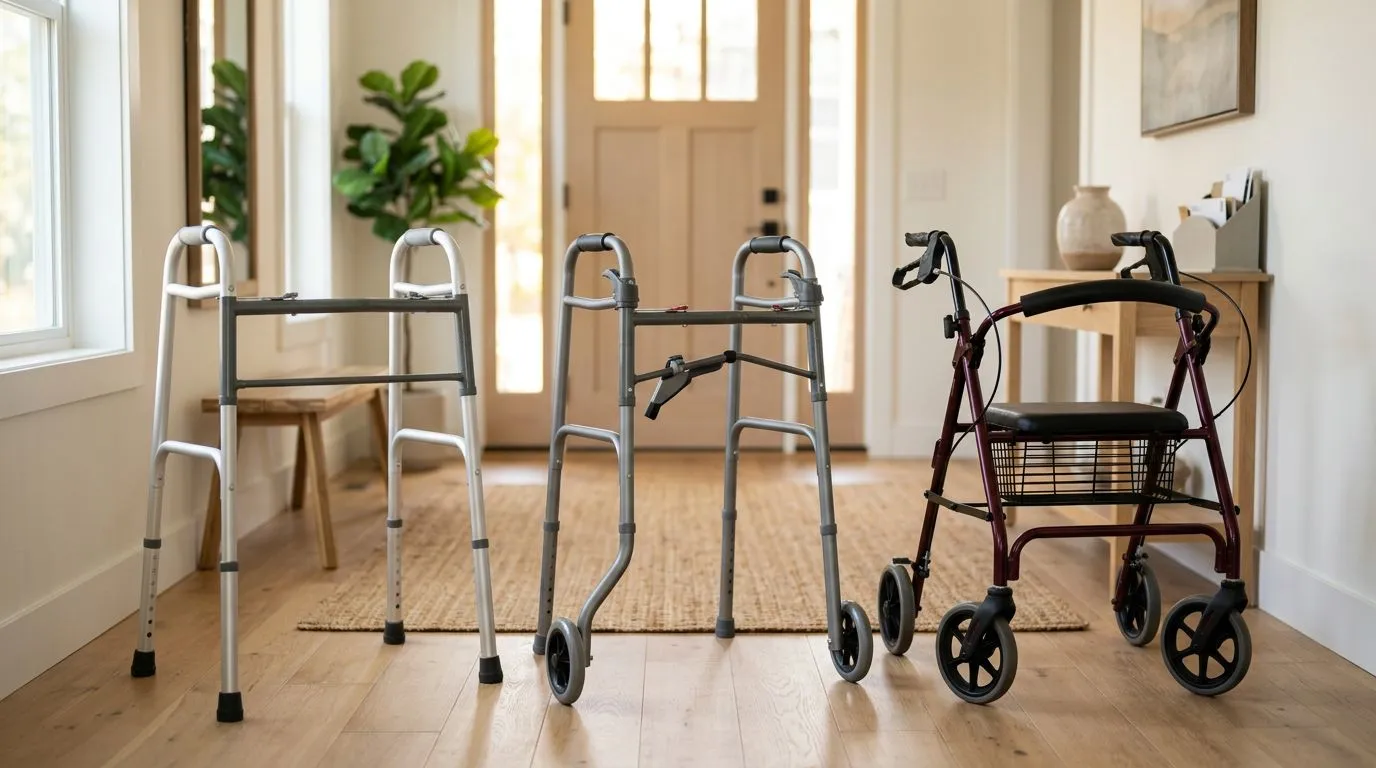
Walkers include standard no-wheel walker frames, folding walkers, and two-wheel walkers. A standard walker has 4 legs and no wheels, so the user lifts it, places it forward, then steps into it. This provides strong stability but requires arm strength and coordination. Many standard and folding walkers are about 24 to 28 inches wide, which matters in narrow bathrooms and older homes.
A two-wheel walker has wheels on the front legs and rubber tips or glides on the rear legs. The user can push it forward without lifting the whole frame every time. It is often easier for people who tire from lifting a no-wheel walker, but it still provides more stopping resistance than a full rollator.
Rollators are wheeled walkers with hand brakes, usually 3 or 4 wheels, and many 4-wheel versions include a built-in seat. A rollator rolls continuously, so it is best for people who can control speed, use hand brakes, and walk with decent balance. Common rollator seat heights are roughly 20 to 24 inches, and many frames support about 250 to 300 pounds, with bariatric rollators commonly rated higher.
An upright or stand-up rollator has higher forearm or hand supports to encourage a more upright posture. It may help some users feel less bent over, but it requires careful fitting and brake control. It is not automatically safer than a standard rollator.
| Device type | How it moves | Best fit | Key caution |
|---|---|---|---|
| Standard or folding walker | User lifts and places frame | Maximum walking stability over short distances | Requires arm strength and timing |
| Two-wheel walker | Front wheels roll, rear tips stop | Short indoor trips with less lifting | Can catch on thresholds or rugs |
| 3-wheel rollator | All wheels roll with hand brakes | Tight spaces and lighter outdoor use | Usually no full seat and less stable than 4 wheels |
| 4-wheel rollator | All wheels roll with brakes and often a seat | Longer walking distances with rest breaks | Can roll away if brakes are not used correctly |
When walking support is enough: 5 signs a walker may work
A mobility walker may be enough when walking is still realistic, predictable, and safe. The person does not need to be fast. They do need enough control to move from point A to point B without repeated near-falls.
- They can stand for at least 1 to 2 minutes. This matters for bathroom transfers, kitchen tasks, and getting positioned before walking.
- They can bear weight through both legs or through one leg as directed. If a clinician has given weight-bearing restrictions after surgery or injury, follow those instructions closely.
- They can walk household distances. For many homes, this means 10 to 50 feet at a time, such as bed to bathroom or living room to kitchen.
- They can use both hands on the device. Walkers and rollators are harder to use safely if one hand must constantly carry oxygen tubing, a bag, or household items.
- Their judgment and reaction time are reliable. A rollator especially requires remembering to lock brakes before sitting and controlling speed on slopes.
A standard walker is often the safer walking aid when balance is poor but the person can still lift and place the frame. A two-wheel walker may be a good middle ground when lifting a no-wheel walker causes fatigue. A rollator can help when the person walks better with a smoother rhythm and needs a seat for rest breaks, but only if they can manage the brakes every time.
Choose walking support when the goal is to preserve safe movement, not when it forces the person to struggle. If a 40-foot walk leaves someone shaky, breathless, or unable to turn safely, seated mobility may be the better tool for that situation.
When a transport chair or wheelchair is safer: 6 red flags
A chair may be safer when walking support does not reduce risk enough. This is especially true when fatigue appears suddenly, balance changes throughout the day, or the person must travel farther than they can manage on foot.
- Frequent falls or near-falls. More than 1 fall in a short period should prompt a professional safety review.
- Severe fatigue after short distances. If 20 to 30 feet causes trembling legs or unsafe posture, a walker may not be enough.
- Uncontrolled dizziness or faintness. A walking aid cannot correct lightheadedness that makes standing unsafe.
- Shortness of breath that limits activity. Seated mobility may reduce strain during longer trips, but symptoms should also be discussed with a healthcare professional.
- Inability to manage brakes, turns, or obstacles. This is a particular concern with rollators on ramps, curbs, and uneven pavement.
- Caregiver strain. If a caregiver is catching, lifting, or physically holding the person up, the device plan is not safe enough.
A transport chair works well when the user cannot safely walk long distances but has a caregiver available to push. It is often lighter and easier to load into a car than a full manual wheelchair. However, the user depends on someone else for movement, and small wheels can struggle on gravel, thick grass, broken sidewalks, and high thresholds.
A manual wheelchair may be better when the person needs longer periods of seated mobility or may self-propel. It can also offer more seating support options than a basic transport chair. The tradeoff is size and weight: many manual wheelchairs are bulkier than transport chairs and require more storage space.
Using both: a 2-device plan for home and outings
Many people do best with 2 mobility tools because daily life includes different distances. The safest setup for a bedroom may not be the best setup for a hospital parking lot.
A common plan is a folding walker or two-wheel walker for indoor use and a transport chair for long appointments. For example, a person may safely walk 25 feet to the bathroom using a walker but need a caregiver-pushed chair for a 600-foot walk from a parking lot to a clinic office. That does not mean the walker failed. It means the environment changed.
Another common pairing is a 4-wheel rollator and a transport chair. The rollator supports short community walks and gives the user a place to sit when brakes are locked and the chair is on level ground. The transport chair is reserved for longer distances, crowded places, or days when energy is low.
Be careful with combination devices that try to act as both a rollator and a transport chair. Some can be useful for short, supervised use, but they still require careful attention to weight capacity, footrests, brake access, wheel size, and caregiver control. A device that is excellent as a walker may be only modest as a chair, and the reverse can also be true.
| Situation | Often works well | Why |
|---|---|---|
| Small bathroom, 24 to 30 inch doorway | Standard or two-wheel walker | More stable and narrower than many chairs |
| Level hallway, frequent rest breaks | 4-wheel rollator | Rolls smoothly and includes a seat on many models |
| Medical visit with long corridors | Transport chair | Reduces fatigue and fall risk over distance |
| All-day seated mobility | Manual wheelchair evaluation | May offer better self-propulsion and seating support |
How to measure and choose: 3 key fit checks
Fit affects safety. A walker that is too tall can raise the shoulders and reduce control. A rollator that is too low can encourage leaning. A chair that is too narrow can cause pressure and discomfort, while one that is too wide may be hard to maneuver indoors.
1. Handle height for walkers and rollators
Have the person stand in supportive shoes with arms relaxed at their sides. The walker or rollator handles should usually line up near the wrist crease. When hands rest on the grips, elbows should be slightly bent, often around 15 to 30 degrees. This is a general fit guide, not a substitute for clinical instruction after surgery, stroke, or major illness.
2. Width, turning space, and doorways
Measure the narrowest doorway and the tightest turn. Many interior doors are about 28 to 32 inches wide, but older bathrooms can be smaller. Compare that with the outside width of the walker, rollator, transport chair, or wheelchair. Also check whether the device can turn near the bed, toilet, and favorite chair without backing up repeatedly.
3. Seat width and weight capacity for chairs and rollators
For seated devices, measure hip width while sitting and allow enough room for comfort without excessive side-to-side movement. Common transport chair seat widths include 17 to 19 inches, while wheelchairs may offer more size options. Always check the stated weight capacity, including clothing, bags, and any carried items. Bariatric rollators and wheelchairs are designed for higher capacities, but they are also wider and heavier.
Other practical details matter: folded size for a car trunk, total device weight for the caregiver, brake style, wheel size, and whether the user can operate the device with current hand strength. A device that is technically safe but too heavy to load will not work well in real life.
Feature comparison table: 4 mobility options at a glance
The table below compares the broad categories most families consider. Exact dimensions and capacities vary, so treat these as decision points rather than fixed specifications.
| Feature | Walker | Rollator | Transport chair | Manual wheelchair |
|---|---|---|---|---|
| Primary purpose | Supports walking | Supports walking with wheels and brakes | Caregiver-pushed seated mobility | Seated mobility, sometimes self-propelled |
| Typical wheels | 0 or 2 | 3 or 4 | 4 small wheels | 2 large rear wheels plus front casters |
| Seat | No | Often yes on 4-wheel types | Yes | Yes |
| Brakes | Rubber tips or rear glides slow movement | Hand brakes | Caregiver brakes on many designs | Wheel locks, sometimes hand brakes for caregiver |
| Best distance | Short indoor distances, often under 50 feet at a time | Short to moderate walks with rest stops | Moderate to long outings with caregiver | Longer seated use or independent propulsion if appropriate |
| Main limitation | Requires standing and stepping | Requires brake control and balance | User usually cannot self-propel | Bulkier and may need more fitting |
If the person wants to keep walking but needs stability, begin with walker type and fit. If the person can walk but needs frequent seated breaks, compare rollator options carefully. If walking is unsafe beyond very short distances, look at transport chairs or manual wheelchairs for those trips.
Safety, training, and home setup: 7 practical steps
The device is only one part of mobility safety. The home, caregiver technique, and daily routines matter just as much.
- Remove trip hazards. Loose rugs, cords, clutter, and raised thresholds can catch walker legs or small wheels.
- Practice transfers. Sitting, standing, turning, and backing up should be practiced before the device is used alone.
- Lock brakes before sitting. This is essential with rollators and many transport chairs.
- Do not use a rollator as a wheelchair unless designed for that use. Many rollator seats are for resting, not being pushed while seated.
- Check tips, wheels, and brakes weekly. Worn rubber tips, loose bolts, and weak brakes can change how a device behaves.
- Plan for fatigue. A person may walk well at 9 a.m. and need a chair by 3 p.m.
- Ask for a professional fit when risk is high. A physical therapist, occupational therapist, or qualified clinician can help match the device to strength, balance, home layout, and medical restrictions.
Also consider caregiver safety. Pushing a chair up a ramp, loading a device into a trunk, or helping someone stand can strain the back and shoulders. If the caregiver cannot safely manage the equipment, the plan needs adjustment.
FAQs: 5 common walker and wheelchair questions
Is a walker better than a wheelchair?
A walker is better when the person can walk safely and benefits from staying active during daily tasks. A wheelchair or transport chair is better when walking creates a high fall risk, severe fatigue, or unsafe symptoms. Many people use both for different distances.
What is the difference between a walker and a rollator?
A walker is a stable frame with 0 or 2 wheels, and it supports slower, controlled walking. A rollator has 3 or 4 wheels, hand brakes, and often a seat. Rollators roll more easily but require better balance, brake use, and judgment.
Can a transport chair replace a wheelchair?
Sometimes, but not always. A transport chair is mainly for caregiver-pushed outings and short-term seated mobility. A manual wheelchair may be better for frequent seated use, self-propulsion, or more supportive seating.
Should someone use a rollator if they are unsteady?
Only if they can control the rollator and use the brakes reliably. If the device rolls faster than the person can step, a standard walker or two-wheel walker may be safer. A clinician can help assess this.
When should we consider using both a walker and transport chair?
Consider both when the person can walk safely at home but struggles with longer distances outside the home. A walker can support independence for short daily routes, while a transport chair can reduce fatigue and fall risk during appointments or errands.
FAQ
Frequently asked questions
Can you use a walker at home and a transport chair outside? +
Yes. Many people use a walker or rollator for short indoor distances and a transport chair for longer outings, medical appointments, airports, or days when fatigue is worse.
When should a clinician help choose the device? +
Get professional guidance if there have been falls, recent surgery, stroke, major weakness, dizziness, weight-bearing restrictions, or caregiver strain. A physical or occupational therapist can help with fit and safe use.
Keep reading
Related guides
No-Wheel Walker vs Two-Wheel Walker vs Rollator: How Wheels Change Stability, Effort, and Control
13 min read
One Mobility Walker for Home and Outdoors? Standard Walkers vs Rollators for Daily U.S. Use
13 min read
Walker or Rollator for Day Trips and Events: Museums, Restaurants, Stadiums, and Crowded Places
12 min read