Disclosure: We may earn a commission when you buy through links on this page, at no extra cost to you. We buy nothing, sell nothing and accept no payment for coverage — commissions never decide what we recommend. How we make money.

A rollator transport chair combo makes sense when someone can walk part of an outing with a wheeled walker but may need to sit and be pushed for short stretches. It is best for malls, medical appointments, travel days, and caregiver-assisted trips when walking endurance changes. It is not the same as a full wheelchair and should not be treated as one for all-day seating, self-propelling, or high-support medical positioning.
These hybrid devices are popular because they promise two jobs in one frame: a rollator for walking and a transport chair for resting while a companion pushes. That can be genuinely useful. It can also disappoint buyers who expect wheelchair-level comfort or independence. The right choice depends on walking ability, caregiver strength, brake control, seat fit, and where the device will be used.
What a 2-in-1 rollator transport chair is
A rollator transport chair combo is a 4-wheel rollator that converts into a lightweight companion-pushed chair. In walking mode, the user stands behind the frame, holds the hand grips, and uses hand brakes to slow or lock the wheels. In transport mode, the user sits on the built-in seat, places feet on swing-away or fold-down footrests, and a caregiver pushes from behind.
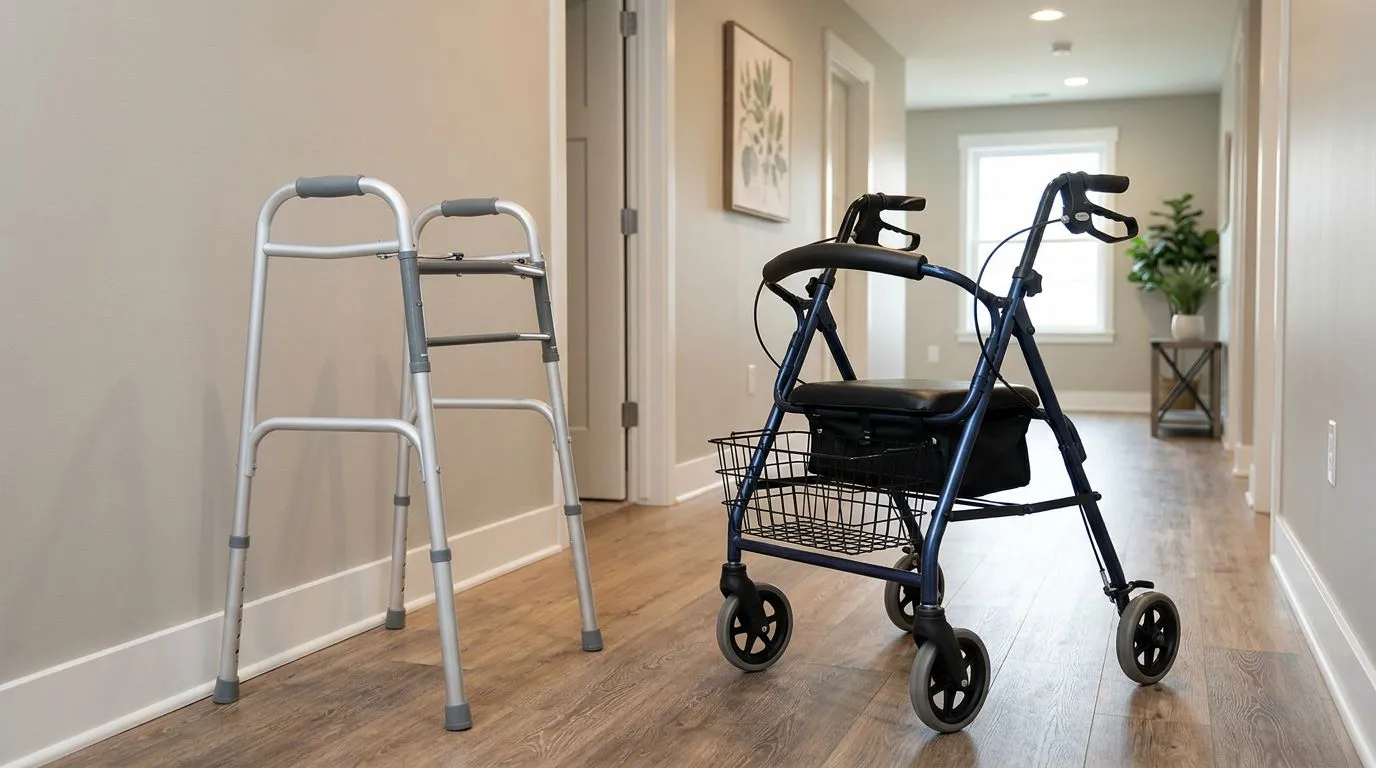
This differs from a standard walker. A standard walker, folding walker, or two-wheel walker is mainly a walking aid, often with no seat and no hand brakes. It is lifted or rolled forward a short distance, then used for support while stepping. A rollator is a wheeled walker with brakes; most 4-wheel rollators include a seat. A combo rollator adds transport-chair features, usually including a reversible backrest, footrests, and push handles that work better for a caregiver.
Most general-use models are built for adults in the common 250 to 300 lb weight-capacity range, while heavy-duty versions may be rated higher. Seat widths often fall around 17 to 20 inches, though exact sizing varies. Those numbers matter. A device that is too narrow, too low, or too heavy to lift into a vehicle can turn a smart idea into a daily frustration.
| Device type | Main job | Typical key features | Best fit |
|---|---|---|---|
| Standard or folding walker | Maximum steady support while walking | No seat, no hand brakes, often no wheels or 2 front wheels | Short indoor walking with slower step-by-step support |
| 4-wheel rollator | Walking support with a place to rest | 4 wheels, hand brakes, seat, storage pouch or basket | People who can steer and brake safely while walking |
| Rollator transport chair combo | Walking plus short assisted rides | 4 wheels, brakes, seat, footrests, caregiver push handles | Variable endurance and caregiver-supported outings |
| Full wheelchair | Seated mobility for longer use | Large rear wheels or transport wheels, stronger seating options, more positioning support | Frequent seated mobility, longer distances, or higher support needs |
Who it is best for: trips of 10 to 30 minutes
A walker-wheelchair hybrid is most helpful when the user can walk safely some of the time but loses stamina during longer trips. Think of a person who can walk from the parking lot to a clinic desk, then needs to be pushed down a long hallway. Or someone who enjoys shopping but cannot reliably stand through a 30-minute errand. The combo provides a backup plan without bringing both a rollator and a transport chair.
It is also useful on unpredictable days. Arthritis pain, fatigue, balance confidence, breathing limits, or recovery after illness can change from morning to afternoon. A combo rollator can let the person start upright and sit only when needed, which may feel more independent than arriving in a wheelchair from the start.
The strongest use cases usually include 3 conditions: the user can transfer on and off the seat with minimal help, a caregiver is present and physically able to push, and the terrain is mostly smooth. Indoor flooring, paved paths, airports, museums, and medical campuses are common examples. These devices are less satisfying on broken sidewalks, gravel, steep driveways, or thick carpet.
Good candidates often include
- People who walk independently with a rollator for short distances but tire during longer outings.
- Older adults who need a safe seated rest option every few hundred feet.
- Travelers who want one folding device for walking support and occasional assisted transport.
- Care partners who cannot manage a large wheelchair plus a separate walker in the car.
- Users who can sit upright without special lateral supports, cushions, or custom positioning.
It may not be the right device for someone who cannot walk safely at all, cannot follow brake instructions, needs to be pushed for hours, or needs pressure-relief seating. In those cases, a transport chair or wheelchair may be safer and more comfortable.
Where it falls short compared with a full wheelchair
A rollator transport chair combo is a compromise by design. It is lighter and more flexible than a full wheelchair, but it usually gives up seat depth, wheel size, push efficiency, and long-duration comfort. Many combos use smaller wheels, often around 8 inches, compared with the much larger rear wheels found on many self-propel wheelchairs. Smaller wheels are easier to package on a folding rollator frame, but they do not roll over bumps as smoothly.
The seating is different too. A rollator seat is usually meant for short rests, not all-day sitting. The seat may be narrower and shallower than a wheelchair seat, and the backrest may be a padded bar or light fabric strap rather than a supportive wheelchair back. Footrests help keep feet off the ground while being pushed, but they may not offer the same adjustability as wheelchair leg supports.
Most important, a combo is typically not designed for the seated user to propel themselves. In transport mode, the rear wheels are usually too small and too far back for practical self-propelling. The person sitting should expect a caregiver to push and control the route. If independent seated mobility is the goal, a wheelchair configuration is usually more appropriate.
| Feature | Rollator transport chair combo | Full wheelchair or transport chair |
|---|---|---|
| Best seated duration | Short rests or short assisted rides, often 10 to 30 minutes | Longer seated use, depending on seating and cushion |
| Self-propelling | Usually not practical | Possible on many wheelchairs with large rear wheels |
| Walking support | Yes, in rollator mode | No, not a walking aid |
| Storage and lifting | Often folds smaller than a wheelchair, but still may weigh 18 to 25 lb or more | Varies widely; transport chairs can be light, wheelchairs often heavier |
| Seat support | Basic rollator-style seat and backrest | More seating options and better long-use support |
Caregiver needs, brakes, and safe transfers: 3 checks
The caregiver is part of the equipment. A combo rollator only works in transport mode if another person can push, steer, stop, and help with transitions when needed. Before buying, picture the hardest real trip: a ramp from a parking garage, a curb cut with uneven pavement, a crowded elevator, or a clinic hallway that is 200 feet longer than expected.
Check the brakes first. Rollators use hand brakes at the grips, and most have a parking-lock position. In walking mode, the user must be able to squeeze the brakes to slow down and push them into lock before sitting. In transport mode, the caregiver needs good control from the rear. Some combos include caregiver-accessible brake handles; others rely more on the user-side hand brakes. That detail can make a major difference on slopes.
Transfers are the second check. The user should not sit until the parking brakes are fully locked and the device is on level ground. Footrests should be moved out of the way during the sit-to-stand or stand-to-sit movement, then positioned after the user is seated for transport. The caregiver should not pull the device backward while the user is halfway seated. Slow is safer.
The third check is slope and threshold control. Even a mild ramp can feel different when a person is seated and the caregiver is managing the full load. Public accessibility guidelines often use a 1:12 ramp ratio as a reference, meaning 1 inch of rise for every 12 inches of run, but real-world driveways and curb cuts may be steeper or uneven. If the caregiver cannot comfortably hold the device still with the brakes locked and the user seated, the setup is not safe for that environment.
Seat comfort and fit: measure 4 places
Fit matters for both walking and sitting. Start with handle height. When the user stands inside or just behind the rollator frame with shoulders relaxed, the hand grips should be near the wrist crease, with elbows slightly bent, often around 15 to 30 degrees. Handles set too low encourage stooping. Handles set too high can make braking and steering harder.
Next measure seat height. The user should be able to sit with feet supported and stand back up without dropping heavily onto the seat. Many rollator seats are in the approximate 20 to 23 inch range, but petite and tall users may need different dimensions. If the seat is too high, the feet may dangle before footrests are positioned. If it is too low, standing can take more effort.
Measure seat width and depth as well. A practical starting point is hip width plus 1 to 2 inches, while still staying within the device's rated design. Too tight is uncomfortable and can make clothing catch. Too wide may reduce side-to-side stability when turning. Seat depth should support the thighs without pressing behind the knees.
Finally, consider backrest and footrest comfort. A rollator-style backrest is usually acceptable for a short wait in a lobby, but it may not feel supportive for a long museum visit or an afternoon at an outdoor event. Footrests should hold both feet clear of the ground. Dragging toes is a warning sign. It can lead to tripping, ankle strain, or sudden stops while the caregiver is pushing.
How to choose one: 8 features to compare
Choosing a rollator transport chair combo is less about finding the most features and more about matching the frame to real use. Start with weight capacity. Common adult capacities often begin around 250 to 300 lb, while bariatric or heavy-duty rollators may support more. Never treat capacity as a suggestion; it includes the user and the stresses of movement, turning, and sitting down.
Second, look at the device weight. A frame in the 18 to 25 lb range may sound manageable until it has to be lifted into a trunk several times a week. If the caregiver has shoulder, back, or grip limitations, folding size and lift points matter as much as the listed weight.
Third, compare wheel size and tire style. Larger wheels usually handle sidewalk seams better than smaller wheels, while indoor-only use may not require as much wheel diameter. Fourth, inspect the brake layout. The best brake system is the one the actual user and caregiver can operate consistently, with clear parking locks and predictable stopping.
Fifth, check conversion steps. Some hybrids switch from rollator to transport mode by flipping the backrest and lowering footrests; others require more steps. Practice matters. A device that takes 30 seconds to convert in a quiet living room may feel awkward in a busy parking lot if the controls are small or stiff.
Sixth, look at the seat and backrest. Padding helps, but size and posture matter more. Seventh, review storage. A bag under the seat may be useful, but it should not interfere with folding, footrests, or the caregiver's stride. Eighth, check overall width. Many interior doorways are around 28 to 32 inches wide, and bathroom doors can be narrower. A stable wide frame is helpful outdoors, but it still has to fit the home and car.
| Feature | What to check | Why it matters |
|---|---|---|
| Weight capacity | User weight plus safe margin within the rated limit | Protects frame integrity and braking performance |
| Seat size | Hip width plus about 1 to 2 inches | Improves comfort and transfer confidence |
| Handle height | Near wrist crease when standing upright | Supports posture and brake control |
| Device weight | Can the caregiver lift 18 to 25 lb safely? | Affects car loading and travel use |
| Wheel size | Often about 8 inches on many combos | Influences outdoor smoothness and bump handling |
| Folded size | Measure trunk, closet, and entry space | Prevents storage surprises |
Walker, rollator, combo, or wheelchair: a 4-option comparison
The best mobility aid is the one that supports the main activity safely. If the main need is steady indoor walking, a standard walker or two-wheel walker may be better than a rollator because it moves more slowly and gives firmer support. If the person walks well but needs rest breaks, a regular 4-wheel rollator may be simpler, lighter, and easier to manage than a combo.
If the person walks part of the time and needs caregiver-pushed backup, the combo earns its place. If the person will be seated for most of the outing, start the search with transport chairs or wheelchairs instead. That simple distinction prevents many mismatched purchases.
| Main need | Better starting point | Reason |
|---|---|---|
| Step-by-step support at home | Standard or 2-wheel walker | More stable and slower than a wheeled rollator |
| Independent walking with rest breaks | 4-wheel rollator | Seat and brakes without transport-chair parts |
| Mixed walking and short assisted rides | Rollator transport chair combo | One device handles both tasks when a caregiver is present |
| Mostly seated mobility | Wheelchair or transport chair | Better seating and pushing design for longer distances |
Before buying: do a 5-minute home and outing test
If possible, try a similar device before committing. A 5-minute test can reveal more than a long feature list. Have the user stand, grip the handles, apply the brakes, lock the parking brakes, sit, place feet on the footrests, and be pushed a short distance. Then reverse the process. Watch for hesitation, toe drag, brake confusion, or discomfort.
Measure the home path too. Check the narrowest doorway, the bathroom entrance, the hallway turn, the car trunk opening, and the storage spot. Add the real outing path: the clinic ramp, the apartment elevator, the restaurant entry, or the cracked sidewalk between the parking lot and church. A combo that works beautifully in a showroom may be too wide for a 27-inch bathroom door or too heavy for a caregiver to lift after every appointment.
It is also wise to involve a physical therapist, occupational therapist, or other qualified clinician if the user has recent falls, dizziness, significant weakness, cognitive changes, or a new diagnosis affecting mobility. A mobility aid should reduce risk, not create a new one. The right professional can assess walking pattern, transfer ability, posture, and caregiver technique.
A rollator transport chair combo can be a practical middle ground. It offers the dignity of walking when possible and the backup of assisted transport when needed. Choose it for flexible, short-duration mobility with a capable caregiver nearby. Choose a walker, standard rollator, transport chair, or wheelchair when those tools better match the main job.
FAQ
Frequently asked questions
Can the seated user move a rollator transport chair combo by themselves? +
Usually no. Most combos are designed to be pushed by a caregiver when used as a transport chair. If independent seated movement is needed, a wheelchair with appropriate rear wheels is usually a better fit.
Are rollator transport chair combos safe on sidewalks? +
They can work on smooth, level sidewalks, but they are not ideal for gravel, broken pavement, steep driveways, or high thresholds. Wheel size, brake control, and caregiver strength are important for outdoor safety.
What weight capacity should I look for? +
Choose a device with a rated capacity above the user's weight and never exceed the listed limit. Many standard models fall around 250 to 300 lb, while heavy-duty options may support more.
Will insurance or Medicare pay for a walker-wheelchair hybrid? +
Coverage varies by plan, diagnosis, documentation, and supplier rules. Ask the prescriber and insurance plan directly before buying, because combination devices may be handled differently than standard walkers or wheelchairs.
How heavy are rollator transport chair combos to lift into a car? +
Many are heavier than basic rollators because they include footrests and transport-chair hardware. A common range is roughly 18 to 25 lb or more, so the caregiver should test lifting and folding before relying on it for travel.
Keep reading
Related guides

Walker-Rollator Transport Chair Combos: Are 2-in-1 Mobility Walkers Practical for Travel?
13 min read
Rollator Walker That Converts to a Transport Chair: Pros, Cons, and Who It’s For
12 min read
Walker vs Wheelchair: When to Use a Mobility Walker, a Transport Chair, or Both
13 min read