Disclosure: We may earn a commission when you buy through links on this page, at no extra cost to you. We buy nothing, sell nothing and accept no payment for coverage — commissions never decide what we recommend. How we make money.
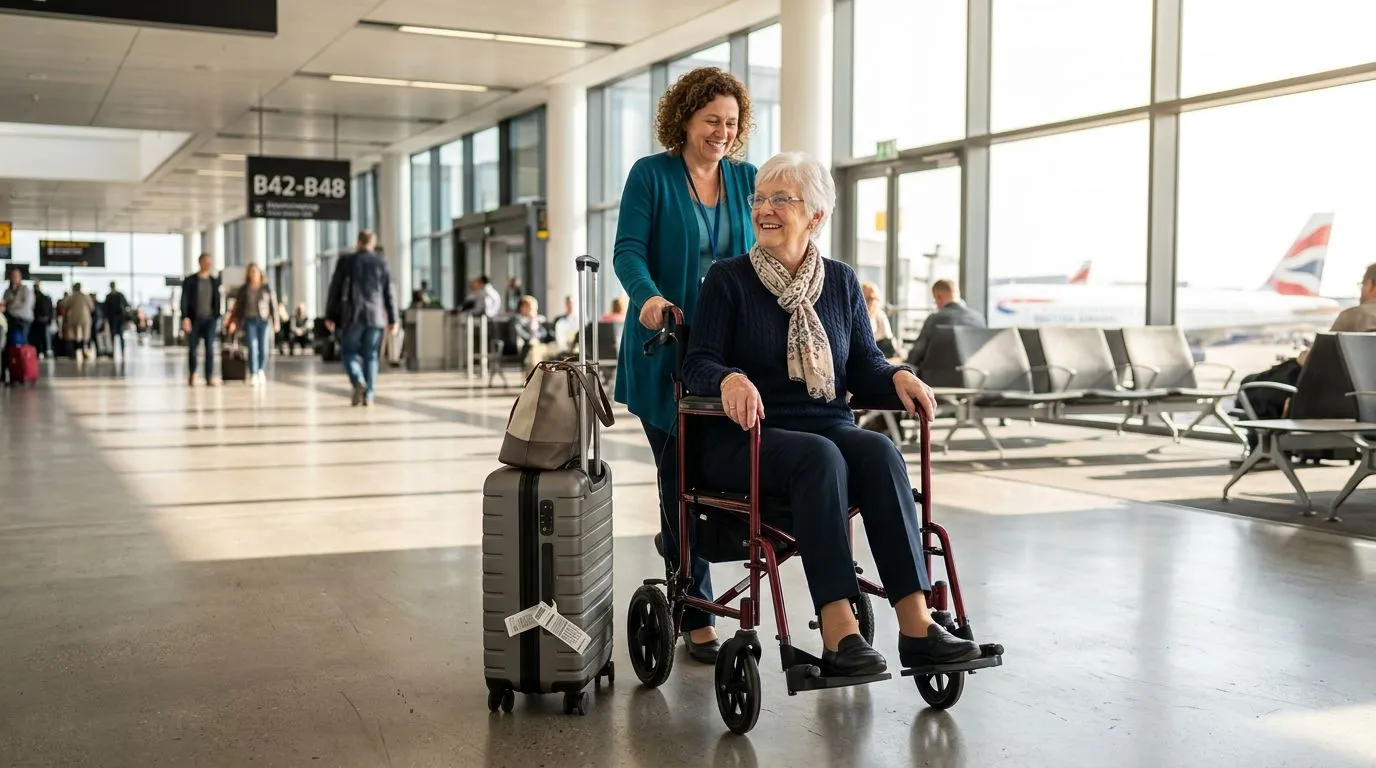
A walker-transport chair combo can be practical for travel when someone can walk for part of the day but may need to be pushed over longer distances, such as in airports, museums, or cruise terminals. Most 2-in-1 designs are really rollator-transport chair combos, meaning they have 4 wheels, hand brakes, a seat, and removable or swing-away footrests. They can be helpful in the right situation, but they are not a perfect substitute for a standard walker, a full-time wheelchair, or a properly fitted rollator.
The key is matching the device to the trip and the user. If the traveler needs strong weight-bearing support with every step, a standard walker or two-wheel walker is usually steadier. If the traveler mainly needs a place to sit and occasional attendant-pushed transport, a combo may reduce the amount of equipment you bring.
How a 2-in-1 walker-transport chair works in 60 seconds
A walker-transport chair combo has two modes. In walking mode, the user stands behind the frame and pushes it like a rollator, using hand brakes to slow down or lock the wheels before sitting. In transport chair mode, the user sits on the built-in seat facing forward while a caregiver pushes from behind using the handles.
That design matters. A standard walker usually has 4 legs, no seat, and no hand brakes; some have 2 front wheels and rear glide caps or rubber tips. It is intended to be lifted or moved forward a short distance, then used for support. A rollator has 3 or 4 wheels and rolls continuously, so it requires more steering and brake control. Most convertible travel devices fall into the rollator family, even when shoppers call them walker-wheelchair combos.
The transport chair portion is specific, too. It is not a self-propelled wheelchair with large rear wheels. Most combos have smaller wheels, often around 6 to 8 inches, and are designed to be pushed by another person. The seated user should not try to move the chair by pushing the wheels with their hands.
Common features include a padded seat, backrest, hand brakes, a folding frame, and footrests for transport mode. Many general-purpose models list weight capacities around 250 to 300 lb, while heavy-duty or bariatric versions may support more. Always follow the stated capacity for the exact device, including any items carried in a bag or basket.
Walker vs rollator vs transport chair combo: 4 practical differences
The terms can get confusing because many people search for walkers that convert to wheelchairs. In everyday US language, walker is the broader and more familiar term, but the mechanics are different. A standard walker gives maximum step-by-step support; a rollator provides rolling mobility with brakes and a seat; a transport chair combo adds a caregiver-pushed seated mode.
| Device type | Wheels and brakes | Best use | Main travel tradeoff |
|---|---|---|---|
| Standard or folding walker | No wheels, or 2 front wheels; usually no hand brakes | Short indoor distances when the user needs firm support | No seat and not useful for being pushed |
| 3-wheel rollator | 3 wheels with hand brakes; usually no full seat | Tight spaces and light errands | Less stable than 4-wheel designs for many users |
| 4-wheel rollator | 4 wheels with hand brakes and a built-in seat | Walking longer distances with rest breaks | Cannot be used as a safe transport chair unless designed for it |
| Rollator-transport chair combo | 4 wheels, hand brakes, seat, backrest, and footrests | Walking part-time and being pushed part-time | Heavier and less specialized than separate devices |
The biggest safety difference is weight-bearing support. A standard walker can feel more secure because it does not roll away when placed properly. A rollator or combo must be controlled with the brakes, and the user needs enough balance and hand function to manage turns, slopes, thresholds, and stops.
Seat orientation is another difference. On a regular 4-wheel rollator, the user sits for rest, usually facing backward relative to walking direction. On a transport chair combo, the seat and back support are arranged so the user can be pushed forward with feet on footrests. That is why a regular rollator should not be treated like a wheelchair unless it is specifically built for transport.
Who it is best for on trips of 1 day or longer
A combo can work well for a traveler who walks safely for short stretches but tires after 5 to 15 minutes, especially when the day includes long corridors, parking lots, sightseeing, or lines. It is also useful when a spouse, adult child, or caregiver will be present and is physically able to push, steer, fold, lift, and brake the device.
Good candidates often share several traits:
- They can stand up and sit down with limited assistance.
- They can use hand brakes reliably in walking mode.
- They can walk on level surfaces but may need seated transport for longer distances.
- They do not require a wheelchair as their primary mobility device.
- They have a travel partner available whenever transport mode is needed.
Consider a common airport example. A traveler may walk from the car to check-in using the rollator mode, sit while waiting in line, then be pushed through a long concourse. At the gate, the device may fold for storage or be handled according to airline procedures. That can be simpler than bringing both a rollator and a separate transport chair.
A combo is less suitable when the user cannot safely control a wheeled walker, leans heavily on the frame, has frequent loss of balance, or needs to be pushed most of the day. If transport is the main need, a dedicated transport chair or wheelchair is often more comfortable and easier for the caregiver over distance.
Travel benefits for car trunks, airports, hotels, and 30-inch doorways
The main travel benefit is equipment reduction. Instead of packing a folding walker plus a separate transport chair, a combo gives you one frame that can cover two common needs. For short trips, that can save space in a sedan trunk, hotel room, rideshare vehicle, or cruise cabin.
Many combos fold, but folded size varies. Before travel, measure the trunk opening, not just the trunk volume. A device that is 25 inches wide may still be awkward if the folded height or footrests catch on the opening. Removable footrests can help, but they also create loose parts you need to track.
In airports, a combo may help with long walking distances and security lines, but it does not remove the need to plan. Ask the airline about mobility device handling before departure, arrive early, and label removable parts. If the traveler needs assistance from curb to gate, airport wheelchair service may still be the easier choice.
Hotels add another set of measurements. Many interior doorways are around 28 to 32 inches wide, but older buildings, bathrooms, and tight furniture layouts can be narrower in practice. Check overall width, turning space, elevator access, shower entry, and where the device will park overnight without becoming a tripping hazard.
Outdoor travel is mixed. Larger wheels, often 8 inches rather than 6 inches, may roll better over sidewalk cracks and low thresholds, but these devices are not built for loose gravel, sand, steep slopes, or uneven trails. On ramps, the caregiver needs brake control and enough strength to manage both the device and the seated user.
Limitations and safety concerns to review before a 2-in-1 trip
The first limitation is that a combo is a compromise. It may not walk as steadily as a no-wheel or two-wheel walker, and it may not ride as comfortably as a dedicated transport chair. For some travelers, that tradeoff is worthwhile. For others, it creates frustration on day 2 of a trip.
Brakes need close attention. Hand brakes should stop both rear wheels evenly, and parking locks should hold the frame still before the user sits or stands. If the brakes feel weak, uneven, or hard to squeeze, do not rely on the device for travel until it is adjusted or inspected. Small brake problems become bigger in airports, curb cuts, and crowded hallways.
Footrests are another safety point. In transport mode, feet should be placed on the footrests so they do not drag or catch under the frame. In walking mode, footrests should be removed, folded, or positioned so they do not interfere with the user’s stride. A dangling footrest can turn a normal doorway into a trip risk.
Weight capacity is not just a number on a label. It includes the seated user and sometimes the way force is applied when sitting down. If a device is rated for 300 lb, it should not be used by someone near or above that limit while also carrying a heavy bag on the frame. Bariatric rollator-transport chair combos may offer higher capacities and wider seats, but they are usually heavier and wider to lift and maneuver.
Comfort has limits as well. Combo seats are often narrower and shallower than full-time wheelchair seating, and smaller wheels transmit more bumps. For a 10-minute push through a terminal, that may be fine. For a full afternoon of seated sightseeing, pressure, posture, and fatigue can become real concerns.
Ask a physical therapist, occupational therapist, or qualified mobility professional for fitting advice if there is a history of falls, recent surgery, neurological conditions, significant weakness, or unclear weight-bearing instructions. A travel device should support the care plan, not work around it.
How to choose and measure in 10 minutes
Start with handle height. In walking mode, the handles should typically line up near the crease of the wrist when the user stands upright in regular shoes with arms relaxed at the sides. The elbows should have a slight bend, often about 15 to 30 degrees, when holding the grips. Handles that are too low encourage stooping; handles that are too high can reduce control.
Next, measure seat fit. Check seat width and depth, and compare them to the user’s hip width while wearing typical clothing. There should be enough room to sit without squeezing, but not so much that the user slides side to side during transport. Also check seat height: the user’s feet should be able to reach the footrests comfortably in transport mode, and standing up should not require a deep, unstable push.
Measure total width. Compare the outside wheel-to-wheel width with the narrowest doorway or hallway you expect to use. A 26-inch-wide device may pass through a 30-inch doorway, but hands, brake cables, angled approaches, and door trim reduce usable space.
Do a lifting check. If the caregiver must load the device into a car several times per day, weight matters. Many wheeled mobility frames are in the 15 to 25 lb range, and heavy-duty versions can weigh more. A device that folds easily in the store can still be difficult when you are tired, in a parking lot, or handling luggage.
Use this quick selection table as a starting point:
| Feature to check | What to look for | Why it matters for travel |
|---|---|---|
| Handle height | Adjusts to wrist-crease height | Improves posture and steering |
| Brakes | Easy squeeze, firm parking lock | Essential for sitting, slopes, and lines |
| Seat and backrest | Comfortable for short seated periods | Reduces fatigue during waits |
| Footrests | Secure, removable, or swing-away | Needed for safe transport mode |
| Folded size | Fits car trunk and storage areas | Prevents last-minute travel problems |
| Weight capacity | Appropriate margin for user and items | Protects frame integrity and safety |
| Wheel size | Often 6 to 8 inches on travel designs | Affects thresholds and outdoor surfaces |
If possible, test the device in both modes before the trip. Practice turning in a hallway, locking brakes before sitting, placing feet on the footrests, crossing a threshold, folding the frame, and loading it into the vehicle. A 10-minute trial can reveal more than a long feature list.
When a separate walker or rollator is better after 20 minutes of walking
A separate standard walker is usually better when the user needs maximum stability, puts significant weight through the arms, or has been advised to use a walker for a specific gait pattern. No-wheel and two-wheel walkers move more deliberately. That slower pace can be safer for people who are unsteady or recovering from certain injuries, though individual instructions should come from a clinician.
A regular 4-wheel rollator may be better when the user walks independently but needs frequent rest breaks, not seated transport. It is often simpler than a combo, and the seat is there for resting with the brakes locked. For someone who does not need to be pushed, adding transport hardware can mean extra weight without much benefit.
A dedicated transport chair is often better when the person will be seated for long distances or most of the day. Transport chairs are built around caregiver pushing, foot support, and seated positioning. They do not provide walking support, so they may pair well with a folding walker at the destination if the traveler needs both types of help.
A full wheelchair may be needed when the user must self-propel, sit for extended periods, use specialized cushions, or manage daily mobility from the chair. A combo is not designed to replace that level of seating and mobility support.
There is no one-device answer for every trip. For a weekend hotel stay with short walks and a steady caregiver, a combo can be efficient. For a 7-day trip with cobblestones, long tours, or limited caregiver strength, two separate devices or arranged wheelchair assistance may be safer and less tiring.
Travel setup checklist: 8 items before leaving home
Use a short checklist before any trip, especially the first one. Small adjustments at home are easier than problem-solving at a curb, gate, or hotel lobby.
- 1. Confirm the mode change. Practice switching from walking mode to transport mode and back without rushing.
- 2. Test the brakes. Lock them before every sit-to-stand and stand-to-sit practice.
- 3. Inspect the footrests. Make sure they attach firmly and do not swing into the walking path.
- 4. Measure the car. Check trunk opening, folded height, and where loose footrests will go.
- 5. Check destination access. Ask about stairs, elevators, door widths, shuttle steps, and bathroom layout.
- 6. Pack a small maintenance kit. Include the needed hex key or wrench if the frame uses adjustable hardware.
- 7. Label removable parts. Footrests and cushions are easier to recover when contact information is attached.
- 8. Plan rest intervals. Build in breaks every 30 to 60 minutes if fatigue is predictable.
Set clear roles, too. The user should know when to brake, when to sit, and when to wait. The caregiver should know when to push, when to slow down, and when to avoid a ramp or surface that feels unsafe. Good communication is as important as the equipment.
For many families, a walker-rollator transport chair combo is practical for travel because it covers the middle ground: walking some of the time, resting often, and being pushed when distances get too long. It works best when the user can still walk safely with a wheeled frame and has a dependable companion. If the need is firm step-by-step support or full-day seated mobility, choose the device built for that job instead.
FAQ
Frequently asked questions
Is a walker-transport chair combo the same as a wheelchair? +
No. Most combos are attendant-pushed transport chairs built into a rollator-style frame. They usually have smaller wheels and are not designed for the seated user to self-propel like a standard wheelchair.
Can a regular rollator be used as a transport chair? +
Only if it is specifically designed and labeled for transport use. A regular rollator seat is meant for resting with the brakes locked, not for pushing someone while seated.
Are 2-in-1 walker combos allowed on airplanes? +
Mobility aids are commonly accommodated, but rules and handling procedures vary by airline and aircraft. Contact the airline before travel, ask how the device will be checked or stored, and label removable parts such as footrests.
Who should not use a rollator-transport chair combo? +
It may not be appropriate for someone who needs heavy weight-bearing support, cannot control hand brakes, has frequent falls, or needs to be seated most of the day. In those cases, a standard walker, dedicated transport chair, or wheelchair may be safer.
What measurements matter most before buying one for travel? +
Check handle height, seat width, seat height, total device width, folded size, weight capacity, and the caregiver’s ability to lift it into a car. Also compare the device width with doorways and bathroom access at your destination.
Keep reading
Related guides

Rollator Transport Chair Combos: When a Walker-Wheelchair Hybrid Makes Sense
12 min read
Walker vs Wheelchair: When to Use a Mobility Walker, a Transport Chair, or Both
13 min read
Walker or Rollator for Day Trips and Events: Museums, Restaurants, Stadiums, and Crowded Places
12 min read