Disclosure: We may earn a commission when you buy through links on this page, at no extra cost to you. We buy nothing, sell nothing and accept no payment for coverage — commissions never decide what we recommend. How we make money.
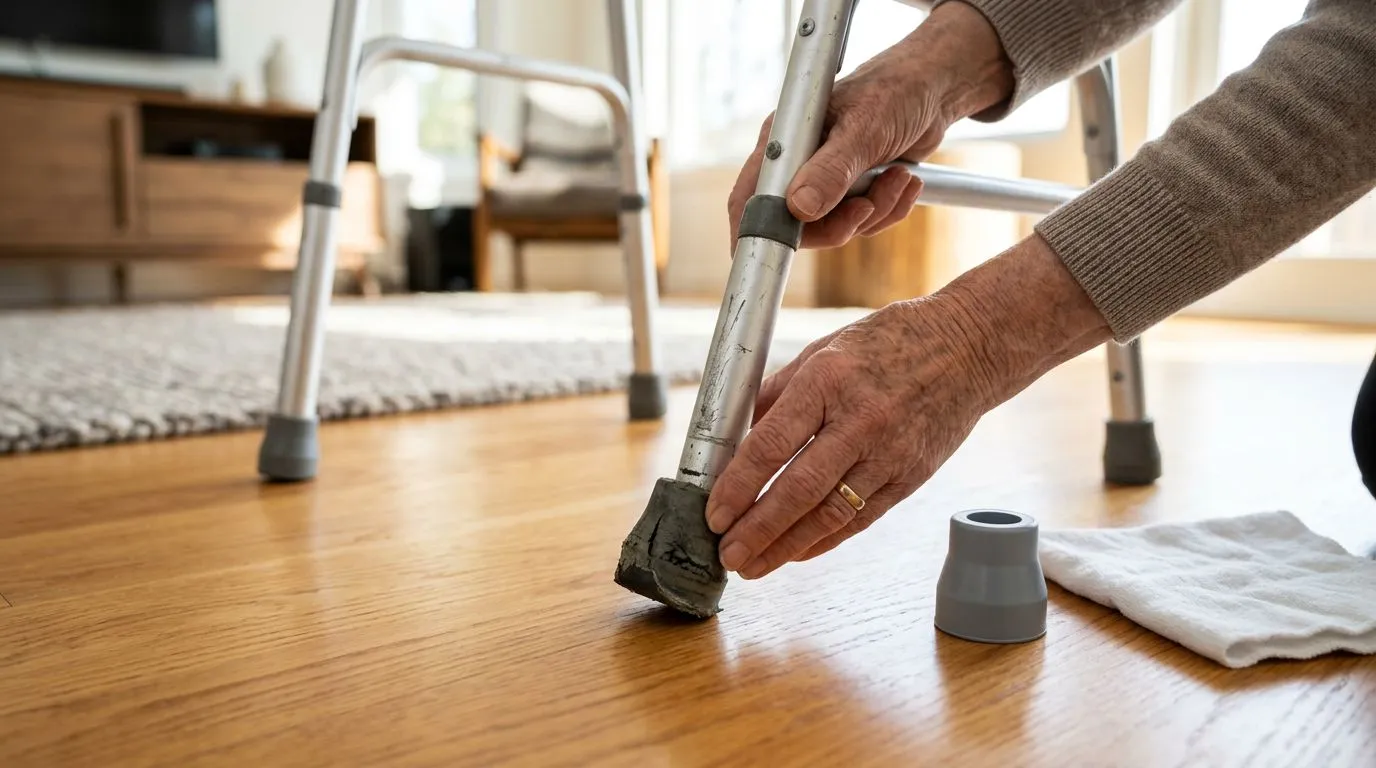
Clean walker rubber tips and glide caps whenever they look dirty, gritty, or sticky. Rotate them when wear is uneven but the material is still thick and secure, and replace them when they are cracked, flattened, loose, or worn through. For most standard and two-wheel walkers, a 30-second check every week is enough to catch unsafe feet before they cause slipping, wobbling, or floor scratches.
Walker feet are small parts, but they carry nearly every pound of force you put through the frame. A rubber tip that has lost its tread, or a glide cap with a sharp worn edge, can change how the walker grips the floor, especially on tile, wood, laminate, ramps, and wet entryways.
Why walker feet matter on all 4 legs
A standard walker usually has 4 rubber tips touching the floor. A two-wheel walker typically has 2 front wheels and 2 rear feet, often rubber tips, glide caps, or ski-style glides. Those rear feet do a lot of work: they help control speed, add friction when you stop, and keep the frame from sliding too far forward.
On a no-wheel or standard folding walker, the rubber tips are the main contact points. Each lift and set-down depends on those tips landing flat and gripping evenly. If one tip is worn shorter than the others by even 1/8 inch, the frame may rock slightly. That small change can make the walker feel less steady, especially during turns or when standing up from a chair.
Glide caps work differently. They are usually smoother and designed to help the back legs of a two-wheel walker move across indoor flooring with less drag. That can reduce the stop-and-start feeling some people get with rear rubber tips, but glide caps still need to be smooth, intact, and clean. A cracked glide can catch on a rug edge. A dirty glide can leave marks on a floor.
Rollators are related mobility aids, but their foot-contact parts are different. A 3-wheel or 4-wheel rollator moves on wheels, uses hand brakes, and often includes a seat. Rollator maintenance should focus on wheels, brake cables, brake pads, locks, and frame hardware. This article focuses on standard walkers, folding walkers, and two-wheel walkers with replaceable rubber tips or glide caps.
The 30-second weekly inspection
A quick weekly check is practical for most home users. If the walker is used outdoors every day, in a garage, on sidewalks, or in a senior living community with long hallways, check the tips or glides 2 or 3 times per week. The more miles the walker covers, the faster small wear can become a safety issue.
Set the walker on a flat, dry surface with good lighting. Look at all contact points, not just the front. On a standard walker, compare all 4 tips. On a two-wheel walker, inspect both rear feet and confirm both wheels still roll freely. If one rear foot looks more worn than the other, the user may be putting more weight on one side, or the walker height may be slightly off.
- Look for flat spots where the rounded bottom has become smooth.
- Check for cracks, splits, or missing chunks in the rubber.
- Press the tip or cap with your thumb; it should not feel brittle or paper-thin.
- Twist each tip gently to see whether it is loose on the walker leg.
- Check for grit, pet hair, sand, or sticky residue embedded in the bottom.
- Stand behind the walker and confirm all legs sit evenly on the floor.
Listen, too. A walker that suddenly squeaks, scrapes, taps, or drags may be telling you that a foot has changed shape. A new noise after a trip outside often means grit is stuck in a tip or a glide cap has worn down on one edge.
Clean when dirt changes grip or leaves marks
Cleaning is the first step when the rubber or glide surface is still intact. Many walker feet can be cleaned in 5 minutes with warm water, mild dish soap, and a cloth or soft brush. Avoid harsh solvents, oily cleaners, or waxy products because they may make the contact surface slick.
Rubber tips collect dust, skin oils, sidewalk grit, and fine sand. Indoors, that buildup can act like tiny ball bearings under the walker. Outdoors, small stones can become embedded in the rubber and scratch wood or laminate when the walker comes back inside. Glide caps can also pick up sticky residue from kitchens, bathrooms, parking lots, or elevator floors.
A simple cleaning routine works well:
- Wipe the bottom and sides of each tip or glide with a damp cloth.
- Use mild soap for sticky spots, then wipe again with clean water.
- Remove pebbles or grit with a soft brush, not a knife.
- Dry the feet completely before the next use.
- Check that no soap film remains on the bottom.
Clean more often during winter, rainy weeks, or after walking through mulch, sand, salt, or mud. Salt and grit tracked in from sidewalks can be abrasive, and a few grains caught under a glide cap may leave visible lines on darker floors.
Rotate when wear is uneven but the tip is still sound
Rotation can extend the useful life of walker rubber tips when the tread is still thick and the opening still grips the walker leg firmly. If one side of a tip is flattening but there are no cracks, holes, or loose areas, turning it 90 to 180 degrees may help distribute wear. This is most common on standard walkers because all 4 tips contact the floor.
For two-wheel walkers, rotation is usually limited to the rear feet. Rear rubber tips may wear at an angle because the walker is pushed forward and then lightly dragged. Glide caps can develop a front-edge wear pattern as well. If the cap is symmetrical and still secure, rotating may help, but many glide shapes are directional and should face a particular way. If the shape resembles a small ski, the smooth raised front should continue to point forward.
Do not rotate a damaged foot just to get more time from it. Rotation is for uneven wear, not failure. A tip that is cracked through the sidewall, worn to a hole, or loose enough to pull off by hand should be replaced rather than moved to another leg.
| Condition found | Best action | Why it matters |
|---|---|---|
| Dust, grit, or sticky residue | Clean | Restores normal floor contact in about 5 minutes |
| One side flattened, rubber still thick | Rotate if the fit remains tight | May even out wear on a 4-tip walker |
| Cracks, holes, or missing pieces | Replace | Damaged feet can slip, snag, or mark floors |
| Loose tip or cap | Replace and verify size | A foot that falls off changes the walker height instantly |
| Sharp worn edge on glide cap | Replace | Sharp edges can scratch floors or catch on thresholds |
Replace at the first signs of structural wear
Replacement is the right choice when the material can no longer do its job. For many users, rubber tips may last several months indoors, but a heavy outdoor user can wear them much faster. There is no safe universal calendar because wear depends on body weight, floor surface, walker height, walking pattern, and how often the walker is used.
Use condition, not age alone. Replace a rubber tip if the bottom is slick and shiny, the tread pattern is nearly gone, or the rubber feels hard and brittle. Replace it if the metal walker leg is close to pushing through the bottom. Replace any tip that no longer fits snugly, even if it looks good from the outside.
Glide caps should be replaced when they become thin, misshapen, cracked, or sharp along the bottom edge. Some users keep using worn glides because the walker still moves easily, but easy movement is not the only goal. The rear feet also need to provide predictable control. If the walker begins to drift, skate, or feel hard to stop, the rear glide setup needs immediate attention.
Floor damage is another warning sign. New black streaks, white scuffs, scratches near doorways, or scrape marks at the same hallway turn often point to worn or dirty feet. Before blaming the floor finish, inspect the walker contact points with the walker turned safely on its side.
How to measure and choose replacement feet in 3 steps
Replacement walker tips and glide caps must match the outside diameter of the walker leg. Common walker tubing sizes are often around 1 inch, but not every frame is the same. Measuring matters because a tip that is too loose can fall off, while one that is too tight may not seat fully.
Step 1: Measure the outside diameter of the lower walker leg, not the old worn tip. A tape measure can work, but a ruler or caliper gives a clearer reading. Measure across the round metal tube at the bottom.
Step 2: Match the foot type to the walker style and the surface. A standard walker usually needs rubber tips on all 4 legs. A two-wheel walker may use rear rubber tips for more braking friction or rear glide caps for easier forward movement indoors. Some users keep rubber tips for outdoor use and glides for indoor surfaces, but changes should be made carefully and only if the user can control the walker well.
Step 3: Confirm the foot seats fully and evenly. After installing, press down firmly on the walker and check that each tip or cap is pushed all the way onto the leg. The bottom should sit flat on the floor. If the walker rocks after replacement, recheck the size and installation.
| Walker type | Usual floor contact | Maintenance focus | Good fit for |
|---|---|---|---|
| Standard walker | 4 rubber tips | Even grip, equal tip height, cracks | Users who need maximum stopping stability |
| Folding walker with no wheels | 4 rubber tips | Tip wear after repeated lifting and setting down | Home use, transfers, short indoor distances |
| Two-wheel walker with rear tips | 2 wheels and 2 rubber tips | Rear tip drag, flattening, wheel alignment | Users needing easier forward movement with some rear friction |
| Two-wheel walker with rear glide caps | 2 wheels and 2 glides | Thin edges, scratches, smooth controlled glide | Users who struggle to drag rear rubber tips indoors |
| Rollator | 3 or 4 wheels | Hand brakes, wheel tread, seat locks | Users cleared to manage a fully wheeled device with brakes |
Who is best served by rubber tips, glide caps, or a rollator
The right contact point depends on strength, balance, walking pattern, and environment. Rubber tips provide more friction. Glide caps reduce drag. A rollator, with 3 or 4 wheels and hand brakes, is a different mobility aid and should not be chosen simply because a walker is hard to push.
Rubber tips are often best for people who rely on the walker for firm stopping support. They are common on standard walkers used after surgery, during rehabilitation, or for short trips inside the home. Because the frame does not roll freely, rubber tips can feel more controlled for users who need to pause after every step or two.
Glide caps may help a two-wheel walker move more smoothly when rear rubber tips catch or skip on indoor flooring. They can be useful for someone who has enough control to keep the walker close but lacks the strength to lift or drag the rear legs repeatedly. They are not a cure for poor walker fit, weak brakes on another device, or unsafe walking speed.
Rollators are best for a different group: people who can steer a wheeled frame, operate hand brakes, and safely use or avoid the built-in seat as directed. A 4-wheel rollator may work well for longer indoor corridors or outdoor paths, while a 3-wheel rollator can be easier to maneuver in tighter spaces. Upright and bariatric rollators add other fitting considerations, including handle height, frame width, and weight capacity. Their maintenance does not involve rubber walker tips, but worn wheels or weak brakes deserve the same level of attention.
Floor surfaces: what changes on tile, wood, carpet, and outdoors
Different surfaces wear walker feet in different ways. A smooth tile hallway may polish rubber tips until they look shiny. Rough concrete can chew through a rear tip in a matter of weeks for a daily outdoor user. Carpet can hide dragging and make it harder to hear a worn glide scraping.
On hardwood, vinyl plank, and laminate, cleanliness matters as much as tread. A dirty rubber tip can leave dark marks, and a glide cap with a sharp worn edge can create fine scratches. Place a washable mat near the door and wipe walker feet after outdoor use, especially if the walker crosses from a driveway or patio onto indoor flooring.
On carpet, rear glides may move more easily than rubber tips, but they can still catch on thick pile or loose rugs. Small throw rugs are a common trip hazard around walkers because a tip, glide, or wheel can catch an edge. If a rug bunches, slides, or has a raised border over about 1/4 inch, consider removing it from the walking path.
Bathrooms, kitchens, and entryways deserve extra caution. Water changes grip quickly. Even a new rubber tip can slide on a wet tile floor, and a worn one is worse. Dry the floor when possible, and do not use furniture polish or floor wax in areas where walker feet land.
Safe installation and a 10-step post-replacement check
Replacing tips or glide caps is usually simple, but the final safety check is the part people often skip. After any change, spend 2 minutes testing the walker before normal use. If the user has significant balance problems, have another adult nearby during the first test, or ask a clinician or mobility equipment professional for help.
- Place the walker on a flat, dry surface.
- Confirm each replacement foot matches the leg diameter.
- Push every tip or cap fully onto the tube.
- Check that all 4 contact points or both rear feet sit level.
- Press down on the handles and look for rocking.
- Move the walker forward 6 to 12 inches and listen for scraping.
- Turn left and right slowly.
- Test on the main indoor floor surface, not only in the garage.
- Recheck the feet after the first short walk.
- Inspect again the next day to confirm nothing loosened.
Do not add oil, tape, felt pads, or homemade sliders to walker feet. These quick fixes can change friction in unpredictable ways. If a walker remains hard to move after proper fitting and new feet, the issue may be walker height, user technique, wheel condition, or whether a different type of walker or rollator should be discussed with a health professional.
When worn feet signal a bigger walker fit problem
Fast or uneven wear can point to more than a maintenance issue. If one rear tip wears out 2 times faster than the other, the walker may be too high, too low, bent, or used with uneven pressure. A user may also be leaning heavily on one side because of pain, weakness, or habit.
Handle height is a common factor. As a general starting point, walker handles are often set near the wrist crease when the user stands upright with arms relaxed at the sides and wearing usual shoes. When holding the handles, the elbows should have a slight bend, often around 15 to 30 degrees. This is a fitting guideline, not a medical rule, and individual needs vary.
If the walker is too low, the user may push down heavily and drag the rear feet. If it is too high, the frame may feel hard to control and may wear at odd angles. A bent leg, loose height button, or missing adjustment pin can also make one foot carry more load.
Watch the walking pattern. The walker should stay close enough that the user is not reaching far forward. Reaching increases the chance of sliding, especially with worn rubber tips or overly slick glides. If safe technique is uncertain, a physical therapist, occupational therapist, or qualified mobility professional can assess fit and use in the actual home environment.
A simple maintenance schedule for the next 12 months
A calendar helps because walker feet wear slowly until they suddenly become a problem. Put a reminder on the first day of each month, or pair the check with another routine task such as changing a calendar page or refilling a pill organizer. Once it becomes familiar, the inspection itself takes less than 1 minute.
| Interval | What to do | Replace if you see |
|---|---|---|
| Daily, for heavy outdoor use | Wipe off grit, mud, salt, or water | Loose foot or visible hole |
| Weekly | Inspect all tips, glides, and rear contact points | Cracks, slick flat spots, sharp glide edges |
| Monthly | Compare left and right wear; check walker level | Uneven wear that returns after rotation |
| Every 3 months | Measure questionable feet and keep spares if appropriate | Brittle rubber or caps that no longer seat firmly |
| After any fall, near fall, or hard impact | Inspect immediately before using again | Bent leg, missing tip, cracked glide, new rocking |
Keeping one correctly sized spare set at home can prevent an unsafe workaround. Store spares in a dry place away from direct heat and sunlight, which can age rubber over time. If the walker is used every day, label a small bag with the measured leg diameter so replacement is easier later.
Good walker maintenance is not complicated. Clean the feet when they are dirty, rotate only when wear is mild and the fit remains secure, and replace them as soon as the material is cracked, loose, thin, or slick. Those small checks protect both the user and the floors under every step.
FAQ
Frequently asked questions
How often should walker rubber tips be replaced? +
Replace them based on condition, not a fixed date. If the rubber is cracked, slick, flattened, loose, or worn close to the metal walker leg, replace it right away. Many indoor users check weekly and replace as needed; frequent outdoor use can wear tips much faster.
Can I use glide caps on a standard walker with no wheels? +
In most cases, a standard no-wheel walker is intended to use rubber tips on all four legs for stable stopping friction. Glide caps are more commonly used on the rear legs of two-wheel walkers. If you are considering changing the contact points, ask a clinician or mobility professional to confirm it is safe for your walking pattern.
Why does one walker tip wear out faster than the others? +
Uneven wear can happen when more weight is placed on one side, the walker is set at the wrong height, one leg is bent, or the user drags the frame at an angle. Replace unsafe tips, then check the walker height and frame alignment.
Are worn glide caps dangerous if the walker still moves easily? +
They can be. A worn glide cap may move easily but still have a sharp edge, thin spot, crack, or uneven surface that can scratch floors or catch on thresholds. Easy movement is only safe when the walker remains controlled and predictable.
What size replacement walker tips do I need? +
Measure the outside diameter of the lower walker leg, not the old worn tip. Many walker legs are around 1 inch in diameter, but sizes vary, so measuring helps prevent a loose or poorly seated replacement.
Should rollators use rubber walker tips or glide caps? +
No. Rollators use wheels, hand brakes, and brake hardware rather than rubber feet on walker legs. Rollator maintenance should focus on wheel condition, brake function, folding locks, seat stability, and frame hardware.
Keep reading
Related guides
When to Replace Walker Tips, Glides, Wheels, and Rollator Tires
14 min read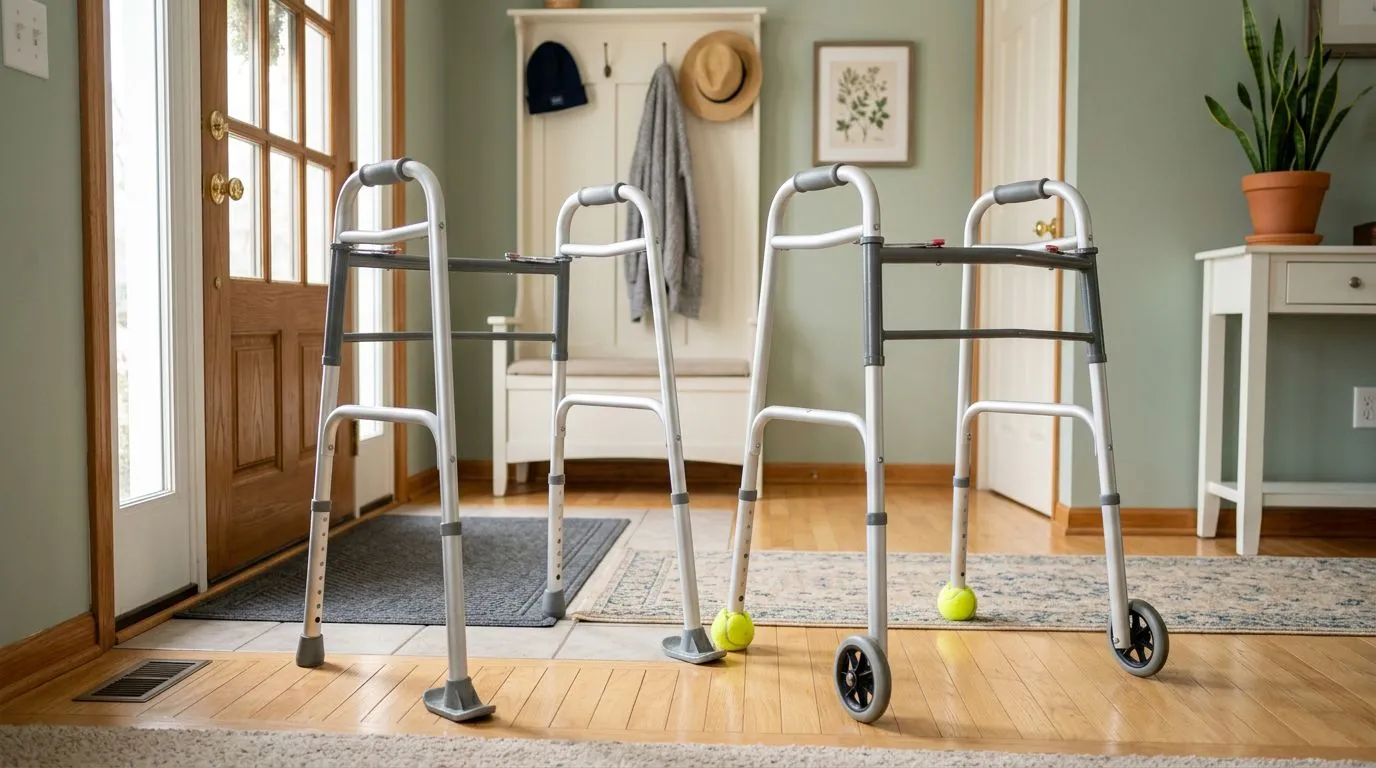
Walker Glides, Skis, Tennis Balls, and Rubber Tips: Which Walker Feet Are Best for Your Floors?
13 min read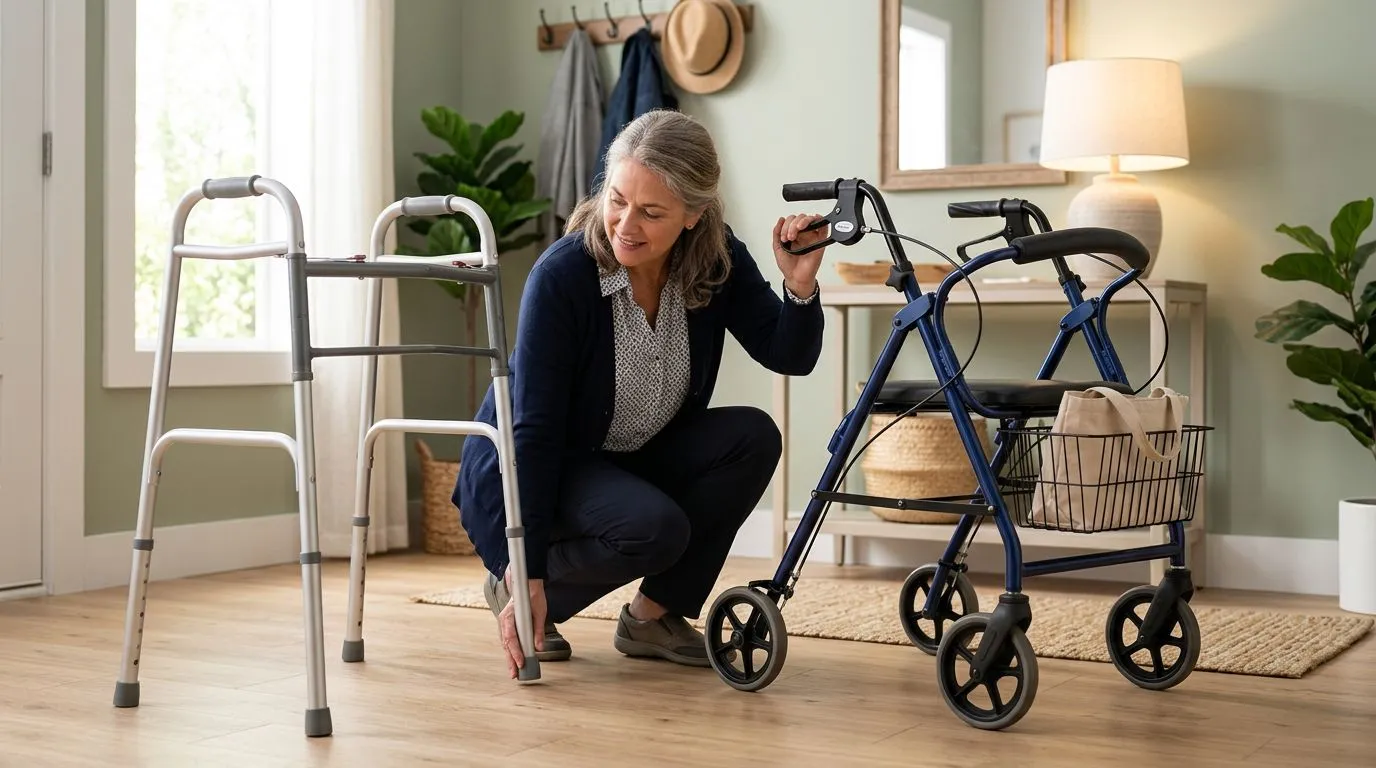
Walker and Rollator Maintenance Checklist: Weekly, Monthly, and Before Trips
13 min read