Disclosure: We may earn a commission when you buy through links on this page, at no extra cost to you. We buy nothing, sell nothing and accept no payment for coverage — commissions never decide what we recommend. How we make money.

A walker or rollator should be inspected regularly so loose parts, worn rubber, brake problems, and frame damage are caught before they affect safety. Do a quick check before each outing, a more complete 10-minute review every week, and a deeper inspection about once a month or before travel.
This checklist covers both walkers and rollators. Standard and folding walkers need close attention to rubber tips, legs, hand grips, folding buttons, and frame joints. Rollators also need wheel, brake, seat, and cable checks.
A 3-level maintenance routine for walkers and rollators
A simple schedule is easier to follow than trying to remember every part every time. Think in 3 levels: a 60-second check before use, a 10-minute weekly inspection, and a 20- to 30-minute monthly review. If the device is used outdoors daily, on ramps, or over uneven sidewalks, move some monthly tasks into the weekly routine.
Walkers and rollators are mobility aids, not set-and-forget furniture. They carry body weight, absorb bumps, and get folded, lifted, and stored in cars. Small problems can grow quietly: a missing rubber tip, a loose height button, or a brake that only catches on one side.
The goal is not to make maintenance a burden. It is to catch obvious problems early, keep the device predictable, and know when a repair or replacement should be handled by a qualified professional.
| Schedule | Time needed | Best for | Main focus |
|---|---|---|---|
| Before each outing or trip | About 60 seconds | Walkers and rollators | Tips, wheels, brakes, locks, obvious looseness |
| Weekly | About 10 minutes | Regular users | Hardware, grips, folding joints, tire wear, frame condition |
| Monthly | 20 to 30 minutes | All users, especially outdoor users | Fit, alignment, brake adjustment signs, seat support, deep cleaning |
| Before travel | 5 to 15 minutes | Car, bus, plane, hotel, or medical trips | Foldability, storage parts, spare tips, brake reliability |
The 60-second check before each outing
Before leaving the house, take 1 minute to confirm the walker or rollator feels stable. This is especially important before medical appointments, grocery trips, or any outing where the device may be folded, lifted, or used on unfamiliar surfaces.
For a standard walker or two-wheel walker, place it on a flat floor and press down gently on both hand grips. It should not rock, twist, or make a new clicking sound. Check that all 4 legs touch the floor evenly. On a two-wheel walker, make sure the front wheels roll freely and the rear rubber tips are fully seated.
For a rollator, test the hand brakes before walking away. Squeeze both brake handles while trying to move the rollator forward. Then engage the parking brakes and confirm the rollator stays put. If it has a seat, do not sit until the parking brakes are locked and the unit is on level ground.
- Look for a rubber tip that is split, missing, or worn flat.
- Confirm folding latches, push buttons, or locking tabs are fully engaged.
- Check that grips do not spin under your hand.
- On rollators, verify all wheels contact the floor and turn without wobbling.
- Remove loose bags or items that swing and affect balance.
Short checks work best when they become automatic. Pair the routine with putting on shoes or picking up keys.
The 10-minute weekly walker checklist
A weekly walker inspection should focus on the parts that touch the floor and the parts that carry weight through the hands. Most standard walkers have 4 legs, and each leg deserves a quick look. Folding walkers add hinges, buttons, or release mechanisms that need attention, too.
Rubber tips and rear glide surfaces
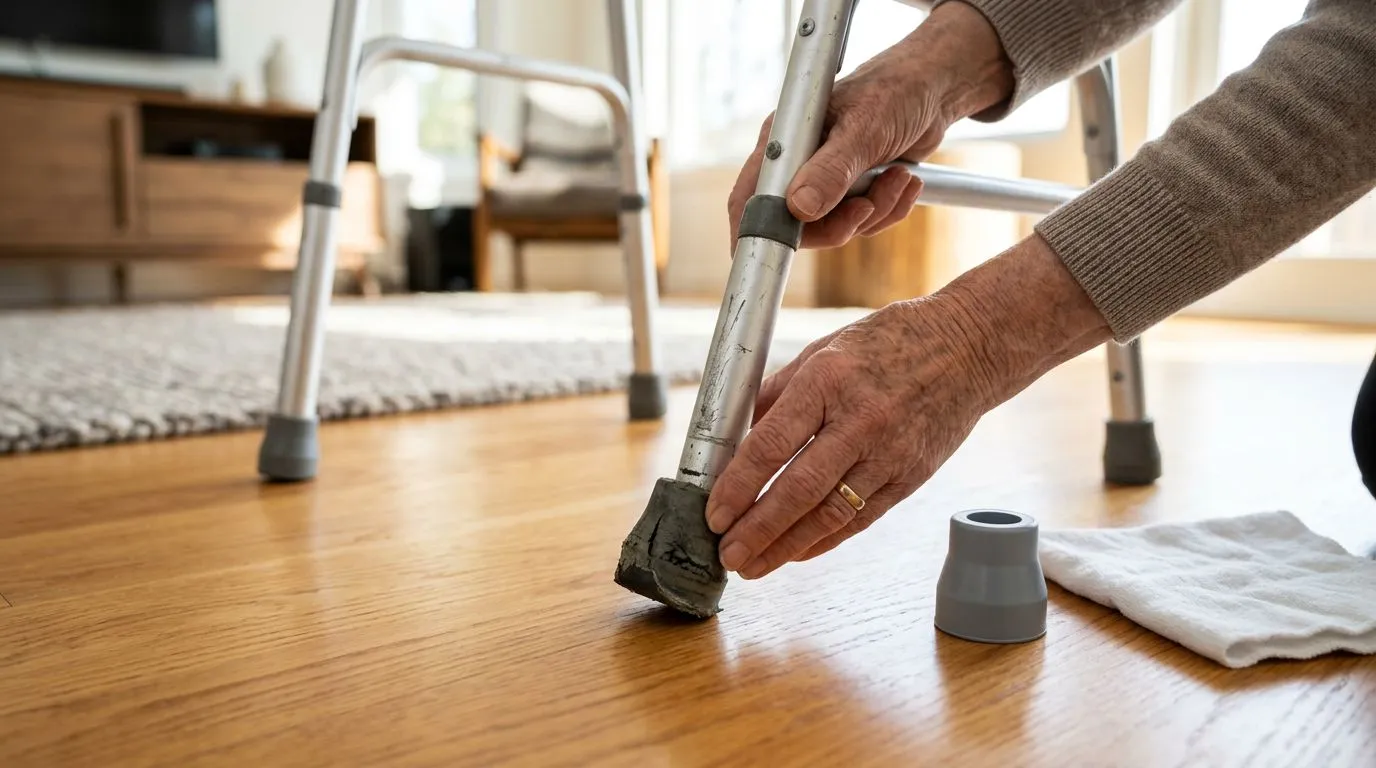
Rubber tips are small but critical. Replace a tip when the tread is smooth, the rubber is cracked, the metal leg is close to poking through, or the tip no longer grips the floor. A tip worn more on one side may mean the walker is being loaded unevenly or the height is not set correctly.
Check all tips together. Mixing a tall new tip with 3 compressed older tips can make the walker uneven. When possible, replace tips in pairs or in a full set so the frame remains level.
Leg height buttons and adjustment holes
Most adjustable walker legs use spring buttons that click into holes at 1-inch increments. Make sure every button protrudes fully through its hole. If one button sits halfway in, the leg may slip under load.
Look around the adjustment holes for elongation, cracks, or sharp wear. Also check that all legs are set to the same height unless a clinician has recommended a specific adjustment for posture, leg length, or a unique medical need.
Folding frame and crossbar
Open and close the walker once during the weekly check. The frame should move smoothly, then lock firmly into the walking position. A folding walker that does not lock completely should not be used until the problem is corrected.
Inspect the crossbar, side braces, and joints for dents or bends. A lightweight frame can be strong when intact but less reliable after being crushed in a car trunk or dropped onto concrete.
Hand grips
Hand grips should feel secure and comfortable. If a grip slides, rotates, cracks, or feels sticky from age, it can reduce the user’s control. Wipe grips with a damp cloth and mild soap, then dry them fully so hands do not slip.
The 10-minute weekly rollator checklist
A rollator has more moving parts than a standard walker. Along with the frame and hand grips, it usually has 3 or 4 wheels, hand brakes, brake cables or rods, a seat, and sometimes a storage pouch or backrest. These features make rollators convenient, but they also call for closer inspection.
Wheels and tires
Spin each wheel by hand. It should rotate without scraping, wobbling heavily, or stopping immediately. Hair, thread, grass, and grit can wrap around the axle and create drag. Remove visible debris carefully, and do not force parts that are stuck.
Look at the tire surface. Indoor use may create smooth wear, while outdoor use can leave cuts, chips, or embedded gravel. A 4-wheel rollator with one badly worn wheel may pull to one side or feel unstable during turns.
Hand brakes and parking brakes
Brake function is one of the most important rollator checks. Squeeze both hand brakes and feel for even resistance. If one handle pulls all the way to the grip while the other engages sooner, the brakes may need adjustment or service.
Set the parking brakes and push the rollator gently. It should resist movement on a flat surface. This matters before sitting. A rollator seat is not safe if the parking brakes do not hold reliably.
Brake cables, housings, and contact points
Follow each cable from the handle to the brake mechanism. Look for fraying, kinks, broken outer housing, or loose attachment points. If a cable catches on a basket, bag, or folding joint, reposition accessories so they do not interfere.
Some rollators use cable brakes; others use different linkages. The exact design varies, but the principle is the same: both brakes should engage smoothly and release fully.
Seat, backrest, and storage area
Check the seat for cracks, sagging, loose fasteners, or a hinge that does not sit squarely. If the seat lifts to access storage, make sure it closes flat. A soft bag or pouch should not drag against the wheels.
Many rollators have a stated weight capacity, often somewhere around 250 to 300 pounds for standard models and higher for bariatric models, but the actual rating depends on the specific device. Never assume a seat can support more than the manufacturer’s stated limit.
Monthly 20- to 30-minute deep inspection
Once a month, set aside enough time to clean and inspect the device under good light. A deeper review is useful because dust, hairline cracks, and slowly loosening hardware can be missed during quick checks. If the walker or rollator is used every day, choose a recurring date, such as the first Saturday of each month.
Start with cleaning. Wipe the frame, grips, seat, and accessible wheel surfaces with a damp cloth and mild soap. Avoid soaking bearings, brake parts, or adjustment holes. Dry everything thoroughly, especially metal hardware and folding joints.
Next, check fasteners. Look for screws, bolts, knobs, or rivets that seem loose, missing, or uneven. Do not over-tighten hardware, especially on lightweight tubing, because overtightening can damage the frame or plastic parts. If hardware repeatedly loosens, the device may need professional service.
Inspect the frame from multiple angles. A walker or rollator should stand squarely, with legs or wheels aligned. Look for cracks around welded areas, bends in the side frame, and shiny stress marks where metal has been rubbing. Any crack in a weight-bearing frame part is a stop-use issue until evaluated.
For rollators, check wheel alignment by pushing the unit several feet on a flat surface without leaning on it heavily. It should track reasonably straight. A small drift can happen on textured floors, but strong pulling to one side may signal a bent fork, uneven wheel wear, or brake rub.
For walkers, check floor contact by placing the frame on a hard, level surface. All 4 tips or contact points should sit evenly. If one leg hovers, the frame may be bent or a tip may be the wrong size.
Before trips: a 5- to 15-minute travel inspection
Travel is hard on mobility equipment. A walker or rollator may be folded, lifted into a trunk, placed in a shuttle, rolled over parking lots, or stored in a hotel room. Before any longer trip, spend 5 to 15 minutes checking the parts most likely to be affected by transport.
Fold and unfold the device completely. Listen and feel for the lock. If a folding walker opens but does not click into place, or a rollator folding strap does not bring the frame together evenly, address that before leaving.
Check for pinch points and dangling parts. Brake cables, removable baskets, under-seat pouches, cane holders, and cup holders can catch during loading. Remove accessories that are not needed for the trip, especially if they make the device wider or harder to handle.
Pack small maintenance items if appropriate: a clean cloth, the user manual if available, and spare rubber tips for a walker if the current tips are older. Do not pack tools with the expectation of making major repairs on the road unless you know exactly what the manufacturer allows.
For air, train, or bus travel, label the walker or rollator with the owner’s contact information. Take a photo of the device before departure. A clear photo can help identify existing condition if the frame or wheels are damaged during handling.
Walker vs. rollator maintenance: 6 key differences
Walkers and rollators overlap, but they do not wear in the same way. A standard walker has fewer moving parts and often depends on rubber tips for grip. A rollator relies on wheels and brakes, and the seat adds another load-bearing component. This table highlights the main maintenance differences.
| Part or issue | Standard or folding walker | Rollator |
|---|---|---|
| Floor contact | Usually 4 rubber tips, or 2 wheels plus 2 rear tips | Usually 3 or 4 wheels |
| Braking | No hand brakes on most standard walkers | Hand brakes and parking brakes need regular testing |
| Seat | Typically no built-in seat | Seat, backrest, and support hardware must be inspected |
| Folding parts | Side buttons, hinges, or crossbar locks | Frame hinges, folding strap or latch, seat hinge, cable routing |
| Wear pattern | Rubber tips flatten, split, or loosen | Wheels wear, wobble, collect debris, or drag |
| Best maintenance priority | Stable frame, secure grips, even leg height, good tips | Reliable brakes, smooth wheels, secure seat, sound frame |
This difference also affects who should choose each device. A standard walker may be best for someone who needs maximum stability and moves at a slower pace, especially indoors. A rollator may suit someone who can control wheels and hand brakes safely and needs a seat for rest breaks during longer walks.
How to measure fit after maintenance in 2 minutes
Maintenance is not only about parts. Fit matters, too. A walker or rollator that is 1 or 2 inches too high or too low can encourage poor posture, wrist strain, or awkward stepping. Fit should be checked after replacing tips, changing wheels, adjusting legs, or lending the device to someone else.
For a common starting point, stand inside or just behind the device while wearing regular shoes. Let the arms hang naturally. The hand grips should be near the crease of the wrist. When holding the grips, the elbows should usually bend about 15 to 30 degrees. This is a general guide, not a substitute for individualized fitting by a physical therapist or other qualified professional.
For a walker, make sure the user can step into the frame without leaning too far forward. The top bar should not force the shoulders upward. For a rollator, the user should be able to reach the brakes easily without stretching the fingers or bending the wrists sharply.
Width matters as well. A mobility aid that fits the user but cannot pass through a 28- to 32-inch doorway at home may create daily frustration. Measure the widest point of the device, including wheels, brake handles, and accessories. Also check turning space in bathrooms and hallways.
- Grip height: near wrist crease when standing tall.
- Elbow bend: roughly 15 to 30 degrees while holding grips.
- Doorway clearance: measure the actual home openings, not just the device.
- Brake reach on rollators: fingers should operate handles without strain.
- Seat height on rollators: feet should rest securely on the floor when seated.
When to stop using it: 8 warning signs
Some issues can wait for routine service, but others are safety concerns. Stop using the walker or rollator and arrange repair, replacement parts, or professional evaluation if any of these 8 warning signs appear.
- A visible crack in the frame, weld, fork, leg, or seat support.
- A folding lock that does not fully engage every time.
- A rubber tip that is missing, torn through, or slipping off the leg.
- A rollator brake that does not hold with the parking brake engaged.
- A wheel that wobbles severely, jams, or rubs the frame.
- A hand grip that rotates or slides during use.
- A seat that sags, tilts, cracks, or feels loose.
- A bent frame that causes rocking, pulling, or uneven floor contact.
Do not ignore new noises. A click, scrape, clunk, or grinding sound that was not there last week deserves attention. Noise often appears before a part fails completely.
If the device was involved in a fall, car trunk crush, stair drop, or other impact, inspect it before using it again. Even if it looks normal at first glance, folding joints, wheel forks, and height-adjustment holes may have been stressed.
Who benefits most from a written 3-step checklist
A written checklist is especially helpful when more than 1 person helps with care. Family members, home health aides, assisted living staff, and adult children may all handle the same walker or rollator at different times. A short list prevents guesswork.
People who use a device daily should keep the checklist near the storage spot. For example, a walker parked by the front door can have a small reminder card nearby: tips, grips, locks, height. A rollator reminder might read: brakes, wheels, seat, cables, frame.
Caregivers should avoid making major adjustments without the user present. A 1-inch height change can feel small to the person adjusting the device but significant to the person walking with it. If balance, posture, or walking pattern changes after maintenance, reset the device to the prior height or ask a qualified clinician to review the fit.
This routine is not a promise that a fall cannot happen. It is a practical way to reduce avoidable equipment problems, support confidence, and keep walkers and rollators working as intended.
FAQ
Frequently asked questions
How often should I inspect a walker or rollator? +
Do a quick check before each outing, a more complete inspection once a week, and a deeper review about once a month. Inspect it immediately after a fall, hard impact, or travel handling.
What parts wear out fastest on a standard walker? +
Rubber tips usually wear fastest, especially on outdoor surfaces. Hand grips, folding locks, height buttons, and frame joints should also be checked regularly.
What parts need the most attention on a rollator? +
Focus on the hand brakes, parking brakes, wheels, brake cables, seat, backrest, and folding frame. A rollator should not be used as a seat unless the parking brakes hold securely.
Can I tighten loose walker or rollator hardware myself? +
Minor tightening may be fine if it follows the device instructions, but do not over-tighten or modify the frame. Repeatedly loose hardware, damaged threads, cracked parts, or brake problems should be handled by a qualified repair source.
When should rubber walker tips be replaced? +
Replace rubber tips when they are cracked, smooth, unevenly worn, loose, or worn close to the metal leg. Replacing tips in pairs or as a full set helps keep the walker level.
Should a rollator be checked before a trip? +
Yes. Before travel, test the brakes, fold and unfold the frame, inspect wheels and seat hardware, remove loose accessories, and confirm the device can be safely loaded and stored.
Keep reading
Related guides

Daily Walker Safety Checklist: What to Inspect Before Each Use
13 min read
How to Stop a Walker or Rollator From Squeaking, Rattling, or Feeling Loose
12 min read
Walker or Rollator Feels Wobbly? Common Causes and What to Check First
12 min read